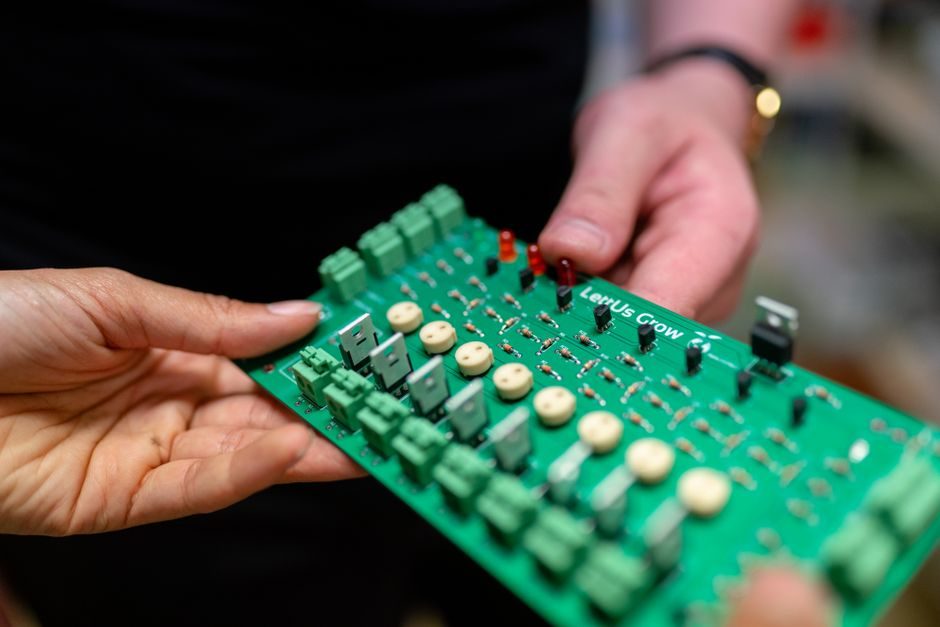
Industrial buyers in July 2026 are not facing the headline 2020–2021 automotive shutdown pattern, but a quieter, structural squeeze on legacy nodes — 8-inch wafer analog, ≥40 nm MCU, 600–1200 V IGBT/MOSFET discretes — where order books remain allocated and lead times stretch 26–52 weeks on specific part numbers [S1].
The relevant frame is no longer "is there a chip shortage" but "which wafer node, which package, and which end-equipment vertical absorbs the next allocation cut." Discrete power semiconductors (thyristors/SCR, TRIACs such as BT136E series, planar MOSFETs, diode modules) and mature-node MCUs continue to gate throughput in motor drives, pressure transmitter electronics, switching power supply PFC stages, and industrial valve positioners, while leading-edge logic fabs in the U.S., Korea, and Japan continue to add capacity for AI/HPC demand that does not relieve the legacy bottleneck [S1][S4].
Why 2026 risk is structural, not cyclical: the 8-inch wafer and discrete power bind
The 2020–2021 shortfall was a logistics + utilisation shock on a narrow set of MCU and SoC part numbers; by 2026 the binding constraint has migrated to 8-inch (200 mm) analog/power fabs whose capex is structurally lower than 12-inch (300 mm) logic fabs, and to discrete power semiconductor lines dominated by a small set of Asian and European suppliers [S1][S4]. On Made-in-China wholesale listings dated 2026-06-25, single-piece MOQ pricing for commodity discretes sits at US$0.14/piece for parts such as FDG327N, FDG6318PZ, FDG6316P, FDG313N, FDG311N in SOT-363 packaging, with bulk 5000-piece BT136E-series TRIAC orders at US$0.052/piece and 70%+ discount tags — wholesale spot pricing suggests spot liquidity exists for low-end discretes, but allocation persists for branded, automotive-grade, and high-current modules [S1].
SIA-reported 2021 global semiconductor sales reached $555.9 billion on 1.15 trillion units shipped, a 26.2% year-over-year jump that was the industry's response to shortage-era demand [S4]. That capex super-cycle delivered 12-inch leading-edge lines, not 8-inch legacy, which is why the discrete-power bind has outlasted the consumer-electronics squeeze: every kW of EV charger, servo drive, welding inverter, and DC power supply front end needs 600 V+ switching devices, and the wafer input to those devices is the structurally tightest layer of the supply chain [S1].
Spec-first selection: which semiconductor category is actually at risk in 2026
Not all chip categories behave the same. Three buckets carry most of the residual risk for industrial buyers: (a) 600–1700 V IGBT modules and SiC MOSFET discretes for traction and renewable inverters; (b) analog ICs — op-amps, voltage references, ADC/DAC, isolated gate drivers — on 8-inch wafers; (c) automotive-grade MCUs at 40/65/90 nm, still allocated by tier-1s even after the 2023–2024 normalisation [S1][S3].
Commodity logic, DRAM, and NAND have moved into oversupply cycles since 2023 as cloud cap digested, and are not the binding constraint for industrial OEMs. The risk that bites a flow meter or pressure sensor bill of materials is the analog front-end IC and the MCU that runs the HART/Modbus stack, not the memory. A practical comparison frame for sourcing teams in mid-2026:
- Discrete power (IGBT/SiC/MOSFET/SCR/TRIAC): 26–52 week lead time on branded parts, spot available at 2–5× contract on Asian B2B platforms, allocation persists for ≥100 A modules and SiC at 1200 V [S1].
- 8-inch analog IC (op-amp, ADC, isolated driver, LDO): 20–40 week lead time on automotive-grade, with last-time-buy (LTB) notices on several legacy op-amps; second-source qualification can take 6–12 months.
- 40/65/90 nm MCU with CAN FD / Ethernet / functional-safety lockstep: allocation continues at tier-1 OEM priority, spot market thin, price premium 1.3–1.8× versus 2022 contracts.
- 28 nm and below SoC, DRAM, NAND: buyable market, no allocation, price-down cycle — not a 2026 industrial risk.
Spec-side, the lever is second-source-by-design: pick pin-compatible MCU families, qualify two analog vendors on the BOM, and design the gate-drive stage to accept both Si IGBT and SiC MOSFET symbol-footprint parts so the power stage can be re-sourced on six-week notice, not six-month notice [S1].
Demand-side reality: EV, renewable, AI data centre — and the industrial squeeze
Three end-markets absorb the marginal wafer output in 2026: EV traction inverters and onboard chargers, utility-scale solar/wind inverters, and AI-server 48 V / 800 V DC power conversion stages. Each of these competes with industrial OEMs for the same 600–1200 V discrete and the same 8-inch analog capacity [S1].
The 2020–2021 automotive cut-of-production — Toyota, Ford, GM, VW all throttled lines because a single MCU family was unavailable — is the cautionary tale industrial buyers should price into 2026 contracts [S3]. The Biden administration's February 2021 supply-chain review, which named semiconductors, high-capacity batteries, and rare earths as priority chains, set the policy direction that has since funded domestic fab incentives; fab construction is visible in Arizona, Ohio, Texas, Dresden, Kumamoto, and Yongin, but the output of those lines is heavily weighted to advanced-node logic, not the analog/power nodes that bind industrial BOMs [S2].
For industrial buyers, the practical read is that 2026 demand-side competition is fiercer on the same part numbers that were tight in 2021, but the failure mode is now lead-time drift and LTB notices rather than line shutdown. The distribution cabinet build cycle, the planetary reducer drive package, and the gear selection on a servomotorised actuator all share the same upstream IGBT/SiC exposure. Sourcing reality is that Asian B2B wholesale platforms (Made-in-China, Alibaba Industrial, LCSC/LCSC-grade) hold real inventory of low-end discretes at sub-US$0.10/piece in 5000-piece reels, useful for non-safety, non-automotive SKUs but not a substitute for franchised allocation on branded automotive-grade parts [S1].
Geopolitical and standards overlay: export control, ITAR, functional safety
Two non-price risk layers stack on top of the wafer bind. First, export controls on advanced nodes and on certain compound-semiconductor (GaN, SiC) substrate equipment continue to redirect capital and constrain capacity in specific geographies; the effective constraint is not on the discrete power device itself in most industrial use cases, but on the upstream epitaxial wafer and MOCVD toolset that feeds SiC lines. Second, functional-safety and automotive-qualification standards — ISO 26262 ASIL-B/D, IEC 61508 SIL-2/3, AEC-Q100/Q101/Q200 — mean that a wholesale-market "equivalent" part cannot be drop-in on a safety-rated BOM, even if the datasheet specs match; second-source qualification must run, and that is the 6–12 month gap that turns a 1-week spot buy into a 12-month re-qualification project [S1][S2].
The policy environment also matters for buyers sourcing from Asian wholesale platforms: the same listing that shows 5000-piece BT136E at US$0.052/piece is a spot-market price, not a franchised-distribution price, and carries no traceability paperwork for automotive or medical end-use [S1]. Industrial buyers should treat the wholesale-platform price as the marginal cost of an unmanaged spot buy, not as the budgeted cost of a qualified part.
Who semiconductor allocation hurts most in 2026, and who is insulated
Hurt most: small-to-mid-volume industrial OEMs (annual production 1k–50k units) on safety-rated BOMs that cannot second-source in 6 months; OEMs with single-vendor analog IC choices baked into certified designs; any product line whose power stage depends on a single SiC MOSFET part number from a single foundry. Insulated: high-volume consumer electronics (smartphone, PC, server) on advanced-node logic; semiconductor equipment vendors; cloud / AI infrastructure buyers whose demand profile now anchors foundry capex [S1][S4].
Engineering managers running 2026 sourcing should pre-qualify a second analog vendor on every active op-amp slot, design the MCU sub-system to accept a pin-compatible alternate (e.g. one ARM Cortex-M4 and one RISC-V part with the same peripheral map), and pre-pay last-time-buy inventory on any part that has had an LTB notice in the prior 18 months. The same logic applied to sump pump motor-control boards, PTFE valve actuator drives, and zinc die casting machine PLCs — anywhere an 8-inch analog or a 40 nm MCU sits in the signal path. The signal that the bind is loosening will be a public drop in automotive-MCU lead time below 26 weeks and a fall in 600 V IGBT spot premium toward 1.2× contract; until those two numbers move together, 2026 is an allocation market, not a shortage market.