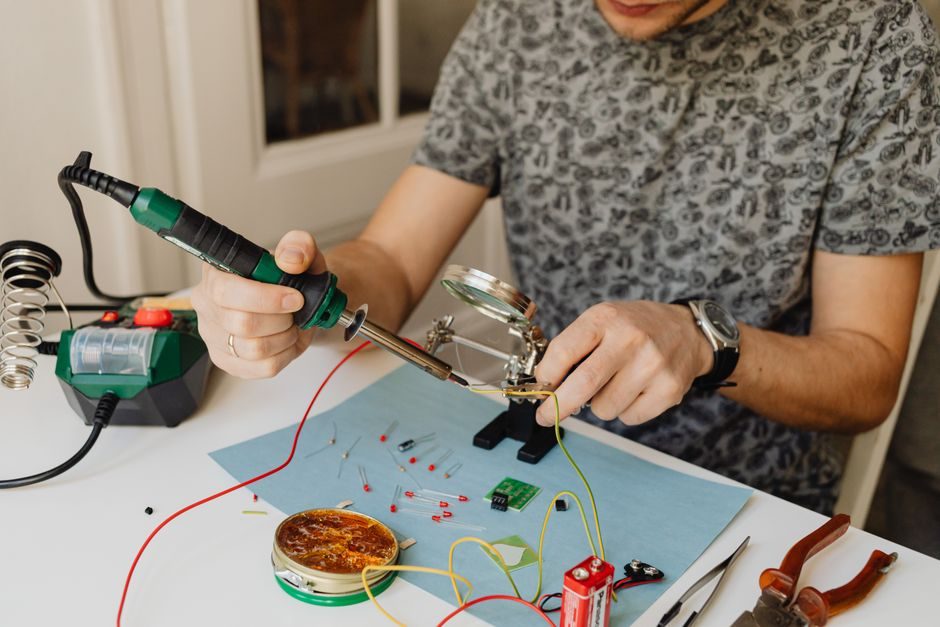
Servo motors run closed-loop with encoder feedback and routinely reach 3000-6000 rpm rated speed, while stepper motors operate open-loop on discrete step angles (commonly 1.8° / 200 steps per rev) and deliver their full holding torque at standstill [S3][S6].
For a new build in 2026 the dividing line is no longer "precision versus cost" alone — it is speed, duty cycle, heat rejection, and whether the application can tolerate the stepper's loss-of-torque behaviour above roughly 1000 rpm [S5]. This article lines the two topologies up against speed, torque, accuracy, control architecture, and total cost of ownership so a process engineer can pick the right axis on the first pass.
Topology and Control Architecture: Open-Loop Stepper vs Closed-Loop Servo
A stepper motor advances one electrical step per drive pulse — typically 1.8° full-step or 0.9° half-step on a 2-phase hybrid — and the drive assumes the rotor has moved; there is no position feedback in the basic topology [S3][S6]. A servo motor is fed by a servo drive running a current/torque loop, a velocity loop, and a position loop, with an encoder (incremental 20-bit class or absolute multi-turn) closing the position loop at kHz rates [S6]. This is why a stepper holds position with current at zero speed while a servo can dynamically correct following error during a move.
The hybrid class — sometimes called "closed-loop stepper" — fits a rotary encoder onto a stepper frame so the drive can detect stall and re-sync, recovering the lost steps that an open-loop stepper would simply miss [S2]. Oriental Motor's αSTEP AZ Series, for example, integrates a mechanical absolute encoder and runs both positioning and torque control modes from the same drive, blurring the line between stepper motor and servo motor in mid-tier applications [S2]. KEB and ISL both flag the same architectural split: open-loop simplicity for "set it and forget it" axes, closed-loop feedback anywhere a missed step costs the line a part [S3][S5].
Speed, Torque, and the Stepper Torque-Drop Knee
Steppers deliver their highest torque at low rpm and lose torque as speed rises because the inductive time constant of the windings limits current rise/fall — a NEMA 23 frame typically falls to roughly 30-50% of holding torque by 1000 rpm, and many NEMA 34 frames cross into a second torque knee near 1500-2000 rpm [S3][S5]. Servo motors, by contrast, are designed to operate at constant torque up to their base speed (often 2000-3000 rpm) and constant power into a field-weakening range that can extend to 5000-6000 rpm on industrial AC servos [S6].
KEB's pros-and-cons breakdown puts it bluntly: pick a stepper for low-speed, short-move, hold-position loads; pick a servo where the move profile includes high acceleration, high duty cycle, or a top speed that would push a stepper past its torque knee [S5]. Motion Solutions (2022) calls out the same three branches — speed, acceleration, and price target — as the top-level decision tree, and adds that a stepper's open-loop accuracy is only as good as the assumption that the load never exceeds available torque.
Accuracy, Resolution, and Repeatability
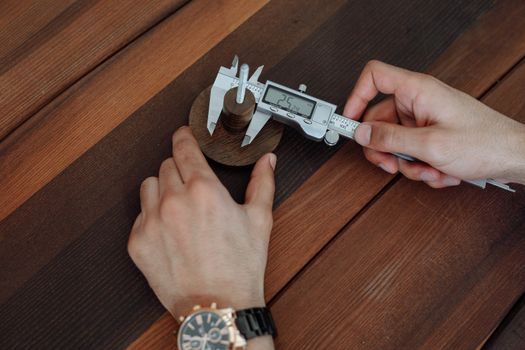
An open-loop stepper driven in full-step mode gives 200 positions per rev (1.8°) with no cumulative error between commanded steps; microstepping (1/8, 1/16, 1/32, 1/256) subdivides each step into smaller electrical increments but does not improve the fundamental positional accuracy of the motor — most of the microstep resolution is lost to detent torque and friction at light loads [S3][S6]. Industrial servos with 20-bit encoders (1,048,576 counts/rev) and a well-tuned position loop routinely hold ±1 count repeatability, and linear scales or absolute multi-turn encoders can push that to sub-arc-minute class on premium axes [S6].
For pick-and-place, CNC, and packaging lines the practical gap is wider than the spec sheet suggests: a stepper on a belt-drive can be perfectly adequate at 0.05 mm repeatability if the load is stiff and the move is short, while a servo on the same mechanics will hold that same band while running 5-10× faster [S5]. ISL's design note adds that closed-loop servos also flag a following-error alarm the instant the load exceeds torque capacity, so the control system can fault instead of scrapping the part [S3].
Heat, Duty Cycle, and Energy Efficiency
A stepper draws full phase current to hold position, so it dissipates heat even when stationary — a NEMA 23 holding at 2.8 A per phase can easily sit at 60-80 °C case temperature in a sealed cabinet, which is why many designers oversize the stepper frame or fit a servo drive with idle-current-reduction features [S3][S5]. A servo only draws the current the load actually needs; at standstill under no load the bus current drops to a fraction of rated, and regenerative dumps or common-DC bus architectures can recycle the braking energy back to other axes on the line [S6].
Closed-loop hybrid steppers (the αSTEP AZ class) close part of this gap by chopping current when the encoder reports zero following error, so holding heat drops to roughly 30-50% of an equivalent open-loop stepper's holding dissipation [S2]. For a 24/7 conveyor or indexing table the cumulative difference shows up on the cabinet HVAC load and on bearing grease life — a frequently-overlooked line item when comparing motor sticker prices [S5].
Cost, Sizing, and Total-Axis Economics
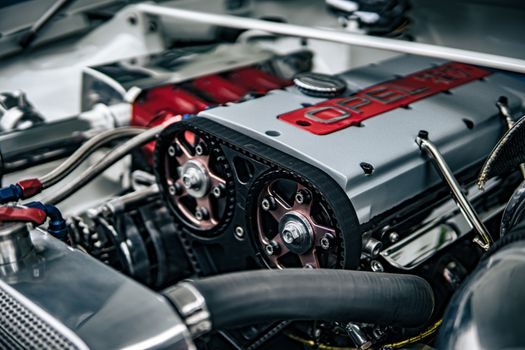
Stepper remains the lowest cost per axis: a NEMA 23 frame motor + microstep drive lands in the $60-150 range for OEM quantities, and a NEMA 34 high-torque frame + closed-loop hybrid drive is typically $200-450 [S3][S4]. An equivalent industrial AC servo (200-750 W) with matching drive lands at $400-900, and a premium direct-drive torque motor with absolute encoder is $1500-4000 per axis [S5][S6].
KEB's rule of thumb — echoed by ISL and Circuit Digest — is to size the motor at 50-100% torque margin so the drive never runs at its thermal limit, and that rule is what flips a stepper-vs-servo decision on a multi-axis line: a 6-axis Cartesian driven by steppers with 30% margin may end up heavier, larger, and harder to keep cool than 3 servos running the same mechanics at lower frame sizes [S3][S5][S6]. For a broader look at how these motors sit inside the supply chain, see the Electric Motor Supply Chain 2026: SiC, Axial Flux, Rare-Earth Substitution build reference, and for the drive-side selection gates that follow the motor pick, the Servo Drive Selection Criteria 2026 spec walk-through lines up with the closed-loop side of this comparison.
Decision Matrix: Stepper vs Servo vs Hybrid Closed-Loop
Below is the working matrix most control engineers reach for on a 2026 axis decision. Numbers are typical industrial bands, not guaranteed vendor specs: [S1]
Selection axis — Open-loop stepper: Speed band 0-1000 rpm best, 1500 rpm ceiling on light loads; Torque behaviour full holding torque at standstill, steep drop past 1000 rpm; Accuracy ±1 step (no feedback to catch a stall); Cost per axis lowest ($60-150 typical NEMA 23); Best fit short moves, hold-at-position, low duty cycle, lab/bench automation [S3][S5].
Selection axis — Hybrid closed-loop stepper: Speed band 0-2000 rpm; Torque behaviour holding current auto-reduces, ~30-50% less heat than open-loop; Accuracy encoder flags missed steps, drive re-syncs; Cost per axis $200-450; Best fit conveyors, indexing tables, mid-tier pick-and-place where stepper mechanical fit is already in the cabinet [S2][S3].
Selection axis — Industrial AC servo: Speed band 0-3000 rpm constant torque, 5000-6000 rpm field-weakened; Torque behaviour constant torque to base speed, then constant power; Accuracy ±1 encoder count, sub-arc-minute with linear scale; Cost per axis $400-900 (200-750 W), $1500+ for torque/linear motors; Best fit high-duty-cycle packaging, CNC, robotics, any axis where a missed step is a scrapped part [S5][S6].
Failure Modes, Sourcing, and Standards to Watch

The dominant stepper failure is stall under load: rotor position slips one or more steps, the open-loop drive has no idea, and the part is misregistered. The dominant servo failure is following-error overshoot or encoder fault, which the drive catches and alarms in real time [S3][S5][S6]. For stepper drive sourcing the relevant compliance anchors are CE (EN 61800-3 for EMC, EN 61800-5-1 for safety) and UL 61800-5-1; for servo drive builds the same EN 61800-3 / EN 61800-5-1 pair applies, plus functional-safety options such as STO (Safe Torque Off) under EN 61800-5-2. IP65 motor frames (IEC 60034-5) and insulation class F (IEC 60034-1) are the practical minimum for washdown or warm-cabinet installations.
Lead time in mid-2026 is the second watchpoint: NEMA 23/34 steppers ship in 2-4 weeks from Sanmen Taili and similar Asia-OEM lines, while 200-750 W industrial servos from the major Japanese and German brands still run 8-14 weeks on popular frame sizes [S4]. For builds that need to ship in Q3 2026, that lead-time gap alone is enough to push borderline axes from servo to hybrid closed-loop stepper.
Field Notes from the 2026 Build Cycle
Two signals to track over the next 90 days: (1) encoder resolution on closed-loop steppers is climbing into the 23-bit class, which is closing the accuracy gap on positioning axes that used to be servo-only; (2) integrated servo + drive + multi-turn absolute encoder packages (so-called "all-in-one" servos) are now shipping in the $250-400 range for 100-400 W frames, eating into the top end of the stepper market on small Cartesian robots [S2][S6]. For a deeper dive into the mechanical side of motion — how the motor choice changes the rest of the machine — the Conveyor Chain vs Flat Belt 2026 spec cut covers the downstream drive element that both motors end up turning.