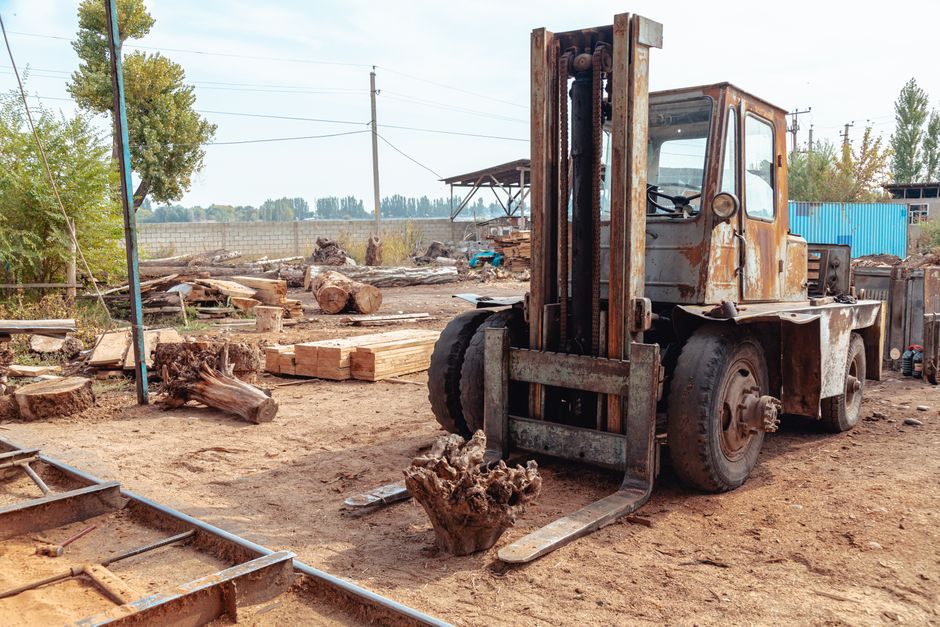
A 3D rotary tank cleaning machine rated 500-1000 bar operating pressure with a 6-12 minute wash cycle and a 158 mm minimum tank opening is engineered for one task: blasting residue out of an enclosed vessel [S1]. A forklift rated 1-10 t lift capacity is engineered for an unrelated task: moving palletized or unitized loads across a yard or aisle [S2]. The two are routinely listed on the same "industrial equipment" procurement page, which is why junior buyers confuse them; the engineering envelopes do not overlap.
Tank cleaning machines split into high-impact rotary heads (500-1000 bar, 6-20 m spray diameter, work pressure 4-20 bar feed) and lower-pressure chemical-sector skids for IBC totes and drum washers [S1][S2]. Forklifts split into electric counterbalance, diesel, and rough-terrain classes, with the latter specified for unpaved chemical-yard work [S2]. The point of the comparison is not which is "better" — it is which problem you are actually paying to solve.
Operating Envelope: Pressure and Cycle vs Lift Capacity and Mast
Tank cleaning heads are spec'd by operating pressure, cycle time, and spray geometry: 500-1000 bar peak, 6-12 min full cycle, 6 m effective spray diameter for radial heads and up to 20 m for long-throw rotary nozzles, fed by 4-20 bar work (supply) pressure [S1]. A typical IBC tote cleaning device and drum washer run far lower pressures but use heated detergent recirculation, with chemical-resistance defined by seal and wetted-parts material [S2].
Forklifts are spec'd by rated load (commonly 1.0-10.0 t for electric and diesel counterbalance units), lift height (3-7 m standard mast, up to 12 m on triplex masts), and turning radius. A rough terrain forklift adds 4-wheel drive, higher ground clearance, and larger pneumatic tyres for construction or tank-farm yards. None of those numbers map onto a tank cleaning cycle.
Selection Criteria: What Drives the Buy Decision
For a tank cleaning machine the four binding criteria are (1) residue class — crude-oil sludge, paraffin, polymer, pharmaceutical API, food-grade — which sets pressure and chemistry; (2) tank opening diameter — the 158 mm minimum is a hard gate for any rotary head, and a separate small-opening nozzle line exists for vessels under that [S1]; (3) cycle time target, which sets pump sizing; (4) explosion-proofing, with ATEX/IECEx zones 1 and 2 common in petrochemical service. A separate tank container washing guide layers in cargo-compatibility rules per IMO/IMDG [S6].
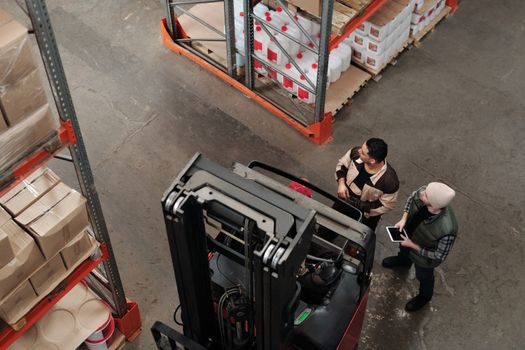
For a forklift the four binding criteria are (1) rated load and load center (500/600 mm standard), (2) aisle width and mast height, (3) power source — electric for indoor food/pharma, diesel or LPG for outdoor, (4) tyre type and surface. ATEX zones 1/2 forklift variants exist but use sealed electrics, not rotary spray pumps. The decision trees diverge at the first question: are you cleaning the inside of a vessel, or moving a load?
Who Each Tool Is For — and Who It Is Not For
Tank cleaning machines are for plant operators, terminal operators, and third-party tank-cleaning service companies running ISO tank containers, road tankers, bulk storage tanks, IBC totes, and process reactors. They are not for general floor cleaning, for which a standard hot-water high-pressure washer is the correct tool, and not for hygienic open-vessel washdown in food plants, where CIP (clean-in-place) skids are specified instead. The KQG30 Automatic Tank Cleaning System from a solids-control OEM is purpose-built for crude oil storage tank bottoms and mud — not for cosmetic washdown. [S1]
Forklifts are for warehouse, port, manufacturing, and yard operations moving unit loads. They are not for tank entry — manual tank entry is a confined-space operation governed by permit-to-work and respiratory protection rules that no forklift addresses. They are also not for personnel lifting; a forklift with a manbasket is a last-resort configuration with its own OSHA/EN 14502-1 rules and is not a substitute for a MEWP.
Criteria Comparison: Tank Cleaning Machine vs Forklift
Lining up the two against four procurement criteria makes the non-overlap obvious. On operating pressure vs rated load: tank cleaning is spec'd in bar (500-1000 bar peak, 4-20 bar work) [S1], forklifts in tonnes (1-10 t). On cycle time vs duty cycle: tank cleaning has a defined 6-12 min wash cycle per vessel [S1]; forklifts have an hours-per-day duty cycle (typically 4-8 h on a single battery or tank). On hazard classification: tank cleaning heads in petrochemical service need ATEX/IECEx zone 1 or 2 motors; forklifts in the same zones need EX-rated electrics but the certification path is different. On the equipment-class reference: a tank cleaning machine is a process vessel-cleaning asset, while a forklift is a materials-handling mobile asset. The two rarely share a BOM line item beyond a generic "plant equipment" capex bucket.
Standards and Reference Frames That Govern Each
Tank cleaning equipment in chemical tanker service is governed by IMO MARPOL Annex II cargo-residue rules, the IBC Code, and ship/shore cleaning guides; the German-language tankcleaning.de reference frames it as a chemical-cargo-changeover problem, not a wash-quality problem [S6]. Onshore petrochemical tank cleaning falls under OSHA 29 CFR 1910.146 confined-space entry, EPA SPCC for crude-oil storage, and the operator's own HSE procedure. ATEX 2014/34/EU and IECEx govern the EX-rated motor and pump skids in zone 1/zone 2 service.
Forklifts in the EU are governed by EN ISO 3691-1 (industrial trucks — safety requirements), EN 1175 (electrical requirements), and the Machinery Directive 2006/42/EC; rough-terrain variants add EN 1459 (rough-terrain trucks). In North America, ANSI/ITSDF B56.1 and OSHA 29 CFR 1910.178 apply. ATEX 2014/34/EU again applies to EX-rated variants in zone 1/2. A buyer who conflates the two will mis-cite the wrong EN/ANSI standard and the wrong hazardous-area certificate.
Real Failure Modes and Field Limits
Tank cleaning machine failures cluster around seal blowout (running above rated pressure or with wrong chemistry), nozzle clogging in wax/polymer service, and EX-motor ingress in washdown environments. High-impact rotary heads run 500-1000 bar — at that pressure a failed seal is a needle-jet injection injury risk, which is why most OEMs insist on deadman controls and pressure-relief dump valves [S1][S3].
Forklift failures cluster around tip-over from off-center loads, mast-chain wear, and battery thermal runaway on lithium-ion units. Rough-terrain variants add tip-over risk on slopes rated beyond the truck's published gradeability. These failure modes share nothing with tank cleaning; a "compare and contrast" that pretends they do is marketing copy, not engineering.
Procurement Signal: When Both Appear on the Same RFQ

Buyers who spec both in a single 2026 capital plan are usually scoping a greenfield tank terminal or chemical-logistics yard: tank cleaning skids for the wash bay, forklifts for the load-handling fleet. In that case the correct RFQ split is two separate technical packages with two separate bidder lists — a tank-cleaning OEM such as KELIYING (Guangzhou) or a North American specialist [S4][S5], and a materials-handling OEM with EX-rated variants where the zoning demands. Bundling them under one "material handling" line invites scope creep and wrong-spec deliveries.
Trackable signal: a related spec frame for buyers is the Tank Cleaning Machine Buying Guide 2026, which lays out pressure, geometry, and residue class as the three binding gates. Buyers weighing aluminium vs carbon steel for tank-container frames should cross-reference the Tank Container Buying Guide 2026 and the Aluminum Alloy vs Carbon Steel spec-driven selection piece, since the cleaning chemistry and the vessel material grade interact.