
Automotive tank cleaning breaks into three application clusters — paint-shop circulation tanks (200-1,500 L), parts-washer sumps (50-400 L) and bulk coolant/lubricant reservoirs (1-10 m³) — and the machine class that dominates all three is the rotary spray-head family, with fixed spray balls restricted to low-debris rinse duty [S5].
What follows distils the 2026 vendor lineup (rotary nozzles, orbital clean-in-place heads, robotic crawlers) against the selection variables that actually move a purchase: pressure envelope, zone classification, wetted material, flow budget and footprint inside an automotive cell [S3][S5].
Clean-in-Place Rotary Spray Heads vs Spray Balls for Paint Shop Tanks
Rotary two-axis spray heads deliver impact pressures in the 2-6 bar range at 80-150 L/min flow and produce a 360° coverage pattern that meets the typical 0.5-1.5 m/s impact figure cited in CIP design notes [S5]. Solid-cone spray balls, by contrast, are limited to low-pressure rinse at 1-3 bar and 30-80 L/min; they are spec'd for water-flush pre-rinse on bulk coolant reservoirs where debris load is light, not for paint-resin removal [S5].
Selection rule of thumb: a rotary jet head pays back inside twelve months on any paint tank that runs waterborne or solventborne basecoat because it cuts manual-entry cleaning from roughly 4 hours to under 45 minutes per cycle [S5]. Spray balls are the right call only for the rinse stage ahead of a CIP loop or on bulk storage of low-viscosity cutting fluid [S5].
Zone Rating, Wetted Material and ATEX/IECEx Pairing for Solvent-Borne Cells
Any tank cleaning machine installed in an automotive paint mix room or thinner tank farm has to be selected to the zone classification of the surrounding cloud, not the liquid surface — Zone 1 for normal operation, Zone 2 for abnormal, and Zone 0 only inside the tank ullage itself [S3]. Ex db (flameproof) and Ex eb (increased safety) gear pairs with IIA/IIB solvent groups; gear-motor casings, cable glands and the drive air (for pneumatic rotary heads) all need the same certificate family [S3].
Material side, 316L stainless is the default wetted spec for waterborne paint, while solvent-borne tanks frequently spec PTFE/PEEK seals and Hastelloy or PTFE-lined rotors because aromatic hydrocarbons attack EPDM in under a year of service [S5]. Surface finish stays at Ra ≤ 0.8 µm on wetted parts to keep resin-build-up below the 0.5 mm threshold that triggers manual intervention [S5].
Flow Budget, Pressure Envelope and Pump Pairing in the Parts-Washer Loop
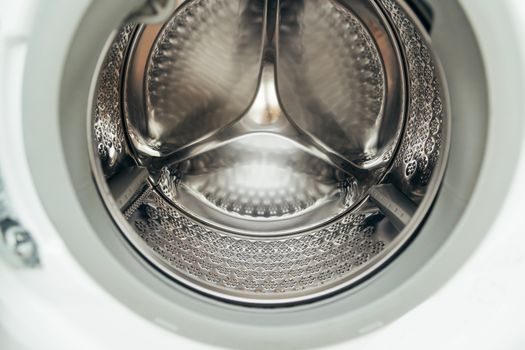
A 1,000 L paint circulation tank with a mid-class rotary spray head needs roughly 8-12 m³/h at 4 bar, which a 1.5 kW centrifugal pump handles with a 1.5-2× safety margin on the flow curve [S5]. Smaller 200 L parts-washer sumps sit in the 3-5 m³/h range and can be driven from the existing wash-pump skid if the engineer adds a dedicated CIP return line and a Y-strainer with 0.5 mm aperture [S5].
Engineers routinely undersize the supply line, so the hard rule is this: keep the supply run under 6 m of 1-1/4″ hose (DN32), and never throttle below the pump's BEP — a rotary jet head that sees 1.5 bar instead of its rated 3-4 bar simply stalls and stops rotating, which looks like a "worn-out nozzle" but is a hydraulic issue [S5]. A pressure transmitter on the supply manifold, hard-wired to interlock the heater, is the cheapest insurance against this stall mode, and a pressure transmitter reading in the 0-10 bar range with HART output is the typical pick for this guard duty.
Fixed Spray Heads, Orbital CIP Heads and Robotic Crawlers: A Criteria-Based Cut
Three machine classes compete in the automotive cell. The fixed spray ball is the cheapest (typically 80-200 USD fitted) and works only for low-debris rinse; the rotary two-axis spray head is the workhorse at 600-2,500 USD fitted and covers 90% of paint-shop and parts-washer duty [S5]. Orbital clean-in-place heads — a geared turbine that sweeps a 90° or 360° arc — sit in the 2,500-6,000 USD range and pull heavier soils (cured resin, drying-oven condensate) off larger reservoirs [S5].
Robotic crawlers, the class CYC International markets for petrochemical service, add remote inspection and high-pressure jetting up to 500 bar but push the unit cost into the 25,000-80,000 USD band and are justified only when the tank is too hazardous to enter or the throughput justifies a 24/7 cleaning asset [S3]. A 50,000 L diesel tank, an IBC tote farm of more than 200 units, or any tank flagged for periodic internal inspection is the right crawler application; a 500 L paint tank is not [S3].
IBC Tote Cleaning and the Cross-Link to IBC Tote Engineering
Automotive plants that ship paint, coolant concentrate or cutting fluid in 1,000 L intermediate bulk containers treat those totes as moving tanks, not packaging, and they need a dedicated cleaning machine with a top-entry spray head, bottom drain verification and a flow-balanced CIP loop [S5]. A standard IBC tote cleaning cycle runs 12-18 minutes at 200-400 L/min and 3-5 bar, well above the spray-ball rating, so a rotary head with a 2″ Tri-Clover connection is the common pick [S5].
For the full container engineering picture — valve geometry, frame dimensions, UN/DOT packaging code — the IBC tank reference covers the matching data set. Plants that run an IBC wash station in-line with their paint kitchen typically pair a 0.75-1.5 kW centrifugal pump with a 50 µm in-line strainer and a 1.5″ pneumatic pinch valve on the drain, sized to clear the resin-loaded effluent inside one full cycle.
Self-Cleaning Filters and Tank Container Integration on the Wash Loop
Resin-loaded CIP return water is what kills rotary spray heads, not the chemistry — a 0.5 mm chip lodges in the rotor and stalls the gear, so the supply side of every rotary-head circuit deserves a self-cleaning filter rated to 80-200 µm with a blow-down valve back to the sump [S5]. This single piece of equipment extends the service interval on a 1,000 USD rotor from three months to twelve months in most paint-shop audits and is the cheapest reliability upgrade available on a CIP loop [S5].
For plants that ship basecoat in ISO tank containers, the wash-station sizing also has to match the container's wash-port geometry, baffle layout and heating-coil envelope — that engineering baseline is documented on the tank container reference page. The cross-link matters because an undersized CIP return line on a 25,000 L ISO container is the most common root cause of an extended wash cycle on a tanker return.
Failure Modes, Service Intervals and the Selection Checklist
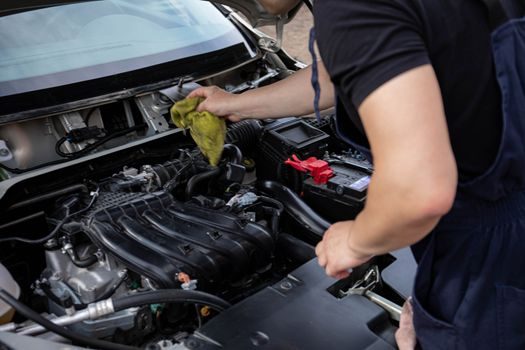
Three failure modes dominate automotive tank cleaning machine service data: rotor stall from supply under-pressure, seal swell from solvent incompatibility, and bearing wash-out from resin-build ingress past a worn lip seal [S5]. A 1,000-hour or six-month seal-and-bearing swap, performed without breaking the process piping, is the realistic maintenance window for a rotary head in a paint shop; orbital heads stretch that to 2,000 hours because their gear trains run at lower tip speed [S5].
Selection checklist for a 2026 purchase: confirm ATEX/IECEx zone and gas group match the worst-case solvent cloud [S3]; confirm wetted material against the chemistry (316L minimum, PTFE seals for aromatics, Hastelloy for ketones) [S5]; size the supply pump to deliver 1.5-2× the rated flow of the head at its rated pressure [S5]; install a self-cleaning strainer upstream of the head [S5]; and verify the drain cycle time against the rated wash cycle (12-18 min for a 1,000 L paint tank, 25-40 min for a 25,000 L ISO container).
Two signals to track: vendors that publish ATEX/IECEx certificate numbers with the gas group (not just "Ex" in the model code) and machine builders that publish a measured 0.5-1.5 m/s wall-impact figure with the test fluid — both are the cheapest filter against a marketing spec sheet that overstates coverage by a factor of two.
For related coverage, see Overhead Bridge Crane Price 2026: Cost Ranges, Spec Levers and Sourcing Reality.