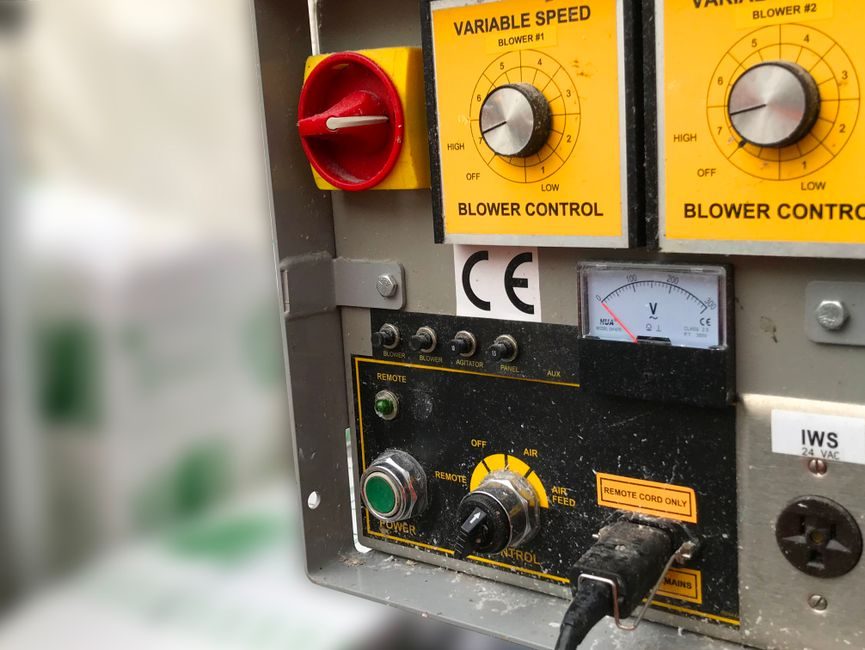
A temperature controller and a digital panel meter (DPM) are two separate instrument classes, even though some DIN-sized products merge the two roles in one housing. A controller reads a thermocouple or RTD, runs PID or ON/OFF logic, and drives outputs; a DPM only conditions and displays a process variable, with no control action [S2][S1].
Selection therefore hinges on whether the loop needs to be closed or only observed. Closed-loop thermal control, alarm management, and output switching require a temperature controller; purely local readouts, secondary indication, or retrofit of an analog gauge point to a digital panel meter. Confusing the two is one of the most common spec errors on packaged HVAC, plastics, and food-process skids.
Functional Definition and Scope
A digital panel meter accepts an analog or digital sensor input — voltage, current, thermocouple, RTD, or frequency — converts it through an A/D stage, and shows the scaled value on an LED or LCD. It has no decision authority over the process; the operator or a downstream PLC must act on what the meter shows [S3].
A temperature controller is a measurement device that obtains a temperature change signal and drives at least one output to hold the process at setpoint. Delta Electronics divides them by sensing element into thermocouple-type and resistor-type (RTD/thermistor) controllers, with PID and ON/OFF as the two control algorithms [S2]. Maxwell adds timer-integrated variants for plastic-machinery and packaging heat-seal duty [S4].
The merged class — meter/controller — exists in products like the OMEGA iSeries, which combines a digital panel meter front end with a full PID controller, programmable color display, and 2 control/alarm outputs in 1/32, 1/16, and 1/8 DIN sizes [S1].
Decision Criteria: Control, Readout, or Both
Selection reduces to four criteria the spec engineer can score on a one-page worksheet: closed-loop action, alarm handling, output count, and display behaviour. A temperature controller with PID autotune, dual relays, and RS-485 Modbus satisfies all four at once; a basic DPM satisfies only the display criterion [S1][S2].
On control authority, a controller carries at least one control output (DC pulse, solid-state relay, mechanical relay, or analog 4-20 mA / 0-10 V) sized to drive heaters, solenoid valves, or SSR coils; a DPM carries outputs only for retransmission or simple alarm signalling, not for sustained loop actuation [S1].
On accuracy and stability, the iSeries spec is concrete: ±0.5 °C (±0.9 °F) absolute with 0.03 % of reading, plus temperature stability of ±0.04 °C/°C on RTD inputs and ±0.05 °C/°C on thermocouple inputs referenced to 25 °C ambient [S1]. A typical DPM has no published RTD/TC drift figure because it is not specified for control-grade measurement duty.
Side-by-Side Comparison on Four Criteria
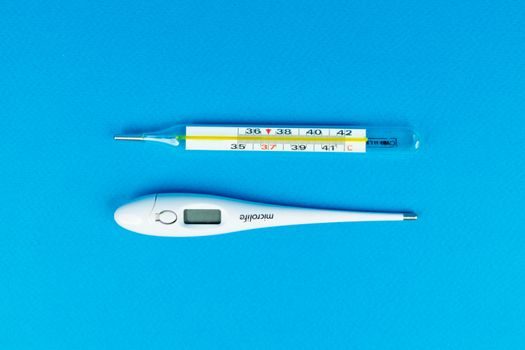
Cost vs capability: a 1/16 DIN PID controller (DTB, DTA, or DTC class) lists in the THB 4,000-9,000 range for Asian-channel resellers; a merged meter/controller like the OMEGA i/16DPI8 lists at THB 17,016.63 in current SEA distribution [S1].
Output count: DPM = 0 control outputs (alarm relay optional on some lines); PID temperature controller = 1-2 control outputs plus 1-2 alarm outputs, often configurable as SSR drive, mechanical relay, or analog 4-20 mA / 0-10 V retransmission [S1].
Sensor support: a controller lists thermocouple types J, K, T, E, R, S, B, N, plus PT100/RTD and process inputs; a generic DPM covers process voltage/current only, and needs an external transmitter for TC/RTD. The iSeries accepts TC, RTD, and process voltage/current on a single universal input [S1][S2].
Integration effort: a DPM is drop-in to a 4-20 mA loop or shunt circuit; a controller needs output wiring, alarm logic, and often a serial option (RS-232 / RS-485 Modbus on the iSeries) for SCADA tie-in [S1]. The spec engineer who chooses a DPM where a controller is required will pay that integration bill twice — once to add an external controller, once to rewire.
Real Use Cases by Industry
Injection-molding and extrusion: PID temperature controller with J or K thermocouple input, 15-30 A SSR drive output, and over-temperature alarm — DPM is not acceptable as the primary loop element. DTB / DTA class controllers from Delta target this exact duty [S2].
Panel-build and OEM skids where the HMI is remote: a DPM at the local panel for operator readout, with the controller mounted in a sub-panel and wired to the same RTD. This is a valid hybrid; the DPM is a temperature monitor surrogate, not a controller.
Food, pharma, and cold-chain: a temperature recorder with on-board logging is the audit instrument, but the control loop still requires a dedicated temperature controller with a separate temperature sensor input. DPMs are not accepted by FDA / GxP auditors as control-of-record.
Test benches and lab instrumentation: a digital multimimeter or bench DPM is fine for spot checks; a controller is unnecessary unless a fixture must hold a stable temperature. Specifying a controller in a lab-only role is over-engineering and inflates the BOM.
Failure Modes and Common Mis-Specs
The most common mis-spec is buying a DPM because it has a relay output and assuming that is "control." A single alarm relay with no PID and no proportional output will chatter under load and either cycle the heater to destruction or fail to hold setpoint. The fix is to require autotune PID with at least one proportional output — DC pulse for SSR drive or 4-20 mA for a phase-angle module [S1][S2].
The second common error is the reverse: installing a full controller where a DPM is enough. On a non-critical read-only point — a bearing-temperature indicator, a hydraulic-oil-temperature gauge, a duct-temperature spot check — a controller adds cost, output wiring, and a configuration burden with no functional return. The hierarchy should be: DPM for indication only, controller only where a control decision is taken.
For application-specific selection logic on PID vs ON/OFF, sensor input wiring, and output-type sizing, see the spec engineer's walkthrough on PID vs ON/OFF controller selection — it pairs directly with the decision matrix above and lays out the output-stage sizing rules that DPMs cannot satisfy.
Standards, Sourcing, and Warranty Anchors
Front-panel ingress on combined meter/controllers carries NEMA-4 / IP65 rating on the iSeries 1/8, 1/16, and 1/32 DIN family, which matters for washdown food plants and outdoor panels [S1]. Warranty on the same line is 5 years; mainstream Asian-channel controllers ship with 1-2 years.
Communication: both instrument classes increasingly carry RS-485 Modbus; the iSeries also supports RS-232 on the same instrument via menu selection, with ActiveX controls and free configuration software for PC-side setup [S1]. DPMs in the same DIN cutout typically ship Modbus-only or as 4-20 mA analog retransmit only.
For sourcing context on the bench-instrument side — where DPMs and bench multimeters overlap with function generators in a test bench — the Function Generator vs Digital Multimeter spec guide lays out the adjacent decision logic.
For a cost-bands view on adjacent instrumentation, the Function Generator Price and Cost Guide and Safety Barrier Price and Cost Guide are the closest published cost-band references and can be used as a proxy range for panel-instrument pricing when direct quotes are unavailable.