The decision between a three-phase asynchronous motor and a servo drive system is set by three measurable axes — speed regulation bandwidth, starting torque profile, and feedback-loop structure — not by horsepower alone. Recent OEM product lines (May 2026) show induction cage motors shipping from 0.02 kW to 18.7 kW in IP55 frames [S1], while compact three-phase servo drives such as the DIAS Drive 100 family cover 230–480 V, 4–18 A and 2- to 8-axis modular configurations in a single package [S2].
Both platforms are now sold on the same global catalogs: the induction motor is treated as a passive torque actuator sized for a load curve, the servo is sold as a control node that closes current, velocity and position loops around a servo motor. Specifying one when the duty cycle calls for the other is the most common motion-control mis-spec seen in 2025–2026 panel-builder RFQs.
Operating envelope and power class
Three-phase asynchronous induction machines on the 2026 market span a wide industrial range. The Carpanelli MA-series brake motor family, for example, runs from a minimum of 0.02 kW (0.03 hp) up to 18.7 kW (25.42 hp) in IP55 motor and IP44 brake housings (IP55 on request), with frame sizes MA56 through MA160 [S1]. This is a constant-speed, cage-rotor topology with external ventilation and a fail-safe brake — sized to the load curve, not to a feedback loop.
Servo drives in the same period are sold by axis count and bus voltage, not by shaft kW. The SIGMATEK DIAS Drive 100 is rated 230–480 V, 4–18 A, 3 kVA per axis, in 2-axis or 8-axis modular blocks [S2]. The relevant comparison metric is current density per axis and bus voltage, because the servo is a closed-loop amplifier that pairs with a matched servo motor of chosen frame size.
Wholesale induction-motor pricing on China’s B2B portals in March 2026 sat between US$30 and US$355 per piece at MOQ 1–50, depending on pole count (typically 4) and direct-on-line starting configuration [S6]. A comparable servo drive module — amplifier electronics plus matching permanent-magnet motor and encoder — sits roughly an order of magnitude above that on a per-axis basis once encoder cable and EMC filter are included.
Control loop and feedback structure
The defining technical separation is the feedback architecture. A three-phase asynchronous motor running direct-on-line has no position feedback: its slip is the natural difference between synchronous speed and rotor speed, and a typical DOL hydraulic-pump simulation shows the machine reaching rated speed at roughly 2.5 s and stalling mechanically when the downstream valve diameter collapses (the MathWorks pump example drops valve diameter at 9 s, which pulls the motor into stall) [S4]. That is an open-loop torque device, not a position device.
Sensorless field-oriented control narrows the gap. MathWorks’ sensorless ASM model runs a grid-side AC/DC converter plus a machine-side DC/AC converter, with two controllers performing rotor-flux-oriented torque and flux regulation without a shaft encoder [S3]. This raises dynamic response into the low-millisecond range and is the bridge topology used in many modern V/Hz-and-vector drives sold as “servo-like” — but it still has no absolute position loop, so it cannot replace a true servo in point-to-point indexing.
A genuine servo drive closes three nested loops — current (typically 1–4 kHz update), velocity (typically 1 kHz), and position (typically 1–4 kHz) — fed by a resolver or sine/cosine encoder on the back of the servo motor. That is why the DIAS Drive 100 is sold as a control node with a defined axis count (2-axis or 8-axis) rather than as a single horsepower rating [S2].
Starting, braking and transient behaviour

Direct-on-line starting of an induction motor draws 5–7× rated current at the moment of connection, and the start transient takes hundreds of milliseconds to settle. The MA-series brake motor embeds a separate electromagnetic brake (IP44, optionally IP55) that engages on power loss — a fail-safe feature, not a dynamic brake [S1]. Soft-starters and VFDs are the usual way to cut the inrush, and the engineering trade-off there is covered in the Soft Starter vs Three-Phase Asynchronous Motor: 2026 Spec Cut reference.
A servo drive inverts that picture. Because the drive is already a current-controlled amplifier with a DC bus, the start transient is a software ramp, not a mains inrush. Braking is regenerative back into the bus (or dissipated into a brake resistor), and emergency stops are decel-limited by the drive firmware, not by a mechanical brake shoe. For high-cyclic indexing — packaging, pick-and-place, CNC feed axes — the servo profile is set in milliseconds, while the induction motor’s DOL start is set by rotor inertia and load.
Selection criteria and decision matrix
For a 2026 RFQ, four quantitative gates separate the two technologies cleanly. First, speed regulation: induction ±2–5% open-loop, servo ±0.01% closed-loop. Second, position accuracy: induction N/A without an external encoder; servo ±1 encoder count, typically ±10–20 arc-seconds on a 20-bit encoder. Third, starting current: induction 5–7× inrush on DOL; servo limited to rated current at the bus. Fourth, unit cost per axis at the 0.5–5 kW class: induction US$30–355 [S6], servo roughly 5–15× higher once motor, encoder, cables and EMC filter are bundled.
The duty-cycle map that follows from those four gates is straightforward. Fans, pumps, conveyors, compressors, mixers, and hydraulic pump drives (where the MathWorks DOL-pump example deliberately uses an induction machine [S4]) belong on asynchronous motors. Packaging indexers, robot joints, CNC axes, semiconductor handlers, and any application that needs a programmable electronic gearing ratio belong on a servo drive plus servo motor pair.
A gray zone remains: high-performance VFDs running sensorless FOC on an induction motor — the MathWorks sensorless ASM block being a textbook case [S3] — can hit sub-100 ms dynamic response and are widely used on web tension, extruders and simpler speed-ratio lines. They are not a substitute for a servo when absolute position matters, but they often beat a servo on price for a constant-horsepower variable-speed duty.
Standards, protection and integration
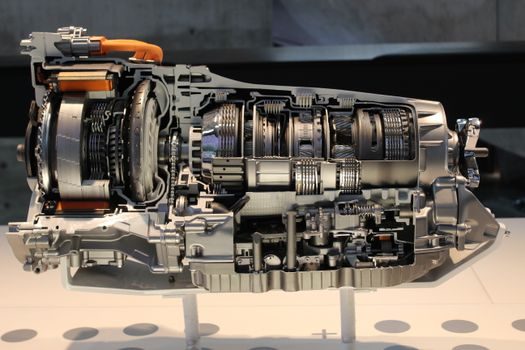
Induction motors on the European market ship to a familiar protection and insulation envelope: IP55 motor, IP44 brake (IP55 optional) on the MA-series example, and Class F insulation as the default in this frame-size band [S1]. This is the spec set engineers expect on a 0.02–18.7 kW general-purpose induction machine, and it slots directly into IEC 60034 family of rotating-machine standards for rated performance and IE2/IE3/IE4 efficiency classes. Servo drives in the same period ship with EMC filter provisions and the safety functions expected under IEC 61800-5-2, but the spec sheet leads with bus voltage, axis count and current — protection is set by the cabinet, not by the drive housing [S2].
Integration also differs. An induction motor with a soft-starter is a passive device: no fieldbus, no node ID, no cyclic data. A servo drive in the DIAS Drive 100 class is a network node from the factory, designed to sit on a real-time Ethernet bus and exchange cyclic position, velocity and torque words with a master controller [S2]. For brownfield retrofit of an existing induction machine, the VFD is the only sensible upgrade path; for a new line, the servo drive is the only path that opens registration marks, electronic cams and torque-limited capping.
Use cases and failure modes
Three concrete use cases anchor the split. A hydraulic-pump test stand that drops a valve from full bore to 4 cm at 9 s into the cycle needs only an induction motor running DOL — the stall is the test, not a fault, and the MA-series brake motor at IP55 would be a typical physical example [S1][S4]. A multi-axis packaging machine running 60+ cycles/min needs a multi-axis servo drive — the DIAS Drive 100’s 2- to 8-axis modular blocks line up directly with that requirement [S2]. And an EV traction or industrial traction duty where peak torque for 60 s matters more than a tight position loop is a textbook induction-motor application, as the Chinese-language induction-motor torque analysis specifically highlights [S5].
Failure modes also diverge. Induction motors fail on bearing, winding and brake-disc wear, and the end-of-life is usually thermal. Servo drives fail on encoder feedback loss, DC-bus capacitor ageing, and regen resistor over-temperature, and the end-of-life is usually electronic. The maintenance skill set, the spare-parts inventory and the mean-time-to-repair plan therefore differ between the two — a fact that often overrides the headline price difference in a 24/7 plant.
Sourcing and 2026 cost signal
Wholesale sourcing for three-phase asynchronous motors in Q1–Q2 2026 is dominated by Chinese ISO 9000-certified vendors offering 4-pole, direct-on-line, closed-casing industrial units at FOB US$30–355 per piece, MOQ 1–50 [S6]. The MA-series European equivalent (Carpanelli) is engineered for higher IP ratings and integrated fail-safe braking, and is positioned at the upper end of that range and above [S1]. Servo drives are not sold by piece in the same way: they are sold as matched drive-plus-motor kits, with pricing gated by encoder resolution, brake option and bus type.
For buyers mapping a 2026 panel, the rule of thumb that survives the spec sheet is: pick induction when the load curve is known and constant, pick a servo drive when the motion profile is programmed. The wider motor-production context for both technologies — stator winding, rotor cage versus magnet rotor, encoder integration — is laid out in the Electric Motor Production Technology: Stator, Rotor and Magnet Process Map reference, which pairs with the more general Three-Phase Asynchronous Motor Selection: 2026 Spec Gates and Sourcing Levers read.
Trackable signals to watch into the second half of 2026: the convergence of medium-voltage servo drives above 480 V (currently the DIAS Drive 100 ceiling [S2]), and the steady drop in 20-bit encoder pricing that keeps pushing the cost crossover between sensorless-FOC induction drives and entry-level servos lower in the power range. Until those move, the spec split described above holds across 0.02–18.7 kW for induction and across the 2–8 axis modular servo band.