
Specifying a timer that meets EN/IEC 60947-5-1 plus EN/IEC 61812-1 with 2 kV burst immunity on power lines and 10 V/m radiated immunity is the minimum bar for control-panel EMC compliance, per Allen-Bradley 700-series timer datasheet values [S1].
EMC immunity testing of time-delay relays follows the IEC 61000-4-x family: 61000-4-2 (ESD), 61000-4-3/EN 50140 (radiated RF), 61000-4-4 (EFT/burst), 61000-4-6 (conducted RF), with the burst test being the single most common failure source in relay-equipped panels [S2][S6].
Interface Layers That Decide EMC Fit
Time relay EMC compliance is a four-layer problem — mechanical mounting, electrical levels, signal/protocol, and materials contact — and a relay that passes a standalone bench test can still fail inside a cabinet once VFDs and contactors are switching nearby [S6].
The mechanical layer is the first gate: a 22.5 mm DIN-rail timer mounted next to a variable-frequency drive without an EMC backplate sees field strengths well above the bench-test 10 V/m level, because radiated emissions from unshielded drive cables couple directly into the timer coil [S6]. Specifying a minimum 100 mm segregation distance from VFD cables, plus a bonded DIN-rail ground bar, restores the in-panel field level to roughly the test-bench envelope for a 10 V/m-class device [S6].
Electrical-layer checks are the second gate: coil inrush and contact switching transients themselves are sources of EFT bursts, so the very relay you are specifying contributes to the interference map of the panel [S3]. The IEC 61000-4-4 burst test injects 2 kV on power lines and 1 kV on signal/I/O lines as the level-3 minimum, with level-4 (2 kV signal-line) called out as the conservative industrial spec for a safety relay or time relay used in a process-control cabinet [S1][S2].
Standards Stack: Which Test, Which Number
EN/IEC 60947-5-1 is the low-voltage switchgear product standard governing time-delay relays, and it pulls immunity requirements from the IEC 61000-4-x basic EMC publications; EN/IEC 61812-1 governs the time-relay function specifically [S1].
The published Allen-Bradley 700-series timer datasheet (700-TD552_-EN-P) lists the binding immunity numbers a process engineer should look for: ESD per EN 61000-4-2 at 8 kV contact (level 2) and 8 kV air (level 3); RF immunity per ENV 50140 at 10 V/m amplitude-modulated 80 MHz to 1 GHz (level 3) and 10 V/m pulse-modulated at 900 MHz; conducted disturbance per ENV 50141 at 10 V from 0.15 to 80 MHz (level 3); burst per EN 61000-4-4 at 2 kV power-line (level 3) and 2 kV I/O signal-line (level 4) [S1].
Generic immunity standards layer on top: EN IEC 61000-6-1 covers residential, commercial and light-industrial environments, and applies when no product-family standard exists; EN IEC 61000-6-2 covers the heavier industrial environment, which is the more relevant target for a panel that includes an industrial relay or motor protection relay [S7]. For OEM panel builders shipping into both EU and US markets, the practical checklist becomes cURus File E14843 (Guide NRNTZ/NRNT8), CE Mark, and the EN/IEC 60947-5-1 + 61812-1 pair [S1].
Decision Criteria: Bench Compliance vs Cabinet Reality

Bench-level immunity compliance does not guarantee cabinet-level immunity — the two are not equivalent, and a timer that passes 2 kV burst on the test bench can still mis-trigger in the field if the cabinet wiring is not engineered to the same standard [S6].
Four decision criteria separate a datasheet-pass timer from a panel-pass timer: (1) signal-line burst level — level 3 (1 kV) is bench-typical, level 4 (2 kV) is cabinet-typical and the more conservative spec for relay output wiring routed alongside VFD cables [S1]; (2) radiated RF level — 10 V/m amplitude-modulated 80 MHz to 1 GHz is the residential/light-industrial bar, while EN 61000-6-2 industrial environments routinely specify 10 V/m with stricter modulation profiles [S1][S7]; (3) surge immunity — IEC 61000-4-5 surge (1 kV line-line, 2 kV line-earth) is commonly required on coil-supply terminals and is not always called out on timer datasheets, so a separate thermal relay or relay module spec often has to cover it; (4) cabinet segregation — minimum 100 mm from VFD cables and a bonded DIN-rail ground bar are the practical field-side mitigations that the bench test does not enforce [S6].
The comparison collapses to a single rule: a timer that is rated EN/IEC 60947-5-1 + 61812-1 plus 2 kV burst on both power and signal lines at level 4, with cURus and CE marks, is the minimum spec for a new industrial panel; anything below level 3 on signal lines is panel retrofit-only [S1].
Failure Modes Seen in the Field
Burst failure in time-delay relays is dominated by three mechanisms: coil-supply EFT coupling, I/O-wiring EFT coupling, and radiated-RF rectification in the timing circuit, with the first two accounting for the majority of field returns [S3][S5].
Concretely, the burst pulse waveform has nanosecond-class rise time, sub-microsecond pulse width, and is delivered in 15 ms bursts at repetition rates adjustable from 1 kHz to 1 MHz on commercial generators (LISUN EFT61000-4 family, 0.25–6 kV output, 50 Ω source impedance ±20%), which is why a single nearby contactor coil can couple enough energy through a 24 V DC control wire to flip a time relay timing bit [S3]. For radiated immunity, dwell time on each frequency step is the controlled variable, and time-delay relays with slower microcontroller-based timing loops can latch into a false-trigger state if the dwell is shorter than the loop's recovery window [S5].
Survival in a cabinet is therefore about giving the timer the right neighbor: ferrite cores on I/O wiring (snap-on, 100 Ω at 25 MHz minimum) attenuate the common-mode burst currents that ride on signal lines; shielded cable for the analog setpoint potentiometer wiring (where present) reduces RF rectification; and a common-mode choke on the AC coil supply catches the 2 kV class bursts before they reach the rectifier front end [S3][S6].
Selection Criteria by Application Class
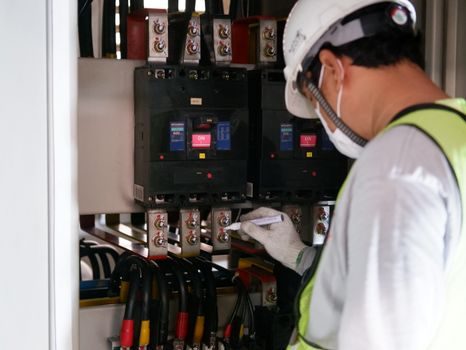
Specifying a time relay for an EMC-sensitive panel requires matching the immunity level to the electromagnetic environment of the cabinet, not the marketing brochure of the relay [S6][S7].
For a residential or light-industrial panel (EN 61000-6-1 environment, no VFDs on the same DIN rail), a timer with EN/IEC 60947-5-1 + 61812-1 plus 2 kV power-line burst (level 3) and 1 kV signal-line burst (level 3) is sufficient, and the Allen-Bradley 700-series published numbers in [S1] represent a working commercial baseline. For a heavy-industrial panel (EN 61000-6-2 environment, VFDs and large contactors in the same cabinet), the level-4 signal-line rating (2 kV) and the addition of surge (IEC 61000-4-5) and conducted RF (IEC 61000-4-6) data on the datasheet become gating items. For a process-control cabinet with motor protection relay coordination, the time relay is typically the slave timing element in a sequenced start/stop, and its immunity must be at least one level above the most-noisy neighbour to avoid being the weak link in the chain [S1][S6].
Limits and Pitfalls That Pass a Datasheet Check
Three common pitfalls pass a datasheet review and still fail on site: mixing AC and DC coil voltages on adjacent timers (the AC timer's triac snubber becomes a common-mode radiator that the DC timer is not rated for), routing timer I/O in the same cable tray as VFD motor leads (couples the radiated RF field directly into the timing circuit), and relying on the timer's CE mark as a stand-in for EN 61000-6-2 industrial compliance (CE under the EMC Directive 2014/30/EU is generic, not environment-specific) [S6][S7].
A fourth pitfall is the assumption that burst immunity scales with surge immunity: it does not. EN 61000-4-4 burst has sub-microsecond pulse width and 5 ns rise time, while EN 61000-4-5 surge has microsecond-class pulse width and lower dv/dt; a timer can pass one and fail the other, which is why both numbers need to be on the datasheet before sign-off, not just the more familiar burst number [S2][S3].
Sourcing and Verification

Verification at goods-in is non-negotiable: request the manufacturer's EN/IEC 60947-5-1 and 61812-1 test reports (not just the declaration of conformity), confirm cURus File E14843 if the panel is shipping to North America, and check that the immunity numbers in the report match the datasheet at the level called out in the panel spec [S1].
Two trackable signals to watch: IEC 61000-4-4 revisions, which continue to refine burst calibration networks and have historically driven relay-level retest cycles within 3–5 years of publication; and EN IEC 61000-6-1/6-2 generic-standard updates, which re-baseline the immunity floor for new panel builds [S2][S7]. For broader industrial-spec context, the measuring instruments supplier map tracks which vendors currently publish complete EN/IEC 60947-5-1 immunity data — a useful cross-reference when a timer datasheet is silent on the level number for any of the IEC 61000-4-x tests.