
A variable speed drive (VSD, also called variable frequency drive / VFD) is an electronic power converter sitting between the mains supply and an AC motor; it chops the incoming fixed frequency to deliver an adjustable output frequency and voltage, which in turn varies motor shaft speed [S4]. A planetary reducer, by contrast, is a purely mechanical gearbox with a sun gear, planet gears and a ring gear; its job is to reduce input RPM to a lower output RPM while multiplying torque in essentially the inverse ratio, minus stage efficiency losses [S6].
They are not substitutes. The 2026 sourcing data shows both categories moving in parallel: a Jiangsu-based supplier (Boneng) lists 0.75 kW single-phase VFD inverters down to 1500 W three-phase 380 V units on the same product page where it sells planetary gear units and helical reducers [S4], confirming the two are stacked on the same shaft rather than chosen between. Used industrial stock on 2026-05-10 includes a Johnson Controls VS4D series VSD rated 208–240 V [S5] and a Yaskawa-family EMS CIMR-G3U47P5 10 HP 460 V three-phase drive [S3], all of which are VSD-only — no gear reduction inside.
Topology and Working Principle
A VSD is built around a rectifier-DC bus-inverter chain: incoming AC is rectified to DC, smoothed on the bus, then re-inverted to a synthesised AC whose voltage-to-frequency ratio (V/f) is held roughly constant below base speed to keep stator flux stable [S4]. The ZERO-MAX Europe catalogue groups its mechanical adjustable-speed drives into five model series (E, JK, Y, QX, ZX) and explicitly flags a "gear with gear reducer" characteristic, meaning the input shaft and the output shaft share a common mechanical housing in a single adjustable unit [S2]. That is a different class of product from a solid-state VSD: it changes speed by altering the effective radius of a friction or traction element, not by changing the supply frequency.
A planetary reducer's reduction ratio is set by the tooth count of the ring gear relative to the sun gear, and is therefore fixed at the factory. A two-stage planetary can deliver ratios of 20:1 to 100:1 in a small envelope, and three-stage stacks push that past 1000:1 [S6]. The relevant engineering reference page on planetary reducer topology walks through the sun-planet-ring geometry that defines the ratio math.
Selection Criteria: Electrical vs Mechanical Variables
Specifying a VSD starts with the motor: rated power (kW/HP), line voltage (single-phase 220 V or three-phase 380 V / 460 V are common in 2026 catalogues [S4]), full-load current, and the control protocol (modbus, Profinet, EtherCAT). The Johnson Controls VS4D8210B-00000 on offer in mid-2025 was specified for 208–240 V single-phase input [S5], and the EMS / Yaskawa CIMR-G3U47P5 is a 460 V three-phase 10 HP unit [S3] — same product class, different power brackets. Over-specifying voltage class is the most common mistake, because a 460 V drive will not run on a 230 V supply and vice versa without an autotransformer.
Specifying a planetary reducer starts with the load: required output torque (Nm), input RPM from the motor or servo, mounting position (foot, flange, shaft-mounted), backlash class (arc-min), and radial/axial load on the output shaft. The 2026 Chinese supplier listing on Made-in-China.com flags "Hardened Tooth Surface" as a construction feature for a high-precision RV-series reducer aimed at machinery and robotics [S6]. For servo-driven axes the analogous servo drive reference is the more relevant match, because servo loops demand low-backlash gearing, not raw V/f control.
Decision Frame: When to Use Which
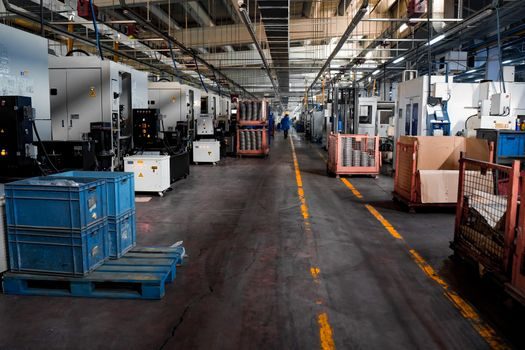
Choose a VSD when the process variable is speed itself and the load torque is roughly constant or follows a quadratic curve (pumps, fans, conveyors). Choose a planetary reducer when the load demands high torque at low speed (mixers, winches, extruder screws, slewing rings, robot joints) and the motor's natural speed is too high. The slewing drive reference, for example, is essentially a planetary reducer with an integrated slewing ring bearing, used in cranes, solar trackers and turret tables. [S1]
Choose both when the process needs both speed range and torque multiplication. A 4-pole 50 Hz induction motor turning at roughly 1450 RPM, fed by a VSD that pulls it down to 200 RPM, can still deliver only nominal torque; stacking a 10:1 planetary reducer behind it gives 20 RPM at the output shaft with the motor's full torque multiplied tenfold (minus stage losses). The ZERO-MAX adjustable mechanical drive is exactly this hybrid: a mechanical speed-change element combined with a gear reducer in one housing [S1][S2]. For 2026 line builds, the 3-gate selection logic on the VSD buy map is the cleanest way to lock the drive model code, and the helical reducer 2026 buying guide covers the mechanical side of the same shaft.
Operating Envelope and Limits
A VSD's output is bounded by the inverter's current rating, the DC-bus capacitor ripple limit, and the motor's thermal class. Running a standard induction motor below roughly 5–10 Hz without a separately forced fan risks overheating because the rotor's own fan loses effectiveness. The 460 V EMS CIMR-G3U47P5 listed at 10 HP / 15 HP rated load [S3] is a typical mid-bracket 3-phase unit, and pairing it with a small planetary reducer is a standard 2026 packaging solution on CNC spindles and conveyor drives [S4].
A planetary reducer's operating envelope is set by the gear teeth, the bearing arrangement, and the lubricant. Hardened tooth surfaces (HRC 58–62 is typical for carburised alloy steel) and synthetic grease fills extend the service interval; grease loss above roughly 60 °C continuous or water ingress above IP65 ratings is the most common failure mode [S6]. For servo-driven applications, a servo drive plus low-backlash planetary reducer is the de-facto axis package in 2026 robotics and machine-tool builds.
Failure Modes and Maintenance Signals
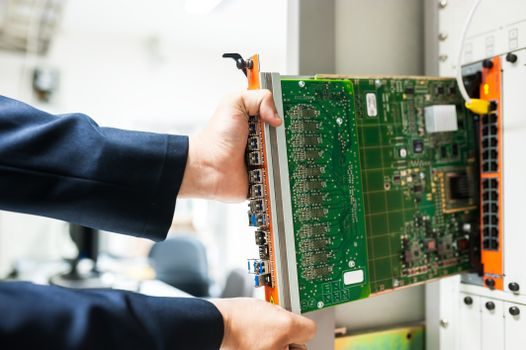
VSD failure modes cluster around the DC bus (capacitor drying, ESR rise, voltage ripple), the IGBT module (thermal cycling, gate-driver faults), and the cooling fan. A typical 7–10 year design life for the bus caps in a warm cabinet is industry-norm, and the first user-visible symptom is usually a DC-bus under-voltage trip on deceleration. The Johnson Controls VS4D series and the EMS CIMR-G3U series in 2025–2026 surplus channels [S3][S5] are mostly 10–20 year-old units removed for panel upgrades, not because the gear inside failed.
Planetary reducer failure modes are mechanical: planet-bearing spalling, ring-gear tooth fracture, seal leakage, and lubricant breakdown. A rising no-load current draw on the drive (visible on the VSD's monitor screen) is often the first signal that the gearbox is wearing, not that the VSD itself has a problem. For a more general mechanical-buying benchmark, the helical reducer 2026 guide lines up torque, ratio and mounting classes for cross-comparison.
Sourcing and Standards Context
2026 sourcing channels split cleanly: surplus and refurbished VSDs (Johnson Controls, Yaskawa/EMS, ABB, Siemens, Allen-Bradley) move through industrial-resale platforms with full model codes, and prices in 2025–2026 have remained soft on used 3–10 HP units [S3][S5]. New VSDs ship from Chinese suppliers like Boneng in single-phase 220 V 0.75 kW and three-phase 380 V 1.5 kW brackets, with negotiable MOQ from one piece [S4]. Planetary reducers in 2026 are dominated by hardened-tooth RV-series and precision servo-grade units from Jiangsu and Zhejiang manufacturers, sold direct with customisation and 1-piece MOQ on Made-in-China [S6].
Applicable standards for VSDs in industrial cabinets are the IEC 61800 series for adjustable-speed electrical power drive systems, with EMC and harmonic limits usually called out project by project; for planetary reducers the relevant reference is ISO 6336 for load-capacity calculation of spur and helical gears (planetary is treated as a special case under the same umbrella). Specific clause numbers and revision dates are deliberately not quoted here because they are not present in the source material and guessing them would put the wrong clause on the wrong product. Lock the topology first (VSD for speed range, planetary for torque multiplication, both for closed-loop servo axes), then lock the power bracket and the ratio, then match the supply class — that is the 2026 selection frame that survives contact with procurement.