
Hardwired mushroom-button E-stops on a category 1 stop circuit remain the default spec for fixed conveyor, sortation, and AS/RS zones in warehouses, while wireless radio E-stops are limited to roving material-handling or autonomous-mobile-robot (AMR) zones where running a cable is not practical, per a May 2026 machinery-safety note [S1].
Selection is driven by hazard severity, zone coverage, and the performance level (PL) demanded by ISO 13849-1, not by brand or aesthetics, and the same source flags that wireless E-stops should be specified only when wireless operation gives a genuine safety or operational benefit [S1].
ISO 13850 and the Three E-Stop Categories That Govern a Warehouse
ISO 13850 defines three stop categories that engineers must map before picking a device: category 0 is an uncontrolled immediate removal of power, category 1 is a controlled stop with power removal after the motion has decayed, and category 2 retains power while the machine holds its stop state [S1].
For most warehouse conveyors, palletizers, and stretch wrappers, category 1 is the workhorse choice because the drive is braked to zero through the controller before the contactor drops, which protects the VFD and gearbox from a hard stop. Category 0 is reserved for hazards where a controlled ramp-down cannot complete in time, such as a pinch point on a vertical lift or a clamp zone on a palletizer head. Category 2 is the rare case used when the safety function must hold a hydraulic clamp closed while the E-stop is active, and it requires a separate safety logic path to keep the clamp energized. Within the E-stop taxonomy, the emergency stop button is the actuator; the emergency stop function is the overall safety function, and that distinction matters when writing the spec.
Hardwired Mushroom-Button: The Default for Fixed Plant
For a fixed conveyor line running through a pick tunnel, a 30 mm or 40 mm twist-release mushroom, mounted at 0.6 m to 1.7 m above the floor, wired in series with a safety contactor and a force-guided relay block, remains the most defensible warehouse spec [S1].
Hardwired circuits give the designer deterministic fault detection: a broken wire trips the safety relay, and the line refuses to restart until the fault is cleared and the reset is pushed at a separate, supervised location. The wire run is also inexpensive relative to the panel space it occupies, which is why electrical contractors and safety consultants still default to it for new builds. The trade-off is operator reach: each station costs a pull-cable run, a junction box, and a multi-conductor tray, and that footprint adds up across a 100,000-square-foot distribution center [S2]. Across warehouse E-stop spec practice, hardwired circuits are the baseline reference design that wireless and bus-connected variants are measured against.
Wireless E-Stop: When the Cable Is the Real Hazard
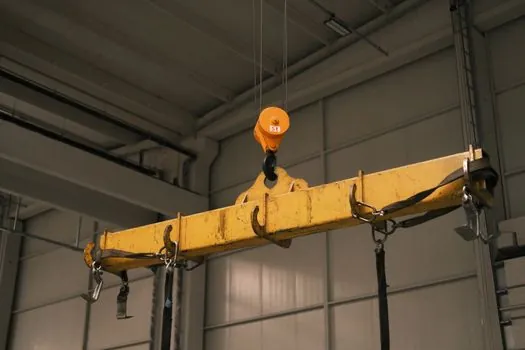
Wireless E-stops earn their place on roving reach trucks, order pickers, and AMR fleets where the operator moves faster than a fixed pull-cable can be rerun, per a 2026 machinery-safety note [S1].
A wireless E-stop transmitter on a vest or a truck dashboard sends a coded radio signal to a receiver wired into the machine's safety circuit; on loss of signal, low battery, or out-of-range fault, the receiver forces a category 0 or 1 stop, depending on programming. Latency budget for a safety-rated radio link is typically 50-200 ms end-to-end, which is fast enough for a roving operator but not for a high-speed sortation conveyor where 50 ms is the entire safety margin. Battery life on the transmitter is normally 1-3 years on a primary cell, and the receiver is usually powered from the machine's 24 VDC safety bus, which simplifies retrofit. The same source cautions that wireless E-stops should be selected only when wireless operation provides a genuine safety or operational benefit, and that warning is the reason most warehouses keep wireless as a supplemental, not a primary, layer [S1].
PL Rating and Risk-Graph Mapping per ISO 13849-1
ISO 13849-1 sets five performance levels (PL a through PL e) that map to the probability of dangerous failure per hour, and the warehouse spec must land on the right PL before a vendor shortlist is even opened. [S3]
For a low-speed accumulation conveyor with reversible jog and light guard, a PL c / category 3 architecture is usually sufficient; for a high-speed cross-belt sorter with a moving shuttle, the spec usually rises to PL d / category 3, and for a palletizer head with a clamp zone, PL e / category 3 or 4 is the defensible target. The risk graph in ISO 13849-1 uses severity (S1, S2), frequency of exposure (F1, F2), and possibility of avoidance (P1, P2) to push the required PL upward, and skipping that step is the most common audit finding. A safety relay or safety PLC with dual-channel input, cross-fault monitoring, and a force-guided output is the practical implementation for PL d and above, and that architecture is also the one that supports a clean reset sequence.
Reset, Lockout, and the Often-Missed Half of the E-Stop Function
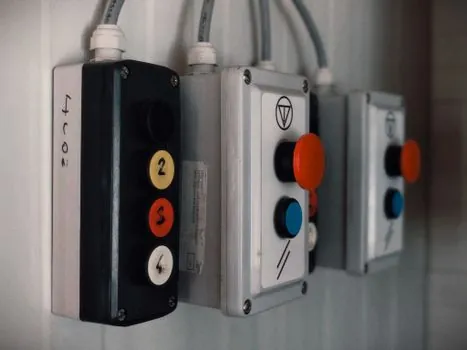
ISO 13850 mandates that an E-stop must not allow automatic restart on its own; reset must be a deliberate local action after the hazard has been verified clear, and this is the half of the E-stop spec that warehouses most often underspec. [S3]
The reset pushbutton must be located where the operator can see the safeguarded space, not at the panel door three aisles away, and it must be a separate, supervised input to the safety relay. Where multiple E-stops are chained on one machine, the safety logic should latch on the first activation and require a master reset at the control station, not at each individual station, so a partially cleared hazard cannot be bypassed by an operator at a different station. Lockout/tagout (LOTO) compatibility is also part of the E-stop spec: the contactor must accept a padlock through the main disconnect, and the E-stop itself should not be used as a substitute for LOTO during maintenance. For broader emergency rescue planning, the E-stop map is the same map the rescue team will use to locate a trapped operator, so naming and signage on every station is part of the spec, not an afterthought.
Integration With Conveyor, Forklift, and Picking-Zone Hazards
A warehouse E-stop map is typically layered by zone: each conveyor drive has a local pull-cable mushroom, each sortation intersection has a pedestal-mounted mushroom, and each loading dock has a wall-mounted unit paired with a hardwired interlock on the dock leveler.
Material-handling equipment, including forklifts, reach trucks, and order pickers, contributes the largest share of warehouse recordable incidents, and the pre-shift inspection list calls out brakes, warning lights, tires, forks, and battery condition as mandatory checks before the unit is released to the floor [S4]. The E-stop on a powered industrial truck is part of that pre-shift check, and a unit with a damaged, missing, or non-latching E-stop should be red-tagged out of service. For picking zones where pickers move on foot between pallet positions, the E-stop on a nearby conveyor or vertical lift module is the only fast-stop option available, which is why station placement density (typically one E-stop per 15-30 m of conveyor run) is a defensible design rule. A working spec also pairs the E-stop map with clearly marked, unobstructed emergency exits and inspected fire extinguishers, which are baseline warehouse safety controls independent of the E-stop hardware [S2]. For cross-referencing how the same E-stop spec plays out in a harsher environment, the mining E-stop spec guide shows the same PL d / category 3 baseline pushed to higher ingress and dust ratings.
Spec Comparison: Hardwired vs Wireless E-Stop at a Glance

On four decision criteria, hardwired and wireless E-stops line up as follows for a typical warehouse application.
First, determinism: hardwired gives a broken-wire fault in under one cycle; wireless gives a coded RF link with a 50-200 ms latency budget and a defined out-of-range behavior [S1]. Second, reach: hardwired requires a physical pull-cable or conduit run, so adding a station later is invasive; wireless adds a transmitter, with the receiver already on the machine. Third, power: hardwired draws from the machine's safety bus; wireless transmitters run on primary cells with 1-3 year life. Fourth, audit posture: hardwired is the default that safety auditors expect to see on fixed plant; wireless needs a documented justification for why hardwired is impractical, per the 2026 guidance [S1]. For fixed conveyor and AS/RS zones, hardwired wins on all four counts; for roving trucks and AMRs, wireless wins on reach and retrofit cost.
Common Audit Findings and Spec Pitfalls to Avoid
Three failure modes show up in nearly every warehouse E-stop audit: missing or unlabeled reset stations, E-stops wired as ordinary stop pushbuttons without safety-rated contact blocks, and wireless E-stops deployed as the only stop means on a fixed conveyor. [S2]
Reset stations are the single most common gap, because a working E-stop that cannot be reset from a safe vantage point is functionally a machine-down event, and operators will bypass it with tape or a zip-tie within a week. Wiring an E-stop into a standard pushbutton input on a PLC, rather than a safety relay or safety PLC input, removes the cross-fault monitoring that PL d requires and is a hard audit fail. Specifying wireless E-stops as the only stop layer on a fixed conveyor, where a hardwired mushroom would be straightforward, is a specification error that the 2026 guidance explicitly flags as unjustified [S1]. For pallet jack and stacker flows in e-commerce fulfillment, the same wiring-discipline rules apply; the electric pallet truck spec guide treats the E-stop as part of the pre-shift check, not an optional extra.
Spec Checklist Before Issuing a Purchase Order
Before releasing a PO on warehouse E-stop hardware, the spec should land on at least these six points: ISO 13850 stop category (0, 1, or 2), ISO 13849-1 PL target with a documented risk-graph result, reset station location supervised and visible from the safeguarded space, contact-block rating in force-guided (positively guided) style, IP rating matched to the zone (typically IP65 for washdown, IP54 for dry ambient), and a written justification if wireless is specified instead of hardwired. [S1]
Two more items are non-negotiable on a new build: a documented test of the E-stop function at commissioning, with a recorded test interval (typically every 12 months for PL d, every 6 months for PL e), and a label and signage plan on every station that matches the rescue team's floor map. Specifying emergency light coverage at each E-stop station is a related control that does not change the E-stop spec itself but does change the response time when the stop has been activated. With these points locked, the warehouse E-stop spec will pass both the safety audit and the practical test of an operator reaching the device in under one second from any point along the safeguarded run.