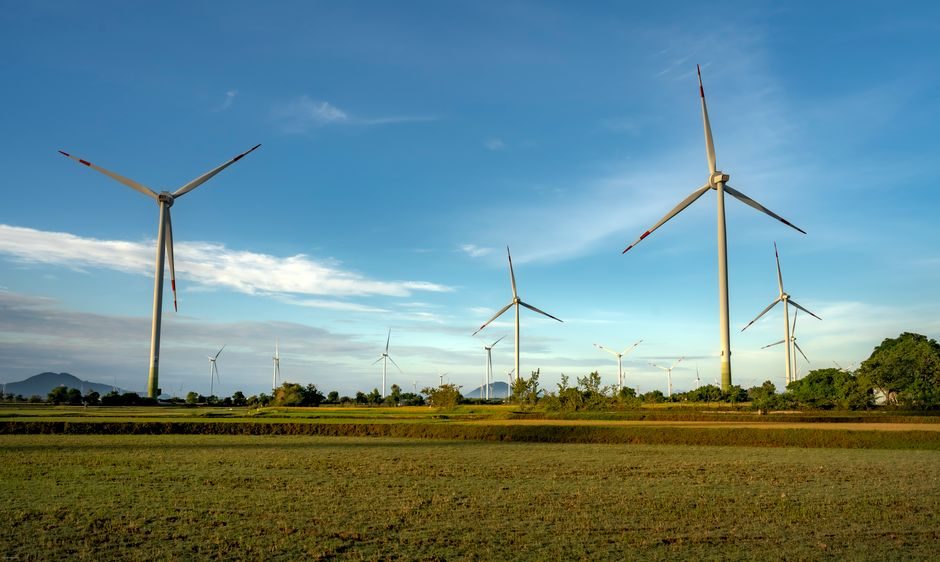
Smart manufacturing for utility-scale wind turbines shifted from pilot cells to multi-line deployment between 2024 and 2026, with Goldwind's smart-factory program and Vestas's global production network acting as the two reference implementations [S2][S6].
Scope now covers the full bill of materials: tower section welding robots, hub and nacelle assembly cells, blade root drilling and grinding stations, generator stator winding, and the drivetrain test bed, with the supply chain extending from Jiangsu and Guangdong SME suppliers to offshore-focused OEM plants [S4][S5][S8].
Digital-Twin and Virtual-Factory Architecture
Digital-twin virtual-factory frameworks demonstrated in 2021 multi-product pilots used real-time shop-floor telemetry, MES integration, and synchronized 3D models to compress commissioning cycles on new turbine variants [S7]. The architecture remains the backbone of 2026 wind-turbine smart factories because nacelle assembly, with its mix of long-lead forgings, large bearings and high-torque bolting, cannot tolerate rework once the rotor is mated to the hub [S2].
Goldwind publishes a smart-manufacturing stack that ties intelligent quality management standards to a green supply chain, with the equipment page updated as of 2026-06-11 listing factory-side automation as a core differentiator [S2]. The implementation pattern matches the multi-product, multi-line twin model: one simulation asset is reused across GW155-4.5 MW, GW171-6.7 MW and offshore platform variants, which keeps the engineering change order process on a single digital backbone [S2][S7].
Hardware Cells on Tower, Blade and Nacelle Lines
Automated tower welding cells typically combine twin-arc submerged-arc welding heads, seam-tracking laser sensors, and a 6-axis handling robot that loads 40-80 mm thick conical sections in a single fixture; this cell layout has been the workhorse of Chinese tower production since the 11th Five-Year Plan period (2006-2010) and is now standard for export-grade conical sections [S1]. Blade root drilling and grinding stations handle the 60-100 m blades used on 8-15 MW offshore units, with automated boring accuracy held inside the sub-millimetre band the bolted root interface requires [S1][S2].
Hub and nacelle assembly uses AGV-fed tooling with torque-controlled multi-spindles rated to 4 000-12 000 Nm, paired with laser-guided alignment of the main shaft to the gearbox housing; the bearing preload, critical for main-shaft life, is set and recorded automatically rather than by hand, which has become a procurement gate for tier-1 OEMs [S2][S6]. Generators assembled on these lines range from 1 kW permanent-magnet units in the Wuxi Rexco vertical-axis range (US$1 000-1 200 per set FOB China, MOQ 1 set) to multi-megawatt doubly-fed and PMG drivetrains for onshore and offshore platforms [S8].
Quality, Sensors and the MES/IIoT Layer
Smart quality management covers three data streams: in-line torque-and-angle records from each bolted joint, vibration spectra from drivetrain test beds, and blade surface defect imaging on the paint-and-finish line [S2]. Chinese OEM literature points to AI-driven vision catching surface cracks, leading-edge erosion and lightning-receptor damage at line speed, replacing the older manual inspection pass that depended on operator experience and ambient lighting [S2]. ISO 9000 / ISO 9001 certification remains the documented floor for factories such as First Wind Turbine Manufacturing in Zhongshan, with management-system audits updated against the smart-factory KPI set on top of the base standard [S5].
Instrumentation density per nacelle is the most visible change since 2023: each modern turbine carries a dense sensor package whose signal conditioning flows back to a turbine-level controller and a plant-level SCADA hop; this is the same architectural pattern used in process plants where pressure transmitters feed into plant historians, so the IIoT stack is largely reusable across industries [S1][S2]. On the test bench, smart meters and smart valves are the next step the Chinese supplier base is chasing, since hydronic and pneumatic test loops for gearbox and hydraulic systems still sit on legacy analogue hardware in many tier-2 plants.
Material and Process Bottlenecks
Wind-turbine manufacturing pulls on three materials that are themselves automation-sensitive: electrical steel for generators, structural steel for towers, and copper for power cables and busbars. The grid-side wiring harness inside a 6-15 MW nacelle carries thousands of kilograms of copper, and automated cutting, crimping and routing of that harness is one of the highest-ROI robotic tasks; for buyers who are also evaluating copper sourcing, the Copper Material Buying Guide 2026 walks through grade, form and spec choices that map directly onto nacelle and tower-internal wiring [S1][S2].
Carbon steel selection is the upstream gate for tower and foundation flange production, with plate grade, CEV and impact toughness picked against the turbine class; buyers and process engineers can benchmark against the broader Carbon Steel Selection Criteria reference when auditing Chinese plate mills. Process bottlenecks today sit less in welding and more in transport: an 80-90 m blade is too long for most overland corridors, so the smart-factory KPI set now includes logistics simulation in the same digital twin that drives the assembly line [S7].
Comparison: Mainline vs Distributed Manufacturing Models
Two models dominate in 2026. Model B is the distributed network of tier-2 suppliers in Jiangsu, Guangdong and Inner Mongolia, where SME factories make sub-assemblies — controllers, small PMGs, vertical-axis turbines in the 1-20 kW range, solar-pump inverters — and ship to the OEM hub; capex is low and lead time is short, but MES integration is patchy and quality data is harder to harmonise [S4][S5][S8].
Selection rule: if the buy is a multi-MW utility turbine, the centralized mega-plant wins on cost, traceability and adherence to ISO 9001 plus the OEM's smart-factory KPI set; if the buy is a 1-20 kW small wind or hybrid solar-pump system, the distributed supplier model is faster and cheaper, with vertical-axis maglev units from Wuxi Rexco delivered at US$1 000-1 200 per set FOB and PMG wind-solar inverters shipped from Zhongshan [S5][S8]. For buyers weighing broader factory automation, the Mesh Belt Conveyor Buying Guide 2026 and the Chain Conveyor Price and Cost Guide 2026 cover the material-handling backbone that sits underneath both assembly models.
Standards, Certification and Failure Modes
Smart factories do not replace certification; they make it auditable. ISO 9001 covers the documented quality system, the IWAMA workshop series (2020 edition, Springer Nature) sets the research direction for advanced manufacturing and automation, and individual turbine certifications (DNV type certificate, IEC 61400 design series) gate the final product off the line [S3][S5]. Buyers should ask for the certification IDs and for a sample of the MES data export that the OEM uses internally, not just a marketing brochure [S2][S5].
Failure modes to track: misalignment between the digital-twin model and the physical line (a common issue during fast variant changeover), sensor drift on the torque-and-angle wrenches that quietly loosens bolted-joint reliability, and under-specification of the AGV fleet that creates flow starvation at the drivetrain test bed [S7]. Comparable instrument-density issues appear in process-plant automation, where the turbine flowmeter, the smart camera and the additive-manufacturing-material feed each have a calibration and traceability chain that buyers can audit; the same discipline applies to wind-turbine assembly cells [S7].
Supply Chain and Buyer-Side Checklist
For a buyer evaluating a Chinese wind-turbine supplier in June 2026, four checks separate a smart-factory tier-1 from a tier-2 workshop: (1) the supplier publishes a smart-manufacturing or green-supply-chain page with concrete KPIs, not generic slogans [S2]; (2) the factory holds ISO 9001 and lists the actual certification scope, including the wind-turbine product families [S5]; (3) the supplier's product range matches the buy's need — multi-MW utility nacelle, 1-20 kW PMG, or VAWT maglev — and the listed price band is consistent with market norms (US$1 000-1 200 per set for 1-3 kW PMG as published in June 2026) [S8]; (4) the supplier can deliver a digital-twin or MES export as part of the technical file, not just a CAD model [S7].
Suppliers that pass all four include Goldwind for utility-scale onshore and offshore, Vestas for global multi-MW programs, and the Guangdong/Jiangsu SME cluster for sub-megawatt, hybrid solar-pump and small-wind applications [S2][S4][S5][S6][S8]. The IWAMA 2020 proceedings (Springer) remain the standard academic reference for advanced manufacturing and automation research direction, and a follow-up to that series is the place to watch for the next round of digital-twin and AI-quality-control results on the wind side [S3].