Electrodialysis is an electrically driven desalting process in which dissolved ions migrate through ion exchange membranes under a direct current field: a stack alternates cation and anion selective membranes with flow spacers, and as feed water flows through the alternating cells, ions are pulled out of the dilute compartments into adjacent concentrate compartments, delivering a desalted product and a concentrated brine from the same stack. In electrodialysis reversal, EDR, the DC polarity, and with it the dilute and concentrate streams, is reversed on a cycle of several times per hour, flushing scale forming salts off the membrane surfaces and letting the process run at high recovery on waters that would blind a pressure membrane. Veolia Water Technologies' electrodialysis reversal systems are representative industrial catalogs, and this page treats the complete ED or EDR stack and its power and hydraulic plant as the purchasing object.
This page is written for the engineer specifying electrodialysis for brackish water desalting, industrial water reuse, or selective salt removal. It works through what the stack actually does and what is being bought, how the membranes and the DC field do the work, which configurations fit which duties, the parameters that appear on vendor data sheets, and the selection factors and RFQ language that decide whether the installed plant holds its product quality and recovery for a membrane life measured in years.
The decision concentrates in five places: the feed's ionic composition and its scaling and fouling character, the product salinity and recovery targets, the stack and spacer configuration that carries them, the current density and voltage regime that drives them, and the pretreatment and reversal strategy that keeps membranes clean. Get those right and the stage count, power supply, and hydraulic sizes follow.
Chapter 1 / 06
What Electrodialysis Is and What Is Being Decided
The machine this page describes is an electrodialysis stack and its balance of plant. The stack clamps hundreds of membrane pairs between electrode end blocks: a cell pair is a cation exchange membrane, a dilute spacer, an anion exchange membrane, and a concentrate spacer, repeated up to several hundred times between the anode and cathode compartments. Feed streams are manifolded so that one feed becomes the dilute stream in one set of cells while a second feed becomes the concentrate in the alternating set; a rectifier supplies DC across the electrodes, and ions move, cations through cation membranes and anions through anion membranes, each direction gated by membrane selectivity, so salt leaves the dilute stream and enriches the concentrate.
What is being decided when an electrodialysis plant is purchased is a desalting duty at a stated recovery with a stated energy and membrane life. The buyer is purchasing a product stream at a target salinity and a concentrate volume the site can dispose of, at a direct current energy that scales with the salt removed, roughly, and with membranes and electrodes whose life, commonly five to ten years in well run plants, is the capital refresh cycle. Everything on the vendor data sheet, membrane pair count, stack area, voltage and current rating, recovery, polarity reversal provisions, exists to support those guarantees, and the honest vendor sizes from the complete feed analysis including the scaling ions, not from conductivity alone.
Electrodialysis sits in the desalting family with defined neighbors. It is not reverse osmosis, which pushes water through a pressure membrane and rejects salt with it; ED moves the salt and lets the water stay, so energy scales with salt removed rather than water volume, the fundamental economic division between them. It is not electrodeionization, which stacks ion exchange membranes and mixed bed resin together to polish already dilute water to ultrapure; EDI works at trace salinity, ED at gram per liter salinities. It is not nanofiltration, which separates by charge and size under pressure at much lower salt passage selectivity, and it is not a water softener or an ion exchange train, which swap or capture ions on resin and pay regenerant or brine. Each neighbor owns a salinity band; ED owns moderate brackish desalting at high recovery.
Different buyers buy the same stack for different reasons. A inland municipality buys EDR to desalt a brackish well at 80 plus percent recovery where RO's concentrate volume would be a disposal problem. A power station buys ED to partially desalt a cooling tower blowdown for reuse, moving salt out at a fraction of the water volume. A food plant buys ED to de acidify or de mineralize a juice or whey stream, moving the targeted ions while sugars pass. A dye or textile operator desalts a process brine for recycle. A greenhouse or irrigation scheme buys EDR for sodium control on a moderately saline source. The specification language differs, but the membrane physics is shared.
The economics deserve their own paragraph because ED's energy scales with salt moved, not water treated. At low to moderate salinity, ED's energy competes strongly with RO; at high salinity, RO's pressure wins; and at very high recovery, EDR's scale tolerance wins against everything. On the cost side stack membrane replacement is the refresh, electrode life the second watch item, and the rectifier and pumps the power bill; against those stand high recovery, chemical free scale tolerance, and long membrane life at high recovery. The honest comparison prices energy per cubic meter at the target salinity and recovery, concentrate disposal volume, and membrane life together, and the conductivity number alone prices none of it.
A short tour of named duties makes the plant concrete. At a brackish well works, 2500 ppm TDS feed runs through a two stage EDR train at 85 percent recovery to a 400 ppm product. At a power station, cooling blowdown at 4000 ppm desalts at 75 percent recovery with the concentrate returning to the pond. At a whey plant, ED de minerals a lactose stream stage by stage to a food specification. At a textile recycler, a process sodium sulfate brine desalts for loop reuse. Each duty names the same knobs, pair count, current, recovery, and reversal, with numbers that scale while the membrane pair barely changes.
Chapter 2 / 06
How the Membranes and the Field Do the Work
The mechanism is ion migration under an electric field, gated by membrane selectivity. The cation exchange membrane carries fixed negative charge and passes cations while blocking anions; the anion membrane mirrors it. In a cell pair under DC, the cations in the dilute stream move toward the cathode through the cation membrane into the concentrate cell, and the anions move toward the anode through the anion membrane into the same concentrate cell, so both ions of a salt pair arrive in the concentrate and the dilute stream loses salt. Water stays where it is; nothing is pushed through a membrane, which is why there is no osmotic pressure penalty and why recovery is a hydraulic choice rather than a pressure limit.
Current density and the limiting current set the operating window. The current, amperes through the stack, is proportional to the salt removal rate by Faraday's law, and the current density, amperes per square meter of membrane, is pushed as high as the dilute stream's ion transport to the membrane surface allows; above the limiting current, water splitting at the membrane surface changes local pH and wastes power scaling the surface. Design runs at a fraction of limiting, and as the dilute stream desalts along its path, the limiting current falls, which is why stacks stage, with later stages running lower current on lower salinity. Voltage per cell pair, stack voltage divided by pair count, is the efficiency gauge, rising as membranes age and foul.
Polarity reversal is EDR's signature move and its scale tolerance secret. Every 15 to 30 minutes in classic practice, the DC polarity reverses, and the dilute and concentrate manifolds switch with it: the cells that were concentrate become dilute and vice versa, and the freshly precipitating scale layer that was building on the concentrating side is suddenly on the flushing side and leaves with the new concentrate. A brief off specification crossover is routed to waste at each reversal, a few percent of product. The result is that EDR runs waters with gypsum and carbonate scaling tendency at recoveries and without the antiscalant chemistry that RO needs, a whole category of feed water that pressure membranes struggle with.
Stack hardware and hydraulics do the carrying. Spacers, turbulizing mesh screens a millimeter or so thick, keep the streams thin and mixed so ions reach the membranes, and their design sets both mass transfer and pressure drop per stage; manifolds at the stack faces distribute the parallel cells, and their seal integrity is what keeps dilute and concentrate apart. Flow velocity through the cells is held in its window, high enough to control concentration polarization, low enough to keep pump power honest, and stage count plus pair count per stage convert the salinity duty into hardware. Electrode compartments circulate an electrode rinse stream that carries the electrode reaction products, hydrogen at one end and oxygen or chlorine chemistry at the other, away from the stack.
What ED does not remove is as important as what it does. Poorly ionized species, silica, boron in its uncharged form below pH 9, many organics, and neutral molecules pass largely untouched, because only ions feel the field; suspended solids and oil foul the spacers and need pretreatment out; and gases pass with the water. Selectivity also has ranking: divalent ions migrate and carry differently than monovalents, and special selective membranes trim the spectrum, monovalent selective classes for nitrate or chloride control duties. The specification should name the ions that matter and expect removal quoted per ion, not as a conductivity percentage.
Monitoring and control close the loop. Product and concentrate conductivity trend the desalting, stack voltage per stage at constant current is the fouling and aging gauge, and electrode rinse pH and chlorine signal the electrode compartment health. Reversal timing, flow rates, and current setpoints are the operating levers, and a plant that trends stage voltage catches spacer fouling or scale beginning months before product quality moves. An ED stack that is not trended is a stack whose end of life will arrive as a surprise in the voltage, not the water.
Chapter 3 / 06
Stack Types, Reversal Modes, and Duty Boundaries
Configuration choice begins with reversal mode and staging. Conventional ED runs fixed polarity with dilute and concentrate streams assigned permanently, suiting clean, low scaling feeds and continuous product with no reversal crossover waste; EDR reverses polarity and streams on a timer, buying scale tolerance and chemical free operation at the cost of the crossover waste stream and three way valves at every reversal. Staging then converts the duty: salt removal per pass is set by current and residence, so salinity ratio targets stack stages in series, each with its own current and flow regime, and large plants parallel trains of identical stacks. Between them, the choice is feed scaling character and tolerance for the reversal waste, nothing else.
Configuration
Typical duty
Character
Conventional ED
clean, low scaling feed
Continuous, no crossover waste
EDR, reversal on timer
scaling brackish waters
Scale flushing, high recovery
Multi stage train
deep desalting ratio
Current stepped down per stage
Selective membrane stacks
nitrate, chloride trim
Ion ranked removal
Food and pharma stacks
juice, whey demin
Sanitary materials, low temp
Duty boundaries keep the selection honest. ED is not a seawater desalination machine: at tens of grams per liter, the current densities and energy put RO and distillation ahead. It is not an ultrapure polish: below roughly 50 to 100 ppm TDS the economics hand the duty to electrodeionization with its resin filled dilute cells, or to mixed bed polishing. It is not a suspended solids or organics barrier: cartridge filtration and often a multimedia filter or ultrafiltration guard the spacers, and oil and grease must be absent. Within its band, moderate brackish salinity, high recovery, scale tolerant duty, it is the machine the others are measured against.
Where it sits in the plant matters as much as the stack. Upstream, a multimedia filter or cartridge guards the spacers, a activated carbon filter protects organics sensitive stacks from oxidant and organics, and acid or antiscalant may still trim the worst carbonate cases even under reversal. Downstream, product may feed a reverse osmosis train in hybrid chains where ED roughs the salt and RO finishes, or a mixed bed polisher where higher purity is demanded, and the concentrate goes to evaporation ponds, sewers, or process reuse by the site's disposition. The ED purchase should draw its battery limit around stacks, power, hydraulics, and the pretreatment interface explicitly.
Materials and hydraulics round the configuration. Stacks run in housings and frames of engineering plastics and stainless hardware, membranes as sheet goods clamped between electrodes with tie rods; pumps are low pressure, the stack pressure drop is a bar or two, nothing like RO; and piping in PVC or stainless follows. The rectifier is the electrical heart, sized on stack voltage and current with the reversal switching gear, and its location, cooling, and power factor correction belong in the electrical scope. None of it is exotic; all of it is scope that sits between the membrane vendor and the water plant.
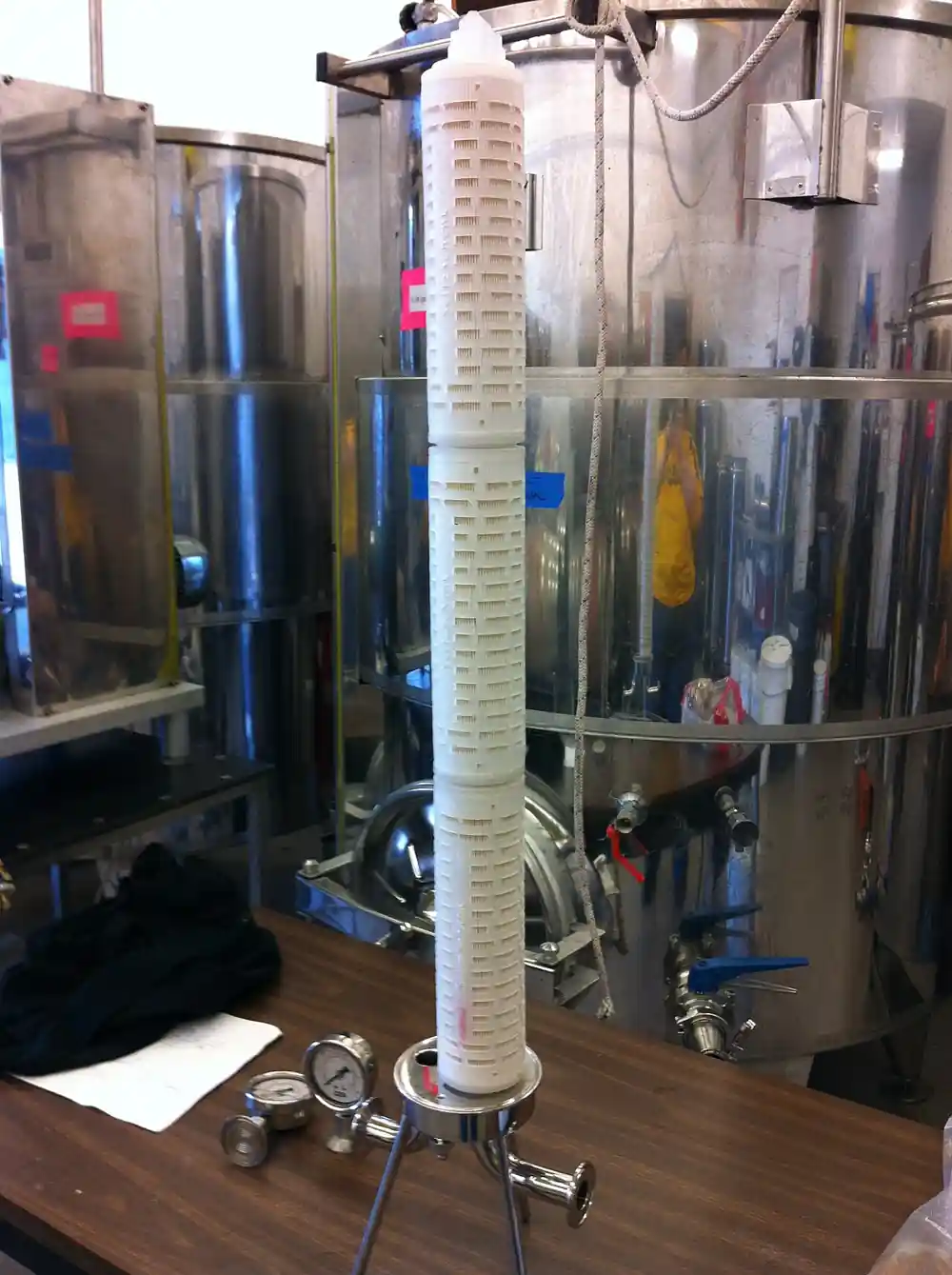
Pretreatment hardware deserves its own paragraph because the stack's spacers are unforgiving. The standard train runs feed through a multimedia filter or cartridge stage, and on difficult waters an ultrafiltration stage ahead of the cartridges extends their life; a precision filter class cartridge guard immediately upstream of the stacks is the last barrier before the spacers. Turbidity is trended with a turbidity meter because rising feed turbidity is the leading indicator of spacer fouling, seen weeks later as stage voltage creep, and iron is held below its limit by the standard oxidation and filtration chain. Oxidant management is gentler than in polyamide pressure membranes, but the vendor's limit stands and the dechlorination step, where fitted, belongs on the same drawing set. The plants that reach a decade on one membrane set are the ones that treated pretreatment as part of the electrodialysis purchase, not as an existing plant's charity.
Chapter 4 / 06
Key Specification Parameters
The data sheet parameters fall into four groups: desalting, electrical, hydraulic, and life. Desalting parameters are salt removal per pass or train, percent or ppm, quoted per major ion where the duty cares, with the product and concentrate salinities at stated recovery. Electrical parameters are stack voltage per cell pair or per stage at rated current, rectifier rating, and specific energy, kilowatt hours per cubic meter or per kilogram of salt removed. Hydraulic parameters are feed, dilute, and concentrate flows per stack, pressure drop, and the reversal crossover waste fraction on EDR. Life parameters are membrane life years, electrode life, and stack rebuild intervals. A quotation that quotes a percent desalting without the ion basis and recovery is not comparable to one that states them.
Parameter
Typical range
Design note
Feed salinity fit
500-8000 mg/L TDS class
The ED economic band
Desalting per stage
40-60% of feed salinity
Stages stack the ratio
Recovery
75-90%+
EDR scale tolerance high
Cell pairs per stack
100-600
Area per pair sets current
Current density
below limiting
Fraction of limiting current
Stack voltage per pair
1-3 V typical
Rises with fouling and age
Specific energy
scales with salt moved
kWh per kg salt removed
Reversal cycle
15-30 min EDR
Crossover waste a few %
Membrane life
5-10 yr
Pretreatment and reversal govern
Specific energy and recovery deserve explicit numbers in every specification because they are the contract. The vendor should state energy per cubic meter of product at the stated feed analysis, salinity ratio, and recovery, with the reversal waste included on EDR, and the buyer should compare against the RO alternative on the same water at the same recovery, including the concentrate disposal volume difference. Energy in ED tracks the salt moved, so a feed analysis shift moves the guarantee; the honest quotation states its analysis basis and offers correction factors, and the dishonest one quotes a laboratory water.
Standards and water compliance ride the application. Drinking water component certifications govern membranes, spacers, and stack materials on potable duty; food contact regulations govern whey and juice stacks; and electrical standards govern the rectifier and reversal switching installation. Performance verification follows accepted electromembrane practice, product and concentrate sampling over a stated run with currents and voltages logged, and the acceptance test belongs in the specification. None of these are exotic; the potable materials scope is the one most often left vague until procurement.
Chapter 5 / 06
Selection Decision Factors and RFQ Language
Selection starts from the water analysis and the targets, written as ions and volumes. The designer needs the complete ion analysis with silica, iron, and organics, the seasonal ranges, the product salinity target per ion where it matters, the recovery or concentrate volume constraint that often drives the whole choice, and the power price. From that basis, ED against RO against hybrid, reversal mode, and stage count follow with little freedom. An RFQ with only conductivity invites vendors to quote the salinity they remember, and the correction factors will not be kind.
Duty driver
Favored configuration
Watch item
Brackish well, high recovery
EDR train
Concentrate disposal volume
Blowdown or reuse desalting
EDR at 75% plus
Silica and organics pretreat
Partial desalt ahead of RO
ED roughing hybrid
Two technologies one owner
Food stream demineralization
sanitary stack
Materials, low temperature limits
Selective ion trim
selective membranes
Per ion removal guarantee
Pretreatment selection is the second decision and it is decided by the spacer's tolerance. Suspended solids and oil foul spacers, so cartridge filtration, commonly 5 to 10 micrometers, is the minimum with a multimedia filter or ultrafiltration on difficult feeds; iron and manganese oxidize and deposit on membranes and are held below their limits by the standard water treatment chain; chlorine is tolerated by ED membranes far better than polyamide RO, which simplifies disinfection management, though the vendor's limit stands. Scaling, the RO obsession, is EDR's strength, but extreme gypsum waters still stage recovery against the concentrate saturation honestly. The pretreatment line belongs in the ED purchase scope, not in a later change order.
The RFQ language that returns comparable offers states the analysis and the guarantees demanded. State the full ion analysis with ranges, feed volume, product salinity target per key ion, required recovery and concentrate disposition, electrical basis and power price for energy comparison, potable or food materials scope, and the acceptance test regime with ion by ion verification. A complete RFQ paragraph reads: brackish well at 2400 mg/L TDS per attached analysis, product below 450 mg/L with sodium below 150, recovery 85 percent with concentrate to evaporation pond, EDR acceptable with reversal waste under 4 percent of product, energy quoted per cubic meter at these conditions, potable certified materials, performance test over 72 hours with per ion sampling.
Commercial comparison is only fair on a normalized basis. Offers should be forced onto one table: product salinity per ion at stated recovery, specific energy with reversal waste included, stack and stage configuration, membrane and electrode life with replacement pricing, pretreatment scope offered, materials and certification scope, delivery, and the initial spares. The cheapest offer is very often the one quoted at the lowest recovery or the friendliest analysis, and its operating cost lands in energy and concentrate disposal; the table that prices energy per cubic meter at the actual recovery is the one that tells the truth.
Lifecycle questions close the selection. What membrane and electrode life the vendor commits to at this water and what a stack rebuild costs and takes; what stage voltage trend predicts the rebuild; how the plant rides a feed upset, a turbidity event, an iron spike; and what the reversal waste costs in product volume at the site's water price. An ED purchase is a membrane decade, and these questions are the difference between a decade of desalting and a decade of excuses.
Chapter 6 / 06
Installation, Standards, Failure Modes, and Maintenance
Installation is an electrical and mechanical plant erection. Stacks set on their frames with hydraulic connections manifolded per stage, the rectifier and reversal switching installed to electrical standards with cooling and power factor attention, pumps and pretreatment tied in, and the electrode rinse system commissioned with its chemistry. Commissioning verifies stack integrity, current versus voltage curves per stage against the vendor baseline, reversal valve sequencing and crossover routing to waste, and then a performance run at design conditions with per ion sampling. The stage by stage voltage baseline recorded now is the machine's health chart for the decade.
Failure modes have a known hierarchy. Spacer and membrane fouling by suspended solids or organics leads, showing as rising stage voltage at constant current and slowly falling desalting; scaling, where reversal cannot fully keep up, shows the same signature and is checked by stack autopsy or cleaning response; electrode wear and electrode rinse chemistry drift degrade the end compartments and show in rinse pH and chlorine; manifold internal leakage blurs the streams and shows as product salinity floor that will not fall; and electrical faults, rectifier or reversal switching, stop the train outright. Nearly all announce themselves in the voltage and conductivity trends before the product visibly fails.
Symptom
Likely cause
First response
Stage voltage rising
fouling or scaling
Trend review, clean per vendor
Desalting falling
current limit or fouling
Verify limiting current, clean
Product floor above target
internal leakage
Stack pressure test, rebuild
Rinse pH or chlorine drift
electrode compartment
Rinse chemistry audit
Reversal valve fault
actuator or sequence
Recommission valve logic
Cleaning and maintenance are gentle by membrane standards. In place cleanings with mild acid and alkaline solutions per vendor procedure restore fouled stacks on schedule suggested by the voltage trend; electrodes renew at their hour or year limits, a planned stack end service; spacers and membranes renew at the multi year rebuild, with stack reassembly by trained crews because pair alignment and gasketing decide the next five years. The day to day items are filter cartridges upstream, calibration of the conductivity and flow instruments the trends depend on, and the reversal valve actuators, which cycle a hundred times a day and deserve their own maintenance line.
Operational stewardship is what the purchase actually bought. Operators who trend stage voltage, recovery, and per ion product quality, who keep the pretreatment honest, and who clean on the voltage signature rather than the calendar, run EDR plants to their membrane life predictions; operators who ignore the voltage trend discover fouling as a product excursion and pay for it in rebuilds. The trend board, stage voltage, current, recovery, product conductivity, is the stack's real contract, and reading it weekly keeps a quiet machine from becoming a quiet failure.
The commercial table deserves the maintenance decade priced into it. A stack rebuild renews spacers and membranes at the five to ten year mark, and its cost and downtime belong beside the initial price; electrode renewal runs on its own shorter schedule and is a planned end service; the reversal valve actuators cycle hundreds of times a day and deserve their own spares line; and the rectifier's efficiency and cooling define the plant's electrical operating cost for the same decade. Offers should be compared on energy per cubic meter at the actual recovery, membrane and electrode life with replacement pricing, pretreatment scope, and the instrumentation package that makes the guarantees witnessable. The cheapest stack quoted at the friendliest analysis is the most expensive plant by the first rebuild, and the bid table that prices the decade is the only honest one.
FAQ
What is the difference between electrodialysis and reverse osmosis?
Reverse osmosis pushes water through a pressure membrane and leaves salt behind, so its energy scales with pressure and water volume; electrodialysis pulls the salt out through ion exchange membranes under a DC field and lets the water stay, so its energy scales with the amount of salt removed. ED wins on low to moderate salinity feeds and at high recovery, RO wins on high salinity and total dissolved solids removal, and hybrid chains use ED to rough the salt and RO to finish. EDR's polarity reversal also adds scale tolerance RO does not have.
What does electrodialysis reversal do?
EDR reverses the DC polarity every 15 to 30 minutes and switches the dilute and concentrate streams with it, so any scale layer beginning on the concentrating membrane face is suddenly on the flushing side and is swept out with the new concentrate. A short crossover stream off specification is routed to waste at each reversal. The result is scale tolerant operation at high recovery, often 80 to 90 percent, on brackish waters that would need heavy antiscalant chemistry in a pressure membrane.
What can electrodialysis not remove?
Poorly ionized and neutral species pass largely untouched: silica, boron below pH 9, many organics, and dissolved gases. Suspended solids and oil foul the spacers and must be removed by pretreatment. And electrodialysis is not a microbiological barrier. Specify removal per ion for the ions that matter, and remember that uncharged contaminants need a different step in the chain.
How much energy does electrodialysis use?
Energy scales with the salt removed, typically quoted as kilowatt hours per cubic meter of product or per kilogram of salt, and at brackish salinities it commonly lands below the RO alternative on the same water, especially at high recovery where RO concentrate disposal energy counts. The honest comparison needs the full feed analysis, the salinity ratio, and the recovery, because a shift in any of them moves the number; vendors should quote specific energy with those bases stated.
What pretreatment does an ED stack need?
Cartridge filtration at roughly 5 to 10 micrometers as the minimum, with a multimedia filter or ultrafiltration ahead on difficult feeds, because spacers foul on suspended solids; iron and manganese held below their limits by oxidation plus filtration or sequestration upstream; oil and grease absent; and chlorine generally tolerated far better than by polyamide RO membranes, though the vendor's limit governs. Scaling needs are mild under reversal, which is the technology's signature advantage.
How long do electrodialysis membranes last?
Five to ten years is the common band in well run plants, set by pretreatment discipline, reversal operation, and cleaning practice; electrodes renew on their own shorter schedule, a planned end service. The aging gauge is the stage voltage at constant current, which rises as membranes foul or degrade, and the trend is what turns replacement from a surprise into a project. A stack rebuild renews spacers and membranes and is a crew skill item; pair alignment and gasketing decide the next five years.
Can electrodialysis reach ultrapure water quality?
No; that is electrodeionization's job. ED works economically in the brackish band down to product salinities of a few hundred ppm, but below roughly 50 to 100 ppm the dilute stream's conductivity cannot carry the current efficiently, and EDI, which fills the dilute cells with ion exchange resin to conduct at trace salinity, or a mixed bed polisher after RO takes over. Plants chain them: ED or RO for the bulk salt, EDI or polish for the trace.