A water softener is an ion exchange unit that removes hardness, the calcium and magnesium that scale pipes, boilers, and membranes, by passing water through a bed of strong acid cation resin in the sodium form: calcium and magnesium ions bind to the resin and sodium releases in their place, so the water leaves soft, with the same total dissolved solids redistributed rather than removed. When the resin's exchange sites are exhausted, the vessel regenerates with brine, sodium chloride solution displacing the collected hardness to drain, and returns to service; duplex and multiplexed trains alternate vessels so softened water flows continuously. Purolite's softening resins and DuPont's AmberLite cation lines are representative catalogs, and this page treats the complete softening train, vessels, resin, brine system, and controls, as the purchasing object.
This page is written for the engineer specifying industrial water softening for boiler feed, cooling makeup, reverse osmosis and electrodeionization pretreatment, or process water. It works through what the vessel does and what is being bought, how the resin and the brine do the work, which configurations fit which duties, the parameters that appear on vendor data sheets, and the selection factors and RFQ language that decide whether the installed train holds its hardness leakage through years of regeneration cycles.
The decision concentrates in five places: the feed hardness, flow, and the leakage target that set resin volume; the regeneration direction, co current or counter current, that sets salt efficiency and leakage; the brine system and salt logistics the site can sustain; the train architecture, simplex to multiplex, that matches the continuity demand; and the upstream protection, iron, chlorine, and turbidity, that guards the resin. Get those right and the vessel count, resin bed, and controls follow.
Chapter 1 / 06
What a Water Softener Is and What Is Being Decided
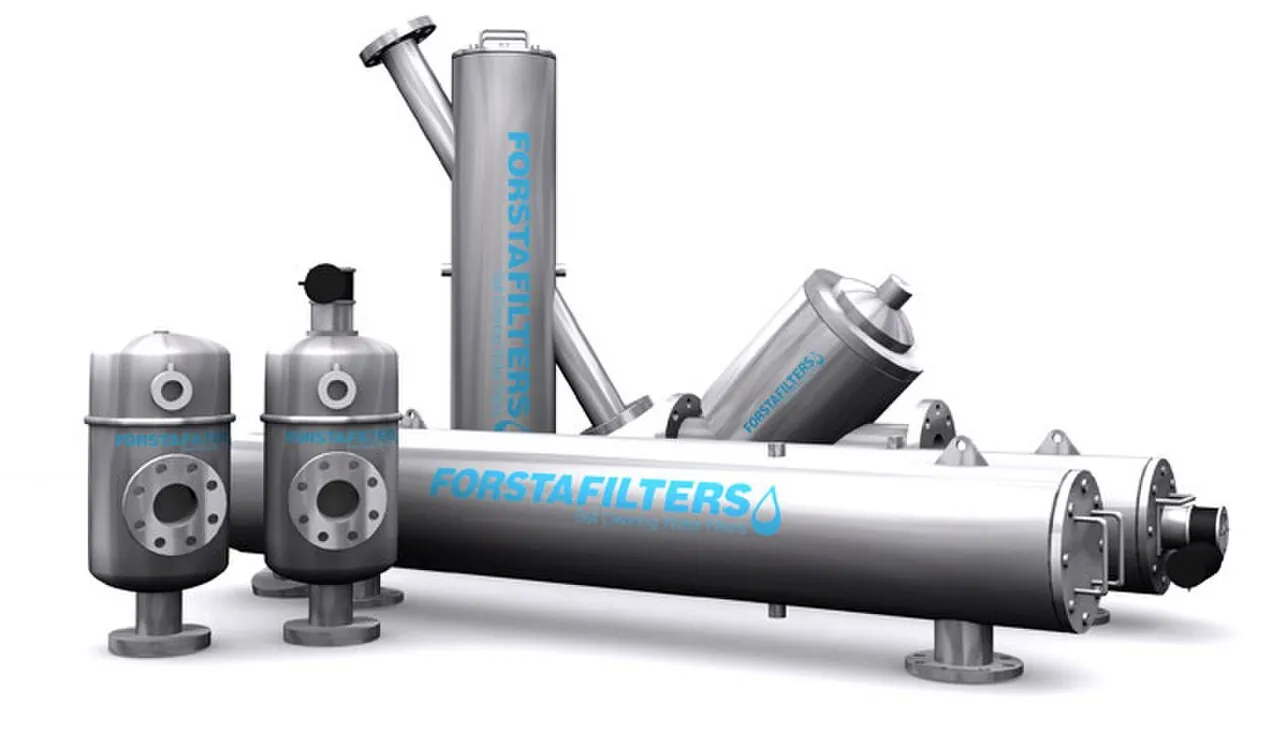
The machine this page describes is a pressure vessel of ion exchange resin with its valve or control package, brine tank, and the piping that sequences it. The vessel is a steel or composite shell with an upper distributor, a bed of gel or macroporous strong acid cation resin in spherical bead form, typically 0.3 to 0.5 millimeter, and a lower collector with underbedding; on top sits the control valve or a nest of diaphragm valves that runs the cycles, service, backwash, brine draw and slow rinse, fast rinse, and return to service. Brine, saturated salt solution from the brine tank, is drawn and educted or pumped through the bed in regeneration. Small units are single valve packaged; industrial trains are multi vessel with a programmable controller and hardness instrumentation.
What is being decided when an industrial water softener is purchased is a hardness leakage guarantee at a stated flow and a stated salt consumption. The buyer is purchasing water below a hardness target, commonly under 1 ppm as calcium carbonate for boiler and RO duty, often under 0.1 ppm with counter current designs, at a stated service flow range, with regeneration consuming a stated salt dose per thousand liters or per equivalent of hardness and resin lasting a stated life, five to ten years when protected. Everything on the vendor data sheet, resin volume, bed depth, service flow rate, regeneration dose and direction, capacity, exists to support those guarantees, and the honest vendor sizes from a water analysis, not from a flow number alone.
The water softener sits in the water treatment chain with defined neighbors. It is not a mixed bed polisher, which finishes already desalted water to trace ionic levels on H and OH form resins; that page's duty is ultrapure polish, and its resin never sees raw hardness. It is not reverse osmosis or electrodialysis or nanofiltration, which remove dissolved solids by membrane processes and can themselves be preceded by a softener for scale protection; membrane softening is a different purchase with different economics. It is not a multimedia filter, which removes turbidity and does nothing to hardness, though the two often sit in series. The softener exchanges hardness for sodium, keeps TDS constant, and pays in salt.
Different buyers buy the same vessel for different reasons. A low pressure boiler house softens feed to hold tube surfaces free of scale at 1 ppm leakage class. A reverse osmosis plant softens ahead of the membranes where the raw water's scaling index would otherwise demand heavy antiscalant dosing. A dairy or beverage plant softens process water where calcium sets product texture and equipment fouling. A textile dyer softens to save dye and protect fabric. A hospital or institution softens domestic hot water. The specification language differs, but the exchange chemistry is shared.
The economics deserve their own paragraph because salt and resin are the budget, and brine discharge is the permit. Salt consumption runs kilograms per kilogram of hardness removed, with efficiency improving sharply with counter current regeneration and correct dose; resin replacement is a five to ten year refresh; and the spent brine goes to sewer or drain under local discharge limits, which on large trains is a real volume. Against those stand avoided costs: scale in a boiler is fuel for the plant's life, and a scaled RO element is a capital loss. The honest comparison prices salt logistics, brine disposal, and the downstream value of softness together, and the train that wins is the one tuned to the actual water and flow profile.
A short tour of named duties makes the train concrete. At a 10 ton per hour steam boiler house, a duplex softener alternates vessels on a 24 hour basis, each regenerating overnight at 150 grams of salt per liter of resin, holding under 1 ppm leakage. At an RO plant on a hard well, a triplex softener cuts hardness below 0.5 ppm ahead of the membranes, letting antiscalant dosing fall to a trim. At a beverage plant, softeners feed the syrup and CIP water systems with a hardness analyzer trending the train. Each duty names the same knobs, resin volume, dose, direction, and architecture, with numbers that scale while the chemistry barely changes.
Chapter 2 / 06
How the Resin and the Brine Do the Work
The exchange is selective and reversible. Strong acid cation resin carries sulfonic acid groups, and in the sodium form every group holds a sodium ion that a divalent ion will displace, because the resin selects strongly for higher charge density: calcium and magnesium bind preferentially over sodium, so hard water flowing down the bed exchanges its hardness for sodium ion for ion. The bed works as an exhaustion wavefront, loading from the top down; above the front the resin is exhausted to calcium and magnesium, below it the resin is still sodium form, and the front's position plus the bed's depth set the leakage, the trace hardness that escapes in the product.
Capacity is expressed in equivalents and the arithmetic is simple. Resin capacity runs near 1.8 to 2.0 equivalents per liter in the working band, and each equivalent removes one equivalent of hardness, roughly 50 grams as calcium carbonate; multiply by the resin volume and divide by the feed hardness in equivalents per liter and you have the liters treated between regenerations. Design then discounts for leakage margins, flow peaks, and raw water quality, sodium and iron in the feed competing for sites and shrinking the useful capacity, and TDS raising the leakage floor. The vendor's capacity basis, salt dose applied, and the water it assumes, belong on the data sheet because capacity without dose is a number without its cause.
Regeneration with brine reverses the selectivity by overwhelming concentration. A 8 to 12 percent sodium chloride solution passed through the bed loads the resin with sodium at a concentration that displaces the collected calcium and magnesium to drain; the salt dose, grams of sodium chloride per liter of resin, sets both the regenerated capacity and the leakage, with higher dose buying more capacity and lower leakage at lower salt efficiency. Typical industrial doses run 100 to 200 grams per liter, with counter current systems running lower doses for the same leakage. Between cycles the bed backwashes first to classify the bed and release suspended solids, then brines, then slow rinses the brine through the bed, then fast rinses to service quality.
Regeneration direction is the design fork. Co current regeneration, brine down the service flow direction, is the simple classical design; the regenerant sees exhausted resin first and the bottom of the bed, the last thing product water touches, ends the least regenerated, so leakage runs higher and salt efficiency lower. Counter current or upflow regeneration, brine up against service flow, holds the most regenerated resin at the bed bottom where product exits, cutting leakage by an order and salt consumption by a third or more, at the cost of flow control to keep the bed packed, a blocking flow or a filled vessel design. High leakage targets and large salt bills buy counter current; small simple duties buy co current.
Resin chemistry has two mainstream forms. Gel type standard crosslinked strong acid cation resin is the workhorse for most waters; higher crosslinked and macroporous grades resist oxidative attack and osmotic shock better on chlorinated waters and demanding cycles, at a price. The enemies are specific: iron fouling, ferric iron precipitating in and on the beads, is the classic capacity killer and needs upstream iron management; chlorine attacks the resin matrix over years, shortening life on chlorinated feeds; turbidity and oil coat the beds, addressed by backwash limits and upstream filtration; and hydraulic abuse, excessive service flow or violent backwash, beads and classifies badly. A resin protected from those four lives its decade.
Control and instrumentation close the loop. Simplex residential and light commercial units run time clock or volume metered valves; industrial trains run meter initiated regeneration, totalizing treated volume against the calculated capacity, with manual override and per vessel sequencing in the controller. The trend instruments are a hardness analyzer on the product header, the train's honesty meter, a flow meter for the metering logic, and pressure differential across each vessel to follow bed condition and collector fouling. A train run without a product hardness trend is a train whose exhaustion front arrives unannounced in the boiler.
Chapter 3 / 06
Vessel Types, Train Architectures, and Duty Boundaries
Configuration choice begins with continuity and size. Simplex units regenerate by stopping service, acceptable for tolerant duties and small flows; duplex alternating pairs give continuous softened water with one vessel always in service or regeneration; triplex and larger multiplex trains serve large flows with vessels cycling in rotation and reserve capacity for peaks. Vessels themselves run from composite fiberglass shells with single control valves at small sizes to lined steel and stainless multi valve industrial vessels at large flows; bed depths hold 0.9 to 1.5 meters or more, deeper beds buying leakage margin, and face velocities run 10 to 50 meters per hour with peaking rules per the duty.
Architecture
Continuity
Typical duty
Character
Simplex
interrupted
small tolerant load
Simplest, cheapest
Duplex alternating
continuous
boiler house standard
One serves while one regenerates
Triplex plus rotation
continuous with reserve
large RO and process feed
Peak coverage, maintenance room
Counter current packaged
per architecture
low leakage, salt lean
Lowest leakage and salt use
Duty boundaries keep the selection honest. The softener exchanges hardness; it does not reduce TDS, and where total dissolved solids reduction is the goal, reverse osmosis or electrodialysis is the machine and the softener is its pretreatment. It does not polish to ultrapure; that is the mixed bed polisher's chain after demineralization. It does not remove iron beyond a small capacity, and iron in the feed is a resin poison to be handled upstream, and it does not sanitize water; microbiological control is a separate step. Within its boundary, hardness exchange at low cost and high reliability, it has no serious rival.
Where it sits in the chain matters as much as the vessel. Upstream, a multimedia filter or cartridge guard keeps turbidity off the bed, dechlorination by activated carbon filter or chemical protects resin on chlorinated waters, and iron removal handles the classic poison. Downstream, a softened boiler feed runs to the deaerator chain, softened RO feed runs to the cartridge and membrane train, and a softener ahead of an electrodeionization train protects its membranes from scale. The brine system, salt storage, saturation tank, and handling, is the softener's logistics tail and belongs in the purchase scope explicitly, because salt deliveries are an operational commitment the site signs up for.
Materials and compliance finish the configuration. Potable water duty needs vessels, resins, and linings certified for drinking water contact, and NSF/ANSI 44 is the named residential cation exchange softener standard, cited here as a named standard without edition claims; industrial duty follows food and boiler chemistry practice instead. Brine piping and floor drainage around salt storage need corrosion materials and a washdown plan; freeze protection matters in cold halls; and backwash flow rates, 12 to 25 meters per hour by bed area and temperature, must be available from the site water supply or a pump, a hydraulic requirement the RFQ should state because it is a surprise when absent.
The train's position in the water room deserves a fuller paragraph because the vessel never stands alone. Raw water reaches the softener after the multimedia filter or cartridge stage that keeps turbidity off the bed, and after dechlorination by an activated carbon filter or chemical dose on chlorinated supplies, because both turbidity and oxidant shorten resin life measurably. Where the works polishes to potable or process standards, downstream steps continue the chain: a cartridge guard in the precision filter class catches any resin fines, a uv sterilizer stage handles microbiological control where the product demands it, and the boiler or reverse osmosis train the softener feeds sets the leakage target that started the design. Each of these neighbors is its own purchase, but the hydraulic and chemical profile of the whole chain decides the softener's duty, and the engineer who specifies the chain rather than the vessel buys a train that meets its guarantee the first winter.
Chapter 4 / 06
Key Specification Parameters
The data sheet parameters fall into four groups: capacity, hydraulics, regeneration, and life. Capacity parameters are resin volume per vessel, working capacity at the stated dose, and treated volume between regenerations at the stated water analysis. Hydraulic parameters are service flow range, peak flow allowance, bed depth, vessel dimensions, and backwash requirement. Regeneration parameters are salt dose, brine concentration and volume, cycle times, and direction, co or counter current, with regeneration water and rinse volumes. Life parameters are resin expected life at the stated feed protection, and liner and valve service intervals. A quotation that quotes capacity without the dose and water basis is not comparable to one that states them.
Parameter
Typical range
Design note
Resin volume per vessel
25 L to 10 m3
Flow and hardness set it
Bed depth
0.9-1.5+ m
Deeper buys leakage margin
Service velocity
10-50 m/h
Peak rules by duty
Working capacity
1.2-2.0 eq/L
Dose and water set the band
Salt dose
100-200 g/L resin
Counter current runs leaner
Hardness leakage
0.1-2 ppm CaCO3
Direction and dose govern
Regeneration water
2-5 bed volumes
Rinse to quality counts
Resin life
5-10 yr protected
Iron and chlorine are killers
Backwash rate
12-25 m/h
Site supply must deliver
Leakage and salt efficiency deserve explicit numbers in every specification because they are the contract. The vendor should state the product hardness guarantee at the stated feed analysis, flow, and dose, and the salt consumed per unit hardness removed, with the regeneration direction basis; counter current claims should carry their flow control arrangement. The buyer should also demand the capacity derating basis for the actual water's sodium, TDS, and iron, because raw water high in sodium cuts both capacity and leakage margin, and the quotation that ignores the analysis will be wrong in the direction the site pays for.
Instrumentation and controls round out the sheet. Meter initiated regeneration with a controller that sequences multi vessel trains, displays status, and alarms on flow, pressure, and quality; a hardness analyzer on the product header as the trend and alarm instrument; pressure differential across vessels; and salt level sensing in the brine system with a low salt alarm. Where the softener feeds an RO train, interlocks that stop the RO on softener excursion protect the membranes, and that logic is a controls line item, not an operator instruction. A train without product hardness trending is a train whose guarantee has no witness.
Chapter 5 / 06
Selection Decision Factors and RFQ Language
Selection starts from the water analysis and the continuity demand. The designer writes the feed hardness, TDS, sodium, iron, manganese, chlorine, and turbidity with seasonal ranges; the flow profile, average and peak; the leakage target the downstream equipment sets, boiler pressure class or RO membrane requirement; and the continuity standard, tolerant or firm softened water. From that basis, architecture, resin volume, dose, and direction follow with little freedom. An RFQ with a flow number alone invites vendors to quote the average water in their catalog, and the hardness spikes will be paid for in the boiler.
Duty driver
Favored configuration
Watch item
Boiler feed hardness
duplex counter current
Leakage target by pressure class
RO scale protection
multiplex softener
Antiscalant trade arithmetic
Process water texture
simplex or duplex
Peak flow allowance
High TDS feed water
derate or go membrane
Capacity and leakage floor
Iron in feed
iron removal upstream
Resin life otherwise short
The softener against membrane softening trade is the second decision and it is arithmetic, not preference. Nanofiltration softens while cutting organics and part of the TDS at membrane cost and energy, with concentrate to dispose; the ion exchange softener keeps TDS constant, pays salt, and discharges brine; and ahead of an RO train, partial softening plus antiscalant often beats full softening on cost at moderate hardness. The comparison prices salt per year, brine disposal, antiscalant alternative, membrane replacement share, and energy, and the crossover point moves with each site's water and prices. The honest RFQ lets both answers compete.
The RFQ language that returns comparable offers states the analysis and the guarantees demanded. State feed analysis with ranges, average and peak flow, leakage target, continuity standard, regeneration direction offered with its control arrangement, salt dose and efficiency at the stated water, brine system scope including salt storage and handling, materials and certification scope for potable duty if applicable, and the acceptance test basis. A complete RFQ paragraph reads: well water at 180 ppm hardness as calcium carbonate, TDS 420 ppm, iron below 0.1 ppm after upstream removal, 30 cubic meters per hour average 45 peak, product hardness below 1 ppm continuous, duplex firm capacity, counter current regeneration with salt efficiency quoted, brine tank and 3 tonne salt storage by vendor, performance tested over 7 days with continuous hardness trending.
Commercial comparison is only fair on a normalized basis. Offers should be forced onto one table: resin volume and vessels, leakage guarantee at the stated water, salt dose per liter resin and projected tonnes per year, regeneration and rinse water volumes, backwash requirement, controls and instrumentation scope, brine system scope, resin life expectation with replacement price, and delivery. The cheapest train is very often the one with the least resin and the highest dose, and its operating cost lands in the salt bill and the leakage excursions; the table that prices a year of salt and a decade of resin is the one that tells the truth.
Chapter 6 / 06
Installation, Standards, Failure Modes, and Maintenance
Installation is a plumbing and salt logistics job more than an erection. Vessels set on house slab with distributor and collector levels verified, backwash supply confirmed at the required rate, brine tank and salt storage placed with delivery access, floor drainage for backwash and brine, and the controller wired with its instruments. Commissioning loads resin with a wetting and double regeneration to condition the bed, verifies cycle times and brine draw rates, and then runs a capacity proving cycle: metered volume to exhaustion against the calculated capacity with product hardness trending throughout. That first cycle curve is the train's baseline for the decade.
Failure modes have a known hierarchy. Iron fouling leads the resin killers, ferric iron coating beads and cutting capacity, an upstream iron problem that arrives as a softener complaint; chlorine attack embrittles resin over years on chlorinated feeds without dechlorination; channeling from fouled beds or hydraulic abuse short circuits flow and raises leakage; valve and injector faults, a worn venturi or a stuck diaphragm, quietly stop brine draw and the train exhausts early; and underbedding and collector failures show as resin in the product and pressure differential shifts. On the water side, hardness breakthrough from meter drift or analysis change is the operational failure the product analyzer catches. Nearly all announce themselves in hardness trend, differential, and brine consumption figures.
Symptom
Likely cause
First response
Product hardness creeping up
capacity exhausted early
Meter and dose audit, analysis change
Capacity falling cycle over cycle
iron fouling resin
Iron upstream check, resin clean
Resin beads in product
collector or underbed failure
Isolate vessel, internal inspection
Brine not drawing
injector or valve fault
Venturi service, diaphragm check
High differential
fouled or channeled bed
Backwash audit, bed survey
Maintenance is planned around salt, valves, and resin. Salt inventory managed against deliveries with the low level alarm honored; control valves and diaphragm kits serviced on interval, injectors cleaned annually; bed depths surveyed at service visits, resin sampled for capacity and integrity every year or two, and cleaned or replaced on the trend rather than the calendar's worst guess; and the hardness analyzer calibrated on schedule because it is the whole guarantee's witness. A resin top up of ten to fifteen percent after a few years of attrition is normal and cheap, and the survey tells when.
Operational stewardship is what the purchase actually bought. Operators who trend product hardness against metered volume, who watch salt consumption per regeneration against the dose sheet, and who keep iron, chlorine, and turbidity out of the feed, run softener trains to their resin life predictions; operators who refill salt and read nothing else discover iron fouling as a boiler tube or an RO cleaning bill. The trend board, hardness, volume since regeneration, differential, and salt per cycle, is the train's real contract, and reading it weekly is the cheapest insurance in the plant.
Instrumentation closes the specification because a guarantee without a witness is a brochure. The product header carries a hardness analyzer as the trend and alarm instrument; the feed line carries a flow meter whose totalizer drives the meter initiated regeneration logic; and a simple ph meter on the feed explains capacity shifts when the source water's chemistry moves, since pH and alkalinity change both the resin's working capacity and the brine system's behavior. Salt inventory is sensed with a low level alarm because an empty brine tank is the most common self inflicted hardness excursion. These are small line items on the quote and the only items that make the train's performance arguable at the annual review; plants that trend them run their resin to a decade, and plants that trend nothing replace their resin on rumors. On difficult feeds, the same discipline extends to the feed side: a turbidity meter on the raw water warns of solids episodes before they coat the bed, and where colloids or iron threaten continuously, an ultrafiltration stage ahead of the vessels is cheaper than a resin replacement.
FAQ
How does a water softener work?
Hard water passes down through a bed of strong acid cation resin in the sodium form. The resin selects divalent ions over sodium, so calcium and magnesium bind to the resin and an equivalent of sodium releases to the water: hardness is exchanged, not removed, and total dissolved solids stay essentially constant. When the bed's sites are spent, brine, sodium chloride solution, is passed through to overwhelm the selectivity, reloading the resin with sodium and flushing the collected hardness to drain.
How much salt does an industrial softener use?
Salt consumption follows the dose, commonly 100 to 200 grams of sodium chloride per liter of resin per regeneration, with the working capacity delivered rising with dose and the salt efficiency falling; counter current regeneration delivers the same leakage at roughly a third less salt. Annualized, salt tracks the total hardness load removed. Because salt is usually the train's largest operating cost and its brine is a discharge volume, the dose and efficiency basis belongs in every bid table.
What is the difference between co current and counter current regeneration?
Co current regeneration pushes brine in the service flow direction, so the resin at the bed bottom, the last thing product water touches, ends the least regenerated and leakage runs higher. Counter current regeneration pushes brine upward against service flow, keeping the best resin at the outlet, cutting hardness leakage by up to an order of magnitude and salt use by a third or more, at the cost of flow control to keep the bed packed during brining. Low leakage targets and large salt bills justify counter current.
Why is iron a problem for softener resin?
Ferrous iron passes through the bed and exchanges like hardness, but any oxidized ferric iron precipitates inside and on the resin beads, coating the exchange sites and physically blocking the bed; fouled resin loses capacity cycle over cycle and no brine regenerant reverses it. The fix is upstream: iron removal or sequestration before the softener, keeping the feed below roughly 0.1 to 0.3 ppm depending on practice. Most softener trains that die young were killed by water the plant already knew about.
Can a water softener feed water to reverse osmosis?
Yes, and it is a standard arrangement: softening ahead of RO removes the calcium and magnesium that would scale the membranes at high recovery, letting antiscalant dosing fall to a trim or the recovery rise. The trade is arithmetic, the softener's salt and brine against antiscalant and cleaning, and at moderate hardness partial softening or antiscalant alone often wins. Where hardness is high or barium and strontium are present, the softener is usually decisive.
How long does softener resin last?
Five to ten years in a protected bed: iron free, dechlorinated on chlorinated waters, turbidity controlled, and hydraulically gentle. Chlorine embrittles the beads over years, iron coats them, osmotic shock from bad regeneration practice cracks them, and attrition from excessive backwash carries them to drain. A yearly resin sample tested for capacity and bead integrity turns replacement from a guess into a schedule, and a modest top up after a few years is routine.
Does a softener reduce total dissolved solids?
No. The softener exchanges calcium and magnesium for an equivalent amount of sodium, so the water's TDS is essentially unchanged while its scaling behavior is transformed; a 200 ppm hardness water leaves with roughly 200 ppm of added sodium chemistry instead. Where TDS reduction itself is the goal, reverse osmosis, electrodialysis, or a demineralizing train with mixed bed polishing is the machine, and the softener is at most its protective front step.