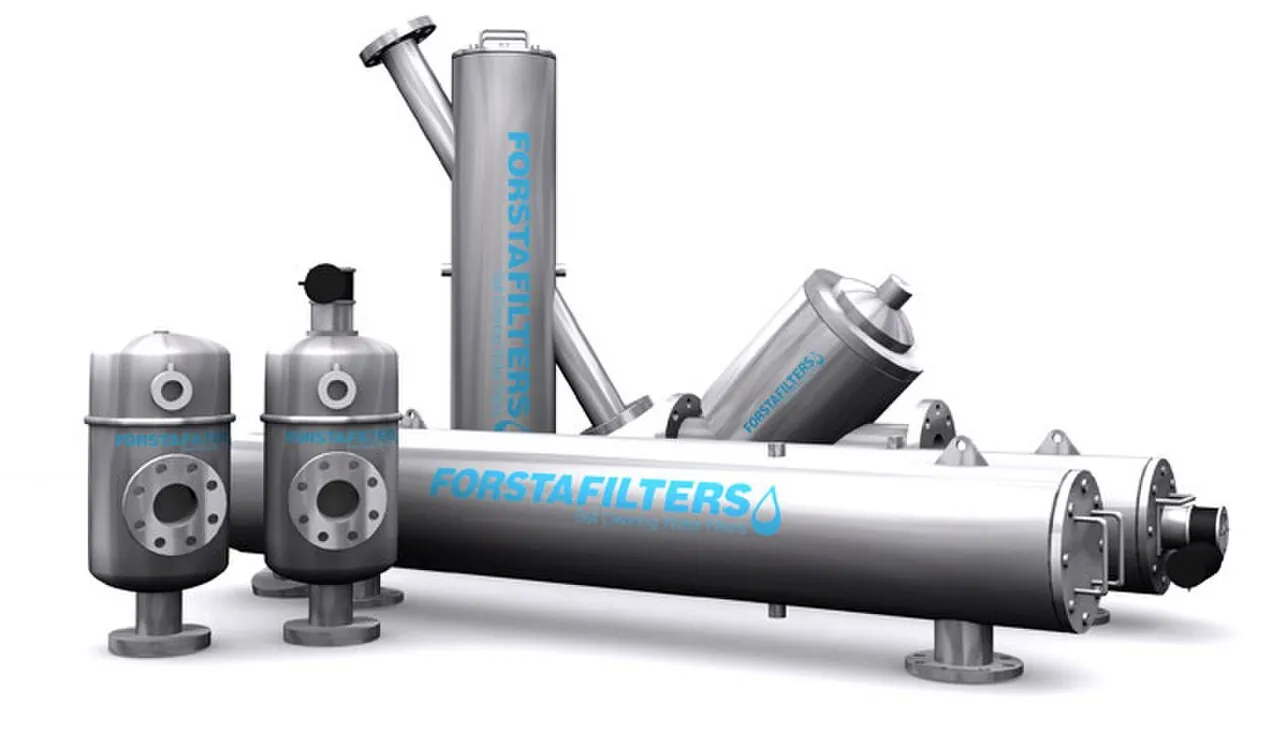
A multimedia filter is a granular bed filter that removes suspended solids and turbidity from water through layers of media graded by density and size: coarse light anthracite on top, silica sand in the middle, and fine dense garnet at the bottom, each layer coarser on top than the layer beneath it in effective size. Because the coarsest grains sit where the water enters, dirt penetrates and deposits through the full bed depth instead of caking on the surface, and the filter runs longer between backwashes at lower headloss than a single sand bed ever could.
This page treats the multimedia filter as a purchasing object: how media layering and sizing set performance, what filtration rate, headloss, and backwash design actually buy, how pressure vessels and gravity basins divide the applications, what underdrain and air scour systems contribute, and which specification lines, flow, influent solids, effluent turbidity, backwash constraints, decide the offer. It is written for water treatment and process engineers buying pretreatment and polishing filtration.
The decision concentrates in six places: the flow and its variability, the influent solids and turbidity character, the effluent target, the pressure or gravity vessel architecture, the media stack and its filtration rate, and the backwash system, water source, air scour, and disposal, that keeps the bed alive.
Chapter 1 / 06
What a Multimedia Filter Is and What Is Being Decided
The physics is depth filtration. Water flows down through the granular bed, and suspended particles are removed by straining at grain surfaces, by sedimentation in pore spaces, and by attachment to previously deposited material; the coarse anthracite at the top captures the largest flocs while letting smaller ones travel, and each finer, denser layer below takes progressively finer load, so the entire bed depth works instead of the top two centimeters. The proof is the headloss curve: a single media filter builds pressure quickly at the surface while its lower bed idles, a properly stacked multimedia bed builds headloss slowly and evenly across runs measured in hours or days.
What is being decided is run length against water quality against backwash economics. A faster filtration rate processes more water per square meter but shortens runs and risks solids breakthrough; a deeper bed polishes longer but backwashes longer; more backwash water per cycle restores the bed better but raises the plant's self-consumption, typically 1 to 5 percent of throughput. The buyer fixes the flow and the effluent target, states the influent reality, and the vendor sizes diameter, bed depth, and media gradation, and the honest conversation is about the run length and backwash volume the offer implies.
The family boundary at purchase: this page is the authority for the granular multimedia bed, in pressure vessel and gravity form, dual and triple media. The neighbors divide the filtration world by mechanism: an industrial filter or self-cleaning-filter handles screen and strainer duty, a precision-filter holds cartridge and membrane elements, a bag-filter runs disposable media bags, and a filter-press dewaters sludge rather than clarifying water. Downstream, the multimedia filter's most common customer is a reverse osmosis train or an electrodeionization polish stage that needs low silt density index feed, and that interface sets the effluent numbers this filter must actually deliver.
Applications cluster in three groups. Pretreatment ahead of membranes and ion exchange, where the product is low turbidity, low silt density index water protecting downstream elements; iron and manganese removal in well water duty, where the media and an oxidation step together precipitate and capture the metals; and general process water polishing, cooling tower makeup, and wastewater reuse, where turbidity targets follow the process. The group matters because it changes the chemistry scope, oxidation and pH adjustment ahead of the bed, and the backwash discipline, and the RFQ should say which group this filter serves.
The membrane protection role deserves its own paragraph because it is the most common reason this filter is bought. Reverse osmosis and electrodeionization elements foul irreversibly on colloids, and the industry's acceptance currency is the silt density index, with element warranties written around SDI below 5 and preference below 3; a multimedia filter operated well delivers exactly that from average surface water. The operating words are operated well: the filter ripens after each backwash, runs its best effluent mid run, and returns its worst water in the first minutes after backwash, so the design that protects membranes includes a rinse to waste period and a return to service criterion on measured turbidity, not just a timer.
Scale spans package skids of 0.3 meter diameter to gravity basins treating municipal flows, with the pressure vessel market dense between 0.5 and 3 meters. Multiple units in parallel cover large flows and allow backwashing one vessel while the others carry the plant, which is the standard architecture above roughly 50 cubic meters per hour; duty plus standby sizing, one filter out of service backwashing or in maintenance, belongs in the specification as an availability statement rather than an afterthought.
Chapter 2 / 06
How the Media Stack, Rate, and Headloss Do the Work
The stack is engineered by effective size and uniformity coefficient. Anthracite at roughly 0.9 to 1.6 millimeters effective size, sand at 0.45 to 0.6, garnet at 0.2 to 0.35, each with uniformity coefficients around 1.5 or lower, layers so that after backwash fluidization and re-stratification the coarse light material always returns to the top, inverted grading against the flow. The layer depths trade capital against run length, common stacks running 300 to 450 millimeters of anthracite, 200 to 300 of sand, and 50 to 150 of garnet, with total media depths of 0.6 to 1.0 meter in pressure vessels and deeper in gravity basins.
Filtration rate sets the throughput per area. Conventional multimedia service runs 10 to 20 cubic meters per square meter per hour in pressure vessels, with 12 to 15 the comfortable center; gravity rapid filters run slower, 5 to 10; aggressive high-rate designs with coarser media reach 25 and above at the cost of effluent risk on difficult solids. The rate interacts with influent load: at 10 nephelometric turbidity units influent and moderate coagulation, 15 per square meter per hour may run 24 hours between backwashes, while 50 NTU storm water at the same rate ends the run in hours. Specify the rate band and the influent band together, or neither means anything.
Headloss is the run's clock. A clean bed starts near 0.2 to 0.5 bar in pressure service and climbs as solids deposit, and the terminal headloss, commonly 1.5 to 2.5 bar by vessel rating or pump limit, ends the run alongside turbidity breakthrough, whichever comes first. The specified terminal headloss should match the real pump and vessel constraints, and the offer should state the expected run length at design influent load, in hours, because that number sets the backwash frequency, the water consumption, and the operating labor rhythm for the life of the plant.
Design variable
Typical range
What it buys or costs
Filtration rate, pressure vessel
10-20 m3/m2/h
Higher shrinks vessel, shortens runs
Media depth, total
0.6-1.0 m
Deeper polishes longer, backwashes longer
Anthracite effective size
0.9-1.6 mm
Coarser holds more solids, coarser effluent floor
Terminal headloss
1.5-2.5 bar
Longer runs until breakthrough governs
Backwash rate, fluidization
25-40 m3/m2/h
Must fluidize bed per media density
Air scour intensity
50-90 m3/m2/h
Cleans grains without full fluidization water
The ripening effect explains filter behavior that surprises new operators. A freshly backwashed bed filters slightly worse for the first minutes to hours, because a modest deposit load actually improves attachment, the deposited solids themselves become collection surfaces; effluent turbidity traces a small peak after backwash, descends through the run, and only rises again at breakthrough. Plants handle the peak with an initial waste period, with slow start filtration into a recycle, or by staggering the return of multiple vessels, and each approach is a control decision written at purchase, because the alternative is sending every filter's worst water to the process on schedule.
Backwash is where the bed is reborn or ruined. The sequence, drain down optional, air scour to scrub the grains, low rate water fluidization to re-stratify, then rising rate rinse to waste, expands the bed 20 to 40 percent so trapped solids lift out while the density grading resettles correctly. Each media demands its own fluidization velocity, garnet needing the most because it is densest, and the backwash system must deliver the highest of them at the coldest water temperature, where viscosity raises the required rate. Undersized backwash is the single most common cause of media mudballs, channeling, and early bed replacement, so the backwash source, pump or elevated tank, sized for simultaneous worst case, belongs in the specification with the same seriousness as the vessel.
Chapter 3 / 06
Vessel Types: Pressure, Gravity, and Duty Variants
Vertical pressure vessels dominate industrial service. A steel or FRP shell, 2.5 to 6 meters tall, rated 4 to 10 bar, holds the media over an underdrain, with a face piping manifold of valves for service, backwash, and rinse arranged for manual or automatic operation; the vessel's pressure turns the whole bed into a pressurized element feeding downstream processes directly, footprint is small, and flows from a few to several hundred cubic meters per hour per unit. Horizontal pressure vessels serve large flows where height is constrained, splitting the underdrain into cells, and they backwash cell by cell, buying internal redundancy in one shell.
Gravity filters serve municipal scale and open-plant architecture. Reinforced concrete or open steel basins, often with galley underdrains and high rate nozzle blocks, run the same media physics at lower rates with the entire train visible and walkable; backwash comes from elevated tanks or pumps, and the civil work dominates the cost. Between the two architectures, the choice usually follows the plant around the filter, pressurized skid plants choose pressure vessels, open treatment trains choose gravity, and the RFQ should state the architecture rather than let the first vendor set it.
Duty variants adjust the stack. Iron and manganese duty adds manganese dioxide coated media or greensand analogs that catalyze oxidation, fed by an oxidant, potassium permanganate, chlorine, or aeration, ahead of or inside the bed; the multimedia stack then works as both catalyst support and solids filter. Activated carbon caps and layers address taste, odor, and organics alongside turbidity in hybrid stacks, at the cost of different backwash discipline and bed life economics. The specification should name the duty elements, standard dual or triple media, catalytic media, carbon layer, because each carries its own replacement cycle and backwash requirement.
Vessel material is a corrosion and weight decision. Lined carbon steel suits large diameters and pressures with proper lining systems for the water chemistry; FRP composite vessels dominate the small and medium package market with corrosion immunity and lower weight at a pressure ceiling typically near 10 bar and diameter limits by filament winding; stainless appears in hygienic and aggressive chloride service at a price. The choice follows the plant's existing fitting universe as much as the water, and the RFQ should state both the chemistry and the maintenance reality, coastal atmosphere, indoor or outdoor, that the shell will live in.
The underdrain is the quiet differentiator. Options run from simple lateral pipe systems with drilled strainers to dome nozzles on a plenum floor to proprietary block systems; the underdrain must collect service flow evenly, distribute backwash evenly, retain the finest garnet, and survive the air scour without grating passage of media into the effluent. Uneven collection short circuits the bed, and media leakage through failed nozzles appears as intermittent turbidity that embarrasses the filter on exactly the days it should be proud. Ask for the underdrain type, its collection uniformity basis, and the nozzle retention size against the finest media specified.
Chapter 4 / 06
Key Specification Parameters
The lines below decide the vessel and the bed. Flow, average and peak, sizes the area at the chosen rate; influent turbidity or suspended solids with their variability sizes the run length; the effluent target, turbidity and silt density index where membranes follow, is the acceptance number. Vessel lines, diameter, height, rating, material, and lining, set the hardware; media lines, layers, depths, effective sizes, and sources, set the performance; backwash lines, rates, source, and disposal, set the operating reality.
Cold water deserves an explicit line. Backwash fluidization rates must be verified at the coldest water temperature the plant will backwash in, since viscosity at 5 degrees C demands roughly 20 to 30 percent higher rate than at 20 degrees to expand the same bed, and warm climate plants enjoy the reverse. Failure to state the temperature range produces beds that clean perfectly in summer and mudball in January, and the fix, a bigger backwash pump found late, is expensive; the source temperature range belongs in the RFQ next to the flow.
Backwash water handling closes the specification, because the filter's waste stream is a process stream with rules. Roughly 1 to 5 percent of throughput leaves as solids laden backwash water, and it needs a route, equalization and settling, recycle to the plant head, or discharge to a permitted drain, each with volume and quality constraints that vary by jurisdiction. The filter skid scope should state where its waste goes and who owns the pipe to there; projects that leave this line to installation discover it as a regulatory conversation instead of a plumbing detail, which is the expensive version.
Instrumentation lines close the operability. Inlet, outlet, and differential pressure indication, ideally transmitted, since headloss is the run clock; effluent turbidity measurement where the target justifies it; and backwash flow indication, because a backwash executed at the wrong rate is the silent bed killer. Automatic valves with a controller that sequences air, backwash, and rinse, initiated by headloss or time, turn the filter from a labor assignment into an instrumented unit process, and the modest control premium repays itself in the first year of unattended nights.
Chapter 5 / 06
Selection Decision Factors and RFQ Language
Selection starts with the water, characterized honestly. Source and its variability, surface water swings by an order of magnitude in turbidity between dry weather and storm, well water is stable but carries iron and manganese, and the filter's sizing lives or dies on the influent band stated. Coagulation ahead of the filter changes everything, well formed floc loads a bed gently while raw colloidal solids blind the surface layer, so state the pretreatment chemistry in the RFQ, and where it does not exist yet, state that the filter is being asked to work on unsettled water, which shifts the design toward coarser stacks and shorter runs.
Then fix the downstream contract. If a reverse osmosis train follows, the effluent currency is silt density index below 5, and the multimedia filter's job is defined by that membrane protection duty; if the product feeds a process directly, turbidity below 0.2 or 0.5 NTU carries the day; if it is reuse polishing, the target follows the reuse class. The downstream contract decides how conservative the rate and stack must be, and quoting the filter without it produces a vessel that meets its own datasheet and starves its customer.
Number and duty of vessels is an availability decision. One large vessel fails the plant when it backwashes; two vessels run 100 percent with one in backwash; three or more allow maintenance outages without capacity loss, and the marginal cost of the second and third unit buys the plant's smoothness. State the availability expectation, backwash during peak, maintenance window coverage, and let the vendor propose the arrangement against it, then check that the backwash source covers the chosen arrangement's worst simultaneous case.
The recurring specification errors are worth naming because they recur. Quoting a rate without the influent band, so the vessel is sized for water the plant does not have. Sizing backwash at summer temperature for a plant that backwashes in winter. Omitting the rinse to waste step and handing every backwash's worst minutes to the membranes. Specifying media by layer name only, without effective size and uniformity coefficient, which lets price shopping substitute inferior media. And leaving the backwash disposal route out of scope, covered above. Five lines added to an RFQ eliminate five of the most common commissioning disappointments in this product class.
State the water: source, average and peak flow, temperature range, influent turbidity or suspended solids band, and iron, manganese, or organics if present.
State the effluent contract: turbidity target, silt density index if membranes follow, and any regulatory number the filter must hold.
State pretreatment reality: existing coagulation and settling, or none, and whether this filter is the first solids capture step.
State the architecture preference, pressure or gravity, with plot constraints, and the vessel material expectations, lined steel or FRP.
State the media stack expectation or require a justified recommendation with effective sizes, depths, and media sources.
State filtration rate band and expected run length at design influent, in hours, as part of the offer.
State backwash constraints: source and its capacity, air scour acceptability, water temperature range, and disposal route and limits.
State automation level: initiation by headloss or time, valve scope, and the instrumentation list with transmitted signals.
Two neighbor notes belong in selection without turning this page into a comparison. Against cartridge and self-cleaning strainers, the multimedia filter wins on solids loading capacity, an order of magnitude more dirt per area, and loses on backwash infrastructure and floor space; the strainer protects pumps, the media bed protects membranes. Against coagulation plus settling ahead, the pair removes bulk solids cheaper per kilogram and the filter polishes, and the best plants run both in series rather than asking one unit to do the other's job.
Chapter 6 / 06
Installation, Standards, Failure Modes, and Maintenance
Installation is vessel and media logistics. The vessels set on pads or skirts with face piping manifolded for the chosen service and backwash arrangements; media loads by hand or by blower truck through the top manway, with the critical disciplines being layer charging in order, water cushioning to avoid grain fracture, and a recorded final bed level and depth per layer, the as built media report. Commissioning includes the initial backwash series to stratify and clean the bed, a media retention check on the underdrain, and a run to terminal headloss with effluent verification, the baseline every future run compares against.
Standards lines to request include the vessel pressure certification for steel shells or the FRP standard basis, the lining system specification for corrosive water, media quality certificates, effective size, uniformity coefficient, cleanliness, and source, and the underdrain material and retention documentation. For potable duty, the media and lining approvals the locality requires travel with the offer, and for membrane protection duty, the media's acid solubility and leachables matter to the downstream elements and deserve the certificate too.
Failure modes are few and diagnostic. Short runs and fast headloss point to influent overload, surface caking from poor coagulation, or a rate above the stack's character; the response is chemistry and rate, not more media. Mudballs and channeling, visible at the surface after backwash, point to inadequate backwash fluidization, usually undersized at cold temperature; the response is backwash rate verification and air scour discipline. Media loss over time points to excessive backwash rates lifting garnet out, failed underdrain nozzles passing media, or attrition of anthracite; the response is a nozzle inspection at the documented interval and rate adjustment. Effluent turbidity that appears with each filter's return to service after backwash points to the rinse-to-waste step being cut short; the response is a timed initial waste period, cheap and immediate.
Symptom
Likely cause
First response
Runs shorten over months
Media fouling or influent load increase
Core sample bed, verify influent, deep clean
Turbidity spike after backwash
Insufficient rinse to waste
Extend waste period, verify effluent before return
Headloss high from start of run
Incomplete backwash or mudballs
Verify rates at cold water, air scour, inspect surface
Garnet in effluent or downstream
Failed nozzle or excessive backwash rate
Inspect underdrain, reduce backwash to spec
Bed level dropping over years
Media attrition and washout
Rebed with certified media, fix rate control
Biofouling is the slow failure mode in nutrient waters. Surface and reuse waters carry organics that colonize the bed, and the symptoms arrive gradually, longer runs that look like improvement until the headloss behavior goes strange and the bed smells of anaerobic corners; the defenses are chlorinated backwash water where the downstream tolerates it, adequate air scour, and periodic checks on the media's biological state. Cold climate plants add freeze protection for face piping and backwash tanks, and both provisions are cheaper in the original scope than in the first emergency.
Media sourcing is the last quality lever. Certified filter media arrive with sieve analyses, cleanliness certifications, and source traceability, and the modest premium over commodity aggregate pays in the first backwash: uncertified media carry fines that cloud effluent for days and clays that mudball within months. Ask for the media certificates with the offer, keep them with the as built media report, and when the rebed year arrives, buy the same specification again rather than the cheapest truckload, because the bed is a precision instrument that happens to look like gravel.
Maintenance is media stewardship on a calendar. Quarterly: bed surface inspection through the manway, headloss trend review, backwash rate verification against the cold water requirement. Annually: core sample or probe of the bed for depth per layer, mudball percentage at the surface, and media condition, garnet rounding, anthracite attrition; top up or rebed as the findings dictate, with a full rebed every 5 to 10 years by water chemistry and diligence. Keep a media inventory record from installation, depths and certificates, because every future diagnosis reads against it, and the five minutes of documentation at commissioning saves the next engineer a day of guessing.
The filter's analytical and hydraulic neighbors complete the water train. An orp meter and the ph meter already listed track coagulation chemistry, a conductivity meter verifies rinse return, and the y strainer guards the backwash pump suction. Raw water arrives through the plant intake or a sewage pump station on reuse duty, and the ozone generator stage may follow for disinfection where the process requires it. The links in this paragraph connect those sibling purchases, each with its own specification page, into the one engineering conversation this filter anchors.
FAQ
What media layers does a multimedia filter use and why?
The standard triple media stack is coarse light anthracite on top, silica sand in the middle, and fine dense garnet at the bottom, graded inverted against the flow so solids penetrate and load the full bed depth. Dual media drops the garnet for lighter duty. The layering is what buys long runs between backwashes compared with a single sand bed that cakes at the surface.
What filtration rate should I specify?
Pressure multimedia service runs comfortably at 10 to 20 cubic meters per square meter per hour, with 12 to 15 the safe center for general duty; gravity rapid filters run 5 to 10. Higher rates shrink the vessel but shorten runs and raise breakthrough risk on variable solids, so specify the rate with the influent band it must handle, not alone.
How often does a multimedia filter backwash and how much water does it use?
Runs typically last 12 to 72 hours depending on influent load and rate, ending on terminal headloss or turbidity breakthrough. Each backwash consumes roughly 1 to 5 percent of throughput as combined air scour, fluidization, and rinse water. The expected run length in hours at your stated influent belongs in the vendor offer, because it sets your water budget and labor rhythm.
Can a multimedia filter remove iron and manganese?
Yes, with the right media and chemistry: catalytic manganese dioxide coated media or greensand analogs oxidize and capture dissolved iron and manganese when an oxidant, chlorine, permanganate, or aeration feeds the process. The multimedia stack then doubles as solids filter and catalyst bed. State the metals and their concentrations, and expect the vendor to design the oxidation step with the bed.
Pressure vessel or gravity basin: which should I choose?
Pressure vessels suit skid-mounted industrial plants up to a few hundred cubic meters per hour per unit, feeding downstream processes directly at pressure with small footprint. Gravity basins suit municipal scale and open plant architecture, easier to walk, inspect, and expand, with civil work dominating. Follow the plant architecture you already have, and say so in the RFQ.
Why is my multimedia filter losing media or making mudballs?
Mudballs mean the bed is not fluidizing fully in backwash, usually a rate undersized for the coldest water or absent air scour; media loss means backwash rate is excessive or underdrain nozzles have failed and are passing garnet. Both are fixed in the backwash system and underdrain, and both are prevented by verifying the fluidization rate at your lowest water temperature and inspecting nozzles on schedule.
Does a multimedia filter protect reverse osmosis membranes?
It is the standard first line: properly run, it delivers effluent turbidity below 0.2 NTU and silt density index below 5, which RO elements require for warranty and life. The downstream contract, SDI below 5, should be stated in the filter RFQ so the rate and stack are chosen for membrane protection, and effluent SDI verified at commissioning and periodically after.