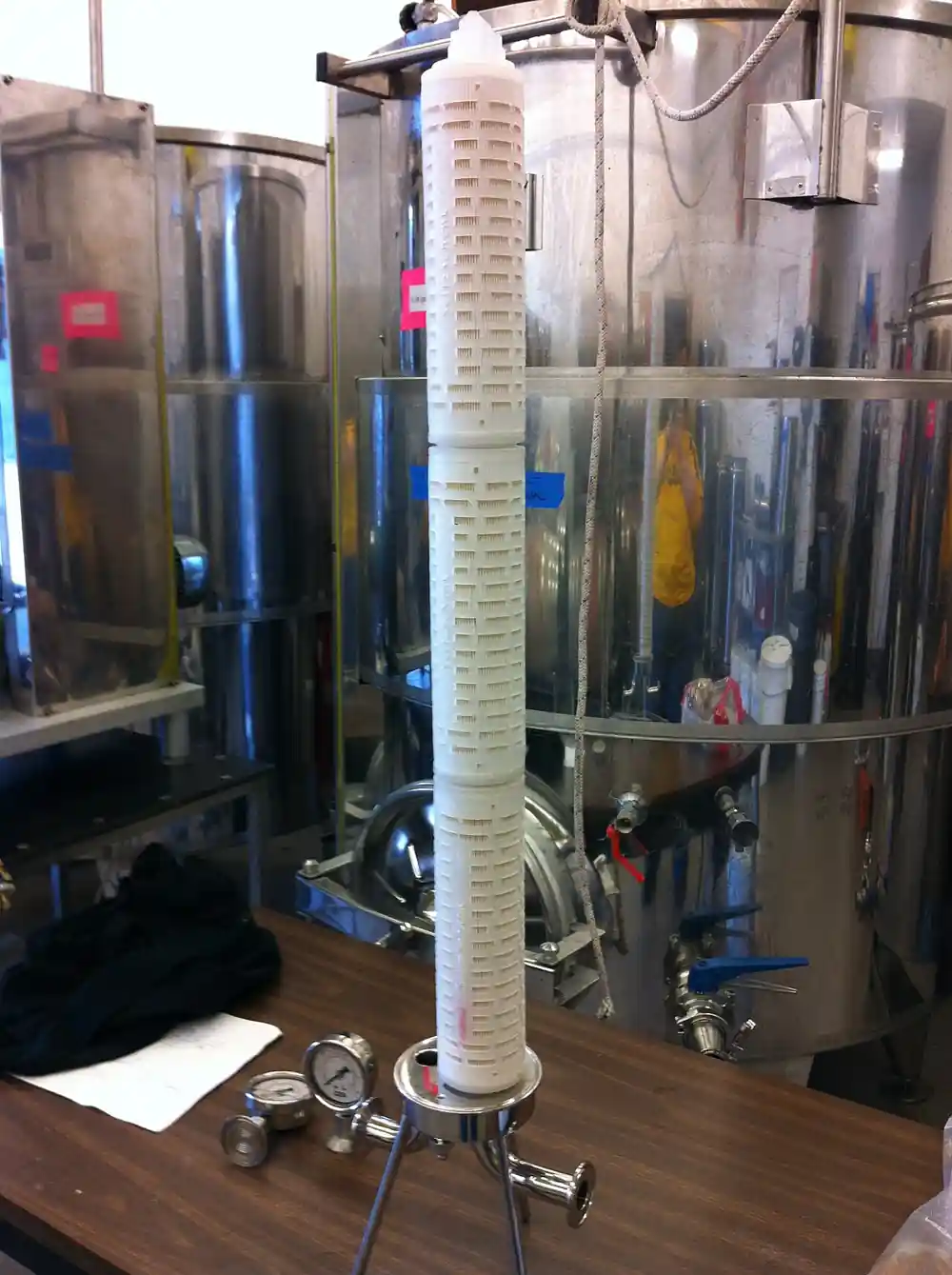
A reverse osmosis system forces water through a semipermeable membrane at a pressure above its osmotic pressure, rejecting dissolved salts, organics, and most everything else dissolved while the permeate passes through. The working element is the spiral wound thin-film composite cartridge, typically 8 inches in diameter and 40 inches long, loaded six or seven deep into fiberglass pressure vessels, staged on a skid with a high pressure pump, and controlled on flow, conductivity, and pressure. It is the workhorse of desalination, boiler and process water preparation, and ultrapure water trains, delivering dissolved solids removal no filter can approach.
This page treats the reverse osmosis system as a purchasing object: how rejection, recovery, and net driving pressure define performance, how element type and staging shape the skid, how fouling control, SDI discipline, antiscalant, and cleaning intervals decide element life, and which specification lines, feed analysis, permeate targets, recovery, pretreatment, decide the offer. It is written for water treatment engineers and plant buyers evaluating RO skids.
The decision concentrates in seven places: the complete feed analysis including temperature and silt density index, the permeate quality and flow targets, the design recovery and its concentrate consequences, the element family, brackish, seawater, low energy, fouling resistant, the staging and array that distribute the duty, the pretreatment already in place, and the cleaning and control philosophy that protects the investment.
Chapter 1 / 06
What a Reverse Osmosis System Is and What Is Being Decided
The physics is pressure defeating chemistry. Osmosis would move water from dilute to concentrated across the membrane; reverse osmosis applies hydraulic pressure above the osmotic difference to drive water the other way, and the membrane's polyamide active layer passes water molecules while rejecting ions and larger solutes, 99 percent and above for modern brackish elements on sodium chloride, higher still for divalent ions. Every kilogram per square centimeter of feed pressure is spent first against osmotic pressure, which rises with concentration, and the remainder, the net driving pressure, produces permeate flow; this is why recovery, which concentrates the remaining water, and pressure are locked together in every design decision.
What is being decided is a skid plus a discipline. The skid, vessels, elements, pump, instruments, and controls on a frame, is half the purchase; the other half is the pretreatment and operating regime that keeps elements alive, because membrane elements are consumables, three to ten year consumables priced in the thousands, and their life is set almost entirely by the water they see and the care they receive. The specification that buys the skid without buying the discipline, SDI monitoring, antiscalant dosing, scheduled clean in place, buys a system that performs beautifully at commissioning and decays on a curve.
The position in the train defines the product. A single pass brackish RO takes city or well water to process or boiler feed quality; a two pass arrangement takes permeate through a second set of elements for low conductivity product; seawater RO makes drinking and process water from the sea at higher pressures; and within ultrapure water trains, the RO stage is one station among multimedia filtration, electrodeionization, and polishing, feeding the polish stages that follow. This page is the authority for the RO element and skid itself; the ultrapure train architecture belongs to the upw-system page, which treats RO as one of its stages, and the two pages are deliberate neighbors, not competitors.
Scale runs from wall mounted units producing a cubic meter per hour to trains of hundreds of vessels producing tens of thousands. Small systems are catalog products with fixed arrays; large systems are engineered projects with staged arrays, energy recovery on seawater duty, and sophisticated controls. Between them the market's center of gravity, 10 to 500 cubic meters per hour, is served by semi standard skid designs adapted per water analysis, and it is in this band that the specification lines in this page matter most.
Energy recovery changes seawater economics and is arriving in large brackish plants. In a single pass SWRO, the concentrate leaves at nearly full pump pressure, and energy recovery devices, pressure exchangers or turbochargers, return most of that pressure to the incoming feed, cutting specific energy from roughly 6 to below 3 kilowatt hours per cubic meter on modern trains; isobaric pressure exchangers are the current standard at scale. Brackish plants historically reject concentrate to drain and ignore the energy, but at large flows and rising power prices, recovery devices and interstage boost economics enter the conversation, and the RFQ for any multi-megawatt pump duty should ask for the specific energy calculation with and without them.
Economics are energy and element dominated. Pumping against osmotic pressure consumes roughly 2 to 4 kilowatt hours per cubic meter on brackish feed and 3 to 6 on seawater, and elements replace on the cycle the water quality dictates. Fouling that costs 15 percent of normalized flow forces the pump harder, which costs energy continuously and elements eventually, so the operating cost curve is really a fouling control curve; the cheapest RO plant over ten years is the one with the best pretreatment, and that sentence is the industry's oldest truism because it is true.
Chapter 2 / 06
How Rejection, Recovery, and Driving Pressure Do the Work
Rejection is the quality variable. Stabilized salt rejection for modern brackish thin-film composite elements sits near 99.0 to 99.7 percent on sodium chloride under standard test conditions, with real feed producing permeate conductivity set by the mix of ions, temperature, and flux; seawater elements test near 99.6 to 99.8. Rejection falls with age and cleaning cycles, and the specification should ask for the projected permeate conductivity at your feed and temperature at start and at the three year point, not the datasheet's standard test on sodium chloride solution, because feed composition moves the real number by as much as the element choice does.
Recovery is the water efficiency variable, and it is limited by chemistry. At 75 percent recovery, the classic brackish array target, the concentrate leaves at four times the feed concentration, and every sparingly soluble salt in the feed, calcium carbonate, calcium sulfate, silica, barium and strontium sulfates, approaches its solubility limit in that final element; beyond the limit, scale precipitates on the membrane surface and the element begins dying. Recovery is therefore a water chemistry computation, softened feed and antiscalant buy a few more points, and the honest RFQ provides the full ion analysis so the vendor computes the ceiling instead of assuming one.
Net driving pressure ties it together hydraulically. The pump must deliver feed pressure equal to osmotic pressure difference, friction losses through the array, and the net driving pressure that produces design flux, liters per square meter of membrane per hour; typical brackish design flux runs 15 to 25 LMH and seawater 12 to 18, with fouling prone feeds deliberately derated below. Flux is the silent element life variable: pushing flux saves elements capital today and spends element life tomorrow, and conservative flux is how long lived systems are built. Ask for the design flux per stage in the offer, and compare it to the element manufacturer's guidance for your feed class.
Performance variable
Typical design range
What pushes it
Stabilized NaCl rejection
99.0-99.8%
Element family and age
Brackish recovery
65-80%
Scaling chemistry, antiscalant, softening
Seawater recovery
35-50%
Osmotic pressure of concentrate
Design flux
12-25 LMH
Feed fouling class and conservatism
Brackish feed pressure
8-25 bar
Recovery and salinity
Seawater feed pressure
55-75 bar
Salinity and recovery
Temperature is the performance variable operators misread most. Permeate flux rises roughly 3 percent per degree Celsius through the normal range, which means the same skid makes visibly more water in August than in February at identical pressure, and salt passage rises with it, so winter water is better quality at lower flow and summer water the reverse; normalization exists precisely to remove this arithmetic from performance judgments. Cold water also raises required feed pressure, and plants in cold climates should confirm the pump and array design at the winter temperature, because a skid designed at 25 degrees can run 30 percent short of capacity at 10 degrees unless the pump and flux design accounted for it.
Staging distributes the duty across the array. A two stage array, four pressure vessels feeding two, concentrates the flow through successive elements at manageable velocity, each stage's fewer vessels accommodating the reduced concentrate flow, and the interstage pressure drop is a designed value, not an accident. Array design balances element type, vessel count, and staging so that no element runs at punitive flux or concentration, and the ratio rules, concentrate flow per vessel and per element minimums to keep crossflow scouring the surface, are the vendor's design discipline; the buyer audits them by asking for per stage flux and crossflow in the datasheet.
Chapter 3 / 06
System Types: Brackish, Seawater, and Pass Architectures
Brackish water RO, the volume market, runs 8 to 25 bar on feed from a few hundred to a few thousand milligrams per liter of dissolved solids, from wells, rivers, municipal supply, and reused water. Elements are 8 inch brackish class, arrays two or three stage, recovery 65 to 80 percent by chemistry, and permeate serves process, boiler feed, and irrigation duty or feeds downstream polish stages. Within the brackish class, variants trade flux for energy: standard elements, low energy elements that deliver design flux at lower pressure, and high rejection elements for tighter permeate specs, and the choice is an energy-versus-quality computation per application.
Seawater RO is the high pressure discipline. Feed near 35,000 milligrams per liter demands 55 to 75 bar, first pass recovery typically 40 to 50 percent, and the machinery scales accordingly, duplex or super duplex high pressure pumps, thicker walled vessels, and energy recovery devices that return the concentrate's pressure to the feed stream and cut specific energy to competitive levels. Element count and staging follow the same rules at higher stakes, because a scaling event at 70 bar is an expensive event, and seawater plants invest accordingly in pretreatment, often a full clarification and multimedia filter train ahead of cartridge protection.
Two pass architectures buy quality. Permeate from the first pass repressurizes through a second array of brackish elements, and the second pass sees almost no scaling load, running 85 to 90 percent recovery while polishing conductivity to boiler and pharmaceutical grades; a partial second pass, routing only part of the flow, and permeate throttling between passes tune the economics. Two pass is standard where the product target is below roughly 10 microsiemens, and it is cheaper than fighting the first pass chemistry to the same number; when even that is not enough, electrodeionization follows the second pass in ultrapure trains.
Special duty elements extend the catalog. Fouling resistant elements with modified surface charge and smoother active layers buy longer cleaning intervals on wastewater and surface feeds; low differential pressure elements help long arrays; and boron rejection duty, irrigation and drinking water from seawater, engages elements and pH engineering together because boron passes as uncharged boric acid unless the feed pH is raised. The point for the buyer is that element selection is a matching exercise against the feed's specific pathology, and a vendor who recommends the same element for every application is recommending their inventory.
The neighbors divide the pressure spectrum. Nanofiltration, a looser membrane, rejects divalent ions and organics at lower pressure and leaves monovalent salts largely through, the right tool for hardness and organics removal rather than desalination. Ultrafiltration rejects particles and biology and passes all ions, the common pretreatment partner directly ahead of RO. Both are separate products, deliberately not re-authorityed here, and the selection question between them and RO is which species the process actually needs removed, a chemistry question answered before any skid is quoted.
Duty boundaries within the plant keep the RO page honest. Feedwater preparation for boilers and cooling; product water for food and beverage; reuse polishing behind municipal effluent; ultrapure water train stage feeding electrodeionization; and seawater desalination for municipal and industrial supply. In every one of these, the RO skid's neighbors are a multimedia filter or ultrafiltration ahead, a precision-filter cartridge guard immediately before the pump, antiscalant dosing with a metering pump, and instruments throughout, and the specification that names those neighbors buys a system instead of a frame.
Chapter 4 / 06
Key Specification Parameters
The lines below decide the skid. The feed analysis is the foundation, full ions plus silica, temperature range, pH, silt density index or its ultrafiltration equivalent, and organics; the permeate targets, flow and conductivity at end of element life, are the contract; recovery and array are the design; element type and manufacturer are the consumables commitment; and the instrumentation and control scope decides whether the plant can actually operate the discipline the elements require.
Parameter
Why it matters
Typical specification line
Feed analysis, complete
Sizes everything, sets recovery ceiling
Full ion analysis, 1,850 mg/L TDS, 12-28 C, SDI below 5
Permeate flow
The product contract
120 m3/h at 25 C normalized, end of 3 year life
Permeate quality
The quality contract
Below 25 uS/cm at start, below 50 at 3 years
Recovery
Water efficiency and scaling margin
75% design with antiscalant, verified projection
Array and staging
Flux and crossflow discipline
12:6 array, 2 stage, per stage flux stated
Elements
The consumable commitment
108 x 8-inch BW low energy, named manufacturer
Instrumentation
Operating discipline hardware
Conductivity, flow, pressure each stream, normalized data
CIP provision
Element life protection
Skid mounted CIP tank, pump, and manifold to arrays
Normalized performance is the acceptance language. RO performance moves with temperature, a degree of temperature moves permeate flow several percent, so raw numbers mislead; the offer should guarantee normalized flow and normalized salt passage per the standard normalization calculation, and the control system should display normalized values continuously. A skid accepted on raw flow in winter and questioned on the same flow in summer is arguing about arithmetic instead of performance, and the normalization provision in the controls scope prevents the argument for the life of the plant.
Warranty structure deserves negotiation attention at order. Element warranties are written against feed conditions, SDI, oxidant exclusion, and against normalized performance decline curves, and they are honored through the projection history, which is one more reason the normalized data logging is a specification item, not a convenience. Skid guarantees cover permeate flow and quality at design conditions for an initial period; ask what the remedy ladder is, cleaning, element replacement, redesign, and who performs and pays at each rung. The plants that read this section before signing are the plants whose year three performance conversation is a warranty claim instead of a mystery.
Pretreatment interface lines close the specification. State what exists upstream, multimedia filter, ultrafiltration, softening, and what the RO vendor must assume about it; state the antiscalant or dispersant program and who supplies the metering pump and dosing; and state the cartridge filter, usually 5 micron precision-filter housing, as the last mechanical guard in the RO scope. Chlorine and oxidants destroy polyamide elements in hours, so the specification must state the disinfectant regime and the dechlorination method, sulfite dosing or carbon, with an oxidation monitoring provision; this single interface kills more elements than all scaling mechanisms combined, and it is a spec line, not an operator note.
Chapter 5 / 06
Selection Decision Factors and RFQ Language
Selection starts with the water analysis, complete, current, and honest. Missing species are the currency of warranty disputes, barium and strontium at microgram levels set sulfate ceilings, silica sets the recovery ceiling more often than calcium, and organics feed the biofouling conversation; a projection run on partial analysis is a projection of a different water. Buyers should pull a fresh sample, run the full panel including the trace species, and attach it to the RFQ, and vendors should return a projection showing every limiting salt's margin at design recovery, which turns the chemistry into an auditable number.
Then choose the element economics deliberately. Named element manufacturers, whose projection software and warranties are the industry infrastructure, price at a premium over unbranded elements that offer datasheets without the same projection accountability; the premium is repaid the first time a warranty claim needs the projection history. Within a manufacturer, low energy elements cut pump cost and often cut rejection marginally, fouling resistant elements trade a little flux for cleaning resistance on difficult feeds, and high rejection elements serve tight specs; ask for the same duty priced two ways with the ten year energy and element replacement arithmetic shown.
Then decide how much discipline the plant will actually operate. A plant with instrumentation and trained staff runs conservative flux, scheduled CIP, and three to seven year element life; an unattended station needs fouling resistant elements, generous flux derating, and automated cleaning triggers, or its elements become an annual subscription. The control system scope, normalized data display, trend alarms, and interlocks on low suction and high conductivity, is the machinery of the discipline, and cutting it to save one percent of the package price spends element life worth far more annually.
Attach the complete feed analysis: full ions including barium, strontium, and silica, temperature range, pH range, SDI or UF equivalent, organics and disinfectant residuals, and for reuse feeds the full effluent character.
State permeate flow and quality at start and at the stated element life point, as normalized values, with the normalization method named.
State the recovery expectation and require the vendor's projection showing each limiting salt's saturation margin at design and at maximum temperature.
State pretreatment reality and scope boundary: what exists upstream, who supplies antiscalant dosing, cartridge filtration, and dechlorination, and the monitoring for oxidant breakthrough.
State element requirements: 8 inch named manufacturer, family preference or a justified recommendation, and the design flux per stage against the manufacturer guidance for the feed class.
State the array and vessel arrangement allowed by plot and the interstage instrumentation expected.
State CIP scope: tank, pump, heating, manifold, and whether cleaning is manual or automated, plus the first two years' cleaning chemical program expectation.
Require controls with normalized performance display, trend data logging, and the acceptance test method: normalized flow and salt passage at design conditions against projection.
Concentrate disposal is the siting question inside the purchase. Every RO plant produces a concentrate stream at design recovery, 25 to 60 percent of feed flow carrying the rejected salts, and its route, sanitary permit, deep well, evaporation pond, ocean outfall, or process reuse, is a regulatory and cost conversation that belongs in the project next to the skid, not after it. Recovery choices interact with disposal directly, a few points of extra recovery shrink the waste stream and raise its salinity, and the optimum depends on which constraint bites. State the disposal route and limits in the RFQ, and the recovery recommendation that comes back will fit the site as well as the chemistry.
Two neighbor notes belong in the record without making this a comparison page. Against nanofiltration or ultrafiltration, RO is the monovalent salt tool; pick by the species to remove, not by the technology's fashion. Against a full ultrapure water train, this skid is one stage; when the product target is 18 megohm ultrapure, the upw-system architecture page owns the train design, and this skid feeds it.
Chapter 6 / 06
Installation, Standards, Failure Modes, and Maintenance
Installation is skid plumbing with a preservation mindset. The skid sets with feed, permeate, and concentrate connections plus drains and sample points; the high pressure piping follows its design class; and the commissioning sequence flushes preservative from the elements, verifies instrument calibration, checks the low pressure protections before the high pressure pump ever runs dry adjacent, and then brings flow up in steps while recording the baseline normalized performance. That baseline, with calibrated instruments, is the yardstick for every warranty claim and every cleaning decision the plant will ever make, and it deserves commissioning-grade care, not startup-shift care.
Documentation to demand with the skid: the element lot numbers and their individual test sheets, the projection report behind the guarantee, the array drawing with vessel and element positions, the normalization calculation setup, and the O&M manual with the cleaning procedures by foulant class. Regulatory context varies by duty, potable product carries local material and treatment approvals, and the membranes and their materials contact statements should arrive with the package rather than after the inspector asks.
Failure modes are the four classics. Scaling, from exceeding the saturation projections or failed antiscalant dosing, shows as rising differential pressure and falling normalized flow at the tail elements; fouling, colloidal or biological, shows as the same trends with different location and pace; oxidation, chlorine breakthrough, shows as sudden salt passage increase, elements partially and irreversibly opened; and o-ring and coupling damage shows as conductivity step changes and is found vessel by vessel with the conductivity probe. Every mode is cheaper prevented than repaired, and prevention is entirely the discipline this page has been describing, SDI honesty, antiscalant reliability, dechlorination integrity, and normalized data watched by someone who knows what the trends mean.
Symptom
Likely cause
First response
Normalized flow down, DP stable
Organic fouling or compaction
Alkaline CIP, review SDI trend
DP rising across array
Scaling at tail or particulate at lead
Locate stage, acid or alkaline CIP, check antiscalant
Permeate conductivity step up
O-ring or element damage, oxidation
Probe vessels, check oxidant monitoring logs
Gradual salt passage rise
Membrane aging or oxidation history
Confirm with normalization, plan element replacement
Performance loss in cold months
Temperature effect misread as fouling
Trust normalized data, not raw flows
The operating team is the final specification line. An RO skid is one of the few machines whose economics are decided almost entirely by whether someone competent looks at its normalized trends every day; plants with a trained operator logging normalized flow and salt passage routinely triple their neighbors' element life, and plants without one consume elements and call it vendor performance. Budget the training, the instrument calibration schedule that makes normalization meaningful, and the management attention that keeps both funded; the skid will repay it at the pump and the element order together.
Maintenance is the discipline on a calendar. Daily: normalized flow and salt passage log, pressures, SDI of feed. Weekly: differential trend review, antiscalant consumption against dose calculation, oxidant monitor verification. On trigger, rising normalized trends, not the calendar alone: clean in place with the chemistry matched to the foulant class, alkaline surfactant for organics and biology, acid for scale, at temperature and flow per the element manual, because a cleaning done wrong abrades elements faster than the fouling did. Every three years or on projection: element replacement staged to keep the skid's best elements where polishing matters. The plants that run RO well log one number religiously, normalized flow, and clean on its trend before it costs them pressure, energy, and elements together.
The skid's wider analytical and pretreatment neighborhood completes the specification context. A flow meter closes the permeate balance, an orp meter guards the oxidant interlock, and a y strainer protects the booster stage. Feed may come from a clarifier and bar screen train on surface water, or from an electrochlorinator equipped plant managing its own disinfection chemistry, and each of those systems links from here to its own page. Buyers who specify the RO train and its feed systems in one conversation buy a plant that starts up on the first attempt, which is the entire point of this encyclopedia.
FAQ
What is the difference between RO and nanofiltration or ultrafiltration?
Reverse osmosis rejects monovalent ions and makes true desalination possible; nanofiltration rejects divalent ions and organics at lower pressure while passing most sodium and chloride; ultrafiltration removes particles and biology while passing all ions. Choose by the species you must remove: salts demand RO, hardness and organics may only need NF, particulates only UF.
What recovery should my brackish RO run at?
Typically 65 to 80 percent, and the ceiling is chemistry, not machinery: as recovery concentrates the feed, sparingly soluble salts and silica approach saturation in the tail elements. A projection with your full ion analysis, plus antiscalant or softening, sets the safe number, and asking each vendor for every limiting salt's margin makes the answers comparable.
What feed pressure does an RO system need?
Brackish systems run roughly 8 to 25 bar and seawater systems 55 to 75 bar, set by feed salinity, recovery, temperature, and the net driving pressure for design flux. Low energy elements and conservative recovery reduce it. The projection datasheet shows the calculation; treat a quote without one as a price, not a design.
What is silt density index and why does it gate my warranty?
SDI measures colloidal fouling potential of the feed at the membrane, and element warranties are written against feed SDI below 5, with below 3 preferred for long element life. It is measured with a 0.45 micron filter and a stopwatch, and it is the single number that connects your pretreatment performance to your membrane warranty, so measure it, log it, and trend it.
How do I protect elements from chlorine?
Polyamide thin-film composite membranes degrade irreversibly under parts per billion level oxidant over hours. Dechlorinate before the skid, sodium sulfite metabisulfite dosing or activated carbon, and monitor for oxidant breakthrough with an instrument that alarms before the membranes see it. Oxidation damage is silent until salt passage jumps, and it is not covered by warranty.
How often do RO elements need cleaning and replacement?
Clean when normalized flow or salt passage trends move roughly 10 to 15 percent from baseline, which typically lands every 3 to 12 months by feed difficulty, with the chemistry matched to the foulant. Replace elements at three to seven years when projections and cleaning economics say so. The discipline is normalized data trending; the calendar alone cleans too early or too late.
Should I buy named-brand elements or cheaper alternatives?
Named manufacturers supply projection software, lot test data, and warranties that the industry's accountability runs on; alternatives offer datasheets with less of that infrastructure. The premium is modest against skid cost and is repaid at the first warranty claim or performance dispute. If alternatives are chosen for cost, verify with a pilot element on your feed before committing the array.