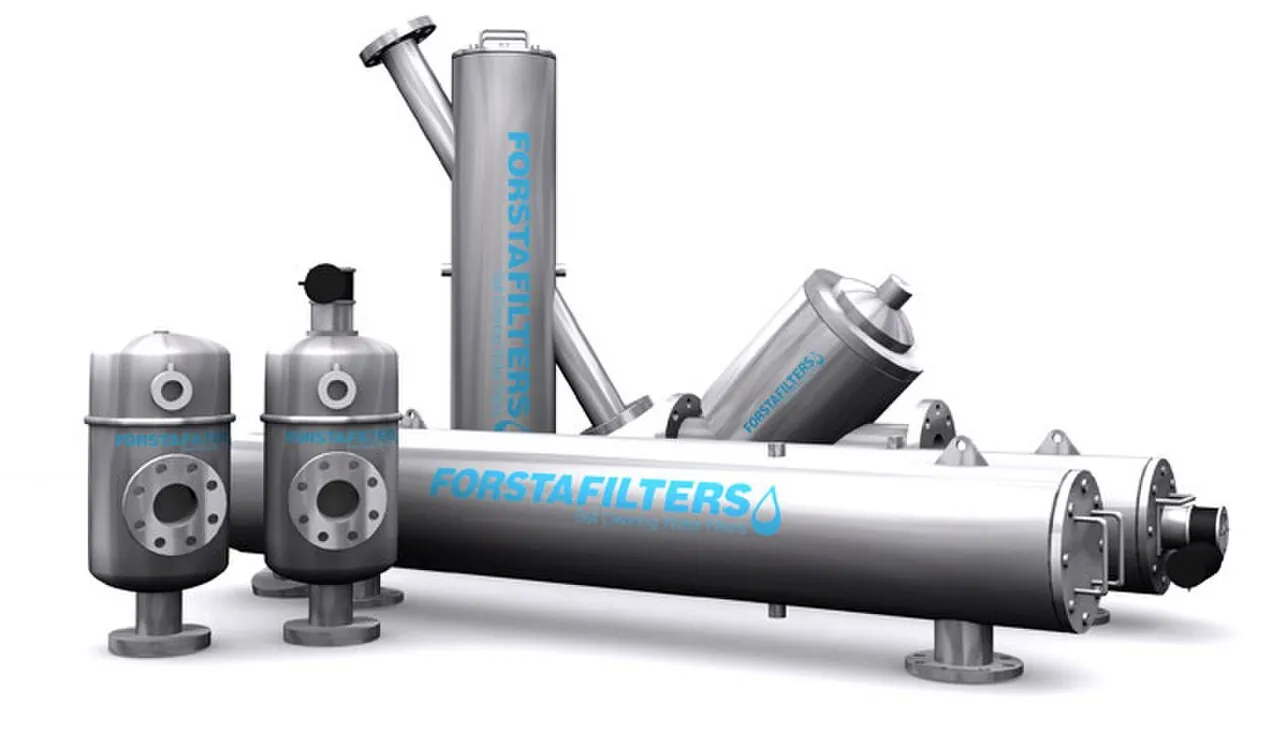
An activated carbon filter, in the sense of this page, is a liquid phase granular activated carbon adsorber: a pressure vessel, or a train of them, packed with granular activated carbon through which water flows while dissolved organic compounds, disinfection byproduct precursors, taste and odor compounds, and many synthetic organics adsorb onto the carbon's immense internal surface. The United States EPA lists activated carbon processes among the recognized drinking water treatment technologies, and Calgon Carbon's equipment and FILTRASORB product lines are the reference commercial form of both the vessels and the media they hold. This page treats the adsorber system, vessels, carbon, and monitoring, as the purchasing object.
This page is written for the engineer specifying liquid phase activated carbon treatment for drinking water, process water, or wastewater polishing. It works through how adsorption and contact time govern removal, which vessel arrangements fit which duties, the parameters on vendor data sheets, and the selection factors and RFQ language that decide whether the installed system holds its effluent target through the carbon's promised life.
The decision concentrates in five places: the contaminant and its concentration, the effluent target the permit or process sets, the contact time and carbon grade that reach it, the vessel arrangement that protects against breakthrough, and the spent carbon's exit, reactivation or disposal. Get those right and the vessel count, carbon volume, and replacement cadence follow.
Chapter 1 / 06
What an Activated Carbon Filter Is and What Is Being Decided
The industrial machine this page describes is a pressure vessel in the water treatment sense: a steel or FRP column with internal distribution and collection underdrains, top and side nozzles, and a bed of granular activated carbon, typically 8 by 30 or 12 by 40 mesh reactivated or virgin coal based carbon, occupying bed depths of one to three or more meters. Water enters above the bed, flows down through the carbon grains, and leaves below; periodically the flow reverses as a backwash that fluidizes and rinses the bed, classifying the carbon and releasing accumulated suspended fines. Vessels ship singly for small duty and in trains, most powerfully in lead lag pairs, for the breakthrough protection serious treatment demands.
What is being decided when a liquid phase carbon system is purchased is an effluent guarantee over a carbon life. The buyer is purchasing a stated removal, a VOC to below its limit, taste and odor to below threshold, disinfection byproduct precursors low enough that downstream disinfection stays compliant, delivered at a stated flow for a stated bed volume throughput between carbon changes, with a stated pressure drop and a stated plan for the spent carbon. Everything on the vendor data sheet, vessel dimensions, bed volume, service flow rate, carbon grade and specification, exists to support that guarantee, and the five decisions this page works through determine whether the plant's compliance calendar and the carbon's breakthrough curve arrive together.
The activated carbon filter occupies a precise place in the water treatment train and its boundaries matter. It is not a multimedia filter: that machine polishes turbidity with graded anthracite, sand, and garnet, removing particles by depth filtration, and its page on this site covers it; carbon appears there only as a thin cap on hybrid beds, a mention, not the adsorber's dissolved organics duty. It is not a bag filter or a precision filter cartridge, which strain particulates from flows at finer and finer cut points with no adsorption at all. And within the adsorption world it is the liquid phase authority: vapor phase carbon canisters for air and odor duty are a related but different product, mentioned in the types chapter, not folded into this page's guarantee.
Different buyers buy the same vessel for different reasons. A municipal drinking water plant buys GAC contactors for taste and odor control and disinfection byproduct precursor removal ahead of or after filtration. A groundwater remediation project buys adsorbers for VOC and solvent removal to discharge limits. A chemical or electronics plant buys carbon ahead of ion exchange and reverse osmosis trains to protect resins and membranes from oxidants and organics. A food and beverage plant buys it for chlorine removal and flavor protection. A wastewater utility buys it as a polish for trace organics. The specification language differs, but the adsorption physics is shared.
The economics deserve their own paragraph because carbon is a consumable wearing a vessel's clothes. The first cost of an adsorber train is steel and valves; the lifetime cost is the carbon that passes through it, purchased or reactivated, cycle after cycle, plus the pumping energy the bed's pressure drop charges. The design levers move money between the two: more bed volume buys longer cycles and fewer changeouts at higher capital; deeper beds squeeze more capacity per ton of carbon at more head loss; better pretreatment extends bed life by keeping solids and competing loads out. A buyer who compares vessel prices without comparing the carbon budget each design implies has compared the smaller number in the wrong column, and the breakthrough basis is where the real comparison lives.
A short tour of named duties makes the system concrete. At a surface water plant, filtered water passes through lead lag GAC contactors with ten minute contact time, and the effluent's total organic carbon holds below the byproduct rule's target through the disinfection season. At a remediation site, two vessels in series catch trichloroethylene from a pump and treat stream, and the lag vessel's influent sampling says when the lead is spent. At a bottling plant, a carbon polisher follows the sand filter and feeds a UV and fine filtration train, removing chlorine ahead of the sterile filtration. At a refinery, carbon guards the demineralizer train, protecting the resins from oil and organics. In each duty the same five knobs appear: contaminant, target, contact time, arrangement, and exit.
The purchase is never the vessel alone, and the RFQ that forgets the carbon's life cycle buys a compliance problem with a delivery schedule. The carbon itself is a consumable with a grade specification, an adsorption capacity basis, and a supply chain; the replacement or reactivation logistics, vessel access, media transfer, vacuum or pneumatic service, decide the changeout's downtime; and the monitoring that detects approaching breakthrough, sampled TOC, specific analytes, or surrogate parameters, is what converts a spent bed from a violation into a scheduled event. The vessel is steel; the product is the calendar it buys.
Chapter 2 / 06
How Adsorption Does the Work
Activated carbon's working surface is internal. One gram of granular activated carbon carries a thousand or more square meters of internal surface, a pore structure created in activation from coal, coconut shell, or wood feedstocks, and adsorption happens when dissolved molecules diffuse into that pore network and bind to its surfaces by van der Waals attraction. The affinity is compound specific: nonpolar, higher molecular weight organics adsorb strongly, very polar small molecules weakly, and the competition among compounds for the same pore volume is why real waters, mixtures always, exhaust carbon faster than single compound isotherms predict.
Empty bed contact time is the design number that converts chemistry into vessel size. EBCT is the bed volume divided by the flow: ten minutes of contact means the bed's total carbon volume equals ten minutes of water throughput, and typical liquid phase designs run five to twenty minutes by duty, with ten minutes a common municipal number for organic precursor control. Inside the bed, the adsorption front forms and travels: near the inlet the carbon reaches equilibrium with the influent and is effectively spent, downstream the bed is removing toward its capacity, and the mass transfer zone between them is the band where the work happens. Breakthrough is the moment the zone's leading edge reaches the effluent and the target compound appears in the outlet above its limit.
Breakthrough behavior is the system's clock and the reason trains exist. A single vessel's effluent quality follows an S curve against throughput: clean for thousands of bed volumes, then rising steeply through the target limit over a comparatively short window. A lead lag train puts the polishing vessel downstream of the working vessel: the lead unit breaks through while the lag unit still removes, the lag's effluent stays at target, and the plant switches roles, replacing or reactivating the spent lead and promoting the lag, on the evidence of the lag's own influent trend rather than on a guess. Fixed bed adsorbers in series are the difference between a compliance calendar and a compliance emergency.
Carbon grade is the second chemistry decision. Coal based granular carbons, the FILTRASORB class, balance capacity, hardness, and cost for municipal and industrial water duty; coconut shell carbons, with denser micropore structures, favor small molecule VOC adsorption in point of use and remediation duty; catalytic carbons, surface enhanced, promote decomposition reactions that ordinary carbon only adsorbs, chloramine removal being the common case. The grade specification quoters work from, iodine number for fine pore capacity, molasses number or tannin value for larger molecule adsorption, apparent density, hardness, and mesh size, is the datasheet language of the media, and the honest vendor matches the grade to the contaminant list rather than selling carbon by the pound.
Backwash and hydraulic behavior keep the bed alive. Carbon beds trap suspended solids and carbon fines, and the bed classifies and densifies over time; a periodic backwash, fluidizing the bed at 20 to 40 percent bed expansion, releases fines and reclassifies the media. Too little backwash and the pressure drop climbs and channeling begins; too much and carbon loss to the backwash water and attrition of the grains rise. The vessel's freeboard, the space above the bed that allows that expansion, is a design dimension the RFQ should verify, and the backwash water's handling is part of the plant's water balance.
Spent carbon's exit closes the cycle. Thermal reactivation, burning off the adsorbed organics in a furnace and restoring the pore structure, recovers most of the capacity at a fraction of new carbon's footprint and cost, and the carbon suppliers operate regional reactivation services with exchange programs; disposal to incineration or landfill serves duties where reactivation's logistics or the contaminant's hazard, in remediation, forbid it. The make up fraction lost at each cycle, a few percent to over ten, sets the long term carbon budget, and the system's economics are written in bed volumes treated per cycle times cycles per carbon life.
Chapter 3 / 06
Vessel Arrangements, Carbon Grades, and Duty Boundaries
Downflow pressure vessels are the standard form: steel or FRP columns, 0.3 to 3.6 meters in diameter in commercial lines, with internal distributors and underdrains, rated at 3.5 to 10 bar class, arranged singly or in trains on a common header with isolation and sample points between units. Gravity contactors, the large open basins with carbon beds on underdrains, serve the biggest municipal duties where head and enclosure favor open construction; disposable carbon cartridges and point of use canisters serve the small end where the carbon is thrown away with the housing; and vapor phase carbon canisters, drum and panel adsorbers for air streams, are the gas side cousin this page names but does not buy.
The arrangement decision that matters most is series. Lead lag, two or more vessels in series with changeable flow paths, protects the effluent as described in the adsorption chapter, and the valves and headering that let any unit lead, lag, or sit isolated for changeout are the difference between a train and a group of vessels. Parallel duty, vessels side by side sharing the flow, adds capacity without adding series protection; combined arrangements, parallel trains each with lead lag, scale both. The sampling plan rides on the arrangement: sample points ahead of the train, between units, and at the effluent are what make the breakthrough visible before it is a violation.
Arrangement
Duty
Protection
Where it wins
Single downflow vessel
chlorine, polish, small duty
none, timed changeout
Simplicity where breakthrough is tolerable
Lead lag pair
compliance VOC, DBP control
lag polishes lead breakthrough
The standard serious treatment answer
Parallel train, each lead lag
high flow compliance duty
series plus capacity
Scale without losing protection
Gravity GAC basin
large municipal contactors
volumes and operating strategy
Big flows, open plant construction
Disposable cartridge
point of use, low flow
changeout by schedule
Small systems, minimal infrastructure
Materials and internals complete the vessel type. Epoxy lined carbon steel serves the common water duties; FRP vessels serve the smaller and corrosion averse installations; stainless serves food, electronics, and high purity trains; and rubber lining serves aggressive wastewater chemistry. The underdrain, the collection system that holds the carbon and distributes the backwash, is the internal that fails first when designed thin: hub and lateral, header and lateral, and underdrain plate designs each carry a fine retention and a backwash uniformity story, and the vessel's later service life depends on it more than on the shell.
Bed chemistry in service adds behaviors the specification should anticipate. A carbon bed is a biological reactor as well as an adsorber: on biodegradable organics it grows a biofilm that degrades a share of the load, extending bed life on municipal waters and occasionally causing head loss and microbiological carryover that the backwash and downstream barriers manage. The bed also leaches trace constituents early in its life, alkalinity shifts, fines, and the first volumes after a changeout rinse until clear; commissioning procedures and the effluent watch cover it. None of this disqualifies the machine; it just means the datasheet's clean adsorption story and the plant's operating story differ in ways the trained operator expects.
Duty boundaries against the neighbors deserve plain language. When the problem is particles and turbidity, the machine is the multimedia filter with its graded bed, and carbon belongs at most as a cap. When the problem is dissolved salts, the machines are reverse osmosis and the ion exchange train, and carbon sits ahead of them as protection, removing the oxidants and organics that would destroy membranes and resins, a placement this page's RFQ language assumes. When the problem is microbial, the uv sterilizer downstream is the barrier, and carbon's role is removing the chlorine that would shield organisms from it. When the problem is oil in condensate or compressed air service, the coalescing filter is that duty's machine, and the fine polishing end may hand its effluent to carbon.
Chapter 4 / 06
Key Specification Parameters
Vendor quotations revolve around a compact parameter set, and a buyer who reads them against the water's chemistry can compare offers on engineering terms. The table below collects the parameters that decide performance for mainstream liquid phase duty, with the ranges a reviewing engineer should expect.
Parameter
Typical specification range
What it decides
Design flow
0.5 to several hundred m3/h per train
Vessel count and headering
Empty bed contact time
5 to 20 min by duty
Removal approach to target
Bed volume per vessel
0.05 to 30 m3
Changeout tonnage and calendar
Bed depth
1 to 3+ m
Mass transfer zone accommodation
Service flow rate
2 to 10 bed volumes per hour
Hydraulic loading and pressure drop
Carbon grade
coal, coconut, catalytic by duty
Capacity and compound affinity
Iodine number
600 to 1,100 mg/g class
Fine pore capacity specification
Vessel rating
3.5 to 10 bar class
Installation hydraulics and cost
Pressure drop, clean to change
specified band
Backwash trigger and pump head
Breakthrough basis
bed volumes or calendar to target
The life guarantee the plant plans on
Two of those numbers do the sizing work. Empty bed contact time, chosen by contaminant and target, times flow fixes the total bed volume, and the vessel count divides it; the depth and hydraulic loading then check that the mass transfer zone fits inside the bed with margin. The breakthrough basis, bed volumes to the target on the actual water, is the life number: everything economic, carbon budget, changeout labor, downtime calendar, follows it, and the honest basis is a pilot column on the real water or the vendor's data on comparable waters, not a generic capacity table.
The remainder of the parameter set carries the operating reality. Carbon grade with its iodine and molasses specifications is the media contract; pressure drop band clean and at changeout sets the backwash regime and the pump's head; vessel rating and materials set the installation; and the monitoring scope, sample points and parameters, is what makes the breakthrough curve visible. On trains, the arrangement and valving that enable lead lag rotation are the protection feature the specification must name, because a group of vessels without series plumbing is capacity without compliance insurance.
Chapter 5 / 06
Selection Decision Factors and RFQ Language
Water characterization comes first because adsorption is compound specific. The specification should state the flow and its variability, the contaminant list with concentrations, VOCs by compound, total organic carbon, taste and odor character, disinfection byproduct precursor level, and the effluent targets the permit or process sets for each. The water's matrix matters as much: competing organics, background TOC, shorten carbon life on trace compounds; pH and temperature shift some equilibria; suspended solids load sets the pretreatment and backwash duty; and oxidants, chlorine and permanganate, consume carbon capacity and are usually removed by it deliberately, which is a duty statement, not a surprise.
Plant context comes second. State the pretreatment provided, screening, settling, multimedia filtration ahead of the carbon, because carbon is not a turbidity machine and its life depends on the water it receives; the downstream processes the carbon protects, membranes, resins, a UV stage, and what they need from the carbon's effluent; and the installation's hydraulic reality, available head, backwash water source and drain, and indoor or outdoor placement. The changeout logistics, access, media transfer method, and the reactivation or disposal route, belong in the specification because they configure the vessels' nozzles and the plot.
Selection factor
What to specify
Common mistake
Contaminant basis
compounds, concentrations, targets
Generic organics removal with no target list
Water matrix
TOC background, solids, oxidants, pH
Pilot capacity applied to a different water
Contact time
EBCT by duty with basis
EBCT copied between unlike duties
Arrangement
lead lag with rotation valving
Parallel vessels sold as breakthrough protection
Carbon grade
grade with iodine or molasses spec
Carbon bought by price per pound alone
Changeout plan
access, transfer, reactivation route
Vessels installed where media trucks cannot serve
Monitoring
sample points and parameters
Breakthrough discovered in the effluent only
RFQ language that produces comparable offers follows from those factors and should read like a treatment data sheet. State the water analysis and targets, the flow and EBCT basis, the arrangement required, and the site constraints. Ask every vendor to state vessel dimensions and bed volumes at the stated EBCT, carbon grade with its specification numbers and the capacity basis on comparable waters, expected bed volumes to breakthrough or the pilot recommendation, pressure drop band, backwash requirements, the materials and underdrain design, and the changeout and reactivation services offered with their logistics.
Guarantees and acceptance close the procurement. A defensible offer states the contact time delivered at design flow, the carbon grade and mass per vessel, the expected throughput to breakthrough on the stated basis with its data source, and the hydraulic performance, demonstrated at commissioning with flow, pressure drop, and effluent sampling on the real water. Hold every bidder to the same water basis, weight offers on cost per thousand cubic meters treated to target rather than vessel price, and pilot where the duty is new or the matrix competitive, because a pilot column is the cheapest insurance the adsorption world sells.
The balance of plant the RFQ must not forget: the influent and effluent headers with the sample points between vessels, the backwash piping and its valve set with the flow control that fluidizes without losing carbon, the pressure instruments that trigger the washes, the metering pump and chemical scope where pH or pretreatment chemistry is adjusted, and the turbidity meter and conductivity meter instruments that watch the train's general health. On disinfection sites, the chlorine dioxide generator or other residual chemistry interacts with the carbon's placement, and the sequence, what removes what and in what order, is the treatment train's design decision this page's purchase hangs from.
Chapter 6 / 06
Installation, Standards, Failure Modes, and Maintenance
Installation is a vessel, media, and hygiene project. The vessels set on their pads or skirts, the train's headering and sample points connect, and the carbon loads by pneumatic or slurry transfer with the bed rinsed and backwashed until the fines clear, an effluent turbidity condition, not a clock, decides the end of commissioning. The first weeks' sampling establishes the baseline the plant will trend against, and the train's rotation procedure is walked through with the operators before the first changeout makes it real.
Standards shape the system through the water regime it serves. The EPA's overview of drinking water treatment technologies places activated carbon among the recognized processes for the contaminant groups it addresses, and the jurisdiction's specific rules, byproduct codes, discharge permits, contact material certifications, govern the installation's compliance surface; pressure vessel codes govern the shells; and the spent carbon's handling falls under waste and transport regimes wherever the contaminants are regulated. A buyer names the applicable rules and certifications, and the vendor's package, vessels, media, and services, maps to them.
Failure mode
Signature
Response
Early breakthrough
effluent target exceeded ahead of plan
Matrix competition audit, EBCT check, pilot, carbon mass review
Channeling and short circuiting
erratic removal, uneven bed
Backwash regime repair, distribution internals service
Pressure drop rise
head loss climbing between washes
Pretreatment audit, backwash frequency and rate
Carbon fines release
post filter loading, black water events
Rinse procedure, media grade review, underdrain check
Biological growth in bed
head loss and microbiology counts
Wash strategy, disinfection upstream review
Vessel corrosion
lining failure, water quality change
Lining repair, material upgrade at changeout
Routine operation is trend led. The between vessel samples walk the mass transfer zone's position through the train, the effluent parameters trend against the breakthrough curve the plan drew, and the pressure drop across each unit schedules the backwashes. Changeout is a campaign, planned on the lead vessel's trend, executed by the media service with the lag promoted to lead and fresh or reactivated carbon in the emptied unit, and the records of throughput and mass replaced are the system's real ledger, the numbers the next cycle's plan is written from.
Records and spares close the ownership picture. The train's ledger, throughput, pressure drops, wash events, masses in and out with the analytical results that bracket each cycle, is what turns the next changeout from a judgment call into an extrapolation, and plants that keep it well discover their carbon lasts longer than the vendor's conservative basis because the basis improves with the data. The spares shelf holds the underdrain fine retention components, the valve and instrument service kits, and the standing arrangement with the media service whose vacuum truck and crew availability, not the carbon price, decides the changeout's calendar slot when the trend says now.
The train's neighbors close the picture. On membrane plants, the carbon stage's effluent feeds reverse osmosis directly, and on the most demanding trains an ultrafiltration stage ahead of the RO and a mixed bed polisher after it complete the water's journey from raw source to point of use; the carbon's job in that line is protecting everything downstream of it, and its breakthrough calendar is the train's maintenance clock. The flow metering that totals the water polished, an electromagnetic flowmeter on the train header where the accounting matters, and the sample panel that draws the trend's points are small instruments with large consequences, and they belong in the same purchase order as the steel.
The end state of a well specified carbon system is compliance the plant schedules instead of discovers. The train's effluent holds its targets because the lag vessel polishes whatever the lead passes, the carbon budget is a planned line item because the breakthrough basis was real data, the changeouts are media service visits rather than excavation projects, and the water leaving the train tastes like nothing at all, which is exactly what it was bought to do.
FAQ
What is empty bed contact time and how do I choose it?
EBCT is the carbon bed volume divided by the water flow, the residence time the water spends in the carbon, and it is the master sizing number: five to twenty minutes covers the common liquid phase duties, with ten minutes a typical municipal choice for organic precursor control and the higher end for difficult trace compounds. Too little contact and the mass transfer zone breaks through early; more contact buys life at vessel cost. The honest choice comes from the contaminant target and a pilot or comparable data, not from a single universal number.
How often does the carbon need replacing?
It is measured in bed volumes treated, not calendar: a well designed duty runs thousands of bed volumes between changeouts, and the calendar follows flow and concentration. The plan is set by the breakthrough curve, pilot or comparable water data, and the train's sampling walks the front's approach so the changeout is scheduled weeks before the effluent risks its target. Municipal seasonal duties may change carbon yearly; high concentration remediation may change it monthly.
Why do serious carbon systems use lead lag vessels?
Because breakthrough is steep. A single vessel's effluent passes from clean to violating over a short fraction of its life, so compliance would depend on perfect timing. With vessels in series, the lead unit breaks through while the lag still polishes, the lag's effluent holds the target, and the plant rotates and recharges the lead on the evidence of the between vessel sampling. Lead lag converts breakthrough from an emergency into a maintenance window.
Does an activated carbon filter remove chlorine?
Yes, quickly and deliberately: carbon catalyzes the decomposition of free chlorine and, with catalytic grades, chloramine, which is why carbon polishers sit ahead of reverse osmosis membranes, ion exchange resins, and other chlorine sensitive processes. The chlorine consumes some carbon capacity as it is removed, so chlorine removal duty sizes the changeout calendar by oxidant dose times volume, and the grade choice matters most for chloramine.
How is this different from a multimedia filter?
The multimedia filter removes suspended particles and turbidity by depth filtration through graded anthracite, sand, and garnet; it does nothing to dissolved organics. The carbon adsorber removes dissolved organic compounds by adsorption onto granular activated carbon's internal surface; it is not a turbidity machine and in fact needs protection from solids. Many trains run multimedia filtration first and carbon second, each doing its own job.
What happens to the spent carbon?
Usually thermal reactivation: the carbon is furnace treated to burn off the adsorbed organics and restore the pore structure, then returned to service at a small make up loss per cycle, and suppliers run regional reactivation services with exchange programs that keep the plant's downtime short. Disposal by incineration or landfill serves where the contaminant's hazard or the logistics forbid reactivation, and the spent carbon's classification follows the contaminants it carries.
Which contaminants does liquid phase GAC actually remove?
The strongly adsorbed list: VOCs and solvents, taste and odor compounds like geosmin and MIB, disinfection byproduct precursors as TOC reduction, pesticides and many synthetic organics, chlorine and chloramine, oil traces, and some color bodies. Weakly adsorbed or untouched: dissolved salts, most metals except at trace levels, ammonia, and very polar small molecules. The honest answer for a specific water is an adsorption isotherm or pilot column on that water.