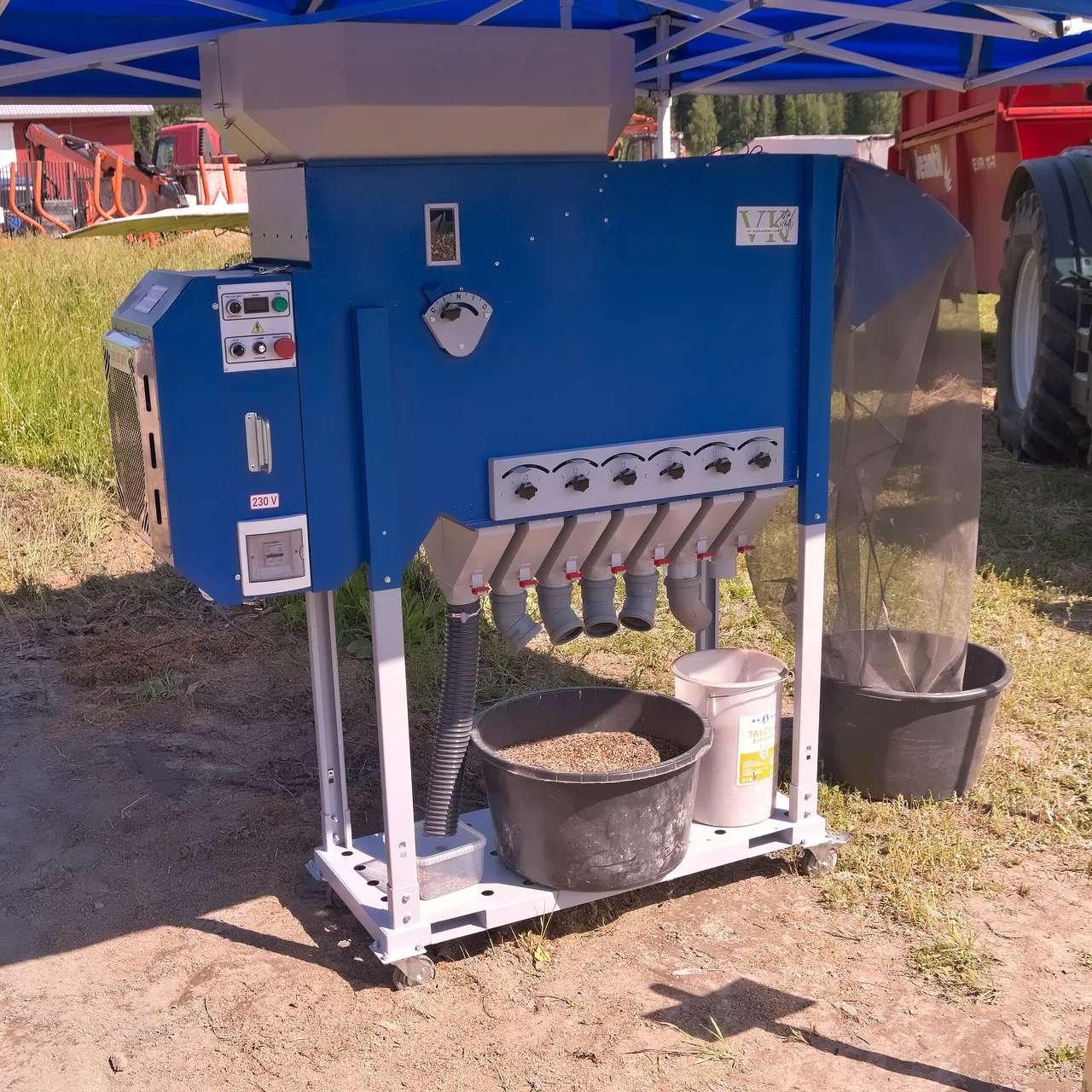
A seed and grain grading machine is the stationary machine that cleans and sizes harvested seed, cereal grain and dried legumes after harvest and before planting, milling or sale. Its working parts are screens that oscillate or rotate, a stream of air, and, in the length grading machines, a cylinder or disc face hollowed into pockets. Together they take straw, chaff, dust, stones, broken kernels and weed seeds out of the lot and divide what remains into fractions of uniform kernel size. The machine is bought as an air screen cleaner, as an indented cylinder grader, or as a combined cleaner grader that carries screens and cylinders on one frame between the receiving pit and the bagging line.
The purchase concentrates on four statements. The first is the lot: which crops, what trash comes in with it and how wet it arrives, because these choose the screens, the pockets and the air volume. The second is the capacity in tonnes per hour at a stated crop. The third is the grade the lot has to meet, since a seed lot is judged by a purity analysis and a cereal lot by its dockage and its grading factors, and the machine must remove exactly what those tests count against it. The fourth is the plant around it: dust extraction, noise, guarding and the bucket elevator and spouts that feed it and take the fractions away.
Five decisions carry the purchase. First the principle or principles: screens for width and thickness, air for light material, indented pockets for length, and which of them the lot needs. Second the screen area and cylinder size that give the capacity on the crop actually handled. Third the air system, its volume and where the dust goes, because grain dust is combustible. Fourth the frame, the drives and their guards, and the access for a screen change between lots. Fifth the grade statement, meaning the test the graded lot must pass.
Chapter 1 / 06
What a Seed and Grain Grading Machine Is and How It Works
A seed and grain grading machine takes a harvested lot as a mixture of crop seed and everything the combine or thresher lifted with it, and divides that mixture by the same logic a seed laboratory applies to a working sample. The laboratory separates pure seed, other crop seed, weed seed and inert matter. Inert matter, in the United States Federal Seed Act regulations, covers broken seed units half the original size or less, empty glumes, free ergot and smut bodies, soil, sand, stone, chaff, stems and leaves. The grading machine takes those fractions out mechanically and, in the same pass, splits the sound seed by size. It stands after the dryer or the receiving pit and before the bagging hopper, the bin or the seed treater.
Screen grading starts with a perforated plate that the kernel either passes or does not pass. A round hole passes a kernel when its least cross dimension, the width, is smaller than the hole; a kernel wider than the hole rides over. A slot passes a kernel thinner than the slot, so a slotted screen sorts by thickness and lets long grains through once they turn on edge. Round shaped seed is cleaned with a round hole top screen and a slotted bottom screen. Elongated seed takes slots above and below. Lens shaped seed such as lentils and flax turns on edge through a slotted top screen and lies flat over a round hole bottom screen.
In an air screen cleaner the lot runs through screens and air in a fixed order. A hopper feeds a metering feeder, and a first air stream, taken before the screens, blows out light chaffy material and dust. The top screen scalps, letting the crop through and carrying straw, heads and large weed seeds over its end. The second screen grades or sizes, a third scalps more closely and a fourth can finish the grading. A second air stream after the screens is set to a stronger blast than the first: plump, heavy seed falls through it against the air, while light seed and chaff are lifted into the trash spout. Two aspiration fans, one before and one after the screens, are standard on a fine cleaner of this class.
Air separates by weight against surface, the property called terminal velocity: the air speed needed to hold a particle suspended in a rising current. It takes shape, surface texture and density together, so two kernels of one width can part company in air. The fan may sit at the discharge, drawing air through the machine as an aspirator, or at the intake, pushing it through as a pressure unit; in both, the air speed is set by the fan intake and everything with a lower terminal velocity is lifted. The air leaves carrying chaff and the finest particles, and the dust that escapes the seals is classed as grain dust when it passes a 40 mesh sieve, 425 microns or less.
Length is the one dimension a screen cannot read, so it is left to pockets. The indented cylinder is a horizontal drum whose inner face is pressed with pockets. The seed mass lies at the bottom; as the drum turns, short kernels lodge in the pockets and are carried upward until they fall out into an adjustable trough and out along a screw. Kernels longer than the pocket are too big to seat and slide back into the mass, so they leave at the far end of the drum. The pockets are chosen as the smallest size that will lift everything to be removed, and a shell carries one pocket size only; grains from 1.0 to 24 mm (0.04 to 0.94 in) can be graded this way.
The indent disc separator does the same job with a row of discs on one horizontal shaft, turning in the seed mass; short seeds such as vetch are lifted out while oats and ryegrass stay behind. Disc pockets are sized by their width in millimeters, and the pockets in a disc bank may grow progressively along the shaft. The rule shared by discs and cylinders is that speed is a setting, not a detail. On a disc separator, variations of only a few revolutions per minute change the efficiency of the separation, so the drive holds a steady speed, and adjustable speed is offered so that the setting can be tuned to the lot rather than fixed at the factory.
Chapter 2 / 06
Seed and Grain Grading Machine Types and Structural Variants
The air screen cleaner is the base machine and comes in three depths. A scalping pre cleaner carries one or two screens and one air passage, and takes out only the coarse trash before the lot goes to a dryer or a store. A fine cleaner stacks several screens, a scalping screen above and grading screens below, between two air passages, and delivers a lot clean enough for seed. A grader is a fine cleaner whose screen set is chosen to split one crop into size grades instead of only removing trash. The screen frame of a fine cleaner allows a flexible screen flow, so one frame takes different screen sets and chutes for different crops and cleaning tasks.
An indented cylinder grader is sold as a single cylinder, as a battery of cylinders or as cylinders in series. A round grain cylinder lifts the short pieces out of long grain, taking cockles and broken kernels out of wheat. A long grain cylinder lifts the good grain in its pockets and leaves the long reject, such as wild oats, to travel through. A re separation cylinder takes the lift of a long grain cylinder and returns the good kernels lifted with it. The drum has no perforations and works as a pocketed surface rather than a trommel screen. Cylinders in one maker's line run from 400 to 900 mm in diameter and from 570 to 4,000 mm long, with a wheat capacity from 0.3 to 16 t/h.
The combined cleaner grader puts the screen section and the length section on one frame. Scalping, aspiration and the screens take out the coarse, fine and light material first, because cylinders work badly on a dirty bed: chaff and dust cushion the kernels and stop them seating in the pockets. The indented cylinder or disc bank then receives a clean lot and removes the short or long kernels that the screens could not reach. The gain is one feed, one frame and one floor space instead of two, and no bucket elevator or spouting between the stages. The cost is that the cylinder must be matched to the screen capacity and that a change of crop can mean changing both the screens and the cylinder shells.
The structure is a welded frame inside a closed housing, and the parts that touch grain are chosen for wear. A cylinder separator is built as a fully closed round housing with a hinged hood, and opening the hood stops the machine through a safety interlock switch. Its shell is split into segments held by quick release catches, so a grading segment is exchanged without pulling the whole cylinder, and the segments can be hardened where the product is abrasive. One fine cleaner in this class carries a painted frame and enclosure rated at corrosivity category C2, low durability, an indoor temperature range of -20 to +40 degrees Celsius (-4 to 104 degrees Fahrenheit) and an intended life limit of 20 years.
Drives are few and open to view. A fine cleaner in this class carries one 3 kW motor for the screen shaft, a 0.75 kW motor for the shaker feeder, a 3 kW motor for pre aspiration and a 4 kW motor for post aspiration, and the screen shaft turns at 280 to 285 rpm. The screen shoe is moved by an eccentric on its shaft and held on swinging supports, so it works as a vibrating screen that decides how the bed travels. Belt drives between a motor and its shaft need fixed guards, the eccentric needs a cover, and the electrical enclosure that holds the starters and the emergency stop needs an IP enclosure rating that keeps dust out.
Two other machines share the word grader and are not this product. A fruit sorter grades produce by color, size and defects on an optical line; it handles soft, wet fruit, not dry kernels. A motor grader is the self propelled machine that levels and finishes soil on a road or a site. The seed and grain grading machine sits in a line with four neighbors of its own. The gravity table and the de stoner separate by density after the screens have taken out everything that differs in size. The seed treater coats the graded lot and must stand after the grader, not before it. A moisture analyzer reports the moisture of the lot, and an optical sorter with cameras can follow the grader where color defects matter.
Chapter 3 / 06
Seed and Grain Grading Machine Key Specification Parameters and Standards
Capacity is the first parameter. A fine cleaner with 24 m2 (258 sq ft) of screen area in 24 screens of 1,250 x 800 mm (49.2 x 31.5 in) is rated at 22 t/h on wheat for fine cleaning and at 25 to 40 t/h for industrial cleaning. On the same frame the ratings fall to 20 t/h on barley, 14 t/h on oats, 12 to 18 t/h on maize and 3 t/h on ryegrass, because capacity follows bulk density: wheat is listed at 0.76 t/m3 and ryegrass at 0.30 t/m3. The maker warns that capacities vary with impurity and moisture content, so a rating holds until tried on the buyer's own lot.
The second group of parameters describes the output and the demands on the plant. The number of fractions is one of them: the dockage tester prescribed for official grain grading divides a sample into the aspirated light material, the matter carried over its riddle, the matter that falls through its sieve and the dockage free grain. The air side is stated as an aspiration volume, 3,600 m3/h (about 2,100 cfm) on the same fine cleaner. Noise is stated for the empty machine, 81.6 dB(A) of sound pressure and 96.1 dB(A) of sound power. The same fine cleaner is declared compliant with EU machinery legislation and not compliant with EU ATEX legislation, so a buyer in a plant zoned for dust knows that the explosion question is left to the plant design.
Three sets of rules apply. ISO 4254-1, the general agricultural machinery safety standard, specifies safety requirements for the design of self propelled ride on, mounted, semi mounted and trailed machines; it reaches a grader when the machine is built as mounted or trailed equipment, and it leaves working tools and the guards of power transmission parts to other documents. A stationary plant cleaner is outside its scope and follows the general machinery safety standard on risk assessment and risk reduction instead. The OSHA rule for grain handling facilities, 29 CFR 1910.272, applies to grain elevators, feed mills, flour mills, rice mills and other listed plants, so it governs a grader inside one of them. The Federal Seed Act regulations, 7 CFR Part 201, set no machine requirement: they define the result the machine has to reach.
Parameter
Typical value or basis
What the buyer states
Capacity on wheat
22 t/h (24 short tons per hour); 25 to 40 t/h industrial cleaning
5 degrees; 280 to 285 rpm fixed, 260 to 300 rpm variable
Fixed or variable shaft speed
Drive rating
Screens 3 kW (4 hp); aspiration 3 to 4 kW (4 to 5.4 hp)
One motor per function
Aspiration volume
3,600 m3/h (about 2,100 cfm)
Air the plant must extract
Indented cylinder
400 to 900 mm (15.7 to 35.4 in) diameter; 0.3 to 16 t/h of wheat
Pocket size against kernel length
Noise, empty machine
81.6 dB(A) pressure; 96.1 dB(A) power
Sound pressure with the machine loaded
Mass and dynamic load
5,800 kg (12,800 lb) empty; 11,300 kg (24,900 lb) choked; 4.6 to 4.8 Hz
Floor and support design
Ambient conditions
Indoors; -20 to +40 degrees Celsius; up to 800 m (2,625 ft)
Plant temperature and altitude
Chapter 4 / 06
Seed and Grain Grading Machine Selection and Duty Calculations
Selection starts from the lot, not from the machine. The engineer works through the crop, the trash it carries, the grade it must reach and the capacity the plant needs, and each step fixes one part of the specification before any catalog is opened.
Capacity is sized from screen area. A fine cleaner with 24 m2 (258 sq ft) of screen rated at 22 t/h of wheat gives close to 1.1 m2 (12 sq ft) of screen per tonne per hour; on ryegrass, rated at 3 t/h, the same screen area gives 8 m2 (86 sq ft) per tonne per hour. The engineer takes the required rate on the actual crop, multiplies by the area that the crop demands and adds a margin for wet or dirty lots, because the maker's ratings hold only at the stated moisture and impurity levels. A plant that grades several crops sizes the machine on the crop with the lowest rating and accepts that the other crops pass through it well under its limit.
Screens are chosen on a sample. The engineer sieves a sample by hand to find the smallest round hole that drops the crop and the widest slot that retains it. The official barley method shows how fine this gets: material that rides over the middle sieve is rescreened on a 5/64 inch equilateral triangular hole sieve, held at a 10 to 20 degree angle and worked with a gentle side to side motion, whenever it holds more than 0.1 percent of wild buckwheat or similar seeds. The prescribed dockage tester runs wheat, barley and rye at an air setting of 4 and a feed setting of 6, but maize at an air setting of 1 and a feed setting of 10, so a screen set and a control setting belong to one crop.
An indented cylinder is sized in two steps: the pocket, then the drum. The pocket is the smallest that will lift every kernel to be taken out, and it is found by trying shells on a sample, because one shell carries one pocket size. The drum follows from the rate: in one maker's line a cylinder 400 mm (15.7 in) in diameter and 570 mm (22.4 in) long is rated at 0.3 t/h on wheat, while one 900 mm (35.4 in) in diameter and 4,000 mm (157.5 in) long reaches 16 t/h. Operating settings are the drum speed, the position of the trough lip that decides where the lifted kernels drop, and the inclination, adjustable from 0 to 3 degrees.
The air duty is calculated after the screens. A fine cleaner that draws 3,600 m3/h (about 2,100 cfm) of air for 22 t/h of wheat moves close to 160 m3 of air per tonne of grain. That air leaves loaded with chaff and dust and must go somewhere: through a cyclone separator, where the chaff drops out, and then an industrial filter with fabric bags for the fine dust, with a rotary airlock at each discharge so that the collected material leaves without letting air back in. Where the OSHA grain handling rule applies, every fabric filter collector in a ducted dust collection system carries a monitoring device that indicates the pressure drop across the filter surface, and that reading shows when the bags are blinded.
Performance is proved by weighing what leaves each spout. The official arithmetic: percent dockage equals the weight of the material removed divided by the original sample weight, times 100, so 24.70 g of dockage from a 250 g sample is 9.88 percent. The seed laboratory works the same way on a purity working sample of 100 g of wheat or barley, 75 g of oats or rye and 500 g of soybeans or field peas; in a sample of 25 g or more the pure seed is found by subtracting the three rejects from 100. On a running machine the engineer takes a timed cut from the feed and from every outlet and builds the same balance, which shows whether good seed is leaving in the rejects.
Decision factor
What the engineer checks
Where it leads
Crop and kernel size
Width, thickness and length spread
An air screen cleaner; an indented cylinder where length matters
Trash load
Coarse, fine and light material
A pre cleaner ahead of a fine cleaner
Capacity on the crop
Screen area per tonne per hour
About 1.1 m2 (12 sq ft) on wheat; 8 m2 (86 sq ft) on ryegrass
Number of fractions
Clean product, size grade and reject spouts
One spout per fraction; a combined cleaner grader adds the length fraction
Dust
Aspiration volume and where the air goes
Cyclone and fabric filter with a pressure drop monitor
Floor and structure
Choked mass and shaking frequency
Floor for 11,300 kg (24,900 lb) at 4.6 to 4.8 Hz
Rules and site
Where the machine stands
ISO 4254-1 for mounted or trailed units; OSHA rule inside listed plants
Chapter 5 / 06
Seed and Grain Grading Machine Installation, Maintenance and Failure Modes
Installation decides how quietly the machine runs and how well it can be cleaned. A grader is set level on a floor that carries its shaking mass, fed evenly from a centered inlet, and wired so that it can be locked out before a screen is touched.
The floor must carry far more than the machine's own weight. The fine cleaner with 24 m2 of screen weighs 5,800 kg (12,800 lb) empty, 6,220 kg (13,700 lb) full of wheat and 11,300 kg (24,900 lb) when choked, and it shakes that mass at 4.6 to 4.8 Hz, the frequency of a screen shaft turning at 276 to 288 rpm, with a horizontal force of about 3,700 N (830 lbf). Feed and discharge spouts are connected with flexible sleeves so that the casing can move without cracking the ductwork, and the inlet is centered on the feeder, because a feed that lands on one side of the screen runs that side deep and leaves the other bare.
The electrical installation is part of the guarding. A cylinder separator stops itself when its protective hood is opened, through its safety interlock switch, and a fine cleaner should be wired to the same rule. An emergency stop button sits at each operating position, a safety fence keeps people off the spouts while the machine runs, and every cable enters the sealed control panel through a cable gland. Grain dust is combustible, so where the air around the machine carries dust the motors and junction boxes are of the dust ignition proof type and the feed to the panel runs through a circuit breaker with earth leakage protection. Before any maintenance the machine is locked and tagged at the isolator, as the OSHA grain handling rule requires for equipment being serviced.
Dust control is a housekeeping routine as much as an extraction system. Where the OSHA grain handling rule applies, the employer runs a written housekeeping program that reduces accumulations of fugitive grain dust on ledges, floors and equipment, and a grain elevator removes any layer above 1/8 inch (0.32 cm) at priority housekeeping areas at once. A fabric filter collector installed after March 30, 1988 must stand outside the facility, or inside an area protected by explosion suppression, or in an area with a one hour fire resistance rating next to an exterior wall and vented outside. The same fine cleaner gives 81.6 dB(A) of sound pressure when empty, which is why a plant adds an acoustic enclosure or a machine noise control housing and issues hearing protectors.
Routine care is short and repeated. Bearings on the screen shaft and on the cylinder run in dust and are greased at the maker's interval with the industrial lubricant it names; a pillow block bearing that begins to rumble is found with a vibration meter before it seizes. V belts are checked for tension and alignment, because a slipping belt slows the screen shoe and lets the bed build up. Under the screens, brushes sweep lodged seed from the perforations and wear down until they stop touching the screen, so they are renewed before the holes blind. Cylinder pockets wear smooth with abrasive seed and then fail to lift, which is why hardened segments are used for such crops.
Changeover between lots is a cleaning job with a witness. The grain is run out until the hopper, the riddle and the screens have cleared, the machine is stopped and locked, and the screens are brushed out. Every pocket in the cylinder is inspected, because a few seeds of the last variety left in a pocket are a mixture in the next lot. The spouts, the trough and the space under the screens are swept by hand or with a vacuum, with a dust mask or a respirator on the cleaner; compressed air is used only under the rule that forbids blowing dust while a machine that could ignite it is running. A check sample after every changeover proves the setting, as check samples prove each part of the official dockage tester.
Interval or trigger
Task
Failure it prevents
While running
Watch bed depth and the reject spouts; sample the product
Plugged screens and good seed in the rejects
At the maker's greasing interval
Grease the screen shaft and cylinder bearings; check belt tension
Seized bearing; slipping belt
On each round
Read the pressure drop across the fabric filter collector
Blinded bags and dust in the room
At each screen change
Lift the screens; check the brushes and gauge worn perforations
Blinded or oversized holes
At each shell change
Inspect cylinder pockets for polished wear
Short kernels no longer lifted
Each lot change
Run empty, stop and lock, draw screens, empty pockets, sweep spouts
Mixture of varieties and weed seed carryover
On each housekeeping round
Remove fugitive grain dust from ledges, floors and equipment
Dust layers above 1/8 inch (0.32 cm)
Chapter 6 / 06
Seed and Grain Grading Machine Applications and Procurement Checks
The main application is seed production. A seed lot offered for sale carries a purity statement found on a working sample of 100 g for wheat, barley and triticale, 500 g for soybeans, field peas and chickpeas and 120 g for lentils, and the grading machine removes most of what that sample would count against the lot. The second application is cereal grain for milling and export, where broken kernels and other factors decide the grade once the dockage has been removed and weighed. The third is dried legumes, which are traded by size and by the share of broken and split seeds; their lens shaped kernels call for a slotted top screen and a round hole bottom screen, and an indented cylinder for length.
In the plant the grader is one station in a line that runs from intake to the bag. A bucket elevator lifts the raw lot into a surge hopper above the feeder, and a level switch on that hopper stops the feed when it runs low. The rejects leave by spout into a screw conveyor. Downstream, the graded seed may pass a gravity table and then a seed treater before it reaches a hopper scale on a load cell and the bagger. The extraction fan is a centrifugal fan with its own motor protection relay, and the cylinders, the screens, the feed and that fan are interlocked in a plc so that the machine cannot be fed unless the air is moving. Where color defects matter, a camera sorter built around an industrial camera follows the grader.
Cost and lead time follow from the parts that touch the grain. Screen area is bought by the screen, so a machine sized on a light crop such as ryegrass costs more than one sized on wheat; a cylinder is bought by its shell, and one shell carries one pocket size, so a crop that needs its own pocket adds a shell. Beyond the base machine the price moves with the variable frequency drives on the feeder and the screen shaft, the electrical rating for a dusty plant, the acoustic lining and the spare screen sets and cylinder segments that a plant should order with the first machine. One cylinder builder proves each unit with a 24 hour test run before dispatch and accepts samples for laboratory trials.
A purchase order for a seed and grain grading machine states the crop or crops with kernel dimensions and moisture, the hourly rate on each crop, the incoming trash load and the grade the lot must reach, with the test method named. It asks for the screen area, the number and size of the screens and the perforations proposed, and for the cylinder diameter, length and pocket size where length grading is required. It fixes the number of outlet spouts and which fraction each delivers, the aspiration volume and what the maker supplies for dust collection, the motor list with ratings and the enclosure and explosion protection ratings for the site. The buyer asks for the sound pressure level with the machine loaded, the masses empty and choked and the dynamic loads for the floor designer, the surface protection category and the expected life. Delivery should include the guarding and interlocks, the screen sets and cylinder segments for the first crops, the spares list, the instruction manual, a factory or site acceptance test run on the buyer's own lot, and the commissioning and operator training.
FAQ
How does a seed and grain grading machine work?
It separates the lot in three ways at once. Oscillating screens with round holes pass kernels by width and slotted screens pass them by thickness, so large trash rides over the top screen, the good seed drops through and broken kernels fall through a lower screen. A stream of air before and after the screens lifts chaff, dust and light seed. Where length matters, an indented cylinder lifts short kernels out of the mass in its pockets while long kernels stay behind. The machine delivers one clean fraction and one or more reject fractions through separate spouts.
What types of grain grading machine are there?
Three configurations cover most plants. The air screen cleaner stacks several screens between two air passages, as a light pre cleaner or as a full fine cleaner. The indented cylinder grader grades by length alone, with a drum 400 to 900 mm (15.7 to 35.4 in) in diameter, and an indent disc separator does the same job with a row of pocketed discs. The combined cleaner grader mounts screens, aspiration and a cylinder or disc bank on one frame, so the lot is cleaned and length graded without a second machine.
Which specifications matter most on a seed grader?
Capacity on the actual crop comes first, and it is tied to screen area: a fine cleaner with 24 m2 (258 sq ft) of screen is rated at 22 t/h on wheat but only 3 t/h on ryegrass. Then come the screen shaft speed, 280 to 285 rpm, the aspiration volume of 3,600 m3/h (about 2,100 cfm) and the motor ratings. For a cylinder grader the drum diameter, length and pocket size decide the result, and drums from 400 to 900 mm (15.7 to 35.4 in) grade grains from 1.0 to 24 mm (0.04 to 0.94 in).
How do I choose the right size of grading machine?
Start from the crop with the lowest capacity rating. Find the smallest round hole that drops the good seed and the slot that retains it. Work out the screen area from the maker's rating on that crop: a fine cleaner with 24 m2 (258 sq ft) of screen rated at 22 t/h of wheat works out at about 1.1 m2 (12 sq ft) per tonne per hour, and at 8 m2 (86 sq ft) per tonne per hour on ryegrass. Add margin for wet or dirty lots, match the cylinder to the screen capacity and ask for a trial on your own lot.
What installation and maintenance does a seed and grain grading machine need?
Set it level on a floor designed for the choked mass; one fine cleaner weighs 11,300 kg (24,900 lb) when choked. Connect spouts with flexible sleeves, fit an emergency stop and interlocks on every access door and lock the machine out before any work on it. Grease the screen shaft and cylinder bearings, keep belts tight, renew the brushes under the screens before they stop touching, and watch for polished cylinder pockets. Between lots or varieties, run the machine empty, stop it, draw the screens and clear every pocket, then prove the setting with a check sample.
What drives the cost and lead time of a seed and grain grading machine?
Screen area and the number of cylinders drive the price. A machine sized on a light crop such as ryegrass needs far more screen than one sized on wheat. Options add cost: variable frequency drives, a version rated for a dusty or zoned plant, acoustic lining, and spare screen sets and cylinder segments. Lead time depends on the frame, the shells and the control panel. One cylinder builder proves each unit with a 24 hour test run before dispatch and accepts samples for laboratory trials, so ask for a trial on your own lot.
What safety rules and standards apply to a seed and grain grading machine?
ISO 4254-1 covers the safety of self propelled, mounted and trailed agricultural machines, so it reaches a grader only in that form; a stationary plant cleaner falls under the general machinery safety standard instead. Inside a grain elevator, feed mill or flour mill the United States rule for grain handling facilities applies: a written housekeeping program, immediate removal of dust layers above 1/8 inch (0.32 cm) at priority areas, a pressure drop monitor on every fabric filter collector, and locks and tags on equipment being serviced.