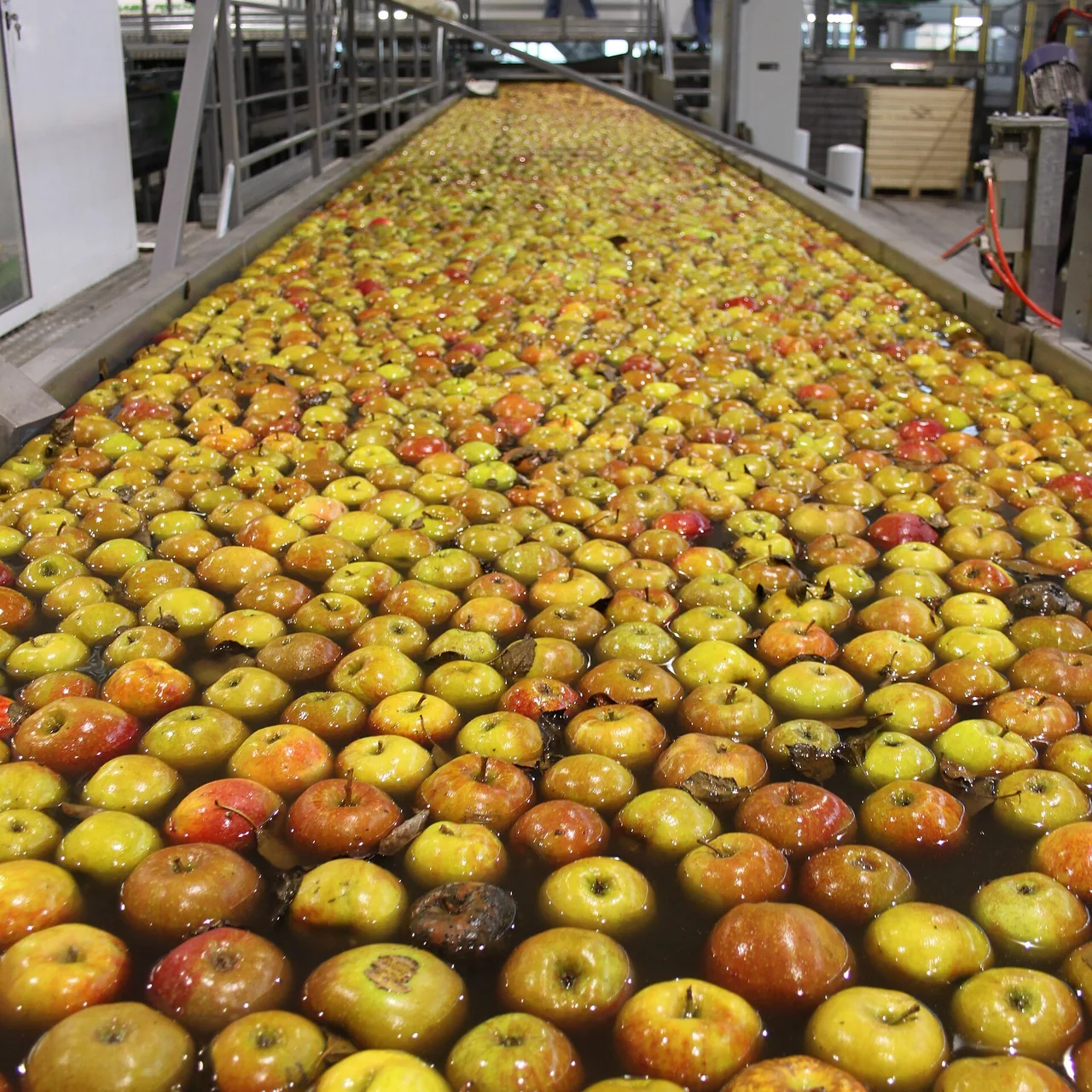
A fruit sorter is the grading machine of a fruit packing house: it takes a stream of washed fruit, separates it into single pieces, carries each piece past sensors, and sends it to a grade outlet by weight, size, color, visible defect and, on the more complete machines, internal quality. Everything upstream, the bin dumper, washer, dryer and waxer, exists to deliver clean dry fruit to it. Everything downstream, the bagger, carton filler, bin filler and labeling machine, packs what it has decided. Capacity is quoted in pieces of fruit per hour and per lane, because a sorter is built as parallel lanes and the lane, not the whole machine, is the unit that carries, inspects and diverts.
It is addressed to the packhouse engineer who has to size a line, write the purchase specification, or explain why a grade drifted. It follows the fruit from the singulator to the grade outlet, describes what each sensor can and cannot measure, sorts the machine types by what they measure and by what carries the fruit, and gives the parameters, the capacity arithmetic, the standards and the failure modes that recur on every installation. Figures for grade tolerances, color and bruise limits come from the United States apple grade standards, the weighing figures from a grading machine builder, the camera and internal quality description from an apple grading line builder, and lighting, guarding and noise limits from FAO and OSHA.
The buying decision concentrates in five places. Capacity in pieces per hour comes from season volume and packing hours and sets the lane count. What the machine must measure comes next, because weight, size, color, external defect and internal quality each add a sensor and a grade outlet. Grading accuracy has to be judged against the tolerance of the grade being packed. The carrier, a cup, roller or lane, decides bruising and how much of each fruit the cameras see. Last come the trial with the buyer's own fruit, the grade definitions loaded in the software, and the service and spares behind them.
Chapter 1 / 06
What a Fruit Sorter Is and How It Works
A fruit sorter measures each piece of fruit and acts on the measurement while the fruit keeps moving. It does not clean, cool or preserve anything. Its output is a set of lots that meet written grade definitions: a minimum diameter or weight, a color percentage, a limit on defect area, an absence of decay or internal breakdown. In the United States apple standards, for example, U.S. Extra Fancy and U.S. Fancy are separate grades with different limits on bruises and russeting, and the sorter is the device that assigns each apple to one of them at line speed. A machine that misassigns fruit does not damage it. It costs the packer money in two ways, by packing a lower grade as a higher one and by sending good fruit to the cull bin.
The path through the machine has four zones. An infeed receives bulk fruit from a bin dumper, in some houses a continuous submerger, and delivers an even flow. A singulator spreads the fruit and places one piece in each carrier. The carriers take the fruit through an inspection zone where every sensor sees it. A PLC tracks each carrier and stores its measured grade as it travels on. At the outlets the machine acts on that stored grade. A rotary encoder on the drive shaft counts carrier positions, so the decision taken at the camera is carried out at the right outlet many meters later. If the count is lost the machine diverts the wrong fruit with perfect consistency.
Three carrier designs are common, and each presents the fruit differently. The cup carrier is a conveyor chain carrying plastic cups, one fruit per cup, with the fruit sitting stem down or on its side. The roller carrier carries each fruit on a pair of driven rollers that turn it as it travels, so the cameras see the stem end and calyx end as well as the cheeks. Lane machines run single-file fruit on a belt conveyor or between guides, with no carrier at all. Weight grading needs a carrier that isolates one fruit at a time, so cups and rollers dominate where fruit is weighed. Color and surface grading need the fruit to rotate, so rollers dominate where the whole surface has to be inspected.
The sensors in the inspection zone are chosen for what the grade asks. A load cell under each cup or roller pair, a strain gauge bridge built into the carrier, weighs the fruit in motion, and a weighing indicator digitizes the signal once the carrier has come up to speed and before the fruit leaves. Size comes from the camera image, as diameter or as projected area, or from weight when the standard allows either, as the apple standards do for two varieties. Color comes from an industrial camera on each lane lit by a steady vision light source, which measures the area of the surface covered by the required shade. One apple grading line builder describes 4 cameras working with hyperspectral imaging, so the whole surface of each apple is scanned several times and rebuilt as a 3D shape.
External defects are found in two ways. Visible and hyperspectral images show russeting, scars, sunburn, bruises, rot and stem or calyx damage, and a 3D shape model finds dents and off-size fruit. Ultraviolet fluorescence and infrared images add defects that are hard to see in color, and a model trained by deep learning grades each defect by severity. Internal quality is measured without cutting the fruit by near infrared spectroscopy, which reads how the flesh absorbs light at each wavelength and from that estimates sugar content, maturity, water core and internal physiological disorders. X-ray measures density and is used where a grade asks for hollow or dense internal structure. Each added sensor needs its own calibration samples and its own maintenance, so a sorter should measure what the grade actually requires.
Diversion is the last zone and the one that most often goes wrong. Most machines use air. At each outlet a nozzle over the carrier aims at the fruit, and a fast solenoid valve opens for a few milliseconds when the carrier holding a reject or a target grade passes, blowing that one piece into a cross belt or a bin. A machine with many grades places one ejector bank per outlet, or drops fruit through a tilting tray or flap driven by a pneumatic actuator. Upstream of the ejectors, an air dryer, a filter and an air receiver hold the supply dry and steady, because a wet or soft air supply weakens every outlet at once. A photoelectric sensor at each outlet can confirm that fruit has left the carrier.
Chapter 2 / 06
Fruit Sorter Types and Structural Variants
Sorters are first classified by what they measure, because that is what sets the price of the sensors and the number of outlets. A weight grader weighs every fruit and sorts it into weight bands, which is how fruit sold by count per carton is sized. A size grader measures diameter or shape from a camera image. A color sorter measures the colored area of the surface. An external defect sorter adds hyperspectral or ultraviolet imaging and sorts by type and severity of defect. An internal quality sorter adds spectroscopy and sorts by sugar content, maturity, water core or an internal disorder. A line rarely buys one of these alone. The common machine weighs and images every fruit, and the buyer chooses which of the further sensors to add.
The second classification is by carrier. Cup machines carry one fruit in each cup on a chain and are built with a few lanes for a small grower or with many lanes for a cooperative. Roller machines carry each fruit on rotating rollers and are used where surface inspection matters, as on apples and pears. Single-file lane machines run fruit end to end on narrow belts and are simple, and a compact one can be built around a smart camera per lane, but the machine sees less of each fruit. For small fruit such as cherries and blueberries the carrier is often a high speed belt or a set of rollers with ejector banks above it, because one-piece carriers become impractical at that size. One builder describes a roller carrier that gives accurate weight measurement and high speed singulation together with reliable camera presentation.
The third choice is where the machine sits in the process. A pre-sizer grades fruit into bins before storage, so the house knows what it holds and can commit to orders before packing. A commit-to-pack machine grades straight into the pack, which means every fruit is handled once less but the line has no second chance at a misgraded piece. Machines also differ in whether they run wet or dry. A grader that takes fruit straight from the washer needs a gripper or carrier that sheds dirt and water, because water on a lens or on the fruit skin changes what the camera measures. One builder describes a pre-sizing unit whose gripper removes dirt and water and that runs in wet or dry environments.
Construction follows sanitation rather than crop. A machine that is hosed down every day is built on a stainless steel frame with smooth welds, rounded corners, no ledges that hold water or fruit debris, and EPDM rubbergaskets at every joint. Product-contact parts are plastics and elastomers chosen for food contact. Guards are clear polycarbonate or stainless mesh so operators can see the fruit. Electrical cabinets are sealed to a stated IP enclosure rating, with washdown cable gland fittings on every entry, and drives sit inside the cabinet or in stainless boxes with sloped tops. Machines built for a dry room may use a painted frame and open guards. They cost less and are harder to clean, which matters when the same line is to run washed fruit.
The boundary against neighboring equipment is drawn by what is measured. A conveyor sorting line and a sorting system are warehouse and parcel machines: they read an identity, a bar code or an address, and send a sealed item to a destination. They do not weigh or image the product to decide its grade. A machine vision system is the general inspection tool, cameras, lighting and software that return a measurement, and a fruit sorter contains one or more of them inside a machine that also carries and diverts the fruit. A checkweigher checks the weight of a finished pack, and an electronic scale weighs a sample by hand. Both sit beside a fruit sorter and neither grades fruit in motion.
What the machine sits between decides much of its specification. Upstream are the receiving, washing, drying and waxing sections, and the sorter inherits their sins: sand from the washer dries on lenses, wax changes surface color, and a wet fruit surface scatters light. Downstream, each grade outlet must feed something. An outlet may feed a bagger or a carton filler working by weight or piece count, a tray line with a labeling machine and a case packing machine, or a bin filler for fruit held for later packing. The number and spacing of the outlets is fixed by the packing plan, not by the sorter, and a line that adds a grade after installation usually has to add an outlet as well.
Chapter 3 / 06
Fruit Sorter Key Specification Parameters and Standards
Six parameters appear on nearly every fruit sorter datasheet, and a buyer should be able to state a target for each before asking for a quotation. The number of lanes sets capacity. The throughput per lane is stated in pieces of fruit per second or per hour and falls as fruit gets larger and heavier. Grading accuracy is the spread of the measurement around a true value, and for weight it is stated in grams. The fruit size range gives the smallest and largest fruit the carrier and the singulator accept. The number of grade outlets sets how many classes the machine can pack at one time. Air and power requirements set what the building must supply. The ranges given here are orientation figures from general practice, not a builder's rating.
Two documents govern the hygiene of the machine, and they address different risks. EN 1672-2 is the hygiene and cleanability standard for food processing machinery. It sets common requirements for machinery and machine components used in preparing food for humans, and its object is equipment that can be cleaned, sanitized and left to drain dry. In the European Union, materials that touch fruit must also be inert. The EU food contact regulation states that materials and articles shall not transfer their constituents to food in quantities which could endanger human health or bring about an unacceptable change in the composition of the food. A builder answers that with written declarations of compliance for each plastic, elastomer and lubricant on the machine.
Machinery and electrical safety are covered by three further documents. In the United States the OSHA machine guarding rule, 29 CFR 1910.212, requires one or more methods of machine guarding against point of operation hazards, ingoing nip points and rotating parts, requires that guards be affixed to the machine where possible, and requires that machines designed for a fixed location be securely anchored. IEC 60204-1 covers the electrical equipment of the machine from the point where the supply connects to it. ISO 13849-1 gives the method for designing the safety-related parts of the control system, the circuits behind an emergency stop button or a safety light curtain, and leaves the performance level to be set by the application. Noise is a hygiene issue as well. The OSHA noise rule sets 90 dBA as the permissible level for 8 hours and starts a hearing conservation program at 85 decibels.
Parameter
Typical value
What it decides
Lanes per machine
2 to 20 lanes
Capacity and footprint
Throughput per lane
Commonly 5 to 12 pieces of fruit per second
Lane count for a required rate
Weight grading precision
Up to 2 grams (0.07 oz)
Closeness to a weight tolerance
Weight tolerance example
160 g target, plus or minus 8 g
Band width in the grade table
Fruit size range
About 20 to 100 mm (0.8 to 4 in)
Cup, roller and singulator size
Grade outlets
4 to 12 outlets
Packing stations and bins
Compressed air
About 6 bar (87 psi)
Ejector force and response
Installed power
3 to 40 kW (4 to 54 hp)
Electrical supply
Manual sorting station lighting
500 to 1000 lux
Defect spotting before the machine
Noise exposure
90 dBA for 8 hours
Hearing protection and enclosure
Apple grade tolerance
10 percent of a lot may fail the grade
Accuracy the sorter must hold
Apple undersize tolerance
5 percent below minimum diameter
Size grading limit
Wash water upstream
pH 6.5 to 7.5, 100 to 150 ppm chlorine
Clean fruit at the cameras
Bruise counted as injury
0.125 inch (3.2 mm) deep, 0.625 inch (15.9 mm) in diameter
Carrier padding and drop height
Chapter 4 / 06
Fruit Sorter Selection and Duty Calculations
Four numbers size a fruit sorter, and each one depends on the one before it: the rate in pieces per hour, the lane count, the number of grade outlets, and the buffer volume that keeps the line running through short stoppages.
Start with the season, not with the machine. The season volume is known in bins, and the bins are known in pieces, because the count in a bin follows from the fruit size. The hours are the hours the house can actually run: hours per day, days per week, and the weeks in the season, less the time the line is washed, waiting for fruit or short staffed. Rate is volume divided by those hours, in pieces per hour. The design capacity is set above that rate, because a sorter that only just meets the average has no margin for a heavy picking week. A house with 4,000 bins to pack in 800 hours needs 5 bins an hour, and should buy for about 6.
Lane count follows from the rate and the fruit. Each lane carries a number of pieces per second that depends on fruit size, carrier pitch and how fast the sensors can expose and read, so the per-lane rate must be taken from the builder for the size being packed, not from the top of a brochure. Lanes are the rate in pieces per hour divided by the per-lane rate, rounded up. Outlets follow from the grade definitions: a house that packs several grades in several sizes needs a path through the machine for every grade and size pair, and two of them can share an outlet only if the fruit is kept apart downstream. Fewer outlets means repacking by hand, which is the cost the machine was bought to remove.
Buffers are sized by the stop they have to ride through. Between the washer and the sorter, a short length of roller conveyor holds fruit while a jam at the singulator is cleared, so the washer does not have to be stopped and restarted with it. Between the sorter and the packing stations, bins or an accumulation table hold graded fruit while a bagger or a case packing machine is changed over. In each place the buffer is the rate multiplied by the longest stop the plan allows. A buffer that is too small passes every stop upstream and downstream. A buffer that is too large holds fruit longer than its cooling or its surface finish allows and adds handling.
Accuracy is checked against the tolerance of the grade, and the grade usually allows more error than buyers expect. The apple standards let 10 percent of a lot fail the grade and let 5 percent of the apples be smaller than the stated minimum diameter. A weight grader that holds within 2 grams of true weight is well inside a weight tolerance, and one builder gives the example of citrus with a 160 g target held to plus or minus 8 g to stay within Extra class. The place to spend accuracy is where the tolerance is tight: the line between a bruise that scores as injury and one that does not is a bruise deeper than 0.125 inch (3.2 mm), or more than 0.625 inch (15.9 mm) in diameter. A sorter should be bought for its weakest needed class, not for its average.
The last check is the building. An ejector machine needs compressed air at a steady pressure, dried and filtered before it reaches the line, and the air consumption of many outlets firing at once is larger than the sum of their average flows. An air receiver close to the machine covers the peaks, and a pressure sensor on the manifold gives warning before the ejectors go soft. Power is drawn by the drives on each section, and the beds are usually driven through a variable frequency drive so that each speed matches the one before. The floor must be level across the machine and able to carry it without deflection, because a cup chain that runs through a dip wears and spills.
Decision factor
Rule or typical value
Effect on the line
Season volume and packing hours
Rate equals volume divided by available hours
Minimum capacity
Fruit size and count per bin
Convert bins to pieces per hour before choosing lanes
Fruit Sorter Installation, Maintenance, and Typical Failure Modes
A fruit sorter is a measuring instrument that is also a machine in a wet room, and it needs the discipline of both. Installation fixes the conditions under which it measures. Calibration ties its readings to real fruit. Maintenance keeps those readings from drifting between one season and the next.
Installation begins with the floor and the light. The machine is set level and anchored, as the OSHA guarding rule requires for machines designed for a fixed location, and its infeed and outlets are aligned to the equipment on both sides so that fruit does not drop or jam at a transfer. Ambient light is controlled next. Daylight through a door or a window changes the color a camera sees between morning and afternoon, so the inspection zone is enclosed, the room has constant artificial lighting, and lamps are not changed for a different type without a new color calibration. The manual sorting table that still stands before or after the machine needs 500 to 1000 lux at the work surface, with dark, dull belts to reduce eye strain.
Calibration is done with real fruit, in a fixed order. Weight is set first, with certified test weights on a cup and checked against a bench scale, because every weight grade depends on it. Track timing is set next: a marked cup is followed from the encoder to the last outlet and the delay is adjusted until the ejector fires under that cup. Color and size are set with a reference tile and a sample of fruit measured by hand. Internal quality is calibrated last and with cut fruit: a sample is read by the machine, then each piece is cut and its juice read on a refractometer, and the model is fitted to the two sets of readings. The fit holds only for fruit like the sample.
Guarding and electrical work come before the first fruit. Fixed guards cover the infeed nip points, the conveyor chain and the roller drives, the guards are fixed to the machine, and every guard door that is opened in normal service has a safety interlock switch so the drive stops when it opens. The electrical equipment is built to IEC 60204-1, with the control cabinet and its cable glands sealed against washdown. An emergency stop button is placed at each operator station, a safety light curtain may protect the hand packing stations, and the safety functions are designed to ISO 13849-1. Before a jam is cleared by hand the machine is locked out, never merely stopped from the HMI.
Maintenance is mostly cleaning and secondarily replacement. The camera windows, lamps and the vision light source are wiped at the start of each shift and whenever the wash line has been running, because a film of dried wash water shifts every color reading on the lane. Rollers, belts and the UHMWPE wear strips that guide the cups are inspected for wear, since a fruit that no longer rotates hides its stem end from the cameras. The air line filters are changed on a schedule rather than when they clog, and the air receiver is drained. The conveyor chain is checked for stretch and lubricated with a food grade lubricant. Software is maintained as well: a model trained by deep learning has to be retrained when a new variety or a new defect appears.
The failure modes follow from the same list. Misgrading from dirt or lighting is the most common: the machine grades consistently but against the wrong reference, so the packed lots drift out of tolerance while every alarm stays quiet. Bruising comes from worn padding, from a transfer that has dropped out of alignment, or from fruit ejected too hard into a hard bin. Singulation faults show as two fruits in one cup or a fruit riding on another, and the sensors then read one piece as another and divert both wrongly. A weak air supply leaves rejected fruit in the premium grade. A slipping encoder shifts every diversion by one or more carriers. Each has the same first test: run a known sample through and count where each piece lands.
Failure mode or task
Symptom or check
Action
Camera window and lamps
Grade drift with no alarm; wipe each shift
Clean the glass and the vision light source; check with a reference tile
Rollers, belts and wear strips
Fruit stops rotating; polished tracks
Replace worn rollers, belts and UHMWPE strips
Air line filters
Ejector force falls; low reading at the pressure sensor
Change the filter on schedule and drain the air receiver
Load cell calibration
Weight grade skewed; test weights each week
Re-zero with test weights and confirm on a bench scale
Internal quality model
Sugar reading drifts from cut samples
Recalibrate against a refractometer on cut fruit
Defect models
A new variety or a defect not seen before
Retrain the model and validate with hand graded fruit
Singulation
Two fruits in one cup; fruit riding on fruit
Reset singulator gap and speed; check the infeed rate
Bruising
Bruises over 0.125 inch (3.2 mm) deep at packing
Renew padding and realign the transfer
Guards and safety circuits
Before each season and after any change
Test the safety interlock switch, emergency stop button and safety light curtain
Chapter 6 / 06
Fruit Sorter Industry Applications and Procurement Checks
Apples and pears are the crop against which most fruit sorters are designed, because the grades are detailed and the fruit is firm enough to be carried on rollers. The United States apple standards make the sorter's job concrete. Color is a percentage of the surface for named varieties, 66 percent for Red Delicious in U.S. Extra Fancy against 40 percent in U.S. Fancy. Russeting is limited by the aggregate area it covers. A bruise counts as injury beyond 0.125 inch (3.2 mm) in depth or 0.625 inch (15.9 mm) in diameter. Size may be stated as a minimum diameter, as a count per container, or for two varieties as diameter or weight, with 2.5 inches or 100 grams as one of the listed pairs. Each of these is a cut point the operator sets in the software.
Citrus, stone fruit and kiwifruit are graded on the same machines with different cut points. Citrus and stone fruit are sold by diameter and count, so size from the camera image and weight carry most of the decision, and internal quality is added where the market pays for maturity. One grading machine builder publishes weight bands as an example of a grade table: apples under 150 g, from 150 to 180 g and over 180 g, and kiwifruit under 90 g, from 90 to 110 g and over 110 g. Peaches, apricots and other soft fruit bruise more easily than apples, so the same grade tolerance has to be met with gentler carriers, lower line speeds and more padding at the transfers, which lowers the pieces a lane can carry.
Small fruit and large fruit sit at the two ends of the same design. Cherries, blueberries and table grapes run on machines with many narrow lanes, where a lane is a narrow belt and ejectors work in banks, and throughput per lane is high because each piece is light. Melons, mangoes and avocados run on a few wide lanes with carriers that cradle one fruit, and throughput per lane is low. Every installation has the same bookkeeping around it. A data logger or the line software records the count and the weight leaving each outlet by lot, a code reader at the infeed identifies the bin, and the packed goods leave on a plastic pallet after a shrink wrapping machine and a strapping machine. The records are what turn a grade from a claim into a fact the buyer can check.
When the request for quotation is written, it should state and ask for the following. State the fruit, the varieties, the size range and the expected pieces per bin. State the season volume, the packing hours and the resulting rate in pieces per hour. Attach the grade definitions as tables: every size cut, every color percentage, every defect with its area limit, and the tolerance allowed in each class. State the number of outlets and what each one feeds. Ask for a trial on the buyer's own fruit, from mid season and late season, with the results counted by hand and reported per grade. Ask which sensors are fitted and how each one is calibrated. Ask who owns the grade models, who retrains them, and whether a new variety can be added on site. Ask for the air pressure and consumption, the installed power and the noise level at the operator positions. Ask for declarations of compliance for food contact parts, the guarding scheme, and the electrical and safety standards the machine is built to. Ask for the spares list, the delivery time for wear parts, and the service response during the season.
FAQ
How does a fruit sorter work?
Fruit leaves the washer and enters a singulator, which places one piece in each cup or between each pair of rollers. The carriers carry the fruit through an inspection zone. There a load cell weighs it, cameras measure its size, color and surface defects under controlled lighting, and on some machines spectroscopy reads its internal quality. A controller stores the grade for each carrier position, counted by an encoder on the drive. When the carrier reaches the outlet for that grade, an air nozzle fires or a tray tips and the fruit leaves the line into a bin, a bagger or a carton filler. Nothing is done to the fruit except measured and moved.
What types of fruit sorter are there?
They are classed by what they measure and by what carries the fruit. By measurement there are weight graders, size graders, color sorters, external defect sorters that use hyperspectral or ultraviolet imaging, and internal quality sorters that use spectroscopy or X-ray. Most multi-lane machines combine weight, size, color and defect sorting and add internal quality as an option. By carrier there are cup machines with one fruit in each cup on a chain, roller machines that turn the fruit so the cameras see all of it, and single-file lane machines on belts. Small fruit such as cherries and blueberries usually runs on narrow belts or roller beds with banks of ejectors above.
Which specifications matter most on a fruit sorter?
Start with the number of lanes and the throughput per lane, because together they set the capacity in pieces of fruit per hour. Then read the grading accuracy for each measurement: weight precision in grams, size in millimeters, and the defect detection rate for each defect the grade names. Check the fruit size range the carrier accepts and the number of grade outlets. Ask for the air pressure and consumption and the installed power. On the datasheet, challenge any accuracy figure that does not state the fruit, the line speed and the test method it was measured at. A builder who cannot give those three is quoting a number rather than a rating.
How do I choose the right size of fruit sorter?
Work from the season, not from the machine. Divide the season volume, converted to pieces of fruit, by the hours the line can run, and the result is the average rate in pieces per hour. Add a margin for heavy weeks and set that as the design capacity. Ask the builder for the throughput per lane at your fruit size and divide the design capacity by it to get the lane count. Count the grade and size pairs you pack and make sure the machine has an outlet for each. Last, size the buffers: the rate multiplied by the longest stop at either end of the machine. Then run a trial at that rate before ordering.
What happens during installation and routine maintenance?
Installation sets the conditions for measuring. The machine is leveled and anchored, aligned to its infeed and outlets, and shielded from daylight so the cameras see a constant light. Calibration follows with real fruit: test weights for the load cells, a marked cup for the track timing, a reference tile for color, and cut samples read on a refractometer for internal quality. In routine service, the camera windows and lamps are wiped each shift, rollers, belts and wear strips are inspected for wear, air filters are changed on schedule, and the chain is lubricated with food grade oil. When a new variety appears, the defect models are retrained and checked against a hand graded sample.
What drives the cost and lead time of a fruit sorter?
Cost follows lanes, sensors and outlets. Capacity sets the lane count, and every lane carries its own cups or rollers, cameras, load cells and ejector valves. Internal quality spectroscopy and hyperspectral or X-ray inspection are the expensive additions, and each raises the software cost as well because it needs models and calibration. Washdown construction in stainless steel with sealed cabinets costs more than a dry room frame and lasts longer under daily hosing. Lead time lengthens with the number of outlets to be laid out, the integration with existing washers and packers, and the building works for power and air. Software training and the trial run on the buyer's fruit belong in the schedule, not after it.
What are the main safety and standards requirements for a fruit sorter?
A fruit sorter must be guarded, electrically safe and cleanable. In the United States the OSHA machine guarding rule requires guards against nip points and rotating parts, fixed to the machine, and requires the machine to be anchored. The electrical equipment is built to IEC 60204-1, and the safety circuits behind the emergency stop and any interlocked guard door are designed to ISO 13849-1. Hygiene follows EN 1672-2 for food processing machinery, and materials that touch the fruit must meet the food contact rules, in the European Union Regulation (EC) No 1935/2004. If the noise at an operator position reaches 85 decibels over 8 hours, the OSHA hearing conservation program applies.