A palletizer converts a stream of packages into unit loads. It receives cases, bags, crates or trays, orients and places them in a repeatable pattern, and hands each completed pallet to the next process. One system builds whole layers before transferring them; another uses a robot to place individual items or groups. Both require a reliable supply of products and empty pallets and a way to discharge the stack without disturbing it.
Buy a completed pallet flow, including the changeovers and interruptions that occur on the line. The individual placement rate can look satisfactory while the cell runs out of prepared pallets, waits for the wrapper or loses time recovering partially completed layers. Specify package condition, allowed orientation, load quality and the output measured at handover, then use representative products to verify the full sequence.
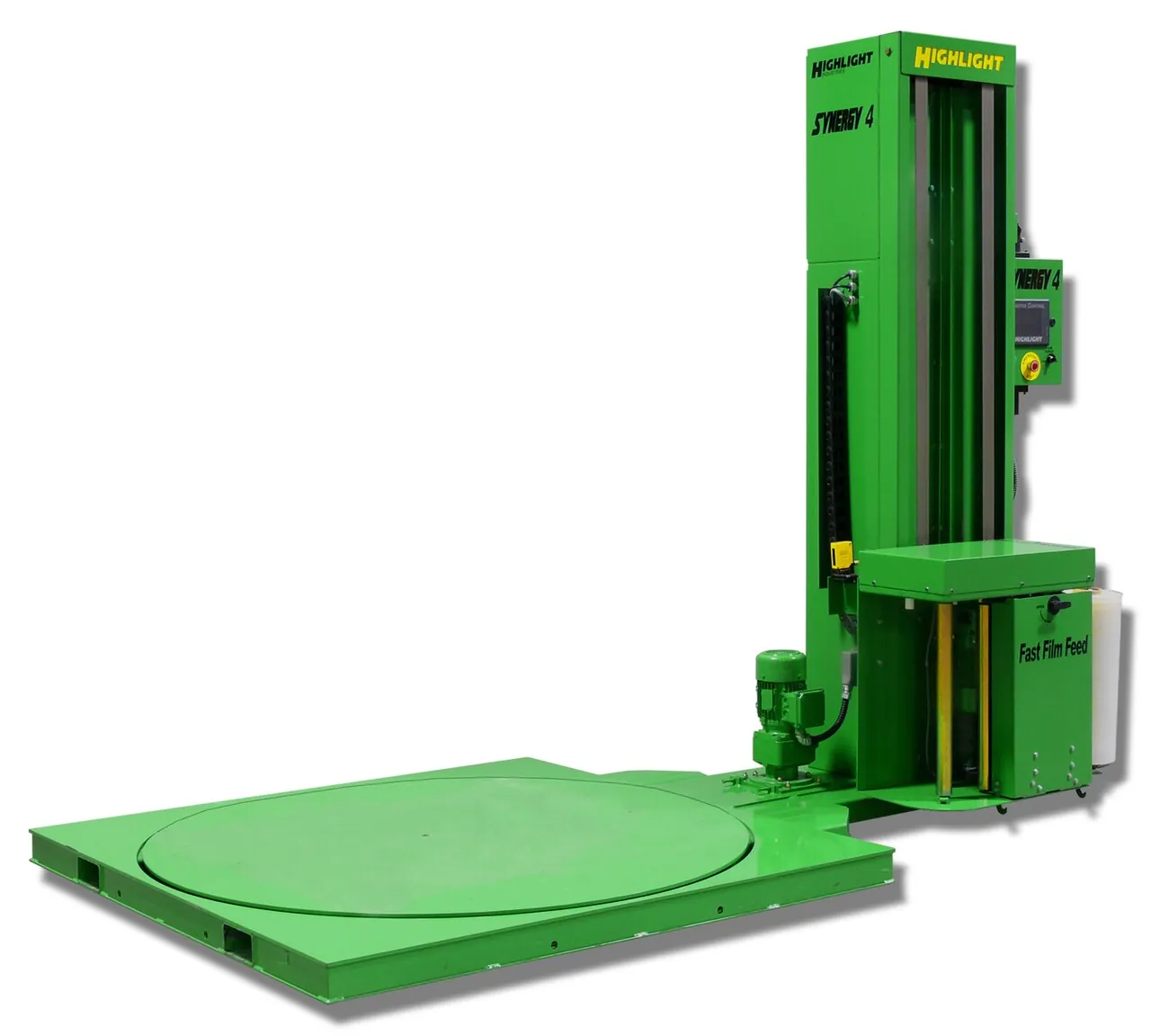
Turntable stretch wrapper with a film carriage. Context photo: Imsquare22, Public domain via Wikimedia Commons.
A usable specification puts the package family, pallet recipe, throughput boundary and rejection policy on the same drawing and schedule. Tooling and controls must meet all of those constraints while operators can replenish, change over and recover the cell safely.
Chapter 1 / 06
What a palletizer includes
The cell begins where the upstream process surrenders identifiable and correctly oriented packages. An upstream carton erecting machine sets up blanks, and a capping and sealing machine closes the applicable containers or cases. A checkweigher can reject a package before it becomes hard to reach in a load. The palletizer usually owns accumulation from an agreed position, orientation or centering, empty pallet supply, controlled placement and finished load release. A wrapping machine stabilizes or protects an already built load and has its own availability and handoff requirements.
The line boundaries should define requests and confirmations for empty pallets, product arrival, receiving space and release. A photo-eye blocked by a transit pallet does not necessarily mean a transfer is complete. A pallet waiting across two conveyor zones can block the next stack and prevent an operator from diagnosing which machine owns it. Assign each zone and each fault to a named controller. Measure successful output at an agreed receiving location where the load has cleared the palletizer and meets appearance, count and integrity criteria. If the wrapper shares a buffer, define whether an occupied buffer is considered capacity loss or a downstream exclusion.
The article the machine places is the production package, including closures, liners, labels and surface finish. A carton box may be rigid when fully filled and flexible on the same top face when partly empty. Bags can settle or change cross-section after conveying. Trays may be rigid only along selected edges. The buyer should ask production for representative packages from tolerance extremes as well as an ideal sample. Package lots should cover normal temperature and storage history where these change handling. The tooling needed to capture a flexible package can set the machine's rate, even when the lifting mechanism has reserve speed.
An empty pallet is itself a variable production input. Provide dimensions, tolerances, underside construction, permitted entry sides, material, deck condition, identification and mix history. A warped pallet can catch while a dispenser moves a stack, and a pallet with a different bottom deck arrangement may seat correctly in one transfer direction but not another. Provide the accepted pallet drawings and representative physical samples. Where both new and returnable pallets will run, define how mismatched or damaged arrivals are identified and removed. Treat slip sheets or bottom pads as separate components with their own magazine, pickup method and change interval.
Premier Tech's palletizing portfolio groups equipment into conventional, robotic and collaborative families [1]. The categories illustrate how different cell designs can solve the same starting problem. To compare bids, define the maximum envelope, rate and variability first. Then require unit loads in the same pattern and condition from all proposals. A palletizer can be procured as a packaged machine, an integrated cell around a robot or one subsystem of a complete packaging line. A party must own the safety and functional behavior across the final assembled interfaces in each case.
The next process may be wrapping, strapping, transport or storage. Automatic pickup by an AGV requires a consistent position, pallet orientation and ready signal. An automated storage and retrieval system or stacker crane can impose stricter envelope, underdeck clearance and center-of-gravity limits than a manual warehouse. Identify which equipment checks overhang and height and what happens if a load fails. A system that repeatedly releases reject loads can look productive at the palletizer while stopping the warehouse interface.
Chapter 2 / 06
Conventional layer formation and robotic placement
Conventional palletizers typically meter incoming packages, orient them, collect a row or layer and transfer the assembled layer. Designs may keep pallet handling near the floor and raise or lower the package path, or build at a higher elevation with an elevator moving the load through the stack height. Specify the elevations and reference surfaces as dimensions. The resulting civil, conveyor and platform work can matter more than the supplier's name for the machine arrangement. Check access to layer-forming surfaces and awkward jam locations early, before enclosing the system or routing overhead services.
A layer machine can place a set of similar packages together while supporting them over a broad surface. Rows need consistent package pitch and geometry. A warped tray or an incompletely squared case can jam at the transition or create a gap that no layer plate removes. Ask the bidder to show how it corrects minor variation and detects an incomplete layer. In the assessment include the maximum permitted slide distance, surface damage risks, package compression and whether the layer can be recovered without discarding the pallet. Support for pad or slip-sheet placement needs to be shown on the cycle schedule.
A robotic palletizer uses a manipulator, end effector, control system and other cell equipment to complete the stacking cycle. A dedicated palletizing robot can rotate a package in plan and move between levels without needing the wrist motion of a general articulated robot. FANUC's palletizing lineup illustrates dedicated solutions alongside integrator options [2]. A general-purpose arm can suit more varied approach angles; a SCARA robot might handle oriented packages upstream without having the reach or vertical travel for a full pallet. Pick and place axis count alone does not establish reach, speed or process suitability.
A multi-pick head can improve output by gathering a row or staged group in one trip. Its value depends on the time required to accumulate the group, the load the robot can carry at the actual offset, and the patterns that allow group placement. A split row or corner closure can force additional moves. Specify average and tail-cycle times for each real load recipe. A double-pallet or shared robot cell still has a single robot time budget. Estimate what happens when two infeeds simultaneously ask for a pick, or when one receiving position is blocked and the integrator reroutes work to the other.
A collaborative robot can be suitable at lower rates or where a compact arrangement is needed. Its arm capability is only one input to the cell risk assessment. Tool geometry, package mass, dropping hazards, pinch locations around the pallet and human exposure determine whether the intended collaboration is possible. Speed reductions and stop distances need to be represented in the cycle study. A cell that can admit an operator for periodic service is a different design problem from a cell intended for regular shared production work. Conditional operation demands a clear evaluation of each permitted state.
Equipment arrangement
Where it can fit
Check before purchase
Conventional layer-forming machine
Long production runs of packages with predictable geometry
Row formation, sliding friction, lift travel and time lost to pallet or pad exchange
Dedicated palletizing robot
Repeated top pick and place across patterns and pallet heights
Full-pallet reach, tooling offset, load chart and counts at pattern edges
Varied packages, unusual grip attitudes or several related stations
Approach paths, floor footprint, interference and motion at joint travel limits
Collaborative arm cell
Defined small loads and an assessed approach to access
Rate with the actual tool, package, layout, safety modes and access conditions
Whole layer or grouped robotic pick
Geometry stable enough for repeatable accumulation
Transfer of mixed quantities and handling of damaged or missing packages
Chapter 3 / 06
Load recipes, throughput and handling limits
The pallet pattern needs a drawing for each SKU and layer. Define footprint, rotation, overhang and underhang, label orientation, stack tolerance and maximum height. Alternating layer patterns can increase interlock, but some cases support compression better in aligned columns. A tall, narrow pallet has a different risk of tipping than the same payload at lower height. An attractive pallet at cell exit can settle during staging or deform during wrapping. Let the logistics and packaging teams approve the design together, using real product and the planned handling route. Record the unit load as accepted at the specified handoff, rather than assuming the maximum allowed package count is always the best configuration.
Bags demand attention to shape and settling. A flattened, closed bag can still move when voids migrate or when the gripper touches the top at different fill levels. Specify empty seam location, filled weight and dimensional distributions, dust, temperature and allowable grip marks. Clamps or supporting fingers must handle both light, loose bags and the heaviest permitted fill. For cases, check panel strength and seal location before using vacuum or side pressure. For trays or crates, identify safe engagement surfaces and whether corners or lugs interfere during rotation. Document the effect of crushed edges, leaking product and dust on sensors or vacuum generation.
Robot reach diagrams describe a geometric workspace but do not show all tool paths. The center of mass, tool mass, inertia, retention method and open dimensions affect use near the rated boundary. Request load checks for the heaviest package group at the maximum grasp offset and the proposed axis speeds. The pallet map should include the first placement at the low far corner and the highest placement at the nearest corner, where the wrist and body can behave differently. Include stud guards, floor rails and a stack of the tallest loaded pallets in the motion layout. A successful reach check with a bare flange tells little about clearance with the production tool.
Line throughput is measured in accepted units or pallets per time. An ideal cycle for one pick omits indexing, pallet release and verification. In an illustrative calculation, a 48-case pattern placed two cases at a time requires at least 24 picks. At a hypothetical eight seconds per full pick-and-place move, motion alone takes 192 seconds. Adding 48 seconds of nonoverlapping pallet exchange and other work gives 240 seconds per pallet, or 12 cases per minute before stoppages. The numbers are arithmetic examples, not equipment ratings. If some placements require single cases, or the line stops at the wrapper, measure the change in the effective cycle instead of presuming the theoretical rate.
A belt conveyor can feed the pick zone, and its friction and speed affect spacing. A mesh belt conveyor may appear in the wider line where ventilation, cleaning or temperature service warrants that construction. Its surface must still support the package and transfer geometry. Ask about accumulation with low back pressure so cases do not buckle and labels do not scuff. A photoelectric sensor can detect edges under suitable optical conditions; check wrap reflection, perforations and low profile. A proximity sensor can confirm selected mechanism positions using a suitable target. Use sensor function and test samples to validate both types.
Define steady-state rate, surge rate and the effective output through an agreed production mix separately. A line can absorb short peaks with a buffer if the average arrival rate and stoppages leave time to recover. Buffer duration should use usable positions and the real flow, allowing for package spacing and indexes, rather than physical conveyor length alone. When products have to be segregated by lot or SKU, specify whether staging positions can be shared. A full accumulation zone should trigger documented upstream behavior so packages stay accounted for when the fill line starts and stops repeatedly.
Rate or load parameter
How to express it
Acceptance boundary
Accepted throughput
Packages per minute or complete pallets per hour with recipe and product condition
Count at release to the receiving zone with rejects separated
Changeover
Elapsed time from last accepted load to first accepted load of the next SKU
Include tool changes, empty pallet change and cleanup as agreed
Layer accuracy
Position, angle, overhang and finished stack dimensions
Measure specified layers and the unloaded finished pallet at handoff
Pick capacity
Package group, tool mass, actual offset and declared duty
Use the heaviest accepted group under planned motion limits
Pallet quality
Allowed variation and a reject path for broken or distorted pallets
Demo approved returnables and representative rejects
Chapter 4 / 06
Key specifications for a palletizer quotation
Make the quotation include a package specification and a drawing set. Record compressed and uncompressed dimensions where relevant, rates by SKU and required pallet compositions. List pallets, sheets, tray materials, voids and difficult packaging variants. Distinguish changes editable by a trained line employee from changes requiring engineering review of trajectories or safeguarding. Identify recipe ownership and how changes are validated, including user privileges, versions and recovery. Request a sample shift schedule. The same machine may satisfy every individual SKU at speed and still lose output when it changes often between them.
Schedule line
Buyer definition
Evidence due with the offer
Article and orientation
Size and weight limits, fragile surfaces, fill variation and label rules
Gripper drawing and sample handling plan
Pallet recipe
Pallet family, layers, finished count, slip-sheet and wrapper interface
Recipe drawings with height, overhang and shape limits
Net output
Normal, surge and changeover performance by SKU
Cell timing model including transfer and pallet replenishment
Layout
Infeed height, handedness, lane count, maintenance access and escape routes
Dimensioned cell plan with swept envelopes and utility points
Control and safety
Machine boundaries, safety devices, role access and recovery states
Functional specification, I/O, assessment responsibilities and test matrix
Utilities
Power, compressed air quality and use profile, network and ambient limits
Connected loads, typical consumption and utility drawings
Service
Tooling spares, wear parts, backups and remote support constraints
Parts list, restoration procedure and support commitments
Main conveyor and lift drives may use an AC motor, a variable frequency drive and a gearbox. An indexed axis can use a servo motor and matching servo drive where the design requires position control. Ask about the replacement and calibration consequences when a drive, encoder or feedback device is changed. Record utility demand under takeoff, bag gripping or simultaneous conveyor movement. Averages cannot verify branch sizing or air storage requirements. An electrical design can have ample rated capacity but experience nuisance resets when components start together if the motion sequence and utility supply were selected separately.
Consider the condition of the finished stack before it is wrapped. Conveyors that turn the pallet, accelerate abruptly or leave a step at transfer can shift cases. Define whether the pallet travels short side or long side first, roller direction, reference centerline and permissible skew. The two machines should exchange a state that means the palletizer has completed the load and the wrapper can safely receive it. Ask for the recovery case when a pallet stops between machines or loses its product identity. The process should preserve the lot and stack count through each ownership transition.
Select an end effector by the class of failure it must catch. A vacuum head may need pickup confirmation and monitoring for degraded seal. A clamp must have enough accessible area at the pick and at the placement position. Support fingers need a controlled space to withdraw at each layer. The cell should define what state follows a partial pickup, double pickup, low pressure, dropped package or ambiguous sensor reading. Include changeover access to tooling and a correct seating check for detachable tooling. An RFQ can require bidder demonstrations with troublesome samples and reserve the accepted packaging condition in the project records.
For systems needing mixed pallet production, identify when the system knows package attributes and who may override them. A missed code read might cause a controlled reject or stop, depending on traceability requirements. Some recipes depend on package orientation or on smaller containers occupying a particular side of the pallet. If only one layer is incomplete at a shift change, specify whether it can remain, how its state is reconciled and which report proves its final composition. Product genealogy is easier to establish at the infeed than to reconstruct after the load leaves.
Chapter 5 / 06
Guarding, controls and system recovery
The safety design must consider motion of the robot or lift, transfer conveyors, stored pneumatic energy and unstable products. A safety interlock switch may monitor an access guard. A safety light curtain can protect an opening when selected and located for the actual stopping behavior. Conveyed pallets can require a risk-assessed protective arrangement that distinguishes a permitted load transfer from personnel access. A safety mat might serve a defined presence-sensing application. No device should be credited in a quote without a named function and verification method.
Develop safety responsibility for the complete cell before asking for component certifications. Standards sometimes considered include ANSI/PMMI B155.1 for packaging machinery and ISO 10218 for industrial robot safety. Collaborative applications may also reference ISO/TS 15066 where applicable. Have the integration team determine locally applicable standards, regulations and adopted editions for the installation. An emergency stop is part of the controls and does not substitute for access control, protective devices or isolation of stored energy. A two-hand control is useful only for a specifically evaluated function and protects no one outside that function's intended station.
An ordinary PLC can manage product sequencing and cell coordination; safety functions require the suitably designed safety-related system. An ordinary industrial relay used for an interface cannot be assumed to provide a validated safety function. In the requests and confirmations between stations, give each Boolean flag a defined physical meaning and expected fallback. A signal called pallet ready might mean that an empty pallet is present at a magazine, or that a complete pallet has arrived at the discharge. Handshake drawings should specify origin, destination and timeouts with the triggering event spelled out.
The HMI panel should give an operator an unambiguous view of package positions, in-progress pallet composition and blocked transitions. Recipe permissions should prevent unreviewed motion or tooling changes. A generic motor fault is less actionable than a row-formation timeout with the underlying device and last confirmed state displayed. The site needs agreed local recovery sequences for empty packaging, an unexpected orientation, a pallet jam and loss of the wrapper. Recovery should provide restart prerequisites and show which product must be reconciled before the cell resumes automatic operation.
Normal line interruptions must not be treated as rare exceptions. A scheduled pallet refill can conflict with an open gate or a wrapper changeover. A sensor that detects a skew pallet can leave the robot waiting to finish a load close to a shared conveyor opening. Validate the intended service zones, operator positions, visibility and restart policy for interrupted production. Include a review of what the upstream machine can continue doing while this cell is stopped. Fault response is complete when it prevents a new hazard and preserves the process state needed for an authorized restart.
Spare parts should match maintenance capability and line availability. A replaceable vacuum cup or sensor can be stocked locally; a custom positioner or proprietary tool plate may require longer procurement. Ask the integrator for cabinet diagrams, robot and recipe backups, software access terms, spare part identification and training on safe service. Define how long backups, components and engineering support will be available. Specify whether the cell can complete an acceptable shift with one path unavailable. If the fallback uses manual pallet building, include its load pattern and downstream identification so the warehouse receives compatible pallets.
Chapter 6 / 06
Selection, RFQ examples and acceptance testing
A packaging group running a single box size for long shifts can prioritize layer stability, exchange time and a clear maintenance path. A site that batches many sizes may need multiple recipes, fast orientation changes and explicit rules for small runs. A bag line may care more about shape control and slip-sheet placement than the pick mechanism. Give bidders operating data for all three dimensions: demand, variability and recovery time. In a retrofit, record actual available infeed elevation, pallet take-away elevation, overhead clearance and the route for removing a failed lift. A bid that assumes free space where there is a conveyor support can move an otherwise acceptable machine outside the project envelope.
Test with real packages and empty pallets over an agreed schedule. Time the interval from the first accepted package entering to a defined sequence of good pallets received. Include representative worst-case lots, highest or most difficult stacks, unattended accumulation and the planned pause for pallet refill. If no warehouse equipment can attend a factory test, emulate its handshakes and list the items that still need site measurement. Begin with an agreed systems state so that a supplier cannot inadvertently use a prefilled approach conveyor to inflate the average.
Case to exercise
Measure or record
Reason for inclusion
Longest normal product run
Good throughput, interventions and rejected packages
Establishes production output at the contract boundary
Light, heavy and difficult package variants
Grasp quality, damage, position and cycle distribution
Exposes limits of the promised package envelope
Recipe or pallet change
Elapsed stop, rejected items, first accepted finished load
Prevents nominal tool movement from standing for full changeover
Wrapper unavailable then restored
Buffer occupancy, state transitions and pallet identity
Verifies orderly interruption and ownership across the boundary
Safety and controlled recovery
Protective responses, operator prompts and restart permissions
Supports site validation of the assembled machine
A factory acceptance test establishes what the integrator built, while the installed system test establishes how it fits the plant. At site use the final wrapper, pallet system, emergency-stop zones and operator access arrangement. Verify light and reflection conditions on optical sensing, utility pressure during line use, and pallet placement tolerances at the receiving machine. Record whether packages were available continuously and identify every exclusion from the rate result. Track stop categories as separate durations. A shortage of product is different from a blocked handoff, and only the record can show which party can correct the shortfall.
For a multi-line bid, demand a trial with an uneven arrival pattern. A line that averages the target rate over an hour can still release packages in closely spaced batches. If the installer sizes the pick buffer from a fixed average, the second lane may repeatedly stop the first. Test a full recipe from each infeed while one discharge position is occupied. Capture the order of priorities, elapsed delay for the lower-priority stream and resulting package count at each exit. If the root cause is the transfer schedule rather than robot motion, a faster arm will not necessarily increase accepted output. Retain the timing charts for later changes in product mix.
Define a quantitative output tolerance for actions normally performed by people. For example, agree what action replenishes empty pallets, when a person receives the call and whether the cell may continue from a second supply point. Test with the expected crewing arrangement rather than assigning a dedicated factory demonstrator to spot impending shortages. A sensor can report the magazine low early enough for an operator away from the machine, or late enough to force a pause. Specify the buffer and alarm policy in coordination with operations. Separately test how the line reacts when an operator finds a damaged pallet in the supply that requires supervised removal.
A washdown or dusty plant should verify restart after the actual exposure permitted by the machine supplier. Dry cartons can carry fibers that accumulate around sensors and grippers. Bagging can shed powder that affects friction, vacuum or optical readings. Agree the housekeeping and cleaning requirements for the feed, tool and magazine, including where components can be accessed when isolated. Inspect sealing and drainage for the intended service rather than assuming an enclosure label covers the complete installation. Confirm maintenance can reach belts and filters without relocating production equipment, and include a clean-start reference in the maintenance documentation to aid troubleshooting as conditions drift.
For a load requiring a sheet or corner protection, document where the consumable is picked and checked in the sequence. Determine whether a missing sheet is a cell stop, a reject or a controlled exception handled by authorized staff. The condition should follow the pallet to the next station. Testing an empty magazine and a misfed sheet can uncover an event that looks like a successfully completed pick in the control display. The acceptance record should connect the sensor evidence to a physically confirmed stack. That gives the warehouse a usable record when a different material or thickness is introduced after commissioning.
Deliver a short exception register with the accepted package family and load types. Examples include a new shipping label that interferes with vacuum, a pallet variant with a changed bottom deck, and a taller mixed stack that breaches a wrapper envelope. Define the inputs that require a new test and how the scope is modified when recipes change. Archive the accepted drawings, training record, fault tests and a restore point for the control software. Record output as accepted packages and completed loads seen at the agreed exit. The practical end of the project is a cell the production and warehouse teams can run, validate and recover using the configuration documented in the handover.
FAQ
How does a palletizer differ from a pallet wrapper?
A palletizer arranges packages into a finished stack; a wrapper applies stretch film or another secured covering to a load already formed. Their interfaces still determine how reliably a full line runs. Specify load direction, envelope, position, handshakes, buffering and what happens if the second machine goes offline during production.
When does a conventional layer machine make sense?
It can fit repeated loads where items can be metered and oriented into stable rows and where whole-layer formation improves transfer. Measure real package variation, product friction and the frequency of recipe changes. Include the layer lift and pallet exchange in the time study so the cell can be assessed at the finished pallet boundary.
Why is robot cycle rate different from palletizer output?
A robot cycle describes a move under specific conditions. The production cell must also collect packages, exchange pallets, handle sheets, confirm patterns and pass loads downstream. Some zones can overlap those tasks and others cannot. Measure accepted units per time using the intended package mix and include the agreed normal interruptions.
How should a buyer check pallet stability?
Build loads with real packages and representative pallets. Measure overhang, height and skew at the cell exit, then review how the load changes during the planned transport and wrapping steps. Check both compression support and interlocking in the approved pattern. Include the most difficult stack, not only a short and rigid sample.
Why can the same gripper fail on two cases of the same size?
Grip depends on more than dimensions. Surface coating, panel deflection, fill, moisture, edges and the position of the seal can change how a package reacts to vacuum, side clamping or support fingers. Include the actual material variants and normal damage tolerance in the grip trials before locking the tool design.
Can a collaborative palletizer work without a fence?
The completed application determines protection. Package mass, tooling, crush points, access, motion and fault behavior must all enter the risk assessment. An arm marketed as collaborative does not settle the issue by itself. Validate the proposed safety functions and measure production rate with the actual approved limits in effect.
What belongs in a palletizer acceptance plan?
Set an output boundary and a reference mix of products, pallet types and recipes. Test difficult packages, pallet replenishment, wrapper stops, safety states and controlled restart. Keep the rate record with loading conditions and exclusions, and verify the stack dimensions at release. Repeat any relevant checks once site interfaces are connected.