
EV battery smart manufacturing fuses electrode coating, cell assembly, formation, and pack integration into a continuous ISA-95 layer stack with AI vision and dry-room robotics, targeting scrap rates under 1 % on cathode coating and inline defect capture above 99 % on cell finishing [S1][S2].
By mid-2026 the bottleneck has shifted from cell chemistry yield to line-level integration: every Tier-1 cell and pack plant is being retrofitted with deterministic Ethernet, OPC UA, and AI inspection to keep scrap and recall risk inside the EV OEM PPAP envelope [S2][S4].
Layered Automation Stack: PLC, SCADA, MES and ISA-95
A 2026 EV cell line is typically broken into four ISA-95 levels: Level 0 process (coating, calendering, stacking, electrolyte filling, formation), Level 1 PLC and safety, Level 2 SCADA/HMI for cell and module, and Level 3 MES that exchanges batch records with the OEM through OPC UA over TSN [S1][S2]. Yokogawa positions its CENTUM VP and e-RT3 controllers as the Level 1/2 backbone for electrode coating and formation, where recipes, alarms, and batch genealogy are pushed up to the plant MES [S1].
Balluff's IO-Link sensor network — RFID on trays, distance sensors on stackers, condition monitoring on winding heads — is increasingly the Level 1 data spine that feeds the same MES, because battery cells must be tracked by serial number from coating to pack [S2]. For line builders, the rule of thumb is one deterministic industrial Ethernet segment per process island (coating, drying, stacking, formation) bridged by a Layer 3 MES, not a flat plant-wide ring.
Dry-Room and Electrode Process Gates
Lithium-ion electrode coating and cell assembly take place in a dry room with dew point typically held at -40 °C to -60 °C, because water above roughly 20 ppm in the electrolyte poisons the SEI and permanently lowers cell capacity [S2]. The dew-point spec, the residual moisture of the electrode, and the coating weight per square metre are the three hard release gates that every new Chinese, Korean, and European gigafactory repeats in its commissioning plan.
Coating tolerance is the dominant quality driver: a ±1 % to ±2 % variation in areal loading translates directly into a ±1 % to ±2 % capacity spread inside a pack, which forces larger cell-to-cell balancing margins in the BMS [S2]. Cognex and Keyence 2D/3D vision systems are placed on the coater exit and the calender exit to log coating edge profile and surface defects at line speed, and the same images feed closed-loop control of the comma-bar or slot-die head [S4]. On the lithium smart manufacturing 2026 reference architecture the dry-room dew-point envelope and the coating tolerance gate are listed as the two hard pass/fail criteria for line qualification.
AI Vision, Inline CT and X-Ray Defect Capture

AI vision on EV battery lines is no longer optional: Cognex positions its AI-based 2D and 3D inspection as the primary defence against costly recalls, because a single contaminated cell can trigger a multi-thousand-vehicle pack recall [S4]. Inline inspection stations are placed at electrode coating exit, notching/stacking, tab welding, and the finished cell, with quoted defect capture rates above 99 % and false-reject rates held below 0.5 % to keep line yield above 99 % [S4].
For internal defects, micro-CT and planar X-ray are now standard on premium cell lines to find electrode overhang, winding alignment, and jelly-roll displacement that no surface camera can see; the same X-ray frames are stored as part of the per-cell digital thread. Cognex-style surface inspection is also being adapted to power-electronics and capacitor soldering as cell electronics migrate into the pack [S4]. Balluff complements this with condition-monitoring sensors on winding and stacking heads so that a drifting tool is corrected before it produces a defect [S2].
Cell Formation, Aging and Energy-Recovery Cycling
Formation is the longest single step on a cell line — typically 24 to 72 hours of controlled charge/discharge at 0.1 C to 0.5 C with temperature held at 25 °C to 45 °C — and it dominates the plant's energy and floor footprint. Yokogawa's e-RT3 and cell-cycling controllers close the CC/CV loop on each channel, log dQ/dV and DCIR per cell, and feed the data into the MES for cell grading and pack building [S1].
Current accuracy on formation channels sits in the ±0.05 % to ±0.1 % range because every milliampere of measurement error turns into a capacity-bin error and an unbalanced pack. Energy-recycling cyclers, which feed discharge energy back into the DC bus, have become standard on lines above 1 GWh/yr to cut formation energy use by roughly 30 % to 50 % versus pure resistive load banks [S1].
Pack Assembly, BMS End-of-Line and Traceability
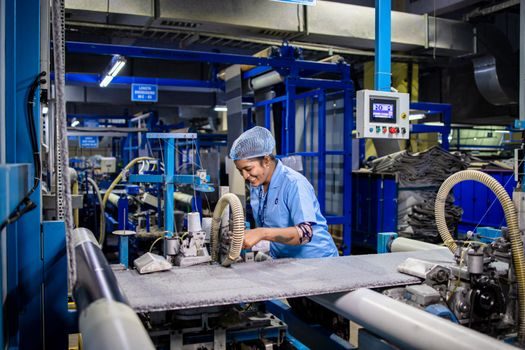
Pack lines look more like automotive than battery lines: torque-controlled bolting, laser welding of busbars, potting and dispensation, and end-of-line (EOL) test of the BMS over CAN, CAN FD, or 100BASE-T1 against a pack HIL target [S2]. Balluff's RFID on every module tray is what makes the per-cell digital thread survive the transfer from cell line to pack line, and the same RFID read events are written into the MES batch record that the EV OEM consumes.
BMS EOL test typically covers insulation resistance above 100 MΩ at 500 V, isolation withstand to 2.5 kV AC, CAN signal integrity, and a full charge/discharge cycle to confirm state-of-charge and state-of-health estimation. Each pack is shipped with a per-cell impedance and capacity log that goes into the OEM's PPAP file, and that same log is what field-service tools read out for warranty and second-life decisions.
Process Instrumentation: Flow, Pressure and Smart Sensors
On the supporting process side — electrolyte mixing, NMP recovery, slurry viscosity, dry-room gas, and cooling water — the line still relies on conventional flow meters, pressure transmitters, and humidity sensors, but with smarter protocols. Yokogawa's Sushi sensors and digital flow devices carry HART or smart meter outputs that integrate into the same SCADA backbone, and ATEX/IECEx-certified instruments are required for solvent-handling areas [S1].
Inline viscosity, temperature, and conductivity probes in the slurry line drive a closed loop on the mixer's solid-to-liquid ratio, which directly controls the electrode's binder distribution and adhesion strength. The same sensor backbone also drives ESG reporting: per-batch solvent consumption, kWh per kWh of cell produced, and dry-room HVAC load are all calculated from this instrument layer and pushed to the plant's carbon dashboard.
Supply Chain, ESG and the 2026 Spec Gates
The decision blueprint for an EV battery line in 2026 is concrete: ISA-95 compliant MES with OPC UA over TSN, dry room at -40 °C to -60 °C dew point, coating weight tolerance ±1 % to ±2 %, AI vision defect capture above 99 %, formation current accuracy ±0.05 %, BMS EOL isolation test above 100 MΩ at 500 V, and full per-cell digital thread through RFID and MES. New lines that miss any one of these gates will struggle to pass EV OEM PPAP and to qualify for IRA-style local-content incentives, where the cell and pack data trail is the audit evidence. [S1]
Trackable signals for the next 6 to 12 months: (1) wider rollout of 100BASE-T1 and 1000BASE-T1 in-cell BMS EOL testers as the OEM demand for zonal E/E architectures grows, (2) more inline CT stations on premium NMC and solid-pilot lines to catch sub-surface electrode overhang, and (3) convergence of MES batch records with OEM battery passports under EU Battery Regulation 2023/1542, which forces the per-cell digital thread to outlive the plant that built it. A useful adjacent read is the 3D printing and additive manufacturing process map for rapid electrode-coating shim development, and the industrial robot manufacturing process map for the dry-room stacker body design — both are now routine reference inputs on a 2026 gigafactory capex package.