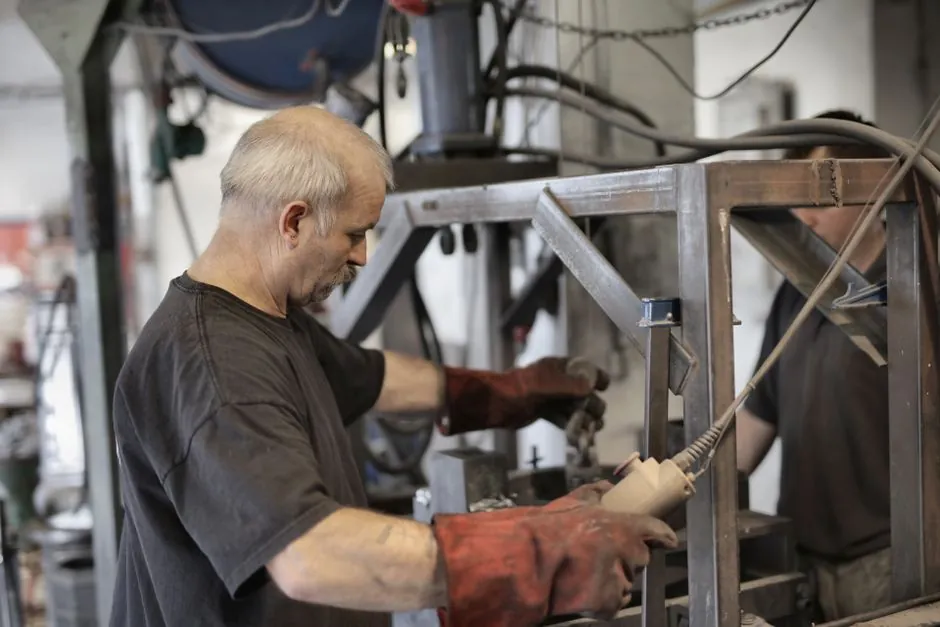
For electronics-housing foundries running 5,000-200,000 cores per year in the 0.5-10 kg shot-weight band, the hot box core shooter is the binder-first default, because the 200-260 °C cure window of a furfuryl/phenolic resin system matches the wall thickness (above 8 mm) and the draft angles (1.5° minimum) typical of connector shells, EMC enclosures, and small motor housings [S4][S8].
Foundries producing 5-80 t/h of castings for electronics, telecom, and power-conversion OEMs treat the binder family as the load-bearing decision, and the four families (shell, hot-box, cold-box, and inorganic/CO2-silicate) each lock the buyer into a different utilities and gas-handling package [S7]. Hot box wins where the cure-on-demand thermal profile matches a 1-2 shift operation and the part family does not push wall thickness below the 8 mm practical floor [S8].
Why Electronics Housings Map to the Hot-Box Cure Window
Electronics-housing cores are typically thin-wall iron or aluminum castings with internal passages for EMC shielding, transformer mountings, and connector windows, and the geometry favors core weights of 0.5-10 kg with wall thicknesses in the 8-20 mm range [S7][S8]. The 200-260 °C hot-box cure window, with a 25-60 s dwell, sits exactly inside the band where the furan/phenolic resin system delivers a rigid, ejectable core without burning through the binder [S4][S5].
The hot-box machine class covers both single-station and duplex shooter layouts, and the horizontal-parting configuration is the dominant mid-volume iron-foundry layout because it allows a flat lower half for chilling blocks and a top half that lifts for ejection, lining up with manipulator take-out on 1-2 shift operations [S4]. A typical small-frame unit, such as the HBS 300II-class machine with a 0.5-0.7 MPa shooting-head pressure, 380 V/50 Hz supply, 6 kW installed power, and a 450×260×160 mm maximum mold size, can deliver 3.2 kg cores in cycle times that match electronics-housing tonnage targets [S2].
Spec Gates: Shot Weight, Platen Size, Heating Power, Cure Budget
2026 catalog data segments hot-box machines into three practical shot-weight bands: small (≤10 kg, platen 500×400 mm class), mid (10-50 kg, platen 700×600 to 900×800 mm), and large (above 50 kg, platen 1000×1000 mm and up) [S4]. A 10-50 kg shot typically pairs with a 200-260 °C platen heater, a sand-blow tank sized to deliver the full shot in one stroke, and a curing dwell of 20-60 s depending on wall thickness [S4].
Four hard spec gates determine machine size and price class: (1) shot weight in kg per cycle, (2) heating power in kW, (3) sand tank capacity in liters, and (4) clamping force in kN, with the fifth lever being the resin binder system (furan vs phenolic) that defines cure temperature and emissions handling [S5]. The hot box core machine reference confirms that the controlled box temperature window is 180-250 °C, held by zoned electric cartridge heaters or gas burners, and the installed heating power is a meaningful running cost that a buyer should compare against a cold-box alternative for the same output [S9].
Hot-Box vs Cold-Box vs Shell: Decision Matrix for Electronics Castings
Three core-making process families compete for the same electronics-housing budget, and the decision breaks on energy, cycle, binder cost, and tooling cost. Hot-box is highest on energy input per cycle because of the 200-260 °C heated core box; cold-box is lowest (room-temperature cure, energy goes to amine vaporiser and scrubber); shell sits in between with a 220-300 °C investment-cure oven but a smaller heated area [S5].
On cycle time, hot-box runs 25-60 s per shot, cold-box can drop to 10-20 s because gas-hardening is faster than thermal cure, and shell processes are 90-180 s per core because of oven dwell [S5]. On binder cost and emissions, hot-box furan/phenolic resin is mid-cost with formaldehyde and phenol fumes requiring local exhaust; cold-box phenolic-urethane (PUCB) has higher binder cost but pushes amine and VOC load to the scrubber, which is why the cold box core machine line flags ventilation as the dominant capex line for amine-cured cells [S5].
On tooling cost, hot-box core boxes are aluminum or cast iron with embedded electric heaters at moderate cost, cold-box core boxes are wood, plastic or aluminum with no heater at the lowest cost, and shell core machine tooling carries the fine-pattern premium needed for the thin cured shell that gives shell its surface finish advantage [S5]. For thin-wall connector shells under 8 mm wall, a shell core shooter typically wins on finish; for thicker EMC and motor housings, hot box wins on mechanical strength and cycle time [S4][S5].
Parting-Plane Layout for Housing Cores
Horizontal-parting hot-box shooters run the parting line along the floor plane of the core box, giving a flat lower half for chilling blocks and a top half that lifts for ejection, the dominant configuration in mid-volume iron foundries [S4]. The chilling block is normally mounted on the rear side of the machine so the local heat-extraction rate can be tuned against the resin cure profile; without that block, thick-section cores (above roughly 30 mm wall) tend to under-cure at the center and crack on ejection [S4].
Vertical-parting shooters split the core box along a vertical plane, the right choice for deep-draw or wrap-around cores that cannot be released from a flat horizontal die, and HBS-series vertical-parting lines are built in single-position and double-position variants with manual operation additionally provided on the HBS-954 and HBS-955 series [S3]. For electronics housings with deep transformer windows or wrap-around connector features, the vertical-parting layout is often the only geometry that releases cleanly without draft-angle penalties [S4].
What Hot-Box Does NOT Fit: Boundaries for Electronics Buyers
Hot box does not fit when the core weight drops below 0.5 kg, when the wall thickness is below 8 mm, or when the internal surface finish must be smoother than shell can deliver, because the hot-box sand grain is coarser and the cured surface carries more binder burn-off staining than a shell core [S8]. It also does not fit when the production volume drops below 5,000 cores per year of the same part family, because the heating-power amortisation assumes a steady-state 1-2 shift duty cycle [S8].
Draft angles below 1.5° on internal surfaces will crack cores on ejection regardless of cure time, and this is the single most common reason a foundry re-specs from hot-box to shell after a tooling trial [S8]. For buyers who need to confirm the broader machine-class landscape before locking the spec, the core machine reference provides a process-family overview covering shell, hot-box, cold-box, and CO2-silicate variants in a single matrix [S9].
TCO and Lifecycle Signals for the 2026 Buy
For a 15-20 year machine lifecycle, foundries should plan on at least one full die replacement per station, two to three ejector/ejector-pin refurbishments, and one control-system retrofit (PLC plus HMI plus thermocouple harness) around year 10-12 to keep spares available [S6]. Comparing the same OEM family over 20 years, energy and binder together typically account for more than half of cumulative TCO, while capex and tooling are second-tier, which is why the heating-power kW figure on a 2026 quote deserves a second look alongside the headline price [S6].
Trackable signals for the 2026 buy: (1) confirm that the quoted shot-weight class is the small (≤10 kg) band matched to housing cores, not a mid-frame line sized for valve bodies that will sit half-utilised; (2) confirm the parting-plane orientation against the core print before the die-cut is released; and (3) confirm that the cure-window budget (200-260 °C, 25-60 s dwell) matches the wall thickness and draft angles the part drawing actually carries, not the optimistic numbers on the OEM's standard cycle sheet [S4][S5][S8].
Related analysis: Rock Wool Panel Selection for Cold Storage Warehouses: Fire-First Spec Map.