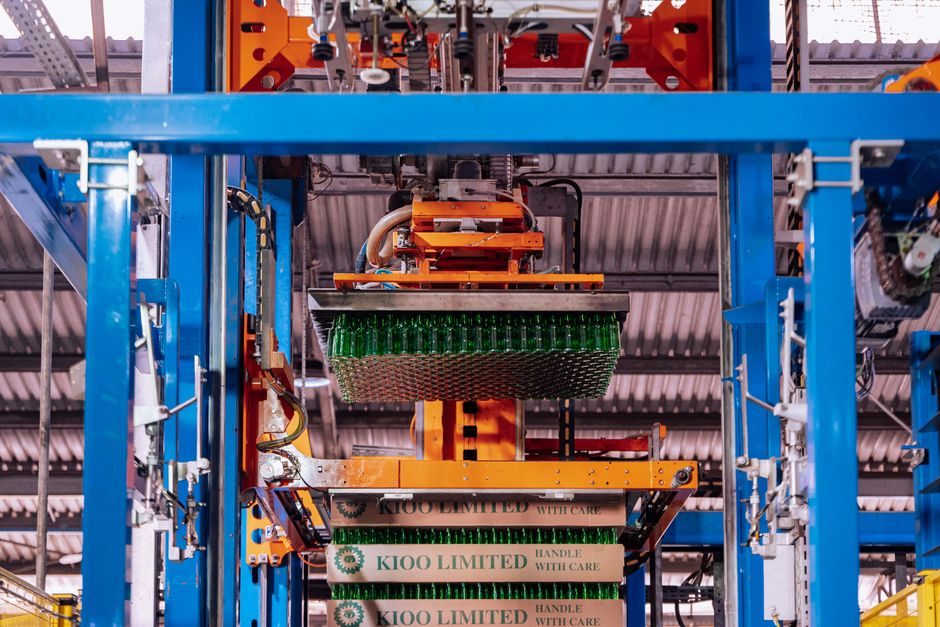
Smart manufacturing in 2026 inside an industrial refrigeration plant is best defined as a stack of four building blocks — PLCs and remote I/O on a real-time industrial Ethernet, servos and variable-frequency drives on motors and electronic expansion valves, sensors and smart cameras wired to edge analytics, and an MES/ERP layer that closes the loop on energy and refrigerant mass-balance.
The reference architecture now in production across APAC and EU cold-chain builds lines up with Industry 4.0 practice: 97% of manufacturing firms in a 2025 Singapore Business Federation survey recognised digital transformation as important, and roughly 60% of large companies said they were actively cutting carbon footprint through sustainability technology [S1]. For a refrigeration cell, that translates into 4 concrete sub-systems — compressor VFDs, evaporator defrost control, ammonia/CO2 leak monitoring, and pack-out cold-chain traceability.
Control Architecture: PLC, HMI, Industrial Ethernet
A new ammonia or CO2 refrigeration plant in 2026 is typically specified around a mid-range PLC, distributed remote I/O over PROFINET or EtherNet/IP, and an HMI on the operator floor — the same SKU pattern stocked by industrial automation distributors such as Allied Automation, which lists Mitsubishi Electric, Festo, Universal Robots and Mechatronic Systems as core vendor partners [S2]. Field I/O counts run in the 1,500–3,500 point band for a 5–15 MW cold-store, with a redundant CPU pair sized for 100 ms scan and PROFINET IRT or EtherNet/IP CIP-Sync determinism for compressor anti-surge loops.
Two network standards are doing the heavy lifting on the process side. PROFINET is the Ethernet-based communications protocol PROFINET University describes as supporting discrete, continuous and batch production alike — exactly the three production modes a refrigeration pack-out line mixes (discrete crate handling, continuous chilled-water flow, batch blast-freezing) [S6]. For wireless backbones, WIA-PA (Wireless Networks for Industrial Automation — Process Automation) is the Chinese WIC sub-standard built on IEEE 802.15.4 for process measurement, monitoring and control, designed specifically for harsh industrial sites where pulling copper to every valve and transmitter is impractical [S5].
Field Instrumentation and Smart Sensing
The instrumentation BOM on a modern industrial refrigeration cell includes suction/discharge pressure transmitters, NTC or PT1000 temperature probes on evaporator and condenser coils, refrigerant mass flow meters, and a growing share of smart valves with integrated positioners on expansion and bypass lines. The two highest-value sensor additions versus a 2018-vintage plant are thermal imaging on switchgear rooms and smart meters on every refrigerant circuit — the former for early fault detection, the latter for ASHRAE 15 / IIAR 2 compliance reporting on charge and leak rate. [S2]
Compressor-rooms are where AI-driven condition monitoring is paying back fastest. Vibration, motor current and discharge-temperature streams are sampled at 1 kHz, fed to an edge model that flags valve-plate wear typically 6–10 weeks before a hard failure — the same data pattern Epicor describes as AI-powered analytics surfacing demand fluctuations and recommending actions in real time [S1].
Robotics, Cobots and Palletising
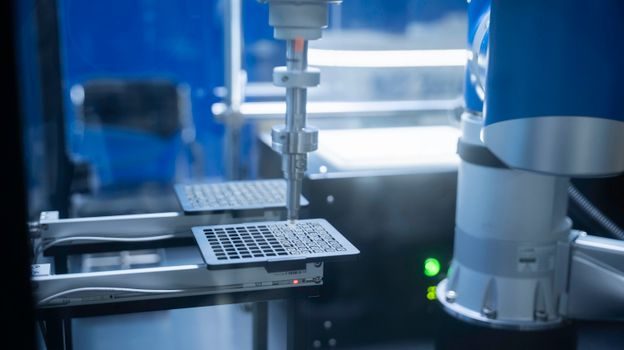
On the pack-out side, six-axis robots, SCARAs and mobile platforms are now off-the-shelf line items for cold-store integrators, with Universal Robots and Mechatronic Systems appearing as standard cobot/6-axis and mobile-robot partners in the automation-distribution channel [S2]. A typical 2026 cell integrates EOAT/grippers, vision-guided pick from a conveyor at –25 °C, and palletising into a 1.2 × 1.0 m Euro or Chep footprint at 6–10 cycles/min.
The materials and process considerations behind those grippers follow the same rules as any industrial adhesive or pneumatic-actuator build: low-temperature elastomer ratings, food-grade NSF H1 lubricants on HMI pushbuttons and pneumatics that share the cold-room envelope. Engineers spec-ing pneumatic actuators for blast-freeze rooms should default to seals rated to –40 °C and stainless bodies to survive the condensation cycle, not the room temperature ratings that show up on the standard catalogue line.
Networking, Wireless and the Edge Layer
Industrial Ethernet is the de-facto backhaul, but the cost of running shielded twisted pair to every evaporator and rooftop condenser is pushing brownfield sites to wireless. WIA-PA's profile is built on IEEE 802.15.4, with star and mesh topologies sized for low-power, low-data-rate field devices — a match for the kind of valve and temperature telemetry that does not need PROFINET's real-time determinism but does need a 5–10 year battery life [S5].
On the radio side, the same engineering logic that drives an industrial router selection in a substation applies to a cold-store gateway: IP65 enclosure, –30 to +60 °C operating range, dual SIM for cellular failover, and VLAN segregation between corporate IT and the OT side of the network. Skipping any one of those four is the single most common reason a Phase-2 IIoT rollout stalls.
Where Smart Manufacturing Fits — and Where It Doesn't
It is not for a single-compressor walk-in cooler where a thermostatic expansion valve and a 7-day chart recorder still beat the TCO of a full IIoT retrofit. [S3]
Three selection criteria dominate the integrator pitch. First, the controller tier — a mid-range PLC for 70 % of cells, a high-end redundant PLC only for ammonia facilities above 4,000 kg charge where EN 378 / IIAR 2 demand a safety PLC on a separate network. Second, the drive tier — VFDs on every screw and centrifugal compressor above 30 kW, typically sized 1.1–1.15× motor kW with sinusoidal filters on long cable runs. Third, the analytics tier — cloud MES for plants with stable connectivity and < 50 ms SCADA latency tolerance, on-prem edge for ammonia sites where the safety case cannot depend on internet availability.
Standards, Compliance and the 2026 Investment Signal
Compliance anchors the spec sheet. Industrial ammonia plants above 4,000 kg follow EN 378 series and IIAR 2 (US), with machinery safety on ISO 13849-1 PL d/e for guard doors and emergency stop circuits — the same e-stop wiring discipline used in any process cell. Electrical equipment in compressor rooms hit the IEC 60079-series ATEX zone classification when refrigerant concentration can reach 25 % of LFL during a worst-case release, and cabinets usually follow IEC 61439-1 panel-build practice. [S3]
The 2026 investment signal is unambiguous: Rockwell Automation's own 2026 outlook page points operators to "shift from automation to autonomy" as the headline trend, with digital-strategy benchmarks and capital-deployment guidance framed around AI-driven analytics, energy feedback and autonomous exception handling [S4]. For refrigeration operators, the two best-tracked signals to watch are (a) refrigerant leak rate below 0.5 %/yr becoming contractually required by major European food retailers by 2027, and (b) AI-driven energy-feedback modules on every screw-compressor line over 200 kW, the kind of energy-feedback platform Lead Intelligent now ships as a standard Li-ion battery line sub-system and that refrig OEMs are beginning to clone [S3].