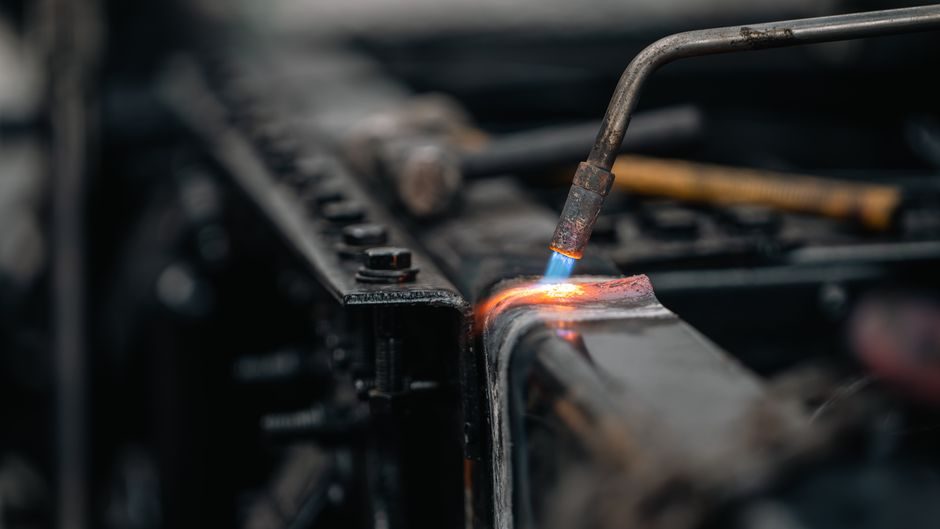
Line frequency induction furnaces — coreless mains-frequency (50/60 Hz) and channel types powered directly from the grid, distinct from medium-frequency and high-frequency units — dominate iron and large-tonnage steel melting where melt mass and continuous duty outweigh stirring intensity, with 2026 China-sourced coreless and channel units spanning roughly US$ 1,280 to US$ 100,000 per set depending on capacity and configuration [S3][S7].
For a 2026 procurement, the engineering buyer must separate three frequency classes (line/mains 50–60 Hz, medium 150 Hz–10 kHz, high ≥10 kHz), three furnace topologies (coreless, channel, vacuum), and a capacity ladder from ~0.1 t pilot units to 30 t+ iron melters, because each axis changes the coil, refractory, capacitor bank, and the price more than the brand label does [S2][S5].
Frequency class and what it actually changes at the coil
Line frequency induction furnaces run on 50 Hz or 60 Hz mains directly, which forces a low current density in the charge, a deep skin depth, and a tall, multi-turn water-cooled copper coil surrounding a refractory-lined crucible; the practical effect is high melt mass, gentle electromagnetic stirring, and a refractory life dominated by slag chemistry rather than induced turbulence [S2][S5].
Medium-frequency induction furnaces (MF, 150 Hz–10 kHz) and high-frequency units (≥10 kHz) use a thyristor or IGBT inverter to step up frequency, which shrinks the coil, raises power density, and improves stirring on small melts; the trade-off is inverter cost, cooling-water duty, and higher refractory wear at higher power density [S2][S5]. A 1-ton MF induction melting furnace with MPU-6/11 control board and 3-phase rectification, for example, is sold as a packaged skid with installation and commissioning bundled into the supplier scope, illustrating the support layer that an MF buyer must price in but a mains-frequency buyer often skips [S2].
For buyers cross-shopping, the line frequency induction furnace selection gates checklist lays out the seven engineering checkpoints a procurement team should run before issuing an RFQ, while the broader induction furnace 2026 price and cost guide covers the capacity, frequency, and coil-tier cost levers behind the headline price.
Capacity, voltage class, and what 1 t, 10 t, and 30 t actually imply
Capacity is the single largest cost driver: 2026 China-sourced intermediate-frequency (the Chinese export term that overlaps with medium-frequency) coreless units cluster at US$ 1,000–2,000 per piece for sub-ton pilots, US$ 6,550–80,000 per set for 1-ton-class melters with MPU-class controllers, and US$ 10,000–100,000 per set for 10-ton-class iron and steel units [S3][S5][S7]. A 10-ton medium-frequency induction furnace is described as a 3-phase AC-to-DC rectifier feeding an inverter that delivers adjustable current to a resonant load — the same topology scaled up, not re-engineered [S5].
A practical 2026 buy is rarely a single unit: a steel foundry running three 10-ton mains-frequency coreless furnaces typically runs them in a "two-melt, one-slag" rotation to keep one crucible live while one is relined, because reline cycle (not coil life) sets the effective tap-to-tap throughput; the 30-ton class, in turn, is where channel (submerged-arc channel) furnaces enter the picture for continuous iron holding and duplexing [S3][S7].
Voltage class matters: 380 V / 3-phase / 50 Hz is the default in Chinese-export documentation, with 415 V, 440 V, 480 V, 600 V, and 6 kV / 10 kV options quoted on request; the busbar, breaker, and step-down transformer upstream of the furnace must be specified together with the furnace, or the buyer discovers the constraint at commissioning [S2][S5].
Refractory, coil, and cooling-water spec gates that decide real cost
Refractory choice is the second-largest cost line after the copper coil: silica, alumina, magnesia, and silicon-carbide linings are selected by charge mix (cast iron, carbon steel, stainless, non-ferrous), with acidic linings unsuitable for basic slags and vice versa; documentation from medium-frequency suppliers explicitly calls out melt cleanliness, fast melting, and "no pollution" as design targets tied to lining integrity [S2].
Cooling-water duty scales with frequency and power density: a 1-ton MF unit typically lists 5–15 m³/h of treated water at 0.2–0.3 MPa with inlet temperature below 35 °C, while a 10-ton unit moves 20–40 m³/h, and a 30-ton unit can demand 50 m³/h or more; a buyer who treats cooling water as a utility afterthought will trip conductivity and pressure alarms in the first month [S2][S5]. For buyers also evaluating foundry-melt alternatives, the induction furnace vs cupola furnace spec, cost, and selection cut frames the refractory and emissions delta that drives the call between a coreless mains-frequency furnace and a cupola.
Capacitor banks for power-factor correction on mains-frequency units are sized to the reactive MVA of the coil and add 8–15% to the furnace price; PF must be corrected to 0.95+ to avoid utility penalties, and the bank should be switched in steps (typically 4–8 stages) to follow melt-down vs holding duty.
Control, instrumentation, and the I/O a 2026 spec sheet should carry
Modern mains-frequency and MF coreless furnaces ship with PLC + HMI stacks, thyristor or IGBT inverter modules, and instrumentation that includes melt temperature (S/R or immersion thermocouple), cooling-water inlet/outlet temperature, water flow, water conductivity, coil current, coil voltage, DC bus voltage, and refractory wear tracking by hours-since-lining [S2]. The 1-ton MF unit referenced on Chinese B2B portals lists an MPU-6/11 control board, 3-phase rectification, and bundled debugging and installation — a baseline that the buyer's RFQ should at least match [S2].
For plants already running programmable logic and SCADA, the practical question is protocol: most 2026 China-sourced units expose Modbus RTU / Modbus TCP, with Profinet or EtherNet/IP on the higher tier; OPC UA is creeping in on European-spec builds. HART is the wrong layer to ask for here — HART is the FSK protocol layered over a 4–20 mA analog loop, not a furnace bus, and induction furnace I/O is digital/analog, not HART-native.
Tariff and customs classification also belongs in the spec pack: medium-frequency induction furnace parts fall under HS 8529 9090 90 (other parts for radio/TV/radar apparatus) and digital frequency meters used in furnace testing under HS 9030 4010 00, with declaration norms covering brand type, export preferences, usage, function, and test parameters [S4]. A line-frequency induction furnace is classified in a different heading, and the 2026 China customs search page for "frequency induction furnace" reports no direct HS match, meaning the classification must be argued from the unit's function and rated power [S1].
Supplier tier, audits, and the price spread behind the headline
The 2026 China-sourced spread for intermediate/medium-frequency induction furnaces is wide because the supplier tier, not the spec, is doing much of the work: Gold Member and Diamond Member audited suppliers on Made-in-China.com carry ISO9001:2015 and ship from named provinces (Henan, Shandong, Hunan, Guangdong), and the price ladders reflect MOQ, controller tier, refractory scope, and commissioning inclusion [S3][S7].
Concretely, the 2026 catalogue shows 1-piece MOQ entries around US$ 200–2,000 (auxiliary blower / heating element scope), 1-set MOQ entries around US$ 1,000–2,000 (sub-ton pilot heaters), US$ 1,280–19,800 (1-ton-class industrial units), US$ 6,550–80,000 (1-ton-class industrial melting furnaces with MPU control), and US$ 10,000–100,000 (10-ton-class medium-frequency melting furnaces) [S3][S7]. A buyer who picks on headline price without auditing refractory scope, inverter type, and the commissioning line will pay for the difference in field.
For a foundry also weighing ladle and degassing choices for the same melt, the casting ladle vs degassing unit 2026 selection frame for aluminum and steel melts maps the downstream equipment that has to be specced in lockstep with the furnace, because a mains-frequency melter paired with the wrong ladle or degasser bottleneck caps throughput regardless of furnace class.
Selection criteria, decision matrix, and who this is for
For a 2026 buy, the decision matrix has four axes: melt mass per shift (≤2 t, 2–10 t, 10–30 t, 30 t+), charge mix (iron, carbon steel, stainless, non-ferrous), duty cycle (single-shift foundry, two-shift job shop, three-shift continuous), and grid quality (stability, PF tariff, harmonic limits). Iron foundries running 20–60 t/day on cast iron favour mains-frequency coreless for capex per tonne; steel job shops running 5–20 t/day of carbon and alloy steel favour 1–10 t medium-frequency coreless; continuous iron duplexing favours channel furnaces; specialty alloy and vacuum melt work exits the induction-mains-frequency conversation entirely [S2][S3][S5].
It is the wrong tool for: non-conductive charges (no induction heating without a conductive starting body), very small lot sizes where a 1-ton crucible wastes energy in dead melt, and any application where the buyer's only spec is "cheap" without a written lining, controller, and water specification — the cheap unit will fail at the refractory joint, not at the coil, and the failure mode is well documented in foundry maintenance logs [S2][S3].
Trackable signals for a 2026 procurement: (1) confirm the customs heading and any anti-dumping scope before signing — the 2026 China customs lookup for "frequency induction furnace" returns no direct HS match, which means classification must be argued from rated power and function [S1]; (2) verify ISO9001:2015 audit status of the named legal entity, not the trading company, on the Diamond/Gold Member record [S3][S7]; (3) lock the cooling-water and PF-correction scope in writing, because these two items routinely add 10–20% to the as-quoted price after the PO is signed [S2][S5].
For component-level specifications, see line frequency furnace, induction furnace, and linear guide.