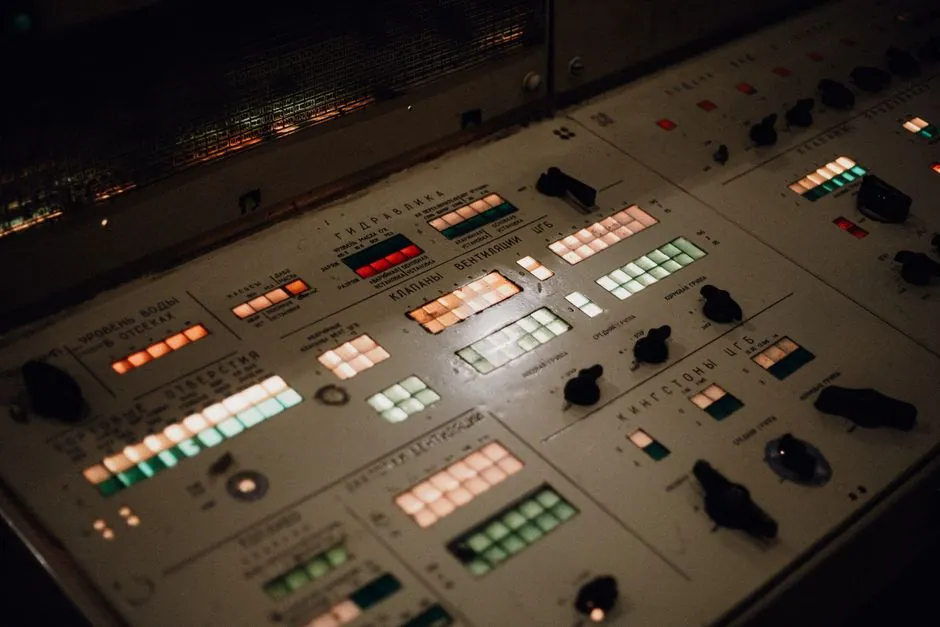
Industrial buyers evaluating motor control center suppliers in 2026 face a USD 7.01 billion global market growing at a 7.93% CAGR toward USD 12.91 billion by 2034 [S1], so the lineup you sign off on will likely run for 20+ years under IEC 61439-1/-2 design rules.
An MCC is a floor-standing assembly of enclosed sections sharing a common bus, with each motor fed from a plug-in bucket containing a circuit breaker, contactor, and overload relay, and a modern specification spans rated voltage (380-415 V, 50 Hz or 480 V, 60 Hz), bus current (630-4000 A), short-circuit withstand Icw, and IP42-IP55 ingress protection depending on the room environment [S2][S5].
What an MCC Actually Delivers Versus a Distribution Board
An MCC centralizes motor starters, contactors, overload relays, and VFDs into withdrawable buckets served by a common copper busbar, reducing field wiring runs by up to 30% versus distributed starters at each motor [S5]. A standard distribution board feeds lighting and small loads; an MCC is engineered for motor inrush (typically 6-8x FLC for direct-on-line starts) and continuous switching duty.
Core components per [S2] include the incoming busbar, individual motor control center buckets, motor starters (DOL, star-delta, soft starter), circuit breakers or fuses, contactors, overload relays, optional PLC/control interfaces, and metering for voltage, current, and power. Each bucket is plug-in, so a faulty unit can be replaced without a full lineup shutdown, a key reason MCCs dominate continuous-process plants.
Selection Criteria: Five Numbers That Gate Every Quote
Before discussing price per section, qualifying engineers should pin five values: rated voltage, main busbar current (630-4000 A range is typical for industrial builds [S2]), short-circuit withstand Icw (must match the site's calculated fault level, commonly 50 kA or 65 kA for 1 s), protection degree (IP42 indoor minimum, IP54 for dusty or humid rooms [S2]), and standards compliance to IEC 61439-1/-2 [S5].
The supplier relationship matters as much as the hardware [S1]. Plants that treat MCC procurement as a one-time cabinet buy repeatedly run into spare-part gaps, retrofit mismatch, and arc-flash labeling churn, while teams that score vendors on application fit, documentation quality, startup support, and lifecycle continuity (parts, retrofit sections, brownfield modifications) report smoother cutovers.
Fixed, Withdrawable, and Intelligent MCC: A Decision Comparison

Fixed-type MCCs mount components permanently inside the cubicle, cost less, and suit applications where planned shutdowns are acceptable, while withdrawable (draw-out) MCCs let each bucket slide on rails so one circuit can be serviced while the rest of the lineup stays live, which is non-negotiable in water treatment, hospitals, and continuous manufacturing [S2].
Intelligent MCCs (iMCC) replace hard-wired relays and timers with microprocessor/PLC-based logic and stream data over Modbus, Profibus, or Ethernet/IP, cutting internal cable volume and enabling real-time current, power factor, and temperature monitoring from a SCADA console [S5]. The trade-off is higher unit cost and a maintenance crew that must be trained on the network protocol, so iMCCs deliver strongest ROI on installations above roughly 30-50 motor circuits where condition data justifies the integration spend.
Maintenance Reality: 85% of Failures Are Preventable
A loose bus bar connection in a 480 V MCC can run above 200 degC and trigger a cascading arc-flash event, yet thermography plus torque audits prevent an estimated 85% of these electrical failures [S4]. The four highest-risk failure points are contactor pitting, overload relay drift, thermal expansion at bus splices, and contaminated cable lugs.
Operational thresholds from the same maintenance reference [S4]: replace contactors when tip thickness drops below 50% of original spec, recalibrate overload relays if trip time deviates more than 10% from the published band, retorque any bus connection showing a 15 degC rise above ambient, and exercise molded-case breakers 3-5 times per quarter to prevent mechanism seizure. A typical monthly thermographic sweep takes 1-2 hours per 10 buckets.
Standards, Arc-Flash, and Documentation Discipline
MCCs supplied into process plants must satisfy IEC 61439-1/-2 for low-voltage switchgear and controlgear assemblies, and the lineup's Icw rating, bus bracing, and IP rating must match the one-line diagram, not just the vendor's catalog number [S5]. Arc-flash labeling under NFPA 70E or CSA Z462 must be refreshed after any modification that changes available fault current or clearing time, so the supplier's documentation package (single-lines, wiring schedules, trip settings) becomes a compliance artifact, not a binder on a shelf [S4].
Field experience shows the cheapest cabinet on bid day often becomes the most expensive lineup in the room when outage windows stretch or one-off modifications pile up [S1], which is why procurement should weigh total lifecycle cost (spare-parts availability over 15+ years, retrofit section lead time, and local field-service coverage) alongside per-section price.
How MCC Sourcing Intersects With Adjacent Electrical and Mechanical Decisions
MCCs are commonly paired with a power distribution board inside the same electrical room, and a poorly coordinated specification across the two assemblies creates cable-routing and fault-level mismatches that surface only at commissioning. The same industrial control panel room also feeds motor-operated valves, where the control cable schedule, segregation rules, and EMC routing need to align with the MCC's internal wireway layout to keep noise off analog loops. For data-center and large facility builds where uptime and predictive maintenance dominate, our related Best MCC for Data Centers: 2026 Spec and Selection Map walks through the higher bus ratings and iMCC density that those projects demand. [S2]
Track two signals over the next quarter: vendor disclosures of IEC 61439-1/-2 test certificates with declared Icw, Icc, and Ipk values (not just "designed to" statements), and published iMCC case studies that quantify avoided downtime in hours per year, since both convert marketing language into the auditable evidence procurement needs.
For component-level specifications, see construction machinery and equipment.