
Natural gas is roughly 70-90% methane, with the balance made up of ethane, propane, butane, CO2, H2S, water vapor, nitrogen, and trace mercury, so any processing plant is, at its core, a multi-stage separation train sized to a defined inlet composition [S4].
The midstream scope covered here is the gas plant itself: wellhead-to-pipeline conditioning, NGL recovery, and the rotating/rotating-coupled machinery that drives the train, rather than drilling or refining. The US EPA's Natural Gas STAR vendor directory lists the equipment categories operators actually buy: compressors, pneumatic controls, pumps, tanks, valves, plus methane leak detection hardware from handheld TDLAS to fixed continuous monitors [S1].
Inlet and Primary Separation Hardware
Slug catchers are the first line of defense in any gas plant, built as oversized, harp-type, parallel-pipe buffer vessels that absorb the multi-thousand-barrel liquid surges that gathering lines push into the facility after pig runs, hydrate melts, or terrain low-spot dumps [S5]. Without this buffer, the downstream 2-phase and 3-phase separators get overwhelmed, amine contactors foam, and compressor impellers suffer aerodynamic imbalance [S5].
2-phase separators split bulk gas from total liquids; 3-phase separators further split oil, water, and gas, with internals sized by Stokes' Law so that gas velocity stays below the terminal settling velocity of the entrained droplets [S5]. Cold boxes and expansion machines, by contrast, sit in the cryogenic block, listed explicitly under the CGA's atmospheric gases and equipment scope as product-handling hardware for gas liquefaction trains [S2].
Acid Gas Removal and Dehydration Trains
Acid gas removal (gas sweetening) uses amine contactors (MEA, DEA, MDEA, or mixed-amine formulations selected on partial-pressure and selectivity grounds) to strip H2S and CO2 down to the pipeline tariff band. The commercial sales-gas ceiling widely applied by midstream operators is H2S under 4 ppmv and CO2 under 2% by volume, and exceeding either limit risks pipeline shut-in plus long-term metallurgical damage to the transmission network [S5].
Dehydration downstream of sweetening typically runs as a TEG (triethylene glycol) contactor plus a glycol regenerator, or as a molecular-sieve adsorption tower pair, with switching valves sized for the adsorption cycle time. Mercury is removed on dedicated fixed-bed adsorbers, since even ppb-level mercury causes liquid-metal embrittlement of aluminium-brazed cryogenic heat exchangers in the NGL block [S5]. Process safety for these units falls under the CGA's process safety publication family, which gives risk-management guidance specific to industrial gas facilities [S2].
Cryogenic NGL Recovery and Fractionation
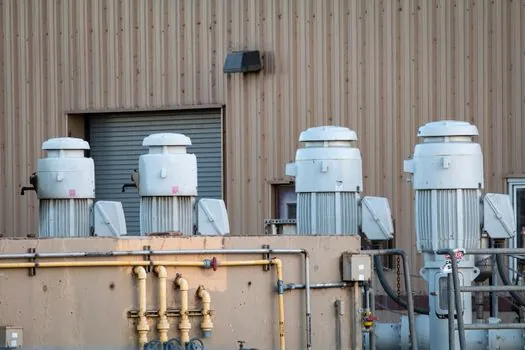
Cryogenic NGL recovery expands the sales gas through a Joule-Thomson valve or expander to roughly -40 to -120 °C, depending on the ethane-recovery target, then feeds the resulting liquid mix to a deethanizer-depropanizer-debutanizer train that splits it into specification ethane, propane, butane, and natural gasoline [S5]. The cold box that houses the cryogenic heat exchangers is treated as a CGA atmospheric-gases scope item, together with expansion machines, bulk storage, and the loading facilities for outbound tankers [S2].
Compressors in this service are split between integral engines (gas-engine-driven reciprocating units) for the bulk gas lift and residue recompression, and motor- or turbine-driven centrifugal units for the NGL refrigeration loop. Buyers evaluating compression packages should map the in-service duty, suction pressure, and rod-load envelope against the [S7] industrial natural gas generator set range, since many plant prime movers are gas-engine packages in the 100 kW-2,500 kW output band and any skidded compression unit sitting on the same plot sits on similar driver economics [S7].
Methane Monitoring and Leak Detection Hardware
The EPA Natural Gas STAR directory is explicit on the instrument classes: handheld OA-ICOS analyzers for the GLA132-Series report a 1 sec precision of 1.4 ppb, 10 sec of 0.5 ppb, and 100 sec of 0.2 ppb, with a linear CH4 range up to 100 ppm, while the fixed laser open-path units using TDLAS hit a concentration MDL of 0.2 ppm [S1]. Handheld remote methane detectors using IR-camera plus GPS mapping report 5 ppm-m up to 15 m, 10 ppm-m up to 50 m, and 300 ppm-m at longer stand-off range [S1].
High-flow sampling optical-sensor units are catalogued with a leak-rate MDL of 9.0 g/hr (0.22 l/min), and the same directory breaks the technology families into near-field techniques, direct source emissions assessment, and remote sensing [S1]. The spec-first lens is critical here: a fixed TDLAS cell is the right answer for perimeter fence-line monitoring, while a high-flow sampler is the right answer for quantifying fugitive emissions from components during a leak survey.
Materials, Codes, and What NOT to Pair

Process vessels fall under ASME BPVC Section VIII, while piping class selection should be driven by the H2S and CO2 partial pressure and operating temperature, not by generic carbon-steel defaulting. NACE MR0175/ISO 15156 applies to all wetted components in sour service above the H2S partial-pressure threshold; for LNG and cryogenic lines, aluminium-brazed heat exchangers must be protected against mercury, and austenitic stainless is the default for cold-box internals. [S4]
One spec trap to avoid: do not specify a HART-only smart valve positioner on a Foundation Fieldbus or PROFIBUS PA segment, since HART is the FSK protocol layered on a 4-20 mA analog loop, and the digital segment protocols use a different physical layer. Cross-reference articles on rotating-equipment selection, such as gearbox selection for wind power: ratios, stages, and replacement economics, show how the same staged-selection discipline applies when sizing the gas-engine drivers that sit on a compressor skid.
Operations, Maintenance, and Spare Strategy
Gas processing plants are continuous-duty assets, so the maintenance spend concentrates on separation equipment, compressors, and heat exchangers operating under combined thermal and pressure stress [S8]. Planned-outage scope should be driven by vibration trends on the rotating kit, amine filter swap intervals, and molecular-sieve cycle time drift, not by calendar hours alone.
Sourcing discipline: align the ball valve types and classifications reference against the actual service class, since the same nominal 2-inch valve is a different SKU in low-temperature NGL, sour amine, or dry residue gas. The procurement lens for adjacent rotating equipment and mining-spec machinery follows the same logic outlined in mining equipment procurement: spec-first spec map for 2026 buyers, where vendor list length is treated as a risk, not a hedge.
What This Equipment Is NOT For
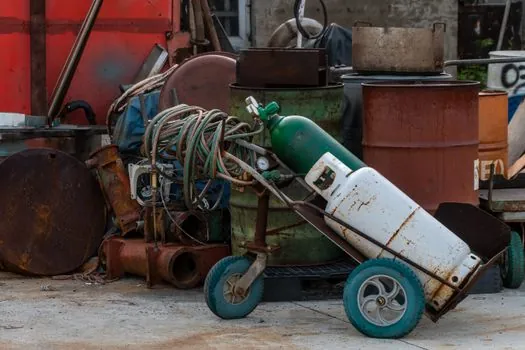
This scope is midstream processing, not exploration drilling, well-completion, refining, or petrochemical cracking. If the question is shale fracking pressure pumping, refinery hydrotreaters, or ethylene crackers, the equipment list, the materials requirements, and the standards baseline all change. Likewise, on-site natural gas generator sets (the 100 kW-2,500 kW, $25,000-$395,000 product class covered in [S7]) are a downstream-power use of gas, not a midstream processing unit, and they share driver technology with compressor prime movers but not the same process duty or emissions scope [S7].
Trackable signals to watch: revised EPA methane rule reporting thresholds, any update to API/GPA sales-gas specification limits, and the next round of CGA natural gas technology publications for CNG and LNG. Watch the Illinois-type state rulings on whether renewable natural gas facilities qualify for manufacturing-equipment tax exemptions, since that classification directly drives whether digester-to-pipeline gas plant capex can be depreciated as manufacturing machinery [S6].
For the relevant spec sheets and selection criteria, see additive manufacturing material, linear guide, and crossed roller guide.