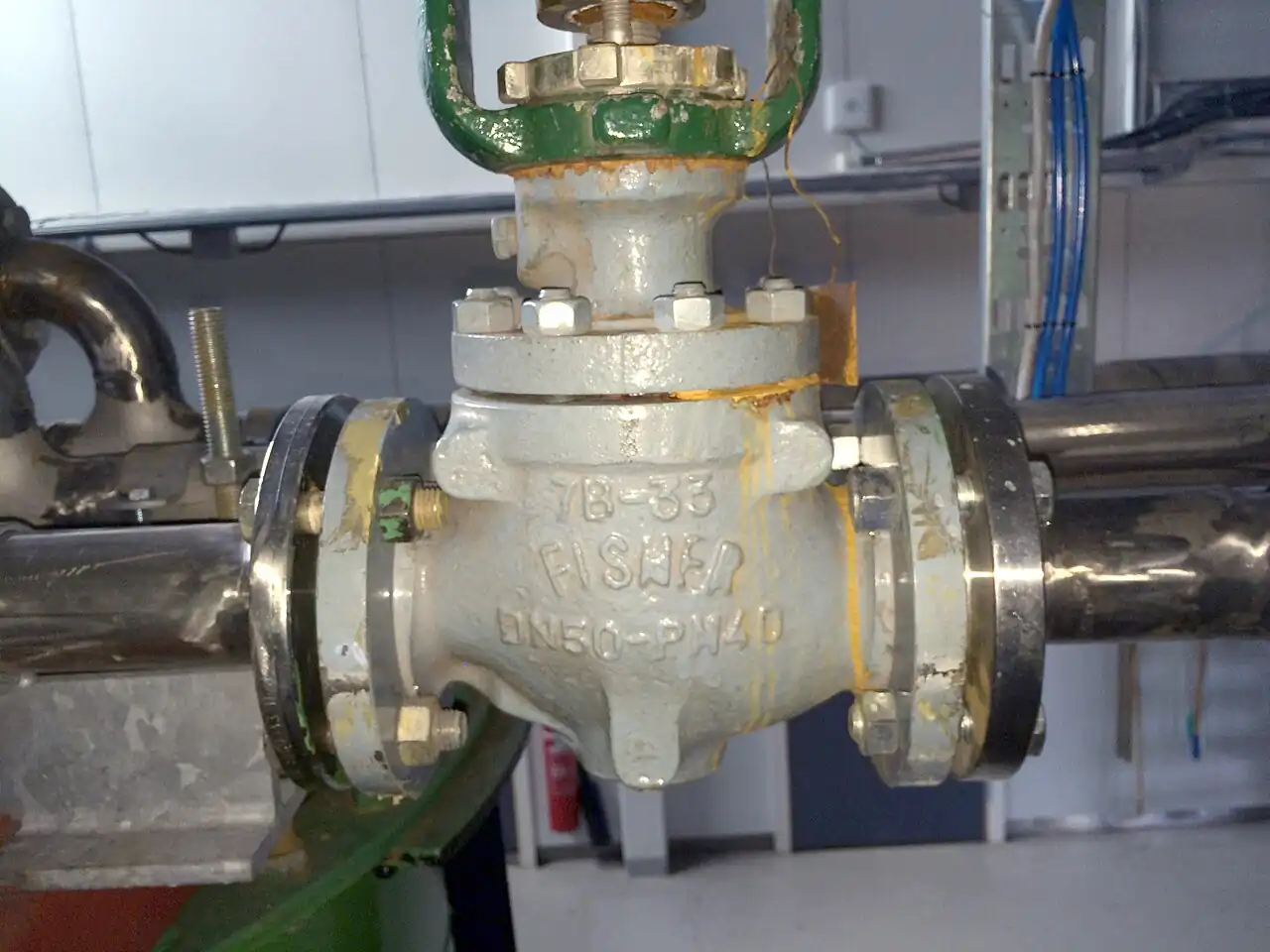
A bellows-sealed valve is an isolation valve, most often a globe valve and sometimes a gate valve, in which the stem penetration through the bonnet is sealed by a welded metal bellows rather than by packing alone. The bellows is a formed tube of typically 2 to 5 plies, in Inconel 625 or AM350 or 321 stainless steel, with hundreds of convolutions, welded to the stem at its lower end and to the bonnet at its upper end. Because the bellows flexes with every stroke, the sliding interface that normally leaks, the stem rubbing through packing rings, is replaced by a static welded barrier with no moving seal exposed to the process. A conventional packing set stays above the bellows as a secondary seal, and a leak detection port between the two is piped to a gauge or monitor, so a failed bellows announces itself before it emits anything to atmosphere.
Procurement engineers buy these valves where stem leakage is not a nuisance but a compliance event or a process hazard: thermal oil circuits carrying diphenyl oxide vapor near 300 deg C, where any packing weeps; hydrogen and helium lines, whose small molecules migrate through packing fibrils; chlorosilane and isocyanate services, where one emission or one ingested drop of air ruins the batch; and potent API containment in pharmaceutical plants. Regulation drives the rest of the demand: TA Luft 2021 with VDI 2440 in Germany and for exporters, ISO 15848 stem tightness qualification internationally, API 624 fire and fugitive qualification for petroleum gate valves, and leak detection and repair programs that put a camera or a sniffer on every refinery stem each quarter. The decision this page settles is narrow: whether the duty justifies a bellows at all, which architecture fits, what bellows material and ply count, what cycle life evidence, and what ISO 15848 class the purchase demands, and the answer lands as an RFQ line set with test reports attached.
This page treats the bellows-sealed valve as a purchasing object: how the welded bellows and its secondary packing work in real numbers, where forged API 602 and cast architectures fit, what TA Luft and ISO 15848 demand on paper, which services justify the bellows premium, and how bellows material, plies, cycle life evidence, leak detection, and certificates combine into a defensible RFQ. It is written for engineers who issue purchase specifications, not for readers who want a brochure summary.
Chapter 1 / 06
What a Bellows-Sealed Valve Is and What Is Being Decided
Start with what is being sealed and why packing cannot seal it. Every rising stem valve has a hole in its pressure boundary where the stem passes, and the traditional answer is packing: compressed fiber or graphite rings loaded by a gland, gripping a stem that slides through them a few thousand times a year. Packing leaks by construction, a little at first and more as rings relax, and every fugitive emission regime is essentially a schedule for finding and re-tightening those glands. A bellows-sealed valve removes the sliding seal from the pressure boundary: the stem moves inside a welded metal bellows, and the only joints between process and atmosphere are welds. That single change is the whole product, bought not because it seals better but because it cannot leak the way packing leaks.
The regulatory drivers have dates and documents, and the RFQ should quote them. In Germany, TA Luft 2021 and the VDI 2440 guideline for refineries set stem leak rate limits in the mbar liters per second per centimeter of seal circumference regime, and German owned plants plus exporters apply them worldwide. ISO 15848-1 grades stem tightness into classes, AH among the strictest for hazardous liquids and BH or BM common for gas, proven through endurance cycling of roughly 205 to 500 cycles in typical qualifications, while ISO 15848-2 governs the production leak test on every valve shipped. API 624 adds a fire test with fugitive measurement for petroleum gate valves, and Clean Air Act leak detection and repair programs put refinery stems on quarterly inspection with optical gas imaging cameras. A bellows valve with a monitored leak port meets all four regimes by making the audited failure mode structurally absent.
The service drivers are older than the regulations. Heat transfer circuits running diphenyl oxide or synthetic thermal oil at 300 deg C class temperatures defeat packing because elastomer and graphite structures weep at those temperatures and small molecule vapor pressure does the rest. Hydrogen and helium pass through packing fibrils by permeation, so a stem that is visually dry can still emit a measurable helium leak. Chlorosilanes and isocyanates attack moisture, so the seal must exclude air as much as contain the process. Pharmaceutical potent compound containment adds an occupational exposure limit measured in micrograms per cubic meter of air. These four chemistries, hot oil, light gases, moisture reactive chemicals, and potent powders, are the natural habitat of the bellows sealed globe valve and its relatives.
Against its neighbors the bellows valve occupies deliberate ground, and the full comparison belongs in the selection chapter. A diaphragm valve also isolates the stem from process with a flexible member, but that member is an elastomer or PTFE diaphragm with temperature limits well below metal bellows territory, suited to slurries and clean utility. A ball valve with live-loaded packing is cheaper, takes high cycle automation, and serves where fugitive rules tolerate graphite emissions, but its stem seal remains a sliding gland, just a well fed one. A globe control valve exists to throttle, and throttling is precisely the duty a bellows isolation valve must avoid, although bellows sealed control trims exist as a specialty. A needle valve covers small bore instrument isolation, and a gate valve covers large bore general isolation where its rising stem can be live-loaded or, above roughly 2 inch, bellows sealed under API 624. An angle seat valve automates steam and utility shutoff cheaply, but its piston stem remains a sliding gland under the same audits. None of these substitutes for a safety relief valve, which is overpressure protection, not containment, and none provides the vented positive isolation of a double block and bleed valve on taps depressurized for instrument removal.
What is actually being decided in this purchase is a set of five commitments. First, necessity: whether the service, regulation, or audit regime genuinely requires zero stem leakage, because the bellows premium buys nothing on a water line. Second, architecture: forged Class 800 globe in DN 15 to DN 50, cast globe to DN 200 and beyond, bellows gate for large bore, or instrument sized needle pattern. Third, the bellows itself: material, ply count, and cycle life with the qualification curve to prove it. Fourth, monitoring: leak detection port, secondary packing specification, and the program that watches the port. Fifth, paperwork: ISO 15848 class and report, TA Luft conformity, fire test where the hazard analysis demands it, and NACE MR0175 for sour service. A quotation that answers only the second commitment has priced a widget, not a containment strategy.
The RFQ should also name the station around the valve, because a bellows valve rarely stands alone. On steam letdown isolation the valve works beside a steam trap on the dripleg that keeps condensate slugs off the seat, and on wellstream skids the permanent pressure drop belongs to a choke valve while the bellows valve only isolates. Instrument and analyzer taps in emissions critical areas increasingly specify bellows sealed isolation valves adjacent to the instrument manifold, so the whole tap audits clean rather than one fitting of it. Stating the station lets one supplier check flange drilling, gasket compatibility, and orientation in a single pass instead of four arguments at delivery.
Chapter 2 / 06
How the Bellows and the Secondary Seal Work
The bellows seal itself is a stack of thin metal convolutions acting as a spring. Each ply is a formed sheet of roughly 0.1 mm, and commercial bellows run 2 to 5 plies nested inside one another: more plies share the movement and the pressure load, lengthening fatigue life at the cost of stiffness and price. The convolution count runs into the hundreds on a DN 50 valve because travel is absorbed a fraction of a millimeter per convolution, keeping bending strain per cycle low. Materials are set by chemistry and temperature: 321 stainless for general steam and oil, AM350 precipitation hardening stainless where pressure and cycle counts are high, and Inconel 625 for chlorides, wet acids, and coastal atmosphere. The temperature ceiling of the assembly is set by the bellows and its welds, about 350 deg C in typical commercial offerings, regardless of what the body could otherwise take.
Arrangement matters more than the catalog admits, and the datasheet must state it. In one design the process fluid is inside the bellows, which sees internal pressure and is stabilized by it. In the other the bellows sits outside the flow in a chamber connected to the process and sees external pressure that squeezes the convolutions together. Each arrangement has a pressure limit and a failure signature, and the back-pressure behavior, external versus internal, is a line item the purchaser should demand because it decides how the assembly behaves at maximum differential. Pressure balance ports, anti-static devices, and stem guides belong on the same datasheet page: an unsupported long bellows can squirm under axial load, and a guide is cheaper than a warranty claim.
Above the bellows, the valve keeps a complete conventional packing set, and the geometry between the two seals is the clever part of the product. The space between the top of the bellows weld and the bottom of the packing is tapped by the leak detection port, a small bored connection piped to a gauge, a switch, or a sample line. In healthy operation that space is dead and the port reads zero. If the bellows cracks or a weld fails, process pressure migrates into the space and the port shows it, long before any fluid reaches the packing or escapes to atmosphere. If the secondary packing should ever weep, the port turns that weep into a reading instead of an emission. The port is not an accessory: it is the condition monitoring channel of the design, and the maintenance chapter returns to it as the quarterly check that makes the valve auditable.
What the fugitive standards actually test is worth understanding, because the RFQ should demand the class and the report together. ISO 15848-1 type tests a design: it pressurizes the stem seal, mechanical cycles it through an endurance program of roughly 205 to 500 cycles in common qualifications, thermal cycles it, and measures leak rate at intervals, assigning tightness classes such as AH for hazardous liquids or BH and BM for gas. ISO 15848-2 defines the shorter production test applied to each valve shipped. TA Luft works as a legal limit with defined measurement procedures rather than a class menu. API 624 wraps a fire exposure around the stem test for gate valves. A datasheet that claims "low emission" without naming one of these frameworks is claiming nothing a test lab could reproduce.
Cycle life is where datasheets diverge from physics, so demand the curve. The bellows accumulates strain with every stroke, and commercial designs quote 10,000 to 100,000 full travel cycles as the qualified range; marketing claims of a million cycles exist for light duty small valves and are claims, not qualifications. The honest submittal states cycle life at stated pressure and temperature with the test reference, and the specification states the demand from stroke frequency: a twice daily valve needs 15,000 cycles for twenty years, a weekly one 1,000. Cycle counting converts the qualified number into a retirement age on thermally severe duty, and chapter 6 builds that into the program.
One mechanism note prevents the most common abuse. The bellows is a flexing spring, not a torque tube: it accepts axial travel and nothing else. The stem drive is arranged so handwheel torque passes through the stem into the seat, never as rotation or bending into the bellows, which is why manufacturers forbid pipe wrenches and limit handwheel extensions. The bellows also dislikes sustained vibration at its resonant frequency, and a valve installed near a chattering flow source converts that vibration into fatigue cycles at a rate no cycle count predicted. Both failure routes, torsion and resonance, reappear in chapter 6 because both are installation decisions.
Chapter 3 / 06
Types, Construction, and Duty Boundaries
Four architectures cover the market, and they are not interchangeable. The forged bellows globe valve to API 602 is the workhorse: a Class 800 forged body in DN 15 to DN 50 with socket weld, threaded, or butt weld ends, the same envelope as every other forged steel globe on the skid, with the bellows cartridge welded in behind standard packing. It dominates chemical plant hot oil, steam letdown isolation, and hydrogen service because it drops into standard forged globe piping and adds the welded barrier where the audit needs it. This is also what most suppliers mean when a catalog says "bellows seal valve" without qualification, and the bellows sealed globe valve name is earned by exactly this class.
The cast bellows globe valve extends the same idea to bolted bonnet bodies, Class 150 to Class 600, in sizes to DN 200 and beyond. The bolted bonnet is gasketed, so the stem is welded-barrier sealed while the body joint follows normal bolted joint discipline. These larger valves serve hot oil headers, toxic service manifolds, and letdown stations where DN 100 class line sizes carry the same fugitive obligations as the small bore skids. Above roughly DN 50 the buyer should expect the bellows to be a replaceable cartridge welded into a bonnet assembly, because nobody scraps a DN 150 casting to change a bellows.
Bellows gate valves answer the large bore petroleum demand. A rising stem gate valve in 2 to 12 inch sizes, qualified to API 624 with its fire and fugitive cycling, is the standard isolation purchase on emission audited hydrocarbon and vapor service where a butterfly valve loses the argument on shutoff credibility at high class. The bellows accommodates the long stem travel, and the same leak detection port geometry applies between bellows and secondary packing. The construction penalty is height and cost, and the duty boundary is that of any gate valve: full open or full closed, never throttling, because a partially open gate sheds flow induced vibration straight into the bellows.
The fourth architecture is small and often overlooked: the bellows sealed instrument and needle pattern valve for analyzer, sampling, and instrumentation isolation in DN 6 to DN 25 bores. On emissions critical or toxic taps these miniature valves put the welded barrier between process and the tube fittings downstream, specified alongside the instrument manifold hardware that distributes the signal. The needle valve trim inside gives metered opening for sampling and gauge equalization, and the bellows makes the whole tap auditable. This is what sampling skids and gas chromatograph enclosures buy when the sample fluid itself is the hazard.
Materials follow the body standards the plant already uses. Forged bodies run A105 carbon steel for non corrosive duty, LF2 for low temperature, F11 and F22 chrome alloys for hot hydrogen, and F316 for corrosion margin. Trims pair 316 stainless or 13 chrome stems and seats with stellite hardfacing where seat tightness at pressure matters. The bellows is the chemistry decision, as chapter 2 set out, and sour service adds NACE MR0175 certification across every wetted part including the plies. The table below consolidates the four architectures for the specifier.
Architecture
Size and class
Ends and body
Typical duty
Forged bellows globe, API 602
DN 15 to DN 50, Class 800
Socket weld, threaded, butt weld; A105, LF2, F316
Hot oil, steam letdown, hydrogen, skid isolation
Cast bellows globe, bolted bonnet
DN 25 to DN 200 plus, Class 150 to 600
Flanged RF; WCB, WC6, CF8M bodies
Hot and toxic headers, letdown stations, manifolds
Bellows gate, API 624 qualified
2 to 12 inch, Class 150 to 600
Flanged RF; cast or forged steel
Audited hydrocarbon and vapor line isolation
Bellows instrument and needle pattern
DN 6 to DN 25, to Class 2500 specials
Tube fitting, threaded, flanged; 316L
Analyzer, sampling, and gauge taps on toxic or gas service
Boundaries deserve one blunt paragraph. A bellows-sealed valve is an isolation instrument: it earns its cost at full open or full closed, and using it as a manual flow regulator both wastes the seat and fatigues the bellows with near seat turbulence. It is not a safety device and never substitutes for a safety relief valve on any overpressure scenario. It does not make a marginal piping design better, because the bellows consumed the stem flexibility budget, so the body expects ordinary bolted joint discipline. And it is not the answer where the fluid, not the emission, is the problem: a slurry that packs a seat needs a different valve family, and chapter 5 draws those lines.
Chapter 4 / 06
Key Specification Parameters
The table below decodes the datasheet lines that decide whether a quoted valve matches the containment duty. Each row is purchase defining; the paragraphs after the table explain what to demand and what a weak answer looks like.
Attribute
Typical range or options
What it decides
Size and architecture
DN 15 to DN 50 forged Class 800 globe; cast globe to DN 200 plus; gate 2 to 12 inch; instrument DN 6 to DN 25
Envelope, cycle duty, and the qualification standard
Pressure class and derate
Class 150 to 800 standard, Class 1500 specials, per ASME B16.34
Body rating and bellows back-pressure limit at temperature
Temperature limit
About 350 deg C typical ceiling set by bellows material
Whether the bellows, not the body, limits the service
Bellows material
321 stainless, AM350, Inconel 625
Corrosion envelope, chloride survival, strength at heat
Bellows plies and travel
2 to 5 plies, hundreds of convolutions
Fatigue margin and the defensible cycle life
Bellows arrangement
Internal pressure or external back-pressure design
Failure signature at maximum differential
Cycle life qualification
10,000 to 100,000 cycles claimed; test curve demanded
Retirement age against plant stroke frequency
Leak detection port
Tapped port between bellows and secondary packing
The monitoring channel that makes the valve auditable
Secondary packing
Graphite or PTFE set, live loaded, repackable in situ
Backup barrier behavior and maintenance access
Fugitive qualification
ISO 15848-1 class with report, TA Luft conformity, API 624 for gate
The cycle life row and the fugitive row travel together, because a leak class is only proven for the cycles the test ran. A supplier quoting ISO 15848-1 class AH for a DN 50 forged globe should attach the report: the class letter alone does not state the endurance, pressure, or temperature at which the leak rate was measured. The same discipline applies to the TA Luft statement, which should name the valve family and the test basis rather than certify the brochure. Where the audit regime is ISO 15848 based, write the class and endurance into the RFQ; where it is TA Luft based, write the conformity statement; where the valve sits in a fire mapped area, add API 624 or API 607. These are three different pieces of paper, and only the hazard study, not the buyer, can waive one.
The bellows rows deserve the skepticism budget. Plies and convolution count are facts a report can state; the cycle number is a claim until the qualification curve appears. The arrangement row, internal versus external back-pressure, is the one most often omitted and most consequential at Class 600 and above, because external pressure designs can squirm at differential even when the body rating is comfortable. The temperature row is the bellows ceiling: a WCB body that would carry 425 deg C in packed service is capped near 350 deg C by the bellows, and specifying the body rating while ignoring that cap is how hot oil startups discover warranty exclusions.
The framework table below compresses the four fugitive and fire regimes into the form a specification meeting can argue from, because the most common RFQ error in this product family is demanding the wrong paper.
Framework
Scope
Evidence the RFQ demands
TA Luft 2021 with VDI 2440
German clean air law; refineries and exporters
Conformity statement naming valve family and test basis
ISO 15848-1
Type test of stem tightness class, e.g. AH, BH, BM, with endurance cycling
Class letter plus report stating cycles, pressure, temperature, leak rate
ISO 15848-2
Production acceptance test per shipped valve
Certificate per lot or per valve as the spec requires
API 624 and API 607
Fire test with fugitive measurement for rising stem valves
Type test report for the exact model and class
Close the chapter with the joint discipline the datasheet rarely prints. The bolted bonnet on cast bodies seals with a gasket, and hot oil service wants a spiral wound gasket with an inner ring, not a soft cut grade. Flanged ends follow ASME B16.5 drilling with the line standard facing, and the purchase should state gasket and stud supply explicitly so the bellows valve is not commissioned with the cheapest compatible grade in the store. Seat tightness acceptance follows EN 12266 leakage rates, a different leak path from the stem and a different certificate; both belong in the submittal.
Chapter 5 / 06
Selection Decision Factors and RFQ Language
The decision sequence is short enough to run as a checklist in a specification meeting, and each step eliminates a class of quotations before price comparisons begin.
Establish the driver in writing: regulation named by clause, process chemistry, or occupational exposure limit. If none applies, buy a packed valve and stop reading.
Fix the duty: isolation only, with stroke frequency estimated per year for the cycle life demand.
Set the envelope: size, class per ASME B16.34, ends, and the temperature ceiling the bellows, not the body, will set.
Choose the architecture from the chapter 3 table: forged globe, cast globe, bellows gate, or instrument pattern.
Choose the bellows material against chemistry and atmosphere: 321 general, AM350 high pressure, Inconel 625 chloride and coastal.
Fix the monitoring: leak detection port piped where a reading happens, secondary packing specification, quarterly route.
Fix the evidence: ISO 15848 class with report or TA Luft statement, API 624 or 607 where fire mapped, EN 12266 seat test, NACE MR0175 if sour.
State the station: neighbors, including whether a double block and bleed valve serves any tap vented for maintenance, so gasket, flange, and orientation compatibility is checked in one pass.
Against neighboring valve types, the comparison a specifier actually needs runs as follows, and it belongs here in the selection chapter rather than in the page title. The diaphragm valve isolates its stem with a flexible diaphragm and wins slurries, pharma clean utility, and lower temperature services at lower cost, but its elastomer or PTFE barrier cannot follow the bellows into 300 deg C oil or helium. The ball valve with live-loaded packing wins high cycle automated isolation at the lowest cost per seat, and on water, air, and non audited hydrocarbon it is the correct purchase, but its stem remains a sliding gland that a fugitive audit will always find interesting. The butterfly valve wins large bore utility isolation on weight and cost where fugitive rules allow quarter turn glands. The globe control valve is the throttling instrument, and no isolation valve, bellows included, should be asked to regulate; bellows sealed control trims exist for when a control loop and a fugitive rule collide. The needle valve holds small bore instrument isolation, and its bellows sealed pattern is the tap valve of choice beside an instrument manifold on toxic or light gas service. The angle seat valve automates steam barrier and condensate duty at low cost where its piston stem seal satisfies the audit. On wellstream skids the choke valve takes the permanent pressure drop while the bellows valve isolates dead flat, which is the only way a bellows should ever see differential.
The application map below turns those boundaries into a table the project file can carry.
Application
Construction to specify
Check before order
Thermal oil or diphenyl oxide near 300 deg C
Forged bellows globe, F22 or F316 body, 321 or 625 bellows
Bellows temperature ceiling; cycle life at temperature; bonnet gasket with inner ring
Hydrogen or helium isolation
Forged bellows globe or bellows gate, metal to metal plus bellows
Bellows instrument or needle pattern beside instrument manifold
Dead volume data; tube fitting compatibility; solenoid valve interlocks
Two selection honesty notes close the argument. First, a bellows valve bought for an audit but installed without monitoring is half a purchase: the leak detection port that nobody reads is the fugitive equivalent of a smoke detector with no battery, and the RFQ should state where the port reading lands, gauge, switch, or DCS alarm. Second, automation changes the failure surface: actuators with positioners make stroke frequency a control system fact, and on purge or nitrogen blanketing duty a piloted solenoid valve in the actuation line gives the interlock logic something to switch. Specify actuator envelope, fail action, and cycle count basis together, because an automated bellows valve can consume its qualified life in a bad tuning year.
The RFQ block should be written once and reused. A complete block reads: quantity and tag list; size, class, and ends with flange drilling standard; body and trim materials with EN 10204 3.1 certificates; bellows material, ply count, and arrangement, internal or external back-pressure; qualified cycle life at stated pressure and temperature with the test report reference; ISO 15848-1 class and report or TA Luft conformity as the regime requires; API 624 or API 607 fire qualification where the hazard study demands; leak detection port size and routing; secondary packing specification with in situ repack confirmation; seat leakage class per EN 12266; NACE MR0175 applicability; bonnet and flange gasket specification including spiral wound gasket with inner ring for hot service; stud supply and torque procedure per ASME PCC-1; actuation with fail action and cycle count basis where automated; and the drawing package expectation, bellows cartridge drawing, port location, and the pressure temperature derate table. A quotation returned without the cycle life basis or the fugitive test reference is incomplete at any price.
Chapter 6 / 06
Installation, Standards, Failure Modes, and Maintenance
Installation quality decides whether the bellows reaches its qualified life. The body is an ordinary bolted joint consumer: bring flange bolts up in a cross pattern to the stated torque table per ASME PCC-1, use a compatible spiral wound gasket with inner ring on hot service, apply anti-seize as specified, and keep piping strain off the flange faces, because the stem flexibility budget of this valve was spent on the bellows and none remains for a misaligned line. Support the piping, not the valve. Vertical installation with the handwheel up is the default for globe patterns, and bellows gate valves need their rising stem clearance. Before first stroke, confirm the leak detection port is plugged, piped, or gauged as designed, because an open unterminated port is a small fugitive source of its own and a monitoring channel that reads nothing forever.
Commissioning protects the bellows and the seat in that order. Stroke the valve slowly full travel once or twice and log the handwheel turns: a rising count over later years signals trim wear or bellows drag before anything leaks. Verify the secondary packing gland torque and note the port reading with the line at pressure; that zero is the monitoring baseline. On steam service, warm the line with the dripleg and its steam trap working before the valve sees full differential, because a condensate slug at velocity is both a seat hazard and a bellows vibration source. Enforce the torque rule from day one: no handwheel extensions, no pipe wrenches on stems, since torsion into the bellows is the one abuse no inspection forgives.
The standards set the verification frame, and the RFQ quotes them by name. API 602 governs the forged steel globe architecture, API 600 the cast valve context, API 624 the fire and fugitive type test for rising stem valves, ISO 15848-1 and 15848-2 the stem tightness class and production test, TA Luft with VDI 2440 the German legal limit framework, ASME B16.34 the pressure temperature rating, EN 12266 the seat leakage acceptance testing, API 607 the fire test context, and NACE MR0175 the sour service material rules. A specification that cites these by name transfers the burden of proof to the supplier and gives the inspector a checklist that matches the certificates in the file.
Failure modes in service follow a short and predictable list. Bellows fatigue leads it: cycles beyond the qualified life, or resonance from flow induced vibration near a partially open seat, crack a convolution and show up as pressure on the leak detection port long before any external emission; the response is to stop using the valve as a regulator, isolate, and schedule the cartridge change. Torsion damage is second: forcing a stuck seat with an extended handle winds the bellows until it fails, which is why the abuse is forbidden. External corrosion of the plies ranks third on coastal and chloride sites, where 321 pits from outside regardless of what flows inside and Inconel 625 is the answer; annual inspection catches it as staining before it becomes cracking. Thermal shock from rapid quench can distort sound convolutions, so quench procedures belong in the operating instructions. Seat and trim wear complete the list, read as rising turn counts or weeping, maintained by lapping or trim replacement like any globe valve.
The maintenance program is short enough to run on a card. Quarterly, read or sniff the leak detection port per the LDAR route: port readings confirm the primary barrier, and a nonzero port is a same day work order, not a trend to watch. Annually, stroke full travel and compare turn counts, check secondary packing gland torque, repack the secondary seal in situ if needed, and inspect the bellows exterior on coastal sites. Per cycle count, retire the bellows cartridge when logged cycles approach the qualified life on thermally severe duty, because the qualified number is a structural fact about metal. Keep spares matched to the tag list: one bellows cartridge, one packing set, one gasket set including the spiral wound gasket and port seals, with certificates on file. Where the valve is automated, add actuator service, verify the fail action by bleeding the motive supply rather than trusting the nameplate, and include any solenoid valve piloting purge or actuation lines on the same route.
Close the lifecycle with records the next purchase can use. Keep the qualification reports, the commissioning baseline, the quarterly port readings, the stroke logs, and the cycle counter values in one file per tag. When the next line is specified, that file converts supplier claims into line items: measured stroke frequency sets the cycle life demand, port history sets the monitoring design, corrosion findings set the bellows material. A fugitive program without those numbers is paying bellows prices for packing discipline.
FAQ
When is a bellows-sealed valve required instead of packed construction?
Specify a bellows-sealed valve when stem leakage is a compliance event or a process hazard rather than a nuisance: TA Luft or ISO 15848 audited services, thermal oil and diphenyl oxide vapor near 300 deg C where packing weeps, hydrogen and helium lines whose molecules permeate packing, moisture reactive chemicals such as chlorosilanes and isocyanates, and potent API containment. On water, air, and unaudited utility service, live-loaded packing is the honest purchase and the bellows premium buys nothing.
How does the leak detection port tell me the bellows has failed?
The port is a tapped connection in the space between the bellows and the secondary packing. While the bellows is intact, that space is dead and the port reads zero. If a convolution cracks or a weld fails, process pressure migrates into the space and appears at the gauge, switch, or sampling line on the port, long before fluid reaches atmosphere. Read or sniff it quarterly, and treat any nonzero reading as a same day work order.
What fugitive emission qualification should the RFQ demand?
Match the paper to the audit regime. For ISO 15848 based plants, demand the class letter, such as AH for hazardous liquid or BH and BM for gas, plus the test report stating cycles, pressure, temperature, and leak rate. For German TA Luft exposure, demand the conformity statement naming the valve family and test basis. For fire mapped petroleum areas, add API 624 for rising stem valves or API 607 as applicable. A class letter without the report is a claim, not evidence.
Can a bellows-sealed valve be used for throttling?
No. It is an isolation instrument designed for full open or full closed. Partial opening puts the seat in high velocity flow, the resulting vibration feeds straight into the bellows convolutions as fatigue cycles, and chatter near the seat consumes qualified life at a rate no cycle count predicted. If the loop must regulate, specify a globe control valve for the duty, or a bellows sealed control trim as the specialty crossover, and keep the bellows isolation valve dead flat when open.
What bellows material suits hot oil or coastal chloride service?
Match the alloy to the attack. For general steam and hot oil to about 350 deg C, 321 stainless is the economy choice. AM350 adds strength where pressure and cycle counts are high. Inconel 625 is the answer for chlorides, coastal atmosphere, and acid condensate, because 321 plies pit from the outside on marine sites regardless of the process fluid. The bellows is also the component that sets the temperature ceiling below the body rating.
What cycle life claim is credible and how is it verified?
Commercial designs quote 10,000 to 100,000 full travel cycles qualified at stated pressure and temperature, with higher marketing numbers for light duty small valves. The credible submittal attaches the qualification curve or report reference from ISO 15848-1 endurance testing or the maker's protocol. Set your demand from stroke frequency: a valve stroked twice daily needs about 15,000 cycles for twenty years. Log cycles on severe duty and retire the cartridge as the count approaches the qualified life.
What maintenance does a bellows-sealed valve need in service?
Quarterly, read or sniff the leak detection port per the fugitive route and file the reading. Annually, stroke full travel and compare turn counts to the commissioning baseline, check secondary packing gland torque, and inspect the bellows exterior for chloride staining on coastal sites. The secondary packing can be repacked in situ; a failed bellows is a shop job, a cartridge replacement at shutdown. Keep the cartridge, packing set, spiral wound gasket, and port seals as matched spares with certificates on file.