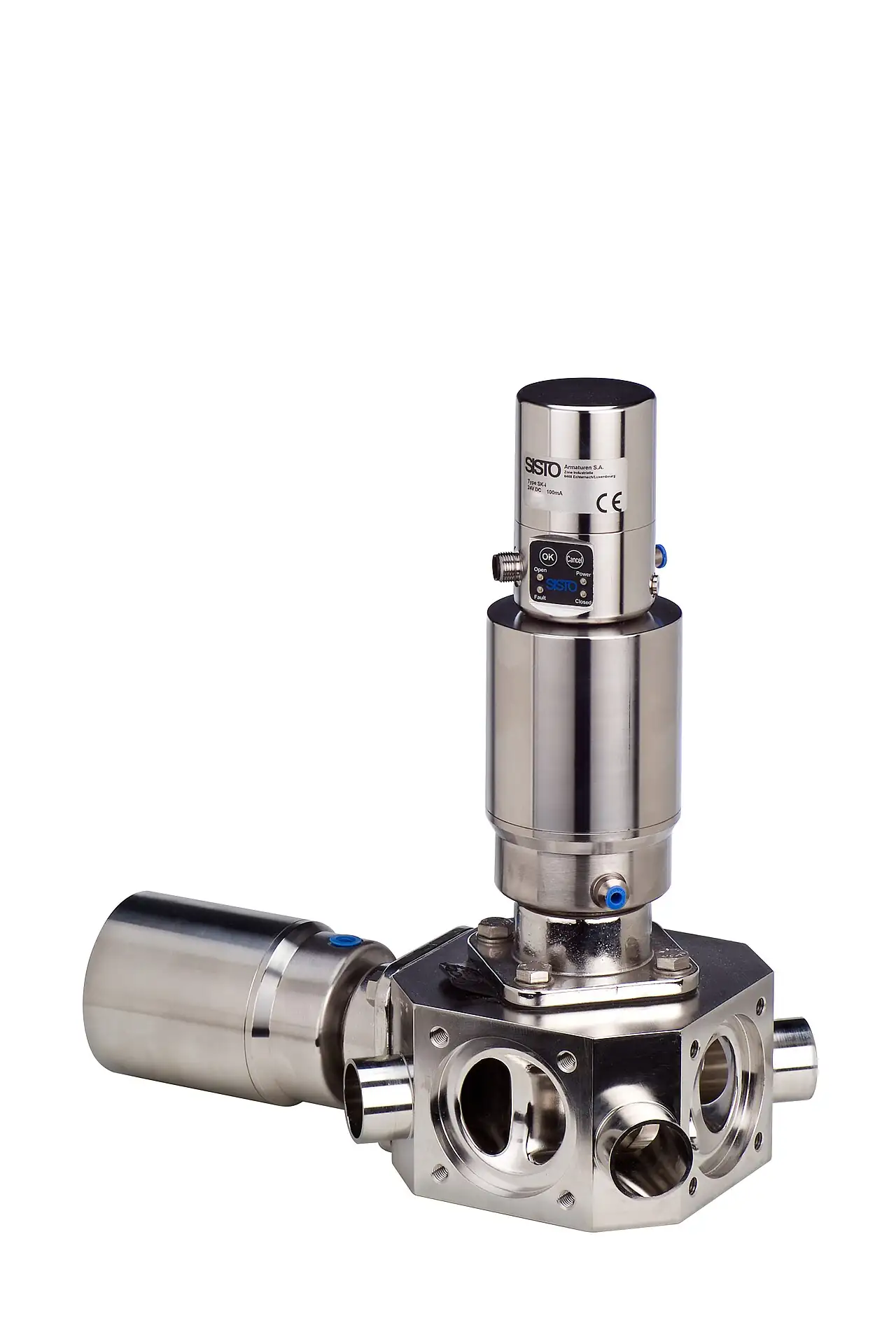
A mixproof valve is a hygienic double seat valve used at the junctions of product routing manifolds in dairy, beverage, brewing, personal care, and biotech plants. Two different products, or a product and a cleaning fluid, occupy the same valve body from opposite ports at the same time without mixing: two independent plug and seat pairs seal in series, and the space between them, the leakage chamber, is vented to atmosphere, so any seat leak drains out of the chamber nozzle instead of crossing into the other product. Suppliers also call it a double seat valve or double seat mixproof valve, and the concept is written mix proof valve in some older plant documents. Sizes run DN 25 to DN 150 on working pressures to about the 10 bar class.
Procurement engineers meet these valves wherever a valve matrix routes many products and CIP circuits through common headers: pasteurized product routing in a dairy, syrup and cleaning manifolds in a beverage plant, buffer distribution in biotech, cream and lotion transfer in personal care. The decision this page settles is narrow and practical: double seat or single seat architecture, which cleanability class the duty actually needs, which elastomer survives the product chemistry and the sterilization regime, and how the actuator and control top integrate with the plant. The answer lands as an RFQ line set, and every chapter below feeds that line set.
This page treats the mixproof valve as a purchasing object: how two seats in series with an atmospheric leakage chamber let two fluids share one body, what seat lift does during cleaning, how basic, seat-clean, ultra-clean, and aseptic builds differ in real numbers, and how elastomer, surface finish, and control top choices combine into a defensible RFQ. It is written for engineers who issue purchase specifications, not for readers who want a brochure summary.
Chapter 1 / 06
What a Mixproof Valve Is and What Is Being Decided
The problem the valve solves is manifold arithmetic. A product matrix routes a dozen products and a clean in place circuit through common headers using tee and cross bodies, and at every junction a valve may see product on one port and CIP solution, or a second product, on the other at the same moment. A single seated valve at that junction is one seat failure away from routing a batch into the wrong tank or detergent into product. The mixproof valve accepts simultaneous exposure by design: each fluid meets its own plug and seat, and the gap between the two seals never closes, so there is no shared sealed volume to leak across in the first place.
What is actually being decided in this purchase is five commitments. The first is the body combination, tee or cross, at each junction of the matrix. The second is the cleanability class, basic, seat-clean, ultra-clean, or aseptic, which is the real price driver. The third is the elastomer, decided by product chemistry and sterilization method. The fourth is the seat lift and chamber cleaning scope, which sets how the seal paths are cleaned. The fifth is the control topology, from twin solenoid pilots to a digital control top on a bus. A matrix valve bought on size alone delivers none of those five deliberately, and matrix mistakes are batch sized, not valve sized.
The boundary against the double block and bleed valve deserves a plain statement because the catalogs rhyme. A double block and bleed valve isolates process lines with two seats and a vented cavity in the API 6D tradition, and it is excellent at that duty, but it is not hygienic, not drainable to a food standard, and not built for simultaneous two product service. The mixproof valve is a hygienic routing element whose atmospheric chamber exists precisely so that two fluids can occupy one body at once. Different products, different standards, different paragraphs of the specification, and substituting one for the other fails on the first audit or the first batch.
Closer neighbors need boundaries too, with the fuller comparison reserved for the selection chapter. The diaphragm valve is the classic hygienic shut-off, legitimate and cheaper, but it passes one product at a time and its diaphragm is a wearing spare with a fixed life. The butterfly valve appears all over product matrices on cost and compactness, but it cannot mixproof at all: one disc, one body volume, both ports in it. A ball valve traps cavity volume around the ball and has no hygienic drain story. Aseptic duty is not a separate purchase: it is a type row on this page's own table, the aseptic mixproof with a steam sterilizable chamber.
Four reference frames organize the datasheet. Hygienic design answers to 3-A sanitary standards and EHEDG hygienic design criteria, with ASME BPE the working frame in biotech. Wetted elastomers carry compliance to FDA 21 CFR 177.2600 and EU 1935/2004, declared by compound and certificate rather than by generic grade names. Surface finish is specified as a number, Ra under 0.8 micron, often electropolished, and drainability is a design claim the supplier should be able to show on a section drawing. Material certificates to EN 10204 3.1 close the paper trail. A datasheet silent on these four frames is a price tag with a drawing attached.
The valve never works alone, and the RFQ should name its station. Feed arrives from pumps chosen by product: a centrifugal pump on water-like dairy streams, a lobe pump on viscous cream and syrup, a twin screw pump where shear damage to structure matters. CIP arrives on its own supply with the return watched by a conductivity meter proving the circuit has rinsed back to clean water. Quality pulls in-process samples through a matrix mounted sampling valve without breaking the routing. Control arrives over the valve bus or through wired pilots with position feedback to the system, and a pH meter or similar analyzer guards the hold points where product identity must be proven. Buying the matrix without naming these neighbors is how commissioning weeks get lost.
Chapter 2 / 06
How the Double Seat Keeps Products Apart
Mechanically the valve is two seat valves stacked in one body with a gap between them. The upper plug seals the upper seat against the upper port, the lower plug seals the lower seat against the lower port, and each plug and seat pair is independent and individually actuated. Two products can press against their respective seats at full line pressure simultaneously because the plugs are balanced: pressure forces on the plug are arranged to cancel or to load the seat rather than to hammer it open, which keeps actuator forces manageable on DN 100 and DN 150 bodies where an unbalanced design would need a cylinder twice the size.
The leakage chamber between the seats is the heart of the concept. It is vented to atmosphere through a drain nozzle, so its pressure is always ambient. If the upper seat weeps, product runs out of the chamber drain to a visible collection point; if the lower seat weeps, the same happens from the other side. Cross leakage is geometrically impossible while the chamber stays open, because no sealed path exists from one port to the other: every leak path passes through the atmospheric gap first. The drain is therefore the diagnostic as well as the protection, and watching it tells operations the condition of both seats continuously, which chapter 6 turns into a maintenance routine.
Upper and lower plugs move on separate actuator stations, either two pneumatic cylinders with their own air connections or one integrated package under a control top. Sequencing is everything: the design requires a defined order for opening and closing, it forbids positions where both seats are lifted together, and it interlocks against line pressure surprises. A solenoid valve pilot on each air connection does the switching in basic builds, and the control top integrates the solenoids, the position sensors, and a bus interface into one head. That head is what large matrices actually install, and it is the difference between a valve and an instrument.
Seat lift is the cleaning trick that makes the architecture survivable. During CIP, the valve deliberately lifts one seat a few millimetres, upper or lower per the design, so cleaning fluid flows through the seat area itself and through the leakage chamber, flushing the very seal paths the valve exists to protect. Without seat lift, the chamber and the seat faces would be the dirtiest dead zone on the matrix; with it, the whole interior sees cleaning flow. Some designs add seat push, pressing the plug onto the seat with defined force for a controlled wipe, and seat-clean versions admit CIP directly to the seat region through external ports.
The envelope numbers are compact and worth memorizing. Sizes DN 25 to DN 150, one to six inches, cover the overwhelming majority of product matrices; larger product headers are usually built from butterflies plus a routing strategy instead. Working pressure runs to about the 10 bar class, which covers product pumps and CIP supply with margin. Cleaning reaches 95 deg C on CIP duty, and steam in place versions take 135 deg C, some designs 150 deg C short term, always checked against the elastomer table because the steam rating belongs to the seal compound, not to the steel.
Materials and surfaces are the hygienic half of the specification. Bodies are 316L, wetted welds ground flush, internal surfaces polished to Ra under 0.8 micron and frequently electropolished. The elastomers do the quiet work: EPDM in steam resistant white food grade compounds is the dairy default, HNBR carries fat rich products with good mechanical life, and FPM takes aggressive chemistry and oils where the steam regime allows it. The chamber drain ships as an open nozzle in basic builds or as a sterile, steam sealable version on aseptic duty, and that choice is made in the RFQ, never improvised in the field.
Chapter 3 / 06
Types, Construction, and Duty Boundaries
Five types cover the catalog, and the table at the end of this chapter compresses them. The basic double seat mixproof is the volume build for utility dairy duty: two seats, open chamber drain, seat lift, pneumatic actuation, and a price that makes it the default at every junction that does not demand more. It is the valve that made the architecture ubiquitous, and most beverage and brewing matrices run on it.
Seat-clean versions add external seat cleaning ports that admit CIP fluid directly to the seat region. They exist for products that blind the seat area, fats that coat, particulates that pack, and syrups that film, where internal seat lift alone does not deliver enough cleaning flow onto the seal faces. The ports are small bore, piped to the CIP supply, and pulsed during the cleaning program, and they belong on the drawing from day one because retrofit piping across a welded matrix is miserable.
High clean builds, the UltraPure class in supplier language, push drainability and surface story to the limit: fully drainable cavity geometry, electrolytic polished surfaces, PTFE free or specifically qualified elastomers, and documentation built for audits. These are the personal care, premium dairy, and biotech upstream workhorses, and the price step over the basic build buys exactly that documentation and drain geometry, nothing more and nothing less.
Aseptic and SIP versions carry a steam sterilizable leakage chamber and a hygienic drain, qualified for steam in place at 135 deg C, some designs 150 deg C short term, and they serve the aseptic process steps before sterile filtration where the chamber itself must be sterile rather than merely clean. The aseptic mixproof is a type on this page, not a separate product search: the decision is made in the type table of this chapter or in the selection chapter, against the actual microbial risk of the step.
Single seat mixproof designs cut cost by sealing with one seat and keeping an atmospheric cavity around the plug shaft: lighter, cheaper, and legitimate for many junctions, but the protection story is one seat weaker because only one seal stands between the two fluids. External mixproof variants place the two seats in separate bodies manifolded together. Manual versions exist for small plants, and for simple single product paths an angle seat valve is the lighter duty answer, but the pneumatic actuator with a control top is the standard matrix installation, because hand sequencing a twenty valve matrix is an incident report waiting for a night shift.
Bodies and ends complete the type picture. Combinations are tee, cross, and multiport weld bodies sized to the matrix layout, with the combination stated valve by valve on the RFQ, because a cross ordered as a tee is a fabrication change, not a line item. Ends are weld to ISO 2037 tube, clamp for maintainability with a food grade gasket, or flange to DIN 11851 and ASME BPE patterns where the plant standard demands it. The control top carries the digital valve control with position feedback, and its protocol is a line in the RFQ, not a discovery at commissioning.
Type
Chamber arrangement
Cleanability class
Natural duty
Basic double seat
Open chamber drain, internal seat lift
Standard CIP
Utility dairy and beverage matrices
Seat-clean version
External seat cleaning ports added
Standard CIP plus directed seat flow
Fat bearing and particulate products
Ultra-clean build
Fully drainable cavity, electrolytic polished
High clean, audit documented
Personal care, premium dairy, biotech upstream
Aseptic or SIP version
Steam sterilizable chamber and drain
Aseptic, SIP at 135 to 150 deg C
Steps before sterile filtration
Single seat mixproof
Atmospheric cavity on the plug shaft
Standard CIP
Lower risk junctions at lower cost
Chapter 4 / 06
Key Specification Parameters
The table below decodes the datasheet lines that decide whether a quoted valve matches the matrix. Each row is purchase defining; the paragraphs after the table explain what to demand and what a weak answer looks like.
Attribute
Typical range or options
What it decides
Line size
DN 25 to DN 150, 1 to 6 in
Matrix pipe schedule and junction geometry
Body combination
Tee, cross, multiport weld body
What each junction can route
Working pressure
To about the 10 bar class
Body and actuator headroom over CIP and product
CIP temperature
To 95 deg C
Elastomer compound and seal life
SIP temperature
135 deg C, some designs 150 deg C short term
Aseptic qualification and elastomer ceiling
Body material
316L, welds ground flush
Corrosion base and cleanability
Surface finish
Ra under 0.8 micron, electropolished
Audit acceptance and cleanability
Elastomers
EPDM, HNBR, FPM, food compliant
Product and chemistry compatibility
Ends
Weld ISO 2037, clamp, flange DIN 11851 or ASME BPE
Installation and matrix maintainability
Actuation and control
Twin cylinders or control top, digital bus
Sequencing, feedback, integration
Beyond the table, five statements separate a specification from a quotation. First, the hygienic standard claimed, by name, 3-A, EHEDG, or ASME BPE, with the certificate behind it. Second, the elastomer compound with its FDA 21 CFR 177.2600 and EU 1935/2004 compliance declaration, because generic EPDM tells an auditor nothing. Third, the drainability statement with a section drawing, not an adjective. Fourth, the seat lift behavior: which seat lifts, how far, and under whose command. Fifth, the control top protocol and the position feedback it returns. A datasheet silent on these five rows has not been engineered yet.
The elastomer choice carries most of the warranty risk in a mixproof purchase, and the table below is the short version of the argument.
Elastomer
Where it wins
Limits to watch
EPDM, white food grade
Water, dairy, CIP chemistry; steam resistant grades take SIP
Surface finish is a specification number, not a description. Ra under 0.8 micron is the working standard for product wetted surfaces, with electropolishing added where the product or the audit demands it. The finish belongs on the drawing together with the weld treatment: internal welds ground flush, no crevices, no fasteners in the product zone. Drainability comes with it, a body that empties completely by gravity, proven on the section drawing, because a matrix that holds rinse water holds bacteria, and no cleaning program fixes geometry.
The control package is where a matrix valve becomes an instrument. Basic builds run on two solenoid valve pilots and hardwired limit signals. The control top integrates solenoids, sensors, and electronics into one head with digital valve control: position feedback, seat lift commands, and diagnostic flags over the bus, AS-i in most dairy plants. A valve positioner is the companion instrument on modulating duty elsewhere, closing the loop on a control valve that throttles; on a switchable mixproof it has no role, and the feedback story belongs entirely to the control top. In the same spirit, a bellows sealed valve answers fugitive stem emission on process lines, a different problem on a different plant, while a hygienic matrix handles stem sealing with lip seals and open, inspectable drains. State the protocol and the feedback points in the RFQ so the control system and the valve agree before delivery, not after.
Chapter 5 / 06
Selection Decision Factors and RFQ Language
The decision sequence below runs as a checklist in a specification meeting, and each step eliminates a class of quotations before any price comparison starts.
Map the matrix first: every junction, and every simultaneous pair that can occur there, including product against CIP.
Fix the cleanability class per junction, basic, seat-clean, ultra-clean, or aseptic, and pay the premium only where the product risk sits.
Choose the elastomer against product chemistry and the real sterilization regime, CIP or SIP, with certificates.
Decide the seat lift and chamber cleaning scope: internal lift, seat push, or external ports.
Set body combination and ends against the plant standard: weld, clamp, or flange.
Package actuation and control: cylinders or control top, protocol, feedback, and fail behavior.
Route every chamber drain visibly, to atmosphere or a monitored collection point, never submerged or shared.
Demand the evidence: compliance certificates, the drainability drawing, seat test records, and the elastomer declaration by compound.
Against neighboring types, the comparison a specifier actually runs is what may sit in the body at the same time, and it belongs here in the selection chapter. The double block and bleed valve gives positive process isolation with a vented cavity in the API 6D tradition, but it carries no hygienic design and no simultaneous two product claim. The diaphragm valve is the honest cheaper alternative where the matrix can be sequenced so that only one fluid is ever present, and its diaphragm budget line replaces this valve's seat budget line. The butterfly valve is the large bore matrix workhorse and proves nothing: it routes, and sequencing protects. The ball valve shares the same cavity objection in hygienic service. The angle seat valve serves simple on-off product paths at lower cost where no junction risk exists, and a control valve with its valve positioner belongs on lines that throttle rather than switch. The bellows sealed valve, for completeness, stays in the process plant: it solves stem emissions there, while hygienic stems seal on food grade lip seals that are inspected openly rather than hidden under a bellows. Where a junction can genuinely see two fluids at once, the mixproof architecture is the hygienic answer, and the type table in chapter 3 picks the class, not a new product search.
The station around the matrix decides half the valve's performance, so the RFQ should name it. Feed pumps follow the product: a centrifugal pump on thin dairy streams, a lobe pump on cream and syrup, a twin screw pump on shear sensitive structures, and a metering pump where an additive enters the manifold on ratio. CIP verification runs on a conductivity meter at the return, product identity at hold points is proven by the analyzers already in the plant, and in-process quality pulls go through the matrix mounted sampling valve. The application map below turns the selection logic into a table the project file can carry.
Application
Construction to specify
Check before order
Pasteurized dairy routing matrix
Basic double seat, white EPDM, seat lift, control top on AS-i
Audit documentation package and drainability drawing
Biotech buffer prep with SIP
Aseptic version, steam chamber, 135 deg C rating
SIP cycle against elastomer ceiling; sterile drain variant
The RFQ block should be written once and reused. A complete block reads: line sizes and body combination, tee or cross, at each junction; the products and the CIP chemistry with concentrations; the hygienic standard claimed by name; the elastomer compound with its FDA 21 CFR 177.2600 and EU 1935/2004 declarations; the surface finish, Ra under 0.8 micron, electropolished where claimed; the CIP and SIP temperatures with exposure times; the seat lift and chamber cleaning requirement, internal lift, seat push, or external ports; the actuator and control top with protocol, AS-i or other, and feedback points; ATEX classification if solvents are present; and the chamber drain routing requirement, open, visible, never submerged. A quotation returned without the elastomer declaration or the drainability drawing is incomplete at any price.
Chapter 6 / 06
Installation, Standards, Failure Modes, and Maintenance
Installation is welding and drainage discipline. Weld ends are orbital welded flush and smooth, with the welds finished to the same Ra as the bore, and clamp connections with their food grade gasket go where the matrix must be broken for modification; flange pairs to the plant standard are torqued evenly with the gasket centered. The chamber drain lines are the detail that gets value engineered into failure: each must run visibly, downhill, to atmosphere or a monitored collection point, never into a submerged drain, a shared header, or a capped tube, because a submerged drain back-floods the chamber and destroys the atmospheric gap that makes the valve mixproof. Support the bodies on the matrix frame rather than on each other, and keep the control top connectors reachable.
Commissioning proves the chamber logic. Pressurize each side alternately with water and watch the chamber drain: a dry drain under sustained hold proves both seats, a weeping drain identifies a leaking seat by the flow direction, and that observation becomes the baseline for every later judgment. Prove the seat lift flows by running CIP and confirming return flow and temperature at the matrix, verified by the conductivity meter at the return line. Verify control top feedback against actual plug positions, interlock the matrix controller against the feedback states before the first product run, and where an additive feeds the manifold, check the metering pump totals against tank draw. On SIP versions, ramp the first steam cycles per the elastomer limits, guard product identity at hold points with the pH meter or equivalent analyzer, and log every cycle.
The standards frame is short. 3-A sanitary standards and EHEDG hygienic design criteria govern the hygienic claims, ASME BPE is the biotech working frame, FDA 21 CFR 177.2600 and EU 1935/2004 govern elastomer contact compliance, and EN 10204 3.1 covers material identity. There is no single international type test for mixproof behavior, which is exactly why the drain observation and the seat test records belong in the purchase order: the buyer defines the proof, and the supplier demonstrates against it before shipment.
Failure modes follow a short and predictable list. Seat wear from product with solids shows at the chamber drain first, which is the design working as intended, and a seat life program that records replacement intervals turns the observation into a schedule. Elastomer swelling from wrong CIP chemistry makes valves stiff and slow, and the fix is a chemistry audit against the compound table, not a bigger actuator. A plugged chamber drain is the most dangerous condition in the fleet, because it masks a leaking seat and can back-flood the chamber; drains are inspected and kept open on a walkdown rhythm. A control top solenoid valve failure holding seat lift open lets product drain silently through the lifted seat, and feedback supervision catches it. Water hammer in the matrix from pump starts against closed paths is managed by sequencing and soft starts, and steam trap failure on SIP versions shows up as wet steam and failed sterilization cycles that the logging should expose.
Maintenance is observation formalized. Watch the chamber drains on a fixed walkdown cadence; a dry drain is the health certificate of both seats. Record every seat replacement with date, product exposure, and cycle count, and replace seats on the trend rather than on failure, because a mixproof seat failure is a batch event, not a maintenance event. Inspect the elastomers annually for swelling, set marks, and compression, and keep a spares kit of seats and the declared elastomer set for each body size. Inspect the pneumatic actuator and control top seals on the same calendar, audit the CIP chemistry against the compound declarations whenever the cleaning program changes, and revalidate SIP cycles after any steam system work. A matrix that passes audits for a decade is a drain line, a logbook, and a spares drawer.
FAQ
Can two products really sit in a mixproof valve at the same time?
Yes, that is the design intent. Each fluid meets its own independently actuated plug and seat, the two seals sit in series, and the leakage chamber between them stays open to atmosphere. Any weep from either seat runs out of the chamber drain to a visible collection point, and no sealed path exists from one port to the other. The condition is that the chamber drain stays open and unobstructed, which is why drain routing is a purchase specification item.
What does seat lift do during CIP?
Seat lift deliberately raises one seat a few millimetres during cleaning so CIP fluid flows through the seat area itself and through the atmospheric leakage chamber, flushing the seal paths the valve depends on. Without it, the chamber and the seat faces would be the dirtiest dead zone on the matrix. Seat-clean versions add external ports that direct cleaning fluid onto the seat region for products that blind the seal area, such as fats and particulates.
Single seat or double seat mixproof for my junction?
Choose by what can sit in the body at once. A single seat mixproof seals with one seat and keeps an atmospheric cavity around the plug shaft; it is lighter and cheaper and suits junctions where the consequence of a seat weep is small. Where a product and CIP, or two products, can press simultaneously and a leak would be a batch or safety event, the double seat architecture with its vented chamber between the seals is the one that carries the guarantee.
Which elastomer survives steam CIP and SIP?
Steam resistant white food grade EPDM is the default for dairy and beverage duty, taking repeated CIP at 95 deg C and, in the right compound, SIP at 135 deg C with some designs allowing 150 deg C short term. HNBR carries fat rich products but checks against the sterilization regime, and FPM handles aggressive chemistry and oils where steam exposure is limited. Always match the compound to the real CIP chemistry and sterilization temperatures, with the compliance certificate rather than the grade name.
What hygienic claims must the datasheet carry?
The working set is 3-A sanitary standards, EHEDG hygienic design criteria, and ASME BPE for biotech duty, plus elastomer compliance to FDA 21 CFR 177.2600 and EU 1935/2004 declared by compound. The surface finish belongs on the drawing as a number, Ra under 0.8 micron, electropolished where claimed, together with a drainability section drawing. Material certificates to EN 10204 3.1 cover identity. Claims without certificates behind them are brochure text, and audits read the certificates.
How do I know a seat is leaking in service?
Watch the leakage chamber drain, which exists precisely to make seat condition visible. A dry drain under normal service means both seats hold; a weep identifies a leaking seat and, from the flow direction, which one. Formalize the observation into a walkdown routine and log it, and record seat replacements with dates and cycle counts so replacement happens on a trend. A plugged or submerged drain is the failure to fear, because it hides the leak and can back-flood the atmospheric chamber.
When do I need an aseptic mixproof rather than a standard one?
When the process step is genuinely aseptic, before sterile filtration or after it, where the leakage chamber itself must be sterile and not merely clean. Aseptic versions carry a steam sterilizable chamber, a hygienic drain, and SIP qualification at 135 deg C, some designs 150 deg C short term. For standard cleanability duty, CIP to 95 deg C with an open chamber drain, the basic or seat-clean build is the honest purchase, and the aseptic premium buys nothing the process uses.