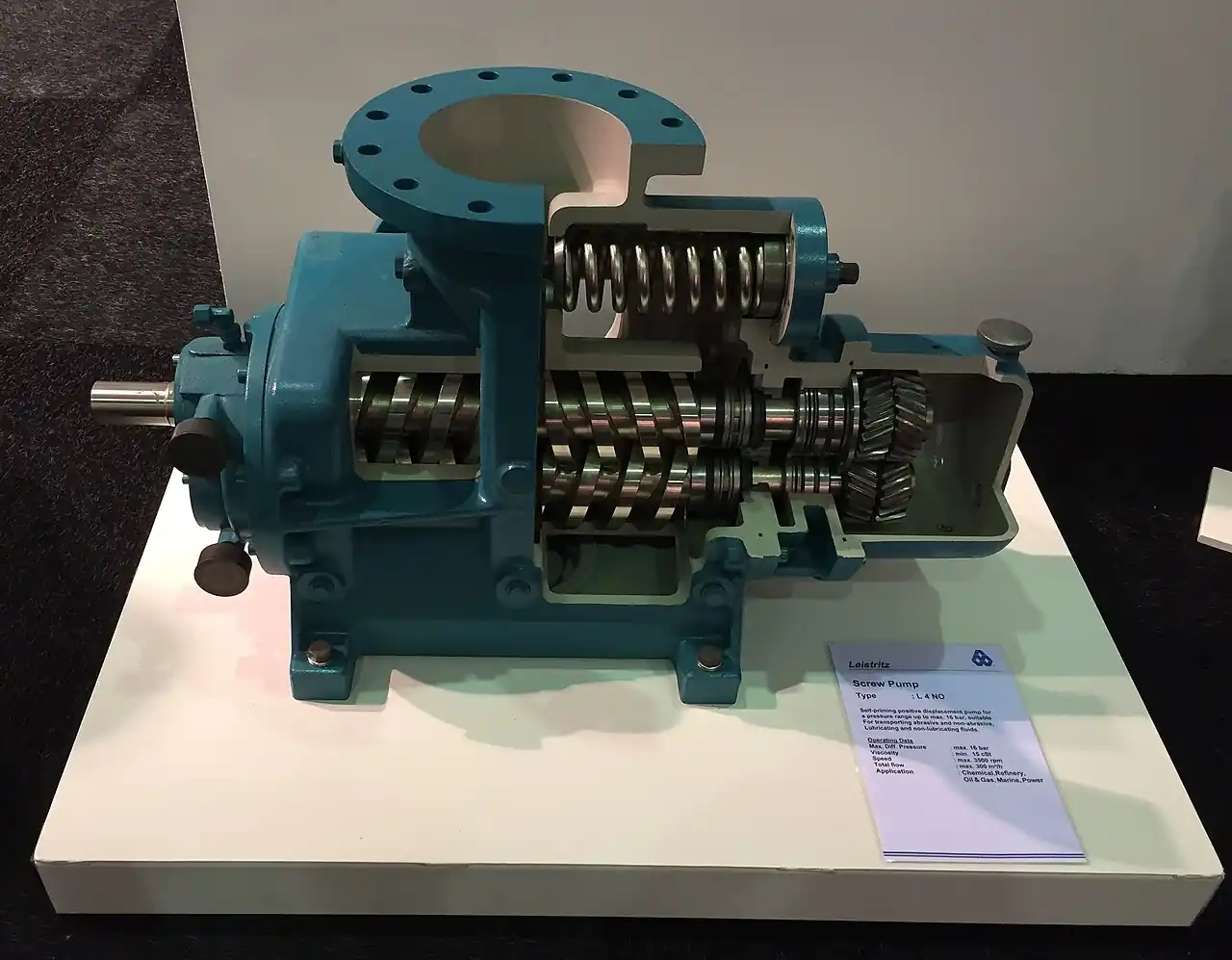
A twin screw pump is a positive displacement pump with two screws turning in opposite directions on parallel shafts inside a figure eight casing bore. External timing gears synchronize the rotors so the screw flanks never touch each other or the casing, and the gear oil never meets the product. Liquid is trapped in sealed chambers between screw flutes and the casing wall, carried axially without acceleration, and delivered to the discharge at full casing pressure; in the common double suction arrangement both ends of the screw set draw liquid and deliver it to a central discharge port, which balances axial thrust and lets one frame carry more differential. Chambers open and close gradually rather than suddenly, so flow is nearly pulse free, the pump primes itself against about 7 to 9 m of suction lift, and it moves fluids from 1 to 100,000 cSt while treating suspended fruit pieces and curd gently. Catalogs also sell the same machine as a double screw pump, a dual screw pump, or a screw spindle pump.
Procurement engineers meet these pumps filling yogurt and fruit preparations, transferring pharmaceutical syrups and suspensions, loading edible oil, fuel oil, and bitumen at tank farms, feeding polymer and paper coating, and returning cleaning solution in clean in place loops. The decision this page settles is narrow and practical: whether the duty needs the timed twin screw architecture against the lobe and centrifugal alternatives, whether one machine can carry both product transfer and CIP return duty at two speeds, which seal, wetted materials, and surface finish survive the cleaning regime, and what the RFQ must state about viscosity range, differential pressure, and certification. The answer lands as an RFQ line set, and every chapter below feeds that line set.
This page treats the twin screw pump as a purchasing object: how two externally timed screws move fluid from 1 to 100,000 cSt without pulsation, what hygienic dual duty transfer plus CIP really demands in speed and seal construction, which datasheet rows separate a hygienic from an industrial build, and how viscosity, differential, finish, and certification combine into a defensible RFQ. It is written for engineers who issue purchase specifications, not for readers who want a brochure summary.
Chapter 1 / 06
What a Twin Screw Pump Is and What Is Being Decided
Two design decisions define the product. First, the screws are timed by external gears: the rotors mesh with a working clearance of a few hundredths to a few tenths of a millimetre, held by the gear train rather than by metal to metal contact. That is why the machine runs for years on clean duty, why it cannot tolerate weld bead or scale in the chambers, and why timing gear health is pump health. Second, the screws do the conveying while the casing does the sealing: each flute pair forms a moving cavity, the cavity volume stays essentially constant along its travel, and the liquid arrives at the discharge with almost none of the velocity energy a dynamic machine imparts. Low pulsation and low shear are geometry consequences, not brochure features.
This page is the product leaf for the two timed screw machine, and its boundary with the family page matters in an RFQ. The encyclopedia screw pump page is the genus umbrella, covering single screw and multiple screw machines together; a progressive cavity pump is a single screw machine with an elastomer stator and a wholly different purchase logic. When a datasheet says twin screw it means two screws, parallel shafts, external timing, and an axial chamber path; anything else belongs to another leaf of the family. The aliases scattered through process literature, screw spindle pump among them, all point back to this same two screw architecture, and none of them is a separate product to buy.
What is actually being decided in this purchase is one of two builds. The hygienic build spends its money on 316L wetted parts, electropolished surfaces, crevice free seal cavities, and certification, and its headline capability is dual duty: transfer the product at process speed, then return cleaning solution at two to three times that speed, one machine, one motor, one variable frequency drive. The process build spends its money on pressure and heating: heavier casings to a 40 bar class, jacketed bodies for bitumen and polymer, and API 676 construction with API 682 seal plans for refinery duty. Between them sits a large middle ground of utility transfer work, and the chapters that follow let a buyer locate the duty on that map and price the right build instead of the loudest brochure.
The neighbors are worth naming early, with the full selection comparison reserved for chapter 5. The lobe pump is the traditional hygienic rotary machine, timed the same way but with lobes instead of screws, pulsing harder and more limited in speed. The gear pump is the compact industrial positive displacement machine, tight clearance and cheap, with no hygienic pedigree. The centrifugal pump is the flow workhorse: not self priming, shearing sensitive products, and blind to viscosity the way a displacement machine never is. Below them in flow sit the dosing instruments, a diaphragm pump or a plunger pump, which meter rather than transfer. Across the whole screw pump genus this two screw machine is the member that pairs self priming with pulse free transfer, and each neighbor boundary is drawn with numbers in the selection chapter.
Four families of documents organize the datasheet. Hygienic design claims hang on EHEDG guidelines and 3-A sanitary standards, verified by certificate rather than by photograph, with ASME BPE as the bioprocessing overlay. Industrial builds cite API 676 for rotary positive displacement pumps and API 682 for the sealing system and its plans. Food contact materials answer to EC 1935/2004 in Europe and to FDA 21 CFR 177 paragraphs for elastomers in the United States, and hazardous area machines carry ATEX marking with the category stated. A datasheet that quotes none of these is a price tag; chapter 6 turns each citation into an acceptance test.
The pump never arrives alone, and the RFQ should name its station. Suction protection at commissioning is a temporary Y strainer or a permanent basket ahead of the first wetted part. Isolation at the nozzles is normally a ball valve each side, light and full bore. The clean in place loop adds a butterfly valve on the return header where pressure is low and a diaphragm valve where product divert must be bubble tight, and a solenoid valve sequences cleaning solution into the circuit. Hygienic lines close with clamp tube fitting hardware whose gasket compound is a food contact decision. Naming the station in the purchase order lets one supplier check nozzle loads, gaskets, and cleanability in a single pass.
Chapter 2 / 06
How the Twin Screw Pump Moves Fluid
Walk the working cycle. As a screw rotates, a flute pair sweeps past the suction port and admits liquid into the space between the screw flank and the casing bore; rotation carries that trapped volume axially like a conveyor, and the geometry of the port and the screw end decides where the chamber closes. There is no valve inside the pump and no contact inside the pumping chamber; the only internal path from discharge back to suction is the working clearance itself. That return path, called internal slip, is the number that explains most of the performance curve, and chapter 4 treats it as a purchase parameter rather than a footnote.
Double suction is the arrangement that made the architecture industrially important. The screw set is mirrored about its center: the left hand thread on one end and the right hand thread on the other pull liquid inward from both suction ports to one central discharge. Axial thrust cancels by symmetry instead of loading a thrust bearing, contact stress on the screws falls, and the same frame carries more differential than an end fed single suction design. Single suction, end to end machines still exist at smaller sizes and in jacketed process builds, and the thrust arrangement is a legitimate datasheet question whenever differential runs above 10 bar.
Viscosity sets the speed. Internal slip through the clearances is driven by differential pressure and damped by viscosity: at 1 cSt and 16 bar a meaningful share of displaced flow quietly circulates back, while at 10,000 cSt the slip is effectively zero and the pump delivers its full geometric displacement per revolution. At the viscous end the constraint flips: chambers must fill against the liquid itself, so screw speed must fall until filling keeps up, and shaft power climbs with viscous drag. The family speed band, roughly 500 to 3500 rpm, is not a free choice but the envelope within which thin products run fast and viscous products run slow, with overall efficiency landing between 60 and 80 percent across the family.
Suction behavior is a specification item, not a footnote. With wet screws and a primed casing the machine lifts 7 to 9 m in the family class, which drains tanks and unloads railcars without a foot valve in favorable installations. But self priming is not dry running: the seal faces and the screw clearances rely on liquid, and a dry start damages a mechanical seal in a seconds to minute class interval. Hot thin products introduce the third suction limit, net positive suction head; a flooded suction line and a short inlet run are the honest answers there, and a temporary Y strainer during commissioning keeps weld bead out of the clearances while the lines are still young.
Two further behaviors follow from the geometry. Reversing rotation reverses flow, mechanically safe because the timing gears carry no thrust change, and useful for clearing product back out of a fill line before cleaning. And because flow is strictly proportional to speed and the chambers do not shear their contents, the machine delivers accurately at constant volume per revolution; on a filling skid that makes speed control a metering instrument in its own right, though where dosing precision and turndown dominate over transfer volume, a diaphragm pump or a dedicated metering pump remains the better purchase.
The dual duty capability deserves its physics paragraph. In transfer duty the pump runs at process speed sized for product viscosity; in clean in place return duty the same machine runs two to three times faster, pulling cleaning solution from tanks, spray devices, and process lines back to the CIP skid at pipe velocities, roughly 1.5 to 3 m/s, that carry the turbulent cleaning action. Steam in place at a 121 deg C class adds thermal expansion to the clearance question and elastomer questions to the seal, which is why SIP temperature belongs in the RFQ next to the CIP speed. One machine, two speeds, one variable frequency drive spanning both, is the whole of the hygienic sales story, and the rest of this page is about buying it honestly.
Chapter 3 / 06
Types, Construction, and Duty Boundaries
Hygienic construction is the differentiator of the class, and its content is specific. Wetted parts are 316L, austenitic and low carbon, with surfaces electropolished to an Ra of 0.4 to 0.8 micron so biofilm has no anchor. The casing drains fully in every offered orientation, the seal cavity carries no dead pocket, and ports terminate in DIN 11851 threads or clamp connections whose tube fitting gaskets are food contact certified. Sealing is a single mechanical seal with a quench, a double seal with barrier fluid, or a compact quad seal behind the screws. Commercial examples that define the class are the NETZSCH NOTOS 2NSH, the Alfa Laval twin screw pump program, the SPX FLOW Waukesha Cherry-Burrell Universal TS series, and the INOXPA DCH+, all cited in the sources below.
Process construction answers a different master. Casings are cast iron or steel, pressure ratings reach a 40 bar class in the heavier frames, and bodies carry heating jackets for bitumen, heavy fuel oil, and polymer duty where the product must arrive hot to flow at all. Refinery and utility installations specify API 676 rotary positive displacement compliance, and the sealing section answers to API 682 with plans the buyer names: Plan 11 flush from discharge, Plan 32 clean external flush for dirty product, Plan 53A dual seal with pressurized barrier, Plan 62 external quench. The wetted screws are the same machine at heart; the frame, the heating, and the seal system are what the process money buys.
The timing end is the part nobody photographs and everybody repairs. Precision gears with backlash set at assembly synchronize the screws; rolling element bearings locate the shafts and, in single suction designs, carry the full axial thrust of the differential. That gear and bearing set runs in its own oil bath, isolated from product by the shaft seals, on an 8,000 hour class oil change schedule. Misalignment, overload, and contaminated oil at this end show up first as timing error, then as screw contact, then as casing damage; the failure chain in chapter 6 starts here more often than at the wetted end.
Screw geometry choices are real but bounded. Two start and three start profiles trade displacement per revolution against pressure holding; larger lead angles move more liquid per turn at lower pressure hold. Double suction symmetric sets dominate hygienic frames for the thrust reasons in chapter 2, while process frames offer both arrangements. The buyer selects geometry indirectly, by stating flow at viscosity and differential and letting the maker pick the profile; what the RFQ must pin is the resulting speed at duty, because that number decides the CIP ratio, the motor frame, and the noise.
The boundaries are short and worth stating bluntly. The machine is not an abrasive slurry pump: the clearances that make it gentle make it intolerant of hard solids. It does not run dry beyond a seal limited interval. It does not tolerate flashing two phase suction without venting provision. And it is wasted on duties a simpler machine serves better: high pressure thin liquid injection belongs to a plunger pump, high head clean water to a multistage pump, and plain bulk thin liquid transfer often to a centrifugal pump at lower first cost. The variant table below consolidates the construction decisions into one page.
Variant
What it changes
Where it is specified
Watch items
Hygienic dual duty build
316L wetted, electropolish, quad or double seal, drive spanning process and CIP speeds
Dairy, beverage, food, pharma transfer plus clean in place
CIP speed ratio and SIP temperature stated by maker
Hygienic low shear transfer build
Same wetted standard, single seal, fixed or two speed drive
Fruit preparations, curd, cosmetic emulsions
Particle integrity evidence at process speed
Jacketed process build
Heating jacket, heavy frames to 40 bar class
Bitumen, heavy fuel oil, polymer, resin transfer
Heat up procedure before start; flush medium
API 676 process build
Full standard compliance, robust bearing frame, API 682 seal plans
The table below decodes the datasheet lines that decide whether a quoted pump matches the duty. Each row is purchase defining; the paragraphs after it explain what to demand and what a weak answer looks like.
Parameter
Typical range or options
What it decides
Flow capacity
1 to 500 m3/h class across family frames
Frame size, nozzle bore, and motor rating
Viscosity range
1 to 100,000 cSt with speed derating
Screw profile, speed at duty, and slip allowance
Differential pressure
10 to 16 bar typical hygienic; to 40 bar class process
Thrust arrangement, casing class, seal loading
Speed range
500 to 3500 rpm family band
CIP ratio, filling accuracy, noise, NPSH margin
Suction lift
7 to 9 m wet, self priming class
Tank drainage and unloading without a foot valve
Efficiency
60 to 80 percent across family
Energy cost and motor frame at worst corner
Wetted materials
316L, CF3M cast equivalents, duplex for chloride duty
Corrosion envelope and certificate content
Surface finish
Electropolished Ra 0.4 to 0.8 micron hygienic
Cleanability evidence and biofilm control
Seal options
Single with quench, double barrier, quad seal, packing
Containment, SIP rating, barrier services
CIP and SIP capability
CIP at 2 to 3x process speed; SIP at 121 deg C class
EHEDG, 3-A, EC 1935/2004, FDA 21 CFR 177, ATEX, API 676
Acceptance evidence behind every claim
Capacity and viscosity deserve the first paragraph because they are the rows most often misused. A maker quotes capacity at a reference viscosity and speed; at the thin end internal slip returns part of that flow, and at the viscous end chamber filling caps speed, so the honest demand is the curve at your product conditions, minimum and maximum viscosity at their temperatures, with the resulting speed written on the datasheet. A quotation that names one capacity at one viscosity for a duty spanning 20 to 20,000 cSt across a season is not a quotation. The same logic sets the motor: power rises with viscosity and differential together, and the drive must cover the worst corner of the duty, not the catalog center.
The seal row is where hygienic and process builds diverge hardest, and the choice is a system, not a component. A single mechanical seal with quench serves clean products that tolerate a flush; a double seal with pressurized barrier, Plan 53A language in process builds, contains abrasive or hazardous product and carries the washing regime best; the quad seal packages hygienic duty compactly at moderate ratings; packing survives only in utility process builds where a regulated drip is acceptable. Elastomer temperature class decides SIP survival: EPDM families lead for steam at the 121 deg C class, and the compound certificate belongs with the order. Where no leakage at all is acceptable and pressure is modest, the answer may be a different machine entirely, a magnetic drive pump with no seal to feed, at the price of tighter viscosity and solids limits.
Pressure and temperature class; wear part interval
Packing with lantern ring
Utility process builds where a drip is acceptable
Flush rate; emissions and housekeeping acceptance
Sealless magnetic drive coupling
Zero leakage duty at modest pressure
Viscosity and solids limits; dry run prohibition
Drive and speed close the specification. Dual duty sizing means the variable frequency drive spans process speed and CIP speed with constant torque margin, and the motor frame covers the viscous corner load plus starting torque at cold product temperature; hygienic plants add washdown enclosures and, in zoned areas, ATEX variants. A high inertia fill line or a hot jacketed casing in process builds argues for a ramped start profile rather than across the line duty, which a soft starter or the drive itself provides. The drive is also the metering instrument on filling skids, which is why speed reference and feedback resolution belong in the RFQ rather than in a commissioning surprise.
Chapter 5 / 06
Selection Decision Factors and RFQ Language
The decision sequence below runs as a checklist in a specification meeting, and each step eliminates a class of quotations before any price comparison starts.
State the duty honestly: product with density and viscosity at minimum and maximum process temperature, flow range, and differential at both ends of the duty.
Decide whether CIP return rides on the same machine; if it does, the drive spans two duties and the frame is sized on the worse one.
Fix the speed plan: process speed and CIP speed from the maker curve, before the frame is chosen, not after.
Check suction: flooded or lift, available NPSH at temperature, prime and vent provision; the 7 to 9 m class is a wet screw figure, not a dry one.
Choose the seal against product and cleaning together, and name the elastomer compound with its steam rating.
Specify wetted materials and finish with certificates: 316L, Ra value, electropolish, EN 10204 3.1.
Name the ports and the station: DIN 11851, clamp, or flange, with isolation and divert hardware listed.
Fix the evidence: performance curve at your viscosity, seal plan drawing, CIP and SIP qualification basis, and certification documents.
Against the neighbors, the honest comparison runs as follows, and it belongs here in the selection chapter rather than in any headline. The lobe pump shares the timed rotor architecture and the hygienic pedigree and undercuts the twin screw on price; it pulses harder, runs slower, and gives up capacity per frame, and on shear sensitive or high speed CIP duty the twin screw earns its premium back. The progressive cavity pump wins first cost on viscous transfer and handles abrasion better than any screw machine, but its elastomer stator caps temperature, resists clean in place chemistry, and introduces a consumable that a metal screw set is not. The gear pump is compact and cheap for clean lubricating liquid, with no hygienic story and tighter solids limits. The centrifugal pump moves thin liquid at high flow for the least money and with smooth output, but it does not prime itself, its delivery floats with pressure, and it shears what it moves. Below those, a diaphragm pump meters and lifts, a peristaltic pump handles difficult fluids at low flow with the hose as the consumable, a metering pump owns precision dosing, a plunger pump owns high pressure thin liquid injection, a magnetic drive pump owns zero leakage transfer inside its viscosity and solids limits, and a multistage pump owns high head clean water. None of them is this machine, and the twin screw pump is the member of the wider screw pump family that buys pulse free transfer and dual duty cleaning with timing gear precision; the RFQ exists to keep those sentences true.
The application map below turns the comparison into a table the project file can carry.
Application
Construction to specify
Check before order
Fruit yogurt and dessert preparation filling
Hygienic dual duty build, quad or double seal, drive spanning both speeds
Particle integrity at process speed; CIP ratio stated
Brewery grundy and syrup transfer
Hygienic build, DIN 11851 or clamp ports, single seal with quench
Vapor handling at warm product; suction head
Pharmaceutical syrup and suspension
316L electropolished, double seal barrier, SIP rated elastomers
SIP qualification basis; finish certificate Ra
Edible oil and tank farm loading
Hygienic or light process build by temperature
Viscosity at winter temperature; nozzle loads
Bitumen, polymer, and paper coating feed
Jacketed process build, API 682 seal plans
Heat up and flush procedure; startup torque
Fuel oil and lube oil transfer, API duty
API 676 build with robust bearing frame
Relief valve and minimum line sizing; test witnessing
Cosmetics and personal care emulsions
Hygienic low shear build, two speed or drive controlled
Shear history evidence; changeover cleaning time
The RFQ block should be written once and reused. A complete block reads: product with density and viscosity at minimum and maximum process temperature; flow range across that viscosity range; differential pressure at both ends of the duty; speed range with the drive spans stated and the CIP speed ratio and SIP temperature named; wetted materials with the surface finish Ra and electropolish callout; seal arrangement with flush or barrier plan and elastomer compounds; inlet and outlet size and standard, DIN 11851, clamp, or flange, with the tube fitting gasket compound named; driver with enclosure class and ATEX category where zoned; certifications demanded as documents, EHEDG or 3-A, EC 1935/2004 or FDA 21 CFR 177 compliance for elastomers, EN 10204 3.1 material certificates; station items listed by name; and the evidence pack, performance curve at your viscosity, seal plan drawing, and cleaning qualification basis. A quotation returned without the curve at your viscosity is incomplete at any price.
Chapter 6 / 06
Installation, Standards, Failure Modes, and Maintenance
Installation quality decides whether the clearances and the seal see their design life. Pipe the suction short, large, and flooded where the product allows, with a temporary Y strainer or a commissioning basket to catch weld bead while the lines are young; align the piping to the nozzles so the casing carries no strain, and set the coupling alignment to the maker tolerance before the guard goes on. Install the isolation hardware the station deserves: a full bore ball valve at each nozzle for lockout, a butterfly valve on the low pressure clean in place return header, a diaphragm valve where product divert must be bubble tight, and a solenoid valve sequenced with the cleaning circuit. Clamp each tube fitting to the gasket maker torque rather than by feel, because a crevice from an under seated clamp is exactly the cleanability failure the electropolish was bought to prevent.
Commissioning protects two things: the seal and the baseline. Prime and vent the pump before the first start, confirm rotation, and run first against a throttled discharge to bring the mechanical seal faces together gently. Record the inputs that will judge the machine for years: flow at duty viscosity, suction and discharge readings, motor current, casing temperature, and vibration if the site meters it. Verify the dual duty behavior explicitly, transfer at process speed and clean in place return at the higher speed, with the solenoid valve sequence proved through a full cleaning cycle. File those numbers; chapter 4 said the curve at your viscosity was the purchase parameter, and this baseline is its living proof.
The standards translate directly into acceptance evidence. EHEDG and 3-A certification documents, not symbols on a brochure, back the cleanability claim. ASME BPE governs the bioprocessing finishes where that world applies. API 676 governs the industrial build from data sheets through testing, and API 682 turns the seal from a component into a documented system with named plans. EC 1935/2004 and FDA 21 CFR 177 paragraphs cover the food contact elastomers, ATEX the zoned area machines, and EN 10204 3.1 the material certificates. The discipline is the one this page repeats: every claim in the RFQ names its evidence, so the burden of proof lands on the supplier where it belongs.
Failure modes in service follow a short and predictable list. Timing gear wear from misalignment or contaminated oil arrives as noise, then as backlash, then as screw contact; the prevention is the oil program and the alignment program, not luck. Screw flank scoring from ingested solids appears as capacity loss and roughness long before it appears visually; the prevention is the commissioning Y strainer and the discipline that kept it fitted. Seal face damage from a dry start is the classic commissioning wound, preventable by the prime and vent routine. Thrust bearing failure concentrates in single suction frames run above their differential class. And in hygienic duty, gel and soil build up wherever CIP velocity falls below the turbulent floor, which is a piping design failure charged to the pump until the velocity audit is done. Each failure writes a line into the machine record, and each line converts the next RFQ from a guess into a specification.
Maintenance intervals scale with duty severity. The timing end wants its oil on the 8,000 hour class schedule with backlash checked at major services; the wetted end wants seal inspection at every planned intervention, with quad seal wear parts and elastomer sets held as consumables from day one. Hygienic machines add an annual verification that CIP velocities and SIP exposure still match the qualified cycle, and process machines add jacket and relief valve checks. A machine transferring abrasive or crystallizing product deserves screw clearance measurement at every second shutdown. The chemical dosing hardware on the skid, a small metering pump or a peristaltic pump for caustic and acid, follows its own chemical service calendar. Every check produces a number, the number goes into the record, and the record is what makes the next purchase specification smarter instead of merely older.
FAQ
What viscosity range can a twin screw pump handle?
The family envelope spans roughly 1 to 100,000 cSt, but position inside the envelope sets the speed. Thin liquids run toward the top of the 500 to 3500 rpm band with internal slip taking a share of displacement, viscous liquids run slower so the screw chambers keep filling, and shaft power rises with viscosity and differential together. Demand the maker curve at your viscosity and temperature, not at a reference water point.
Can one machine do product transfer and CIP return duty?
Yes, and that dual duty is the core of the hygienic sales case. The same machine transfers product at process speed, then runs two to three times faster to return cleaning solution at turbulent pipe velocity, with one drive spanning both duties. The RFQ must state both speeds, the CIP ratio, and the SIP temperature class near 121 deg C, because elastomers and seal arrangements are qualified against that cleaning regime rather than against product alone.
How far can it self prime, and can it run dry?
With wet screws the class lifts 7 to 9 m, which drains tanks and unloads railcars without a foot valve in favorable lines. Self priming is not dry running: the seal faces depend on liquid, and a dry start can damage a mechanical seal within a minute class. Prime and vent before every first start, and give hot thin products a flooded suction line so available suction head never becomes the limiting spec.
What seal should I specify for hygienic duty?
Match the seal to product and cleaning together. A single mechanical seal with quench serves clean products; a double seal with pressurized barrier contains abrasive or high value product and carries the washing regime best; the quad seal packages hygienic duty compactly at moderate ratings. Name the elastomer compound and its steam rating against the SIP temperature, and demand the plan drawing, because the barrier system is as much of the purchase as the pump frame.
Twin screw or lobe construction for a hygienic line?
Both machines are timed rotor rotaries with clean in place pedigree, and the honest difference is running behavior. Lobe construction pulses harder and runs slower, which limits frame capacity on shear sensitive or high throughput duty. Twin screw geometry carries more flow per frame with near zero pulsation and takes the higher CIP speed in stride, at a higher purchase price. Let product sensitivity and cleaning duty decide, not the brochure cover.
What drive and speed range should I plan for?
Plan the drive around two numbers: the 500 to 3500 rpm family band, and the two duty points inside it. Process speed follows viscosity and differential; CIP speed runs two to three times higher, and the drive must deliver constant torque across the whole span with the motor frame covering the viscous corner. Washdown or ATEX enclosures are plant decisions that cost little at order time and a great deal afterward.
What certifications belong in a food or pharma RFQ?
Demand documents, not symbols. Hygienic design claims rest on EHEDG or 3-A certificates; elastomers and gaskets on EC 1935/2004 declarations or FDA 21 CFR 177 compliance; wetted steel on EN 10204 3.1 material certificates with a stated surface finish Ra; zoned area machines on ATEX category marking. Ask for the SIP qualification basis at the 121 deg C class where steam sterilization applies, and attach the list to the purchase order.