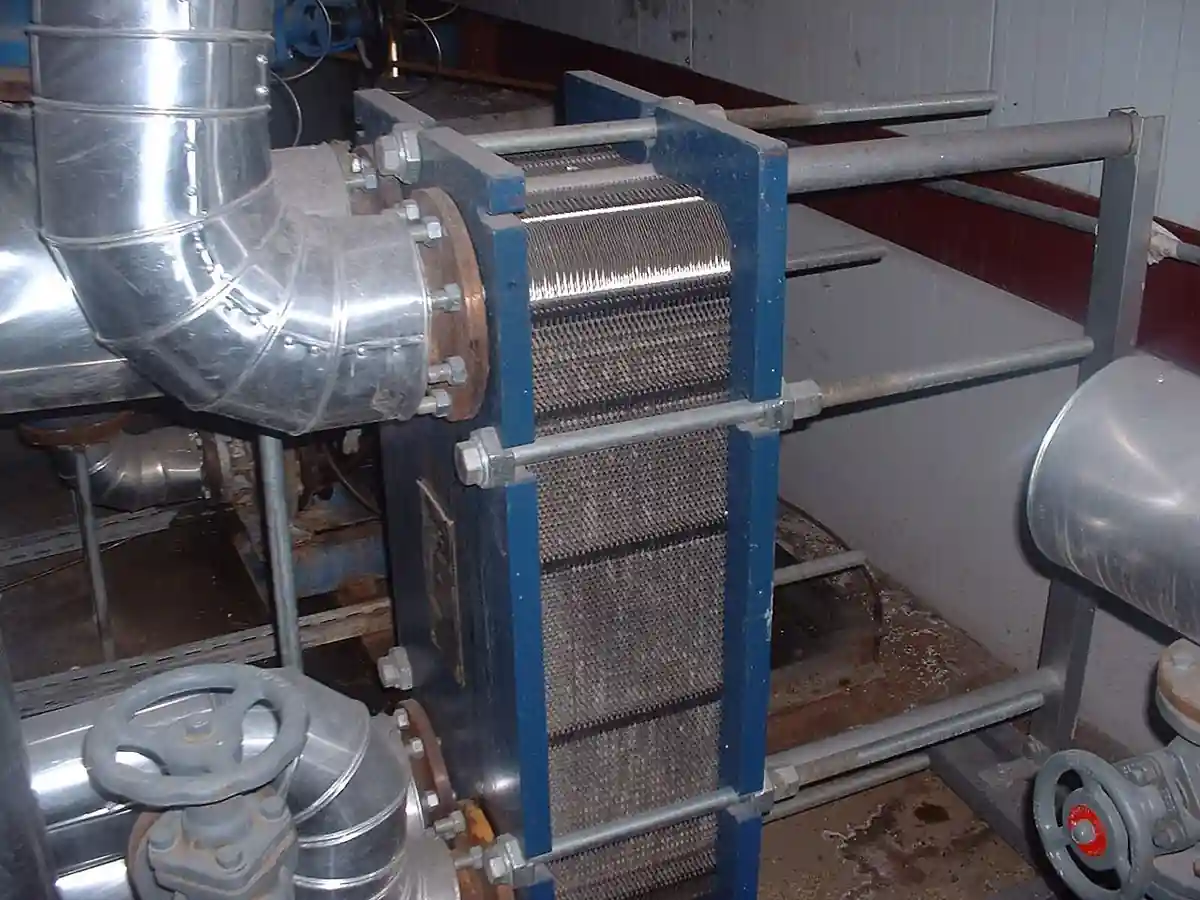
A scraped-surface heat exchanger is a continuous heat transfer machine built around a cylinder: product flows through the cylinder, usually a few centimeters to tens of centimeters in diameter, while a rotating shaft carries blades that continuously scrape the inner heat transfer wall, removing the boundary layer and any film, fouling deposit, or crystal layer as fast as it forms, so that viscous, sticky, particulate, and crystallizing products can be heated or cooled at rates their own physics would otherwise forbid. Utility medium, water, brine, glycol, steam, or hot oil, circulates in the surrounding jacket, and the machine stands vertical or horizontal by duty, in single-wall or double-wall construction. Alfa Laval's Contherm range is a representative industrial catalog, and this page treats the complete machine, cylinder, rotor, drive, and seal system, as the purchasing object.
This page is written for the engineer specifying a scraped-surface heat exchanger for fats crystallization and margarine, dressings and prepared foods, gels and polymers, or any duty where viscosity, particles, or crystallization defeat plates and tubes. It works through what the machine does and what is being bought, how the scraping action restores the heat transfer, which designs fit which duties, the parameters that appear on vendor data sheets, and the selection factors and RFQ language that decide whether the exchanger delivers its duty for a blade and seal budget that stays predictable.
The decision concentrates in five places: the product's viscosity, particle load, and crystallization behavior, which decide whether this machine is the answer at all, the duty, heating, cooling, or crystallizing, and its temperature program, the cylinder arrangement, vertical or horizontal, single or multiple in series, the rotor and blade design, floating or fixed, and the hygiene class, food or chemical, with its CIP and seal expectations. Get those right and the utility side, the seal system, and the service plan follow with little freedom.
Chapter 1 / 06
What a Scraped-Surface Heat Exchanger Is and What Is Being Decided
The machine this page describes pairs an outer pressure jacket with an inner heat transfer cylinder, the product tube, and a rotor down its axis: a shaft carrying scraper blades, spring-loaded or floating so that centrifugal force and blade geometry hold them against the wall, or fixed blades running a designed clearance. Product enters one end, pumped by a positive displacement machine at food viscosities, a gear pump or similar, because a centrifugal pump's head collapses at the viscosities this machine exists for; the rotor turns at tens to a few hundred rpm; blades renew the wall surface continuously; and product leaves the other end at the target temperature or crystalline state. The drive, mechanical seals around the rotor shaft, and bearings complete the machine, and heating or cooling medium serves the jacket at the duty's pressure and temperature.
What is being decided when a scraped-surface heat exchanger is purchased is a temperature change in a stated product at a stated rate, without fouling and without damage, backed by a blade and seal life statement. The buyer is purchasing a stated heat load on a product of stated viscosity and particle content, with an outlet temperature or crystal condition the process requires, at blade and seal lives the vendor should bound for the stated duty, in a cylinder and finish class the hygiene regime demands. Everything on the vendor data sheet, heat transfer area, rotor speed range, blade type, jacket design pressure, exists to support those guarantees, and the honest vendor sizes from tests on the actual product rather than from an analogy to someone else's slurry.
The scraped-surface machine sits at the fouling extreme of the heat exchanger family with defined neighbors. It is the machine the shell-and-tube heat exchanger concedes to when the product fouls or the viscosity defeats tube-side transfer, and that machine's own page in this encyclopedia names scraped surface as the neighbor for sludge and crystallizing duty. It is what a plate heat exchanger cannot be, plates foul and their narrow gaps crush particles; it is what a spiral heat exchanger approaches, with its single curving channel tolerating some of the same duties at lower severity; and it is the continuous answer where a jacketed reactor does batch duty with its utility jacket, the stirred pot that scrapes nothing and heats slowly.
Different buyers buy the same machine for different products. An oils and fats plant runs scraped cylinders as crystallizers, chilling and nucleating margarine and shortening before pin workers and resting tubes, the classic votator duty. A food plant heats and cools dressings, sauces, fruit preparations with whole particles, peanut butter, and processed cheese, valuing particle integrity and cleanability. A chemical plant polymerizes and gels in scraped cylinders, heats viscous resins, and cools melts; a gelatin and photographic plant chills gels that set on any still wall. A paraffin or specialty crystallization duty uses the machine as a controlled nucleator. The specification language differs, but the wall-renewal physics is shared.
The economics deserve their own paragraph because this machine is bought when nothing cheaper works. Per square meter of transfer area it is the most expensive exchanger in the plant, and its running costs, rotor drive power against viscous product, blade and seal replacement, are standing; it earns its price only where the product's fouling or viscosity makes plates and tubes unusable, where the particles must survive, or where the crystallization duty needs the wall it controls. The honest comparison prices the alternatives' fouling and downtime, a plate pack cleaned daily or a tube bundle abandoned to deposit, against the scraped cylinder's capital, and the buyer whose product genuinely fouls finds the comparison short.
A short tour of named duties makes the machine concrete. At a margarine plant, oil blends and emulsion pump through ammonia- or glycol-chilled scraped cylinders at a few degrees, nucleating fat crystals, then pass through pin workers and rest to the packaged plastic fat. At a sauce plant, product with whole herbs and particulates heats to pasteurizing temperature in seconds of residence and cools before filling, particles intact. At a polymer plant, a scraped cylinder holds a temperature-critical viscous stream against a wall that would otherwise skin over. At an edible oil winterization line, scraped cooling scrapes wax crystals that a disc stack centrifuge then removes. Each duty names the same knobs, wall renewal, residence, temperature program, with products that differ while the scraping physics barely changes.
Chapter 2 / 06
How the Blades and the Boundary Layer Do the Work
The heat transfer problem this machine solves is the boundary layer and the deposit. At a still wall, product adjacent slows to zero velocity, the layer conducts heat poorly at high viscosity, and any fouling or crystallization at the surface adds resistance until the wall is insulated from the product; in a plate or tube this proceeds until cleaning, and in a crystallizer until the channel closes. The scraping blade removes both problems at once: every pass strips the boundary layer and any incipient film to the wall, presenting renewed surface a blade-width behind, and the heat transfer coefficient holds steady instead of decaying. The coefficient is a function of blade speed, gap, and product properties, and it stays flat in time, which is the machine's whole value.
Residence time and holdup are small and controlled. The product volume in the cylinder is small, a few liters to tens per unit, and flow is near plug, so thermal response is fast and the temperature program can be sharp; this suits pasteurization and careful crystallization alike, and it makes the machine easy to start and stop on a batch schedule. Back-mixing is limited by rotor design and speed, and multiple cylinders in series with connecting piping stage the temperature program where one unit cannot. Compare this with the stirred jacketed vessel's hours and the plate's seconds, the scraped machine lives in the seconds to minutes of controlled, deposit-free duty.
Crystallization duty is the physics the fats industry built the machine on. As product chills through its crystallization range, crystals nucleate at the cooled wall, the coldest point in the system; the blades scrape those nuclei back into the bulk continuously, seeding the whole volume with fine crystals and preventing both the wall crust and the localized set that would starve transfer. Rotor speed and blade configuration tune the nucleation, shafts can carry pins or working elements between blade rows to work the crystal slurry, and the exit condition, supercooled liquid or worked plastic crystal, is a purchase specification. Ice cream freewares, the ammonia-swept scraped machines that freeze water in the mix, are the extreme of this duty and a neighboring machine of their own.
Particles survive because the machine is gentle at geometry. The annular gap is a designed clearance, millimeters to centimeters, sized larger than the product's declared particle size, and the blades push, fold, and scrape rather than shear through narrow gaps; particle integrity in the outlet is a legitimate guarantee item where the product declares it, and the cylinder's particle passage is a specification number, not an accident. This is the single clearest distinction from the plate pack, whose gaps would hold the same particles, and from a static mixer, whose elements interleave in a fixed geometry that particulates must fit or plug.
The utility side is a conventional jacket duty with one discipline: uniformity. The jacket must deliver its medium, steam, hot oil, water, brine, or glycol, uniformly along the cylinder, because product at the wall responds to local wall temperature and a hot or cold stripe along the cylinder is a stripe in the product; jackets are spiraled or zoned to keep velocity and temperature even, and multiple cylinders share manifolded medium with balancing. Freeze duty brings ammonia or low temperature glycol with their own safety and materials regime. Wall temperature, not medium temperature, is the controlling variable the vendor's design manages, and the design data sheet should state it at duty.
Degradation and failure have a short honest list. Blade and seal wear lead it, blades creep, chip, and round their edges until wall renewal fades, and mechanical seals at the rotor shaft are the machine's most maintenance-intensive element, double mechanical seals with flush or barrier fluid by hygiene class. Cylinder wall wear, thinned by years of scraping, retires the unit and is measured at service. Bearing and drive faults follow ordinary rotating machinery statistics. Freezing duty adds the risk of product freeze-up on a stopped rotor, the reason interlocks stop feed before the rotor stops, and crystallization duty adds the hard-set of a cooled, stopped full cylinder, the reason warm flushes and drained shutdowns are standing procedure.
Chapter 3 / 06
Machine Types, Duty Classes, and Process Boundaries
Vertical machines are the food and crystallization standard: product enters the bottom and leaves the top, or the reverse by duty, gravity assists drainage and CIP, and the drive sits on top clear of the product; vertical stacking of cylinders in series makes crystallization trains and high temperature change duty. Horizontal machines serve viscous pumping duty and chemical service, their rotors horizontal and their L/D arranged by the residence the duty needs. Both orientations share the cylinder, rotor, and seal architecture, and the choice is layout, drainage, and product handling rather than physics.
Single-wall and double-wall cylinders are the construction choice. Single-wall cylinders, one heat transfer barrier between product and medium, give the best transfer and the simplest construction, standard in chemical and closed food duty. Double-wall cylinders put a product-side cylinder inside a separate pressure cylinder with a monitored gap or bonded construction, so that a leak across the wall cannot silently mix product and medium, the construction hygiene-driven and audit-driven duty buys for a margin of containment; the transfer penalty is modest and the inspection story is better. The choice belongs in the RFQ with the hygiene and audit basis stated.
Rotor and blade families name the working types. Floating blade rotors carry blades free to centrifuge against the wall, self-adjusting as they wear, the general-purpose design; fixed blade rotors run a set clearance for duties that need defined gap or gentler wall contact; pinned shafts, mutator rotors with working pins, add crystal working between blade rows for fats duty; and anchor or helical agitator elements serve the highest viscosities where the rotor both scrapes and conveys. Blade materials run food and duty polymers, composite, and metal, and the blade-to-wall pairing, polymer blades on a metal wall, is the consumable engineering the maintenance plan is built around.
Duty classes organize the purchase. Heating duty, viscous products to process temperature, pasteurization included, buys area and residence; cooling duty buys the same at medium temperatures; crystallization duty buys the chilled machine with its nucleation and working elements, the fats and specialty train; and freezing duty, water crystallization in food mixes, buys the ammonia-swept machines that neighbor this page. Within the family, series banks, pin workers, and rest tubes are the train elements the process arranges around the scraped cylinder, and the vendor's scope often includes them. The hygiene ladder, chemical, food, or audited food with double walls and seal barrier monitoring, sets the construction and documentation.
Adjacent machines mark the boundary, and two deserve precision. Against the jacketed reactor, the scraped machine is continuous, small holdup, and self-cleaning where the pot is batch, large, and manually scraped; plants run both, the pot for batching and reaction, the cylinder for the continuous line. Against the high shear mixer and its rotor-stator head, this machine moves and heats product with scraping, not intense shear, and their pages in this encyclopedia draw that line, the rotor-stator machine sometimes sold as a homogenizer and the pressure machine, the high pressure homogenizer, being the finer emulsion tool downstream. The agitator stirs a vessel; the static mixer mixes in pipe without moving parts; this machine's rotor exists to keep a wall clean. Downstream, a falling film evaporator concentrates before a spray dryer in food lines, a freeze dryer serves the gentlest products, and a vacuum belt filter or nutsche filter handles the slurries chemical duty produces; upstream, a disc stack centrifuge clarifies oils whose wax this machine scraped. The RFQ should state product, viscosity, and duty rather than ask for scraped surface and hope.
Chapter 4 / 06
Key Specification Parameters
The vendor data sheet for a scraped-surface heat exchanger centers on area, rotor speed, and duty, and each number carries a purchase consequence. The table below lists the parameters that recur across manufacturers' catalogs, with typical ranges for the general classes; values for a specific project come from product trials the vendors run, and the ranges here are orientation, not a substitute for a test.
Parameter
Typical catalog range
What it decides
Heat transfer area per cylinder
0.1 to 6 m2
Cylinder count for the duty
Cylinder diameter, product side
50 to 400 mm
Capacity; particle passage
Cylinder length
0.5 to 3 m
Residence at flow; L/D duty class
Rotor speed
50 to 400 rpm typical
Wall renewal rate; crystal working; power
Product viscosity range
to 100,000 mPa s and beyond
Applicability; drive and pump sizing
Particle passage
declared by cylinder design
Particle integrity guarantee basis
Jacket design pressure and temp
medium and class specific
Utility regime; ammonia or steam class
Construction
single wall or double wall
Containment story; transfer penalty
Three of these numbers deserve the buyer's suspicion when they arrive without a basis. Area quoted without the product trial's coefficient is a dimension, not a duty, and the honest vendor quotes the test conditions behind any capacity figure. Particle passage quoted as a single diameter hides the gap distribution and the blade geometry that make it real. Rotor speed range quoted without the power at the top of the range on the actual product hides the drive sizing, viscous product torque is the machine's real load, and an undersized drive is a warranty argument. An RFQ that carries the product's viscosity curve and particle declaration separates engineered offers from assembled ones.
Materials and construction follow the hygiene class. Food machines run 300 series stainless product surfaces with finishes to the standard named, food-grade polymer blades, and double mechanical seals with barrier fluid monitored; chemical machines run the metallurgy the product demands, alloy cylinders and metal blades where polymer will not serve. The cylinder wall is the life item, measured at service, and the seal system, its flush or barrier scheme, is the machine's reliability item. Draining, CIP spray or flush provisions, and rotor-out service access, the machine should split or the rotor withdraw without unstacking the line, are scope items the RFQ must price.
Chapter 5 / 06
Selection Decision Factors and RFQ Language
Selection starts with the product, not the catalog. The viscosity curve over the duty's temperature range, the particle size and load or their absence, the fouling or crystallization tendency at the wall, and the temperature program define the problem; a product trial on the vendor's pilot cylinder, which the serious vendors offer, defines the machine. The duty class, heating, cooling, crystallizing, or freezing, and the train context, cylinders in series, pin workers, rest, then set the arrangement. A buyer who skips the trial buys a cylinder sized for someone else's viscosity.
The alternatives belong in the study rather than in habit. A spiral heat exchanger or a wide-gap plate pack serves the milder viscous and particulate duties at lower cost; a jacketed vessel with an agitator serves batch duty that does not need continuity; a double-pipe exchanger serves small clean duties; and for crystallization specifically, the scraped machine competes with controlled bulk crystallizers on the product's need for wall-controlled nucleation. The scraped-surface machine wins where fouling is the constraint, particles must survive, or the crystal program demands the wall, and its premium is paid knowingly or not at all.
The table below organizes the decision into the factors that recur across projects, with the questions the buyer should be able to answer before the RFQ goes out. Each row is a place where an incomplete answer turns into an underspecified machine and a fouling argument later.
Decision factor
What the buyer must state
Consequence if left open
Product characterization
Viscosity curve, particles, fouling or crystallization behavior
Sizing guessed; trial basis absent
Duty and program
Heat load, temperature program, residence or crystal condition
Area and count wrong
Arrangement
Vertical or horizontal, series count, train elements
RFQ language for a scraped-surface heat exchanger should name the product and the basis of guarantee. A workable specification states: product with its viscosity curve and particle declaration; heat load and temperature program with the required outlet condition, temperature or crystal state; arrangement intent, orientation, cylinder count, and train elements; construction class, single or double wall, with the hygiene and audit basis; rotor and blade type with materials and expected blade life at duty; utility medium with design pressures and temperatures; seal system class with barrier provisions; drive sizing basis at the product's worst viscosity; and the acceptance basis, a product trial where warranted and a performance window at duty. Naming the neighbors helps the vendor, the feed pump by class, the crystallizer or rest tube downstream, the CIP system, so the interfaces land in the right bids.
Chapter 6 / 06
Installation, Standards, Failure Modes, and Maintenance
Installation is a piping and alignment job with a commissioning chemistry at the end. The machine sets vertical or horizontal with the support arrangement its thermal growth expects, feed and discharge piping land strain-free, and the utility medium's supply and return manifold to the jacket balanced across cylinders; the feed pump, positive displacement for viscous product, interlocks with the rotor drive so feed cannot run against a stopped rotor. Commissioning proves the rotor at speed, the seals' barrier systems, the jacket's containment, and CIP circulation before product, and the first product runs tune rotor speed and medium valves to the program. Freeze duty machines add refrigeration commissioning and the freeze-up interlock checks.
Standards for these machines are hygiene and pressure driven. Food machines carry the food contact materials and design compliance the buyer's market demands, surface finishes and elastomer classes named; pressure parts, jackets and double-wall constructions, follow the pressure equipment framework of the jurisdiction; mechanical seals and drives follow their component standards; and rotating machine guarding applies throughout. There is no single international scraped-surface standard governing the machine end to end, so the RFQ must name the applicable codes and the vendor's conformity documentation. Any edition reference in project documents should be checked against the current issue at purchase rather than copied from an old specification.
The recurring failure modes are blades, seals, and the stopped-full cylinder. Blade wear degrades wall renewal gradually, seen as fouling behavior and outlet temperature drift, and blades are the scheduled consumable; a chipped blade is a foreign object event the filters catch and the investigation writes up. Seal wear, the double mechanical seals at the rotor, leaks barrier or product by class and the barrier monitoring is the early warning; seal service is the machine's standing outage. Freeze-up and hard-set, product solidifying in a cooled stopped cylinder, are procedural failures the interlocks and flush disciplines prevent, and the cylinder scraped empty and warmed at every shutdown is the habit that avoids the hard-set event. Cylinder wall thinning is the retirement clock, measured at major service.
Maintenance planning is interval driven around blades and seals. The table below lists the actions with the typical cadence a plant will schedule, assembled from common vendor practice; actual intervals follow the product's abrasiveness and crystallization and should be set from the machine's own record.
Item
Typical action
Typical cadence
Scraper blades
Inspect wear, replace at limit or behavior change
1 to 6 months by duty
Mechanical seals
Inspect, service kits, verify barrier system
3 to 12 months
Cylinder wall
Thickness and surface check at rotor service
At major service
Rotor bearings and drive
Lubricate, alignment, vibration survey
Quarterly
Jacket and medium system
Verify containment, balance, insulation
Annual
CIP effectiveness
Verify by inspection after cycles
Weekly to monthly
Interlocks
Proof-test feed-rotor and freeze interlocks
Quarterly
Long term care is a wall and seal story measured in product quality. The machine that holds its outlet condition and its particle integrity for years is the one whose blades were changed on schedule, whose seals were serviced before failure, and whose wall was measured at every major service; retrofit options, better blade materials, upgraded seal barrier monitoring, and double-wall conversion, extend legacy cylinders to modern audit expectations. The plant that treats the scraped cylinder as the precision surface it is, renewed by design rather than cleaned by crisis, is the plant whose fouling products never stop the line.
FAQ
When should a scraped-surface heat exchanger be used instead of a plate or shell-and-tube exchanger?
Use it when the product defeats the alternatives: viscosities beyond a few thousand millipascal-seconds starve plate and tube transfer, sticky or fouling products deposit on any still wall until cleaning stops the line, particles plug plate gaps, and crystallizing products crust on cooled surfaces. The rotating blades renew the wall continuously, so the transfer coefficient holds steady. For thin, clean, particle-free products the cheaper machines win, and the scraped machine's premium is paid only where fouling, viscosity, particles, or crystallization demand it.
What is the difference between single-wall and double-wall cylinders?
A single-wall cylinder has one heat transfer barrier between product and utility medium, the best transfer and the simplest construction, standard in chemical and closed duty. A double-wall cylinder separates the product-side cylinder from a pressure cylinder with a monitored gap or bonded layer, so a wall leak drains or alarms instead of silently mixing product with heating or cooling medium. Double-wall is bought for hygiene and audit reasons in food duty, at a modest transfer penalty and a better containment story.
How does a scraped-surface machine work as a crystallizer?
As the product chills through its crystallization range, crystals nucleate at the cooled wall, the coldest point in the system. The blades scrape those nuclei back into the bulk continuously, seeding the whole volume with fine crystals while preventing wall crusting, so the exit stream is a controlled supercooled or plastic-crystal product. Rotor speed, blade and pin configuration tune nucleation and crystal working, and fats trains add pin workers and rest tubes after the cylinder. Margarine and shortening lines are the classic application.
Can particles survive passage through a scraped-surface heat exchanger?
Yes, and that is one of its reasons to exist. The annular gap is sized larger than the declared particle size, blades push and fold rather than force product through narrow clearances, and particle integrity at the outlet is a legitimate guarantee when the particle declaration is in the RFQ. This is the clearest contrast with plate heat exchangers, whose gaps hold particles, and with in-line static mixers whose fixed geometry particulates must fit or plug.
What maintenance does a scraped-surface heat exchanger need?
Blades and mechanical seals dominate. Blades wear at the wall and are replaced on schedule, months by duty, before wall renewal degrades; the double mechanical seals at the rotor shaft are serviced on their own interval with barrier fluid monitored between. Cylinder wall thickness is checked at major service and retires the unit when thin. Interlocks that stop feed before the rotor and drain-and-warm shutdown procedures prevent the hard-set of product solidifying in a cooled cylinder. Vendor service intervals should be stated at purchase for the declared product.
Why is the feed pump usually positive displacement for these machines?
Because the products are viscous. A centrifugal pump's head collapses as viscosity rises, and at the tens of thousands of millipascal-seconds this machine often serves, a centrifugal pump cannot maintain flow against the cylinder's pressure drop. Gear pumps, lobe pumps, and similar positive displacement machines hold flow against pressure at any viscosity the machine tolerates, and they are specified with the exchanger as its feed partner, interlocked so feed cannot run against a stopped rotor.
What should a scraped-surface heat exchanger RFQ include?
State the product with its viscosity curve over the duty range and particle declaration, the heat load and temperature program with the required outlet condition, arrangement intent with orientation and cylinder count, construction class single or double wall with the hygiene and audit basis, rotor and blade type with materials and expected blade life, utility medium and design conditions, seal class with barrier provisions, drive sizing basis at worst-case viscosity, and the acceptance basis including a product trial where warranted. Naming the feed pump class and train elements lets vendors bid the interfaces correctly.