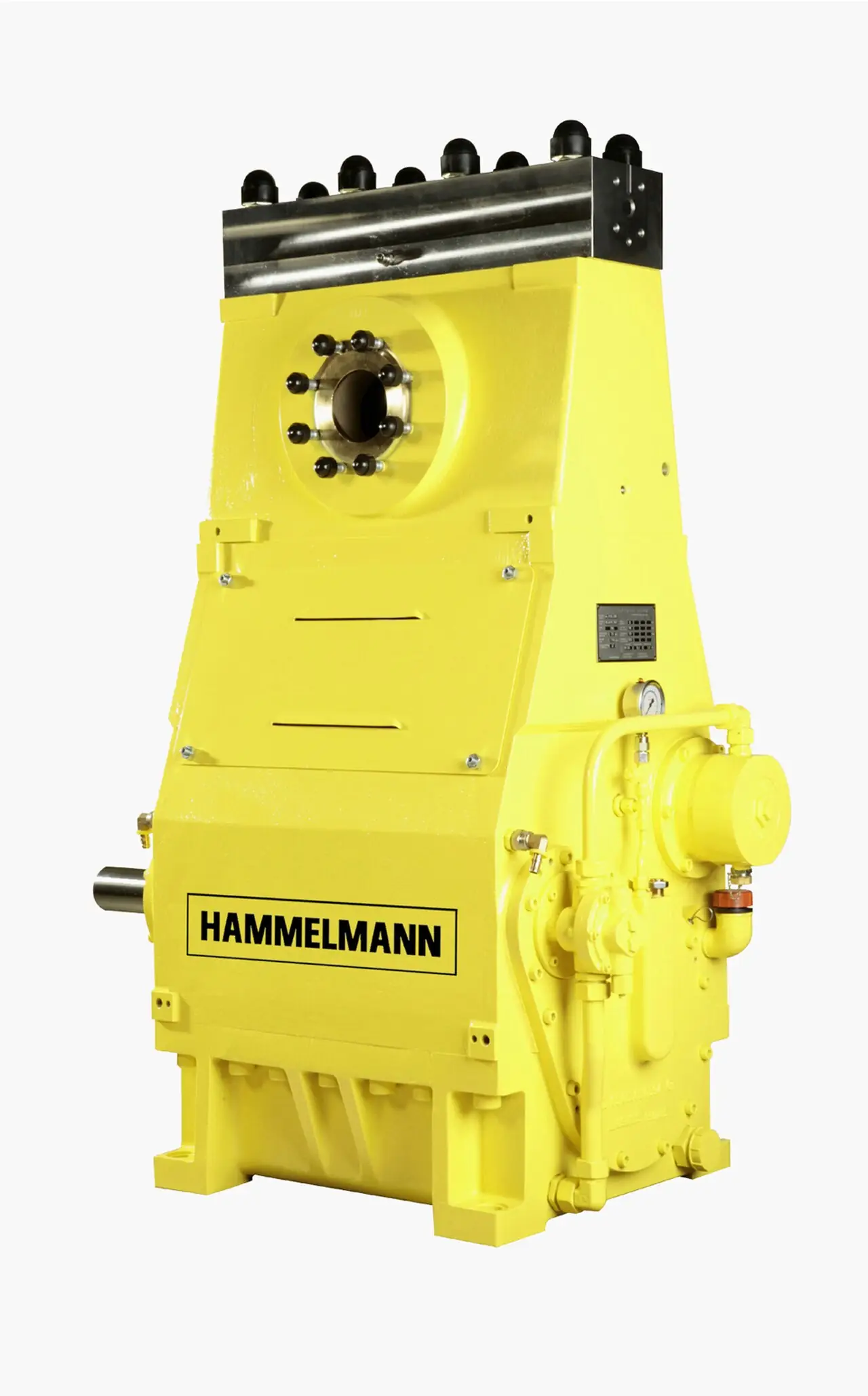
A high-pressure homogenizer is a positive displacement machine, a plunger pump block of three or more plungers, that forces liquid product through a narrow adjustable gap, the homogenizing valve, at pressures from tens to well over a thousand bar, and the violence of that passage, shear, cavitation, and impact in milliseconds, tears droplets and particles to a fineness no gentle process reaches: fat globules in milk to a stable emulsion, droplets in pharmaceutical formulations to nanoemulsions, and microbial cells to fragments in biotechnology downstream processing. The valve, first stage and often a second, is the working heart; the plunger block is the pressure engine; and the machine class spans dairy workhorses to sterile pharmaceutical units. GEA's homogenizer ranges are a representative industrial catalog, and this page treats the complete machine, pump block, valves, hydraulics, and control, as the purchasing object.
This page is written for the engineer specifying a high-pressure homogenizer for a dairy or food line, a pharmaceutical or cosmetic emulsion, or a biotechnology cell disruption step. It works through what the machine is and what is being bought, how the valve gap and the pressure make the dispersion, which designs fit which duties, the parameters that appear on vendor data sheets, and the selection factors and RFQ language that decide whether the homogenizer delivers its particle size target for a valve and plunger budget that stays predictable.
The decision concentrates in five places: the product and its target, a droplet or particle size distribution with a stability requirement, or a disruption yield, the pressure class that achieves it, tens of bar for dairy fat, hundreds to thousands for pharma and biotech, the capacity class and its duty factor, continuous or batch, the hygiene regime, food, cleanable, or sterile, the product demands, and the wear economy, valve, plunger, and seal lives at the operating pressure, which sets the machine's real cost per tonne. Get those right and the stages, the drive, and the service scope follow with little freedom.
Chapter 1 / 06
What a High-Pressure Homogenizer Is and What Is Being Decided
The machine this page describes has a power frame carrying a crankshaft and plungers, three to seven or more, in a pump block whose ceramic or coated plungers run in high pressure seals; the plungers draw product through suction valves and discharge it through the homogenizing valve assembly, where an adjustable gap between a valve and its seat, loaded by a hydraulic or spring system, sets the operating pressure. Product in the gap accelerates to high velocity, then decelerates onto an impact ring and into the outlet, the milliseconds of shear, turbulence, cavitation, and impact doing the work; a second stage valve, downstream, takes a fraction of the pressure and breaks the clusters the first stage formed, standard in dairy duty. The drive, the hydraulic power unit for valve loading, and the control system complete the machine, and a pressure transmitter at the valve block is its single most important instrument.
What is being decided when a high-pressure homogenizer is purchased is a particle size result backed by a capacity and wear statement. The buyer is purchasing a stated droplet or particle size distribution, an index like a d90 or a homogenization index in dairy, at a stated capacity and pressure, with valve, plunger, and seal lives the vendor should bound for the stated product, in a hygiene class the product's regulation demands. Everything on the vendor data sheet, pressure class, plunger count and diameter, valve types, motor power, exists to support those guarantees, and the honest vendor quotes the sizing test, a bench or pilot homogenization on the actual product, rather than the analogy that flatters it.
The high-pressure homogenizer sits in the size reduction family at its pressure extreme, with defined neighbors. It is not a high shear mixer, the rotor-stator machine whose spinning head shears batches and lines at moderate intensity, and whose own page in this encyclopedia notes that the rotor-stator design is sometimes marketed as a homogenizer and leaves the pressure machine as the finer emulsion's neighbor; the colloidal mill, the rotor-stator grinding machine, sits between them. It is not a static mixer, which blends in pipe without moving parts and disperses only what its geometry can; it is not an agitator, which keeps a tank mixed rather than reducing anything; and it is not the batch dispersion duty of a jacketed reactor with its stirrer. Where the target is a fine, stable emulsion or a disrupted cell, the pressure valve is the machine that delivers it.
Different buyers buy the same machine for different products. A dairy homogenizes milk and cream at moderate pressures, twenty to a few tens of megapascal in modern practice, two-stage valves the standard, capacities to tens of tonnes per hour, hygiene to food standard with clean in place. An ice cream and sauce plant homogenizes mixes with the fat and stabilizer systems that demand it. A pharmaceutical plant homogenizes emulsions, suspensions, and liposomes at hundreds of megapascal, sterile-steamable machines in clean rooms, batch and continuous both. A biotechnology plant disrupts microbial cells, E. coli and yeast, at high pressure, releasing protein for the downstream train, where a disc stack centrifuge clarifies the lysate and a freeze dryer dries the product. A chemical plant emulsifies fuels, lubricants, and cosmetics bases. The specification language differs, but the valve physics is shared.
The economics deserve their own paragraph because this machine sells a result nothing cheaper reaches. Rotor-stator mixing, colloid milling, and ultrasound all make emulsions, and all of them stop where the sub-micrometer, long-term-stable, or high-solids target begins; the pressure valve takes droplets to sizes and distributions that carry a product's shelf life, and its premium is paid against the recall or separation the coarser process would ship. The wear economy is the counterweight, valve seats and plungers are consumables with lives measured in hundreds of hours at the highest pressures, and the machine's cost per tonne is capital plus energy, the pressure duty is real power, plus wear parts by the schedule. The buyer who prices the machine without the wear table has priced the introduction, not the marriage.
A short tour of named duties makes the machine concrete. At a dairy, pasteurized milk at temperature feeds the homogenizer between the pasteurizer's regeneration and holding sections, fat globules drop from micrometers to below a micrometer, and the cream no longer rises; the machine runs continuously with the line, cleaned in place nightly. At a vaccine plant, an emulsion adjuvant passes a sterile homogenizer at high pressure, batch to batch uniformity documented for the filing. At an enzyme plant, fermentation broth presses through at rupture pressure, the lysate moving to clarification and purification. At a cosmetics plant, a foundation emulsion runs two passes to its target gloss. Each duty names the same knobs, pressure, stages, passes, and hygiene, with products that differ while the valve physics barely changes.
Chapter 2 / 06
How the Valve and the Pressure Do the Work
The gap is where everything happens. At operating pressure the valve, loaded by hydraulics or springs against its seat, lifts a few tens to a few hundreds of micrometers; the product accelerates through this annular gap to velocities of hundreds of meters per second, then decelerates abruptly at the exit and onto the impact ring. The droplet or particle experiences, in milliseconds, extensional and shear deformation, turbulent eddies at its own scale, and cavitation, vapor bubbles forming and collapsing as the pressure path falls and recovers, and it breaks where the disruptive stresses exceed its cohesive ones. Which mechanism dominates depends on pressure, gap geometry, viscosity, and the product's interfacial chemistry, and the valve's design families, flat seat, conical, and the specialized geometries vendors patent, arrange the mechanisms deliberately.
Emulsion chemistry sets the ceiling the machine works against. Droplets broken in the gap want to recoalesce the instant surface area is free, and the emulsifier, proteins in milk, small molecule surfactants in pharma and chemicals, adsorbs at the new interface in those same milliseconds to stabilize it; the machine makes the area, the chemistry keeps it. Feed preparation matters for the same reason, a coarse pre-emulsion from a high shear mixer or a colloid process feeds the valve a manageable distribution, and product temperature matters, viscosity and interfacial tension both falling warm. Sizing tests on the actual formulation, with its actual emulsifier package, are the only honest predictor of the pressure and passes the target needs.
Two stages shape what one gap makes. The first stage breaks the droplets, and in breaking them forms clusters, fat globules flocculated through protein bridges in dairy's classic case; the second stage, at a fraction of the first pressure, ten to one is a dairy rule of thumb, disperses the clusters and gives the emulsion its stability and its mouth feel. Pharma nanoemulsion duties often run single stage at maximum pressure, the cluster question smaller and the pressure precious; cell disruption runs single stage, the second valve adding nothing to a broken cell. The stage arrangement is a purchase specification with the product's history behind it, not a vendor default.
The pump block is the pressure engine and its own engineering. Plungers of three to seven run in a crank frame, phased to smooth the flow, their discharge pulsation dampened by the block's manifold and, at capacity, by the line; seals, packing rings or lubricated cartridges by class, contain the pressure and are the block's wear item with the plungers themselves, ceramic and coated running surfaces by vendor. Suction valves admit product, and the whole block, in hygienic machines, is designed for clean in place circulation with the valve open and closed cycling. Feed to the machine is a pump's job, a centrifugal pump on low viscosity, a gear or lobe machine on viscous product, feeding at pressure enough to keep the suction valves full and the block from starving, and starved running is the block's classic abuse.
Cell disruption is the biotechnology half of the machine's work and its physics is rupture. A cell suspended in broth passes the gap, and the same stresses that break droplets break cells, the wall failing under the turbulent and cavitation loading; yield, the fraction of cells broken, and selectivity, the protein released versus the debris made, trade with pressure and passes, and the debris itself is the downstream problem, the finer fragments a clarifying disc stack centrifuge or depth filtration must catch. Multiple passes at moderate pressure against one pass at extreme pressure is a genuine optimization the process study owns, heat generation, several degrees per hundred bar, needing cooling between stages.
Degradation has a short honest list, wear and heat. Valve seats and impact rings wear at the operating pressure's rate, the gap drifting and the pressure decay telling the story, and their materials, tungsten carbide and ceramic classes by product abrasiveness and chemistry, set the interval; plungers and seals wear on their own schedule, and seal leakage is the block's visible symptom. Heat is the process tax, the pressure work landing in the product as temperature, joules per pass by the pressure, and cooling, jacketed sections or inter-pass exchangers, protects what the product's chemistry allows. Vibration from a worn valve or a pulsating block, and the drive's own bearings, round out the machine's trend list, all of them visible in the pressure trace if anyone is looking.
Chapter 3 / 06
Machine Classes, Duties, and Process Boundaries
Dairy and food machines are the volume class: tens of megapascal, capacities from a few to tens of cubic meters per hour, two-stage valves, food hygiene with clean in place, and a service economy built around daily cleaning and weekly inspection. Ice cream, evaporated milk, sauces, and juice bodies join the duty list. The class's engineering center of mass is capacity and uptime, the machine runs with the line and stops with it, and its wear parts are changed on the line's calendar.
Pharmaceutical machines are the pressure and documentation class: hundreds of megapascal, smaller capacities, batch and continuous both, sterile-steamable constructions, low dead volume, and a qualification file as heavy as the machine. Emulsions, suspensions, liposomes, and nanoemulsions for injection and topical delivery are the products, and the machine's duty cycles are measured in batches and campaigns. Between food and pharma sit the biotechnology machines, high pressure disruption duty, cleanable rather than always sterile, built for the downstream train's cadence, and the chemical and cosmetic machines, pressure classes by product, hygiene by market.
Laboratory and production scaling is the class's special discipline. Bench machines, a few milliliters per minute at full pressure, develop the formulation's pressure-pass curve; pilot machines, liters per hour, scale it; and production machines run it. Valve geometry families that scale consistently, the vendor's laboratory and production valves drawing the same flow behavior, are what make the development transferable, and a buyer whose pilot work runs one vendor's valve should either buy that family or repeat the work. The scaling risk is the whole point of the test discipline, and the RFQ should state where the development data came from.
The boundaries against the neighbor machines deserve one careful paragraph, because marketing blurs them. The rotor-stator machine, the inline high shear mixer with its spinning head, disperses and emulsifies at moderate intensity, handles batches and lines, and stops at the coarse end of fine; its page in this encyclopedia names the pressure homogenizer as the neighbor for finer emulsions, and this page returns the courtesy. Colloid mills grind between rotor and stator discs, a wet fine-grinding machine for pastes and suspensions, again coarser and gentler than the valve. Ultrasonic homogenizers cavitate on a horn, laboratory to small production scale, niche by scale. The agitator stirs, the static mixer blends in pipe, and none of them carry the pressure that defines this machine.
Adjacent process equipment completes the plant picture. Upstream, the feed preparation, tanks with agitators, pre-emulsification by the rotor-stator or colloid route, deaeration by a vacuum pump where entrained air harms the valve, and temperature control; feed pumping by the class the product's viscosity dictates, and where batches are measured, a metering pump or a peristaltic pump handling small sterile streams. In API plants the streams around this machine include a crystallizer for the solids route and a nutsche filter for batch isolation, and the machine's own instruments run on plant air dried by an air dryer with a vfd smoothing the block's start. Downstream, dairy's scraped surface heat exchanger cools and holds product the homogenizer stabilized, food lines finish in a spray dryer for powders or an aseptic fill, pharma's emulsion goes to filling and its biologicals to purification and a freeze dryer, and process analytics, particle sizing offline or inline, close the loop the machine's guarantees live on. Within the family, the classes differ by pressure and hygiene, not species, and the RFQ should state product, target, and hygiene rather than ask for a homogenizer and hope.
Chapter 4 / 06
Key Specification Parameters
The vendor data sheet for a high-pressure homogenizer centers on pressure, capacity, and power, and each number carries a duty consequence. The table below lists the parameters that recur across manufacturers' catalogs, with typical ranges for the main classes; values for a specific project come from the product's test curve, and the ranges here are orientation, not a substitute for the trial.
Parameter
Typical catalog range
What it decides
Maximum homogenizing pressure
20 MPa dairy to 200 MPa lab
The size reduction ceiling per pass
Capacity
0.001 L/min lab to 70,000 L/h dairy
Machine count; line integration
Installed power
proportional to pressure times flow
Energy per tonne; electrical supply
Plunger count
3 to 7
Flow smoothness; block size class
Valve stages
single or two stage
Cluster breakup; duty fitness
Valve materials
ceramic, tungsten carbide classes
Wear life by product abrasiveness
Hygiene class
food CIP to sterile SIP
Construction and documentation scope
Temperature rise per pass
about 0.2 C per 10 bar
Cooling scope between passes
Three of these numbers deserve the buyer's suspicion when they arrive without a basis. Maximum pressure quoted as a laboratory figure on a production machine's brochure flatters the duty class, the production number is the one the warranty writes. Capacity quoted on water at low pressure hides the derate at the product's viscosity and the operating pressure. Valve life quoted without the product and pressure it applies to is a dimension, not an interval, and the honest vendor quotes wear in hours at the stated duty. An RFQ that carries the product's test curve separates engineered offers from assembled ones.
Materials and construction follow the hygiene class and the product's chemistry. Food machines run stainless product paths with food-grade seals and CIP provisions; pharmaceutical machines add electropolished surfaces, sterile-grade seals, steam sterilizability, and documentation packages the filing needs; valve internals run ceramic and carbide classes by wear and chemistry, and corrosive products move the whole wetted path up the alloy and ceramic ladder. The hydraulic power unit, valve loading and its control, is the machine's precision hydraulic element, and the control system's pressure loop, its response and interlocks, is the operating honesty the guarantees ride on.
Chapter 5 / 06
Selection Decision Factors and RFQ Language
Selection starts with the product's target, not the catalog. The particle size distribution and its stability requirement, or the disruption yield, define the result; the pressure-pass curve from laboratory work defines the machine duty, pressure, passes, and capacity; and the hygiene class defines the construction. Where development data does not exist, the sizing trial is the first purchase, and vendors' application laboratories run it as a matter of course. A buyer who skips the curve buys a pressure rating and discovers the process later.
The alternatives belong in the study rather than in habit. For moderate fineness and stability, the rotor-stator route, a high shear mixer or colloid mill, delivers at lower capital and wear; for the finest targets, nanoemulsions, high-pressure disruption, long-shelf-life dairy, the valve has the field. Between them, product economics decide, and the comparison prices energy, wear parts, and passes against the stability the cheaper process cannot ship. Within the homogenizer family, the class ladder, food, cleanable biotech, sterile pharma, is the hygiene decision, and the capacity ladder follows the line's.
The table below organizes the decision into the factors that recur across projects, with the questions the buyer should be able to answer before the RFQ goes out. Each row is a place where an incomplete answer turns into an underspecified machine and a specification argument later.
Decision factor
What the buyer must state
Consequence if left open
Product and target
Formulation, droplet or particle target, stability spec or yield
Result undefined; pressure guessed
Test basis
Pressure-pass curve on the actual formulation
Sizing by analogy; warranty disputes
Capacity and duty
Flow, continuous or batch, passes, duty factor
Machine class and count wrong
Hygiene class
Food CIP, cleanable biotech, or sterile SIP with standards
Construction and qualification gaps
Wear economy
Valve, plunger, seal lives at the operating pressure
Cost per tonne unknown
Feed and cooling
Feed pump class, temperature limits, inter-pass cooling
Starved block; heat damaged product
Documentation
Qualification file scope for regulated duty
Filing risk at audit
RFQ language for a high-pressure homogenizer should name the product and the basis of guarantee. A workable specification states: the formulation and its target particle size or disruption yield with the test basis; capacity and duty cycle with the pass count intent; operating pressure class and stage arrangement; hygiene class and its standards, CIP or SIP scope; materials of the wetted path and valve internals; plunger and seal wear life expectations at duty; feed system interface and cooling scope; control and instrumentation, the pressure loop and interlocks; and the acceptance basis, a performance run on the actual product against the particle target. Naming the neighbors helps the vendor, the feed pump and pre-emulsification route, the cooling hardware, the downstream separator or dryer, so the interfaces land in the right bids.
Chapter 6 / 06
Installation, Standards, Failure Modes, and Maintenance
Installation is a utility and hygiene job with a pulsation discipline. The machine sets on its foundation with the feed and discharge piping supported strain-free and short, pulsation dampeners where the line needs them, and a pressure transmitter and gauge of their own at the discharge for the operating honesty; the hydraulic unit and its cooling set with the drive, and clean steam, CIP supply, and product utilities land by hygiene class. Commissioning proves the block on water, the valve control's response, the interlocks, low suction, high pressure, and then the product run tunes the pressure and stages to the target from the test curve. In regulated duty the qualification protocols run with commissioning and close before production.
Standards for these machines are hygiene and pressure driven. Food machines carry the food contact compliance their market demands; pharmaceutical machines carry the industry's GMP design expectations and the buyer's quality standards, surfaces, seals, and documentation; the pressure parts, valve blocks and cylinders, follow the pressure equipment framework of the jurisdiction; and machinery safety applies to the power frame and its guarding. There is no single international homogenizer standard governing the machine end to end, so the RFQ must name the applicable codes and the vendor's conformity scope. Any edition reference in project documents should be checked against the current issue at purchase rather than copied from an old specification.
The recurring failure modes are wear, heat, and the starved block. Valve wear, seat and impact ring, drifts the gap and the pressure decay until particle size creeps out of specification, and the pressure trace and particle measurement trend it; plunger seal wear leaks visibly and degrades suction; plunger surface damage, from running dry or abrasive product, takes the block down for rework. Heat excursions cook sensitive products and scale the valve, the cooling discipline's failure. Starved suction, feed inadequate or viscosity untended, cavitates the block and hammers the valves, the classic abuse that shortens every wear item at once. Vibration from the drive and the block's own pulsation rounds out the trend list, and the machine's instruments tell all of it early.
Maintenance planning is hour driven around the valve. The table below lists the actions with the typical cadence a plant will schedule, assembled from common vendor practice; actual intervals follow the product's abrasiveness, the operating pressure, and the duty cycle and should be set from the machine's own record.
Item
Typical action
Typical cadence
Homogenizing valve
Inspect seat and impact ring, renew at wear limit
300 to 2,000 h by duty
Plunger seals
Inspect, replace kits, check leakage
500 to 4,000 h
Plungers
Inspect surface, replace or rework
At block service
Pressure instrumentation
Calibrate transmitter and gauge
Monthly to quarterly
Hydraulic power unit
Fluid and filter service, valve response check
Quarterly
CIP effectiveness
Verify by inspection, valve cycling during CIP
Per cycle, inspect weekly
Drive and frame
Bearings, lubrication, vibration survey
Per schedule, quarterly survey
Long term care is a valve and plunger economy measured in product quality. The machine that holds its particle target for decades is the one whose valves were changed on trend, whose seals were renewed before the block starved, and whose cooling and feed disciplines never lapsed; upgrades, longer-wear valve materials, better valve geometries, and modern controls with data capture, extend legacy machines to modern documentation and efficiency. The plant that treats the homogenizer as the precision pressure instrument it is, trended and serviced, is the plant whose emulsions and lysates meet their specification for the life of the product line.
FAQ
How does a high-pressure homogenizer work?
A multi-plunger pump block raises the product to the operating pressure and drives it through a narrow gap between a valve and its seat; in milliseconds of acceleration, shear, turbulence, cavitation, and impact on an exit ring, droplets and particles are torn to a fine distribution. A second stage valve at lower pressure then disperses the clusters the first stage formed. The result is a fine, stable emulsion or dispersion that gentler machines cannot reach, at pressures from tens to over a thousand bar by duty.
What is the difference between a high-pressure homogenizer and a high-shear mixer?
A high-shear mixer is a rotor-stator machine, a spinning head shearing product in a batch or line at moderate intensity, and it is sometimes marketed as a homogenizer, but it delivers a coarser emulsion and no high pressure. A high-pressure homogenizer is a plunger-pump machine forcing product through a valve at hundreds to thousands of bar, reaching sub-micrometer droplets and disrupting cells. The rotor-stator machine prepares and disperses; the pressure machine finishes what nothing gentler can.
Why do dairy homogenizers use two stages?
The first stage valve breaks the fat globules, and in doing so creates clusters, globules flocculated through protein bridges that would rise as cream anyway. The second stage valve, at roughly a tenth of the first stage pressure, disperses those clusters and stabilizes the emulsion's texture and mouth feel. Two-stage is the dairy standard for that reason; pharmaceutical nanoemulsion and cell disruption duties often run single stage, where clusters are not the issue and the pressure is better spent on the break itself.
What pressure does a homogenizer need?
It follows the target. Dairy fat globules break at tens of megapascal; pharmaceutical nanoemulsions and liposomes need one to two hundred or more; microbial cell disruption runs in the hundred to hundred-fifty class with yield traded against passes; chemical and cosmetic emulsions sit by product anywhere between. The honest number comes from the pressure-pass curve measured on the actual formulation, and the trial is the first purchase a serious buyer makes.
What wears in a homogenizer and how fast?
The valve is the wear center: seats and impact rings erode at a rate set by product abrasiveness and pressure, commonly hundreds to a couple of thousand hours of service, and the pressure decay and particle size drift announce it. Plunger seals and the plungers themselves follow on their own schedules, seals hundreds to thousands of hours, plungers at block service. Valve materials, ceramic and tungsten carbide classes, set the intervals, and the vendor should quote wear life at the stated product and pressure, not in the abstract.
Can a homogenizer be cleaned and sterilized in place?
Food machines are built for clean in place, the block and valve designed for CIP circulation with the valve cycling open and closed through the program. Pharmaceutical machines add steam sterilization in place, sterile-grade seals, low dead volume, and the documentation the filing requires, qualifying as sterile-steamable process equipment. Hygiene class is a purchase decision with real construction consequences, and the RFQ should name the class and its standards rather than assume the vendor's default.
What should a high-pressure homogenizer RFQ include?
State the formulation and its target particle size or disruption yield with the test basis, capacity and duty cycle with pass count intent, operating pressure class and stage arrangement, hygiene class with CIP or SIP scope, wetted materials and valve internals, wear life expectations at duty, feed and cooling interfaces, control and instrumentation scope, and the acceptance basis on the actual product. Naming the feed pump and pre-emulsification route, cooling hardware, and downstream separation or drying lets vendors bid the interfaces correctly.