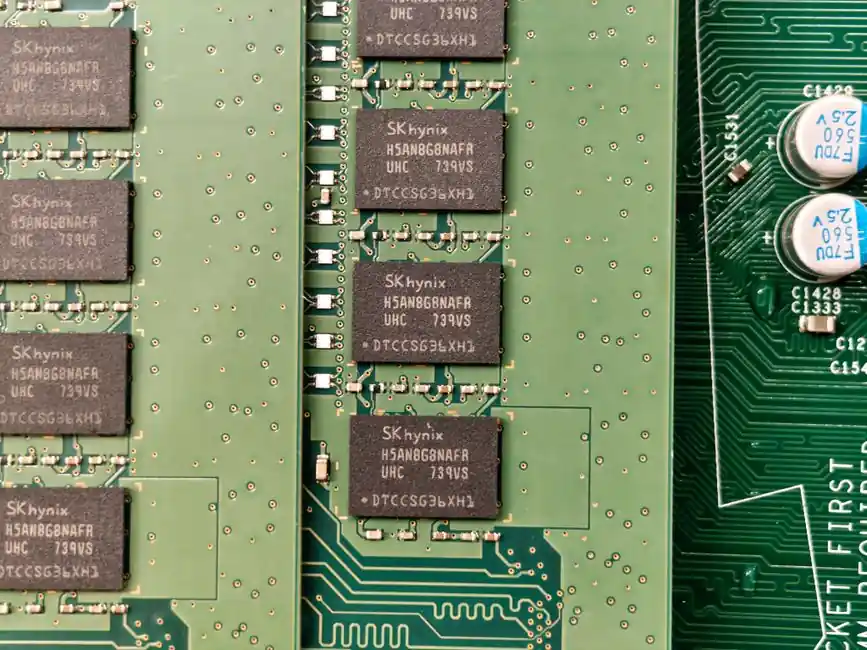
The 2026 edge computing gateway mainstream clusters tightly around ARM Cortex-A53 SoCs clocked at 1.6-1.7 GHz paired with 512 MB to 2 GB of LPDDR4 RAM, fanless housings rated -40 °C to +80 °C, dual Gigabit Ethernet, and 4G LTE Cat 1 or Cat 4 cellular backhaul, with optional Wi-Fi 6, Bluetooth 5.x, and GNSS, as seen in CTHINGS.CO Gateway XS, Robustel EG5120/EG5200, and PUSR's modular M-series [S1][S5][S3].
Buyers evaluating edge AI gateways in mid-2026 are pushed to demand evidence beyond TOPS marketing: workload definition, full software-stack compatibility, failure behaviour, and a clear responsibility map between model owner, application developer, and site integrator, per the vendor-evaluation framework published on 2026-07-21 [S3].
Core SoC and Memory Envelope for 2026 Edge Gateways
The NXP i.MX93 dual-core Cortex-A53 at 1.7 GHz with a Cortex-M33 at 250 MHz sits in CTHINGS.CO's Gateway XS, alongside 512 MB to 2 GB of LPDDR4 and 8 GB to 128 GB of soldered eMMC storage, defining a low-end modular baseline that runs Linux and the vendor's Orchestra OS [S1]. The 83 x 55 x 28 mm footprint and passive cooling make this a fit for DIN-rail cabinets where 24 V DC power is already present, including substation RTU cabinets that often share space with a pressure transmitter on the same marshalling rack.
At the higher end, the Robustel EG5120 uses a quad-core Cortex-A53 at 1.6 GHz (NXP i.MX8) with 2 GB DDR4 and 16 GB eMMC, demonstrating that 2 GB RAM and 16-128 GB storage are now the default for mid-range industrial protocol gateway designs in 2026 [S5]. The OnLogic Helix series, by contrast, steps up to Intel Core Ultra CPUs with discrete GPUs, signalling that the high end has bifurcated into a low-power ARM tier and a x86 edge-AI tier rather than converging on a single architecture [S6].
Industrial I/O, Power, and Environmental Hardening
Industrial I/O on 2026 gateways is converging on 2 to 5 Gigabit Ethernet ports, 2 to 4 software-configurable RS-232/422/485 ports, isolated digital inputs and relay outputs per EN 61131-2, and 12-24 V DC (±20%) inputs with reverse-polarity, OVP, OCP, UVLO, and surge protection on the terminal block [S1][S3]. The CTHINGS.CO Gateway XS specifies up to 2 RS485 (2-wire half-duplex), up to 2 CAN-FD, and up to 3 isolated DI + 3 DO at 24 V to EN 61131-2, plus an Infineon SLB9673 TPM for secure boot and key storage [S1].
Robustel's EG5200 lists 5 Gigabit Ethernet ports, 2 RS-232/422/485 interfaces, a console port, 2 wet-contact DI, 2 relay outputs, HDMI, USB expansion, and optional Wi-Fi 6, Bluetooth 5.3, and GNSS, mapping to typical machine-monitoring and substation-automation wiring where the same gateway also pulls data from a flow meter or an industrial valve actuator [S3]. Operating-temperature ratings of -40 °C to +80 °C and 5-year warranties from vendors like Compulab have become table stakes for fanless industrial SKUs [S4].
Wireless Backhaul: LTE Cat 1 bis to Cat 4, Wi-Fi 6, and Private Mesh
Cellular backhaul on 2026 industrial edge gateways centres on 4G LTE Cat 1 bis (max 10 Mbps DL / 5 Mbps UL on the CTHINGS.CO XS) and LTE Cat 4 for higher-throughput sites, with dual-SIM failover emerging on Robustel EG5120 for redundancy over public cellular [S1][S5]. The XS also supports Wi-Fi 6 (2.4/5 GHz), Bluetooth 5.4 BLE, GPS/GLONASS/BeiDou, Wirepas 2.4 GHz Mesh, Wirepas 5G NR+, and Zigbee/Thread, giving integrators a single SKU that can serve a fieldbus gateway role on a Wirepas-meshed meter network or a 5G-NR+ private campus [S1].
For solar, water/wastewater, oil and gas, and factory-automation sites, Moxa pairs its IIoT edge gateway family with ThingsPro software that exposes Modbus plus generic MQTT/HTTPS, and ships native clients for AWS and Azure, illustrating the dominant 2026 pattern of a containerised on-device stack that bridges OT protocols to cloud brokers [S7].
Edge AI Hardware: When NPU TOPS Actually Matter
Edge AI gateways in 2026 are differentiated less by headline TOPS than by whether the full software stack (OS version, inference runtime, supported model format, conversion toolchain, and CPU/RAM/storage headroom under concurrent apps) is verified against the production workload, per Robustel's vendor-evaluation guidance published 2026-07-21 [S3]. The EG5200, for example, is positioned as a reference for combining local compute, industrial interfaces, cellular backhaul, and fleet management, with each interface still requiring field validation against the connected PLC, sensor, or pressure sensor [S3].
Buyers are advised to require evidence on nine points: input type and data rate, model and inference interval, architecture diagram from field device to upstream system, benchmark conditions including gateway model and software version, failure-mode assumptions for sensor or WAN loss, and a written ownership map covering model, application, gateway, network, and field equipment [S3]. Without these, a TOPS figure on a datasheet does not predict response time on the line, because actual latency depends on model architecture, precision, pre-processing, and input resolution rather than peak accelerator throughput [S3].
Software Stack, Containers, and Security Baseline

The 2026 software baseline across vendors is Linux (Debian 11 LTS-class) with Docker container support, vendor fleet managers, and a security stack that bundles TLS in transit, signed firmware updates, role-based access, network segmentation between OT and IT, and TPM-backed key storage, matching the controls enumerated in the Scale Computing edge-gateway reference architecture [S5][S8]. The CTHINGS.CO Gateway XS adds an Infineon SLB9673 TPM on the optional interface list, hardening against physical key extraction, while PUSR's M-series markets EMC level 3 protection and watchdog-driven auto-recovery as baseline reliability features [S1][S2].
OnLogic's lineup reflects the same bifurcation seen in hardware: the Factor Series (ARM/Raspberry Pi CM4, ultra-compact, cost-optimised) targets space-constrained and cost-driven IIoT, while the Helix 300-600 Series (Intel Core Ultra, GPU options) targets heavy edge AI and visual-inspection workloads, and the CL200 Series sits between as a dual-LAN x86 edge gateway [S6].
Selection Criteria vs Product Tier: A Decision Comparison
Across the documented 2026 product set, three tiers can be lined up against four decision criteria. Tier 1 (CTHINGS.CO Gateway XS, PUSR M100, PUSR N720-G) targets 300-1000 I/O points with ARM Cortex-A53 SoCs at 1.6-1.7 GHz, 512 MB to 2 GB LPDDR4, LTE Cat 1 or Cat 4, and prices anchored at the modular, low-power end [S1][S2]. Tier 2 (Robustel EG5120) adds 2 GB DDR4, 16 GB eMMC, dual-SIM failover, and Docker-native containerisation for sites needing local apps and broker redundancy [S5]. Tier 3 (Robustel EG5200, OnLogic Helix 500/600) layers in NPU or discrete GPU acceleration, 5 Gigabit Ethernet ports, HDMI, and optional Wi-Fi 6 plus Bluetooth 5.3, for visual-inspection and multi-stream inference workloads [S3][S6].
On the four key criteria: (1) compute headroom rises with tier, but only when the vendor can show a verified model-runtime path; (2) industrial I/O density is roughly comparable across tiers, with Tier 1 sometimes offering more isolated DI/DO per dollar; (3) environmental hardening (-40 to +80 °C, fanless, 12-24 V DC with full protection) is consistent across all three tiers, and (4) software/fleet-management depth scales with tier, since Tier 2 and 3 vendors ship native cloud clients (AWS, Azure) and OTA platforms that Tier 1 modular units often lack [S1][S2][S3][S5][S7]. A site that needs an IIoT edge gateway primarily as a Modbus-to-MQTT bridge with local buffering will overpay for Tier 3 NPU capacity, while a vision-based quality-inspection cell on Tier 1 hardware will hit CPU/RAM ceilings within weeks of deployment.
Where Edge Gateways Fit, and Where They Don't
Edge computing gateways in 2026 are the right fit for sites that need local buffering, protocol translation, and decision-grade inference under WAN interruption, with documented deployments in solar, water/wastewater, oil and gas, and factory automation where Modbus and MQTT/HTTPS bridges with built-in AWS and Azure clients are now standard [S7]. They are not a substitute for a full industrial PC in control rooms running SCADA HMI, nor for rackmount servers in central data halls, because their thermal envelope, RAM ceiling, and PCIe expansion are bounded by the fanless DIN-rail form factor [S1][S6].
PUSR's positioning explicitly targets industrial, commercial, and mobile-transportation connectivity with low-latency local processing, watchdog-driven auto-recovery, EMC level 3 protection, and local encryption of sensitive data, illustrating the typical use-case boundary: anything that benefits from sub-second local response and intermittent WAN links, and that does not need a full Windows or server-class OS, belongs on an edge gateway [S2]. A buyer watching this space in late 2026 should track two signals: (a) the share of new industrial SKUs shipping with NPUs and verifiable model-runtime stacks, and (b) the number of vendors adding TPM plus signed-OTA to their default feature set rather than pricing it as an option, since both moves compress the spec sheet further and reset the entry-level price floor [S1][S3][S8].
Related analysis: Backhoe Loader Selection for Urban Infrastructure: 2026 Spec Map.