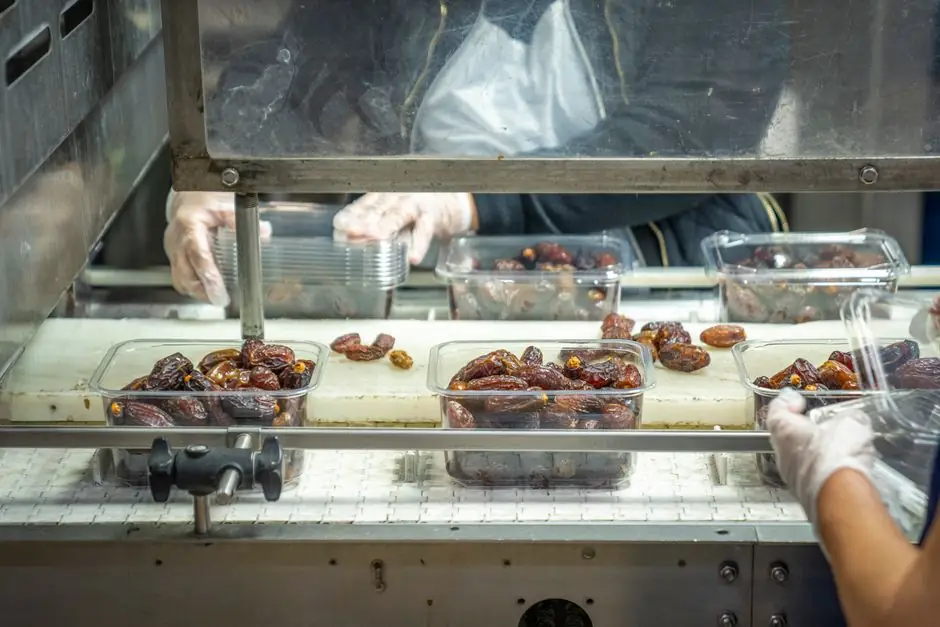
Vibrating conveyors specified for pharmaceutical distribution differ from general bulk units in three concrete respects: 304/316 stainless contact surfaces, fully contained trough or tube geometries to keep dust inside the envelope, and drive tuning that holds amplitude low while pushing frequency above the typical 60 Hz mains mechanical-drive range [S1][S2].
For tablet, capsule, and powder lines the relevant equipment class is a controlled or natural-frequency vibratory conveyor, not a screening feeder; throughput is normally in the 0.5–10 t/h range with trough widths from 150 mm to 600 mm depending on line scale [S2][S3]. These units share the broader operating principles covered in the vibrating conveyor reference, but the pharmaceutical variant is constrained by cleanability and dust control more than by tonnage.
Drive architecture: natural frequency vs. electromagnetic
Pharmaceutical lines split into two drive families: natural-frequency mechanical conveyors that run at the tuned resonance of a spring-mass system, and electromagnetic conveyors driven by an AC coil at variable frequency [S3][S5]. Natural-frequency units are typically chosen for higher-mass, longer-trough runs and energy-sensitive duty, since once at resonance the drive only supplies damping losses [S2].
Electromagnetic drives are specified where amplitude must be varied online, where start/stop cycles are short, and where precise metering into a tablet press or checkweigher is required; their lower amplitude at higher frequency suits fragile coated tablets and friable granules [S3][S5]. Both families are used inside GMP envelopes, but the electromagnetic variant dominates scale-feed and orienting functions because the electromagnetic drive section shows it can be modulated without re-tuning springs. As a rule, mechanical natural-frequency units lead on heavy/abrasive duty, electromagnetic units lead on metering and metering-to-scale duty [S4][S5].
Hygienic and containment specifications
Pharmaceutical vibrating conveyors are built with 304 or 316 stainless contact parts, ground or polished welds, and radii that meet typical 3-A and EHEDG cleanability geometry, with FDA-grade elastomers at any seal point [S1]. The trough is normally a closed tube or fully covered pan so airborne powder cannot escape into the room; this is the same containment logic used on cable distribution cabinet enclosures, where the housing is the safety boundary.
Containment on a vibrating conveyor is rated by the trough closure (open pan, covered pan, fully tubular) and by the dust-class of any vent or filter on the discharge, not by the drive itself [S2][S4]. For OEB 3–4 active lines, fully tubular stainless troughs with sanitary tri-clamp ends are common; the same logic is used for explosion-proof distribution panels, where the enclosure class defines the safe envelope. Compared to belt conveyors, vibrating units also reduce dust generation because the bed stays in micro-hop rather than being lifted and dropped, a meaningful gain when handling API powders [S2][S4].
Sizing: amplitude, frequency, trough width, throughput

Sizing for a pharmaceutical vibrating conveyor starts from the required mass flow (kg/h or t/h), bulk density of the powder or tablet bed, and a target conveying speed normally between 0.1 m/s and 0.5 m/s; trough width is then derived, with width-to-depth ratio kept in the 4:1 to 6:1 band to keep the bed aerated without fluidising fine APIs [S2][S3]. Frequency is set above the mechanical natural frequency of the bed (typically 25–60 Hz for mechanical drives, higher for electromagnetic units) to keep amplitude in the 1–5 mm range for delicate tablets [S3][S5].
Conveying distance is the second sizing axis: short transfers under 3 m are usually direct-drive electromagnetic, 3–15 m runs often use natural-frequency mechanical units, and longer inclined or elevating runs are typically handed off to a bucket elevator or a mesh belt conveyor once elevation exceeds the practical 5–8° limit of a vibratory trough [S3][S4]. One full stroke equals twice the vibration amplitude, so doubling amplitude doubles stroke and roughly doubles conveying speed at fixed frequency, a useful quick-check when scaling lab data to production [S2].
Options compared on four decision criteria
For pharmaceutical distribution, the realistic options reduce to four configurations: electromagnetic enclosed tube, natural-frequency enclosed tube, open-pan electromagnetic for non-dusty tablets, and spiral-elevating electromagnetic for combined horizontal and vertical transfer [S2][S3]. A criteria-based comparison on containment, metering precision, cleanability, and capital cost shows clear differentiation.
Enclosed-tube electromagnetic units score highest on containment and metering precision because the tube seals the dust envelope and the drive is amplitude-variable; natural-frequency enclosed tube units win on capital cost per metre for long runs but are slower to re-tune between recipes; open-pan electromagnetic units are cheapest and easiest to clean but only suit coated, non-dusty tablets; spiral electromagnetic units add elevation but sacrifice throughput per unit footprint and are harder to inspect internally [S2][S3][S4]. For OEB-classified APIs, enclosed-tube is the default regardless of drive type, paralleling the segregation logic used in power distribution cabinets where the enclosure defines the safety class.
Integration with downstream equipment
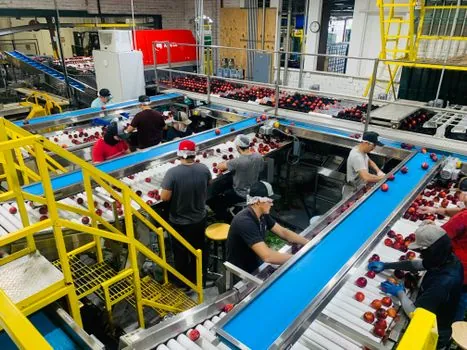
Vibrating conveyors in pharmaceutical lines are rarely standalone; they feed tablet presses, encapsulators, checkweighers, and metal detectors, and they receive from screeners, granulators, and blender discharges [S3][S5]. A correctly sized unit holds amplitude and frequency constant against varying head pressure, which is what makes them preferred over screw feeders for feeding a checkweigher at steady gram-level mass flow [S5].
Where product needs to be diverted to multiple packaging lines, gates on a vibratory trough can be opened and closed to split the stream without stopping upstream equipment, a function that is much harder on screw or belt conveyors and is one of the practical reasons vibrating units are kept in distribution sections of solid-dose plants [S5]. For broader plant layout context, the same containment logic that drives distribution cabinet segregation also drives the segregation of dust-zoned conveyors from packaging aisles.
Failure modes and limits to flag in the spec
Common failure modes on pharmaceutical vibrating conveyors are spring fatigue on natural-frequency units, coil burn-out on electromagnetic units driven continuously at high amplitude, and trough cracking at welded radii when abrasive granules or tablets with sharp edges are run above the design frequency [S2][S4]. Each mode has a concrete spec anchor: spring life is rated in cycles, electromagnetic coils in duty cycle, and trough fatigue in hours at a stated amplitude-frequency pair [S3][S4].
Material limits are also specific: vibratory conveyors do not convey cohesive wet masses well, the bed needs a minimum flowability to micro-hop, and inclined elevation above roughly 5–8° is impractical without switching to a bucket elevator for vertical lift [S3][S4]. A practical sizing rule is to keep the trough width-to-depth ratio in the 4:1 to 6:1 range and to cap bed depth at roughly 50 mm for friable tablets, with deeper beds reserved for robust granules [S2].
Sourcing, standards, and selection checklist

For a procurement-ready spec, list drive type (electromagnetic vs. natural-frequency mechanical), contact material (304/316 stainless with surface finish Ra value), trough geometry (open pan, covered pan, fully tubular), trough width, nominal frequency, nominal amplitude, throughput in kg/h, elevation angle, and required sanitary standard reference [S1][S2][S3]. The same checklist pattern is used in adjacent equipment, for example when sizing a sorting system upstream of a vibrating conveyor, so QA and validation teams can reuse the same documentation template [S5].
Trackable signals for the next planning cycle: supplier releases of OEB-validated enclosed-tube electromagnetic units, updates to EHEDG cleanability guidance for vibratory troughs, and any new natural-frequency drive topologies that push trough lengths beyond 15 m without an intermediate transfer. Confirm trough width, throughput, and elevation angle with the line builder before locking the conveyor, since those three numbers drive drive selection more than vendor brand.