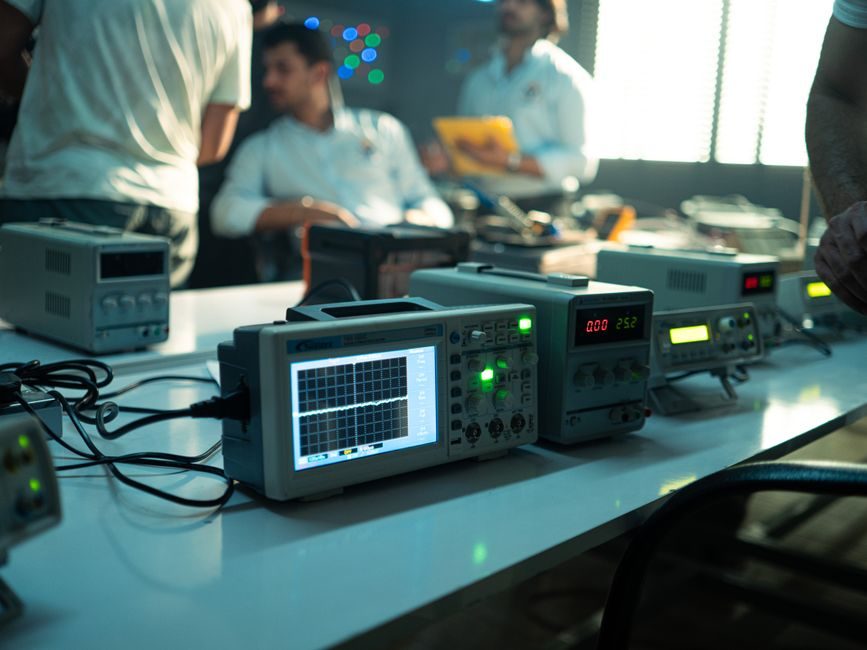
Stepper drives and variable frequency drives (VFDs) solve different problems in the same cabinet: a stepper drive pulses a stepper motor to a commanded angular position, while a variable-speed drive varies the frequency and voltage applied to an AC induction or permanent-magnet motor to control its speed and torque.
The VFD market alone is projected to grow from USD 24.7 billion in 2025 to USD 32.0 billion by 2030, reflecting how widely variable-speed AC control is being deployed across pumps, fans, compressors, and conveyors [S4]. Stepper drives address a smaller but more deterministic motion niche, where a stepper motor must hold a fixed angular position without a feedback encoder.
Operating Principle and Feedback Topology
A stepper drive converts a step/direction or CW/CCW pulse train from a controller into the phase currents of a two-phase (or multi-phase) stepper motor, with each incoming pulse advancing the rotor by a fixed electrical angle, typically 1.8° on a standard 200-step motor before microstepping [S1]. Open-loop operation is the default: the drive assumes the rotor followed the commanded step, and accumulated missed steps are not detected without an external encoder. Modern stepper drives apply microstepping — often 1/8, 1/16, 1/32, or 1/256 — to subdivide the full step and reduce low-speed resonance, while closed-loop variants add an incremental encoder and phase-current regulation to recover from stall events.
A VFD instead rectifies incoming AC to a DC bus and re-synthesises a pulse-width-modulated (PWM) output at variable frequency and variable voltage, following a V/Hz or field-oriented-control (FOC) law so the AC motor's flux stays near its rated value across the speed range [S1][S4]. Speed feedback is commonly provided by a tachogenerator, an incremental encoder, or sensorless estimation from motor current; without feedback, the VFD regulates speed via the V/Hz curve alone, with slip determining the actual shaft speed of an induction motor. The control engineering guidance emphasises that a VFD "requires that end-users perform a proper auto-tune" of the connected motor to lock the current-loop gains and prevent instability [S1].
Where Each Drive Fits — and Where It Fails
Stepper drives are specified for axes that demand repeatable open-loop positioning at low to moderate speeds, such as indexing tables, syringe pumps, small CNC auxiliary axes, label applicators, and laboratory fluid dispensers. They deliver high holding torque at standstill without a brake and cost less than an equivalent servo system — a reason the stepper drive selection criteria for 2026 builds are framed around bus voltage, phase current, microstep resolution, and feedback option rather than continuous power. The trade-off is well documented: at higher shaft speeds the available torque falls roughly as 1/f, resonance bands cause missed steps, and open-loop systems cannot self-correct a stall caused by an impact or overload. [S1]
VFDs are the default for HVAC fans, centrifugal pumps, conveyors, mixers, and any multi-kW process load where the goal is speed variation and energy savings rather than absolute position. The MarketsandMarkets segmentation places pumps, fans, compressors, and conveyors as the four largest VFD applications globally, with the AC drive sub-type dominating over DC and servo variants [S4]. VFDs do not hold a commanded absolute position the way a stepper does; they regulate speed, and an unpowered induction motor coasts freely. If the load must be locked at zero speed under external force, a VFD-driven induction motor typically needs an external mechanical brake.
Comparison on Decision Criteria
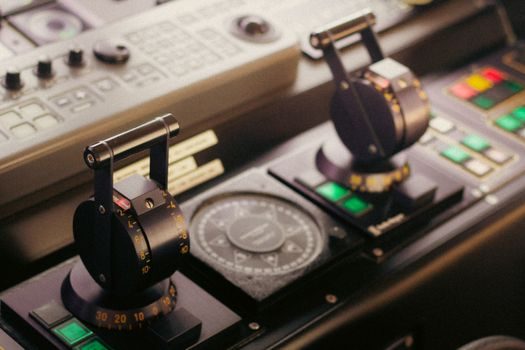
Lining the two against the criteria a controls engineer weights in a 2026 spec review: [S2]
Position hold at standstill: a stepper drive holds rotor position via detent and holding torque without encoder feedback, typically within ±1 full step (or finer under microstepping) as long as the load torque stays below the holding curve; a VFD on an induction motor produces essentially zero holding torque and requires a brake or a PM/servo-style drive for true position lock.
Continuous shaft speed: standard stepper motors are usually limited to roughly 1000–3000 rpm before back-EMF collapses torque, while VFD-driven AC induction motors routinely run at 2-pole 50/60 Hz speeds of 1500/1800 rpm, 4-pole configurations of 750/900 rpm, and with vector control up to several thousand rpm in constant-power regions [S1][S4].
Power range and efficiency: a 0.34 HP (≈0.25 kW) Danfoss VLT Micro Drive VFD such as the 132F0008 lists in the surplus channel at USD 99.95 new-open-box, putting sub-1 HP units in the same cost bracket as a mid-range stepper drive; higher-power VFDs scale into the tens and hundreds of kW for industrial pumps and fans [S5]. Stepper drives are rarely seen above roughly 8–10 A phase current, which bounds their power envelope well below a typical 50 kW industrial VFD.
Closed-loop capability: a stepper drive is open-loop by default and only becomes closed-loop when an encoder is added, whereas a VFD is frequently specified with encoder feedback for tight speed regulation or vector-control torque loops, and sensorless vector control delivers usable low-speed torque without hardware feedback [S1].
Standards, Commissioning, and Cable Discipline
Both drive families share a common set of installation disciplines, and the controls-engineering guidance is explicit that cable routing and motor matching dominate real-world reliability [S1]. For VFDs the three most cited failure accelerators are undersized motor-to-drive cabling, missing or incorrectly sized line reactors, and skipping the auto-tune; cable length, shielding, and grounding must follow the drive maker's EMC installation manual, and the motor insulation must be inverter-rated (NEMA MG1 Part 31 or IEC 60034-25 in the relevant family) when long leads produce high dV/dt at the motor terminals [S1].
For stepper systems the parallel concerns are supply-voltage sizing (higher bus voltage raises high-speed torque but increases heating), logic-ground isolation between the controller and the drive, and EMC on the pulse train when the step/direction lines run next to power conductors. Procurement in 2026 still spans a wide OEM base: DirectIndustry's programmable AC drive category lists 14 manufacturers and 35 products, with three-phase units at 25 of 35 entries, and Asian suppliers including Inovance (9 products), Suzhou VEICHI (7), Jiangsu Gtake (5), and INVT (2) representing a large share of the catalogue [S2]. A useful cross-reference for that supplier mix is the stepper drive buying guide for 2026, which maps bus, current, microstep, and feedback selection onto the same supplier landscape.
Selection Workflow for a 2026 Panel Build
Engineers typically start with three questions: does the axis need to hold a commanded position at standstill; what is the maximum continuous shaft speed; and is the load a positioning task (indexing, pick-and-place) or a process task (flow, pressure, tension)? A "yes" to position-hold at standstill, speeds below roughly 1500 rpm, and a positioning task points to a stepper drive; a "no" to position-hold, speeds at the AC mains synchronous range, and a process task points to a VFD [S1][S4].
For systems that sit on the boundary — high speeds with some position hold, or a process line that also indexes — a servo drive is often the more honest answer, and the servo-drive class delivers closed-loop torque and position control that neither a stepper nor a VFD covers cleanly. A companion soft starter selection criteria reference is also useful where reduced-voltage starting of a large induction motor is the goal, since a soft starter is a different tool from a VFD: it ramps voltage on start and stop but does not vary running speed.
Trackable signals to watch: the 2025–2030 VFD market trajectory toward USD 32.0 billion by 2030 at a multi-year CAGR tied to HVAC and pump retrofit programmes [S4]; continued broadening of the programmable AC drive vendor list on industrial catalogues as Asian OEMs add three-phase entries [S2]; and stepper-drive product launches emphasising higher bus voltages (often 80 VDC or 110–220 VAC) and integrated closed-loop encoder feedback to address the traditional open-loop stall risk.