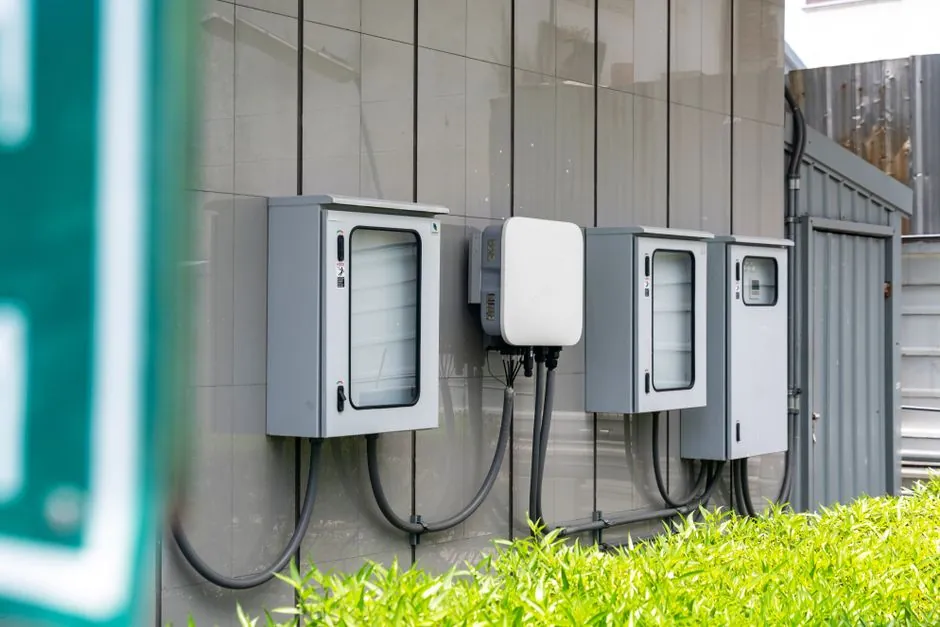
A VFD package inside a motor control cabinet must clear four compliance gates at once, not one: a power-conversion safety mark (UL 508C in North America, EN 61800-5-1 + EN 61800-3 in the EU), a harmonic-control obligation under IEEE 519-2014, an industrial-controls system standard (NEMA ICS 7.0), and a documented quality system at the assembler (ISO 9001) with at least ten years of similar equipment history [S1][S2].
Most rejections at site acceptance are not drive failures, they are missing nameplate marks, a harmonic analysis report that was never run, or an enclosure rating that does not match the room's ambient. The 95% minimum efficiency and 95% minimum power factor at full load, both required by Yale's 26 29 23 design standard, are the quickest first-pass filter when comparing shortlisted drives [S4]. The term variable speed drive covers the same family of AC drive topologies, and the specifier's job is to map the certification list to the right product category before the procurement RFQ goes out.
Safety and agency marks: UL 508C, cUL, EN 61800-5-1
UL 508C is the North American power-conversion equipment standard, and the VFD plus any optional bypass contactors, fuses and control power transformers must ship with the UL mark physically on the inside of the enclosure cabinet, not just on a data sheet [S2]. CSA CAN/CSA-C22.2 No. 14-05 is the Canadian equivalent that a cUL or cCSAus label evidences for cross-border jobs [S1][S2].
For EU-bound cabinets the parallel marks are IEC/EN 61800-5-1 (Low Voltage Directive for power drive systems) and IEC/EN 61800-3 (EMC), with the 1996 +A11 (2000) Category C2 EMC class still being the baseline cited in older guide specifications [S1][S7]. Eaton's North American whitepaper states explicitly that its drives fulfil both 61800-5-1 and 61800-3, and that is the kind of single-line compliance statement to require in submittals rather than relying on a generic CE sticker [S7]. A drive described in plain language as a VFD is one product; the certification list turns it into a cabinet-ready assembly.
IEEE 519-2014 harmonic limits and the analysis report
IEEE 519-2014 is the harmonic-control guide that nearly every North American spec section calls out by name, and the drive supplier is expected to submit a harmonic analysis result alongside the data sheets [S1][S2]. The contract documents at Yale go further and require current-limit set to motor nameplate amps during run, with automatic speed reduction at or below motor FLA so the drive rides through a transient rather than tripping [S4].
For 6-pulse diode-front-end drives, the practical compliance path is either a line reactor, a passive harmonic filter, or an active front-end (AFE) rectifier; the spec section should let the supplier choose the topology but require the resulting THDi to be quoted at the point of common coupling, not at the drive terminals. The Port of Portland guide spec requires a momentary power loss ride-through of more than 17 ms plus under-voltage, over-temperature and phase-to-phase/phase-to-ground short-circuit trips as non-negotiable self-protection features [S6]. When the drive is mounted in a motor control center cubicle, those trip settings are the items the commissioning agent will check first against the motor's nameplate.
Enclosure, ambient and short-circuit withstand

The Johnson Controls VSD FP Series II guide spec, with Eaton HMX, HVX and SVX as approved equals, demands UL 508C, cUL, NEMA ICS 7.0, and a manufacturer operating under an ISO 9001 quality system for at least ten years producing similar equipment [S1]. NEMA 250 governs the enclosure rating itself, and the specifier should write the NEMA type (e.g. Type 1 indoor, Type 12 dust, Type 4X corrosive) into the cabinet section, not leave it to the drive supplier [S2].
Ambient is the second enclosure-side gate. The Port of Portland VFD section caps operation at 0 to 40 degC ambient and requires a factory burn-in where the drive is loaded to 100% on an AC induction motor inside an environmental chamber at 40 degC (104 degF) [S6]. The Johnson Controls VFD68 bulletin quotes a 0.7 to X Hz adjustable output frequency range, and the input voltages of 208/230 VAC at 60 Hz, 230 VAC at 50 Hz, and 400 VAC at 50 Hz, which is a useful cross-reference for global cabinets that ship between 50 Hz and 60 Hz sites [S3]. The short-circuit withstand rating (AIC) must be coordinated with the upstream distribution cabinet breaker, and that coordination study is a separate submittal that frequently gets forgotten.
Self-protection, motor protection and reliability features
Current limit adjustability from 60 to 110% of drive rating, an adjustable instantaneous overcurrent trip, under-voltage trip, over-temperature trip, and phase-rotation insensitivity are the four self-protection items the Port of Portland guide spec calls out as mandatory, and the carrier is a momentary power loss ride-through above 17 ms [S6]. Phase-to-phase and phase-to-ground short-circuit protection is required as well, and motor winding thermistors are required on every motor fed by a VFD, per the Yale standard, so the drive's analog input must be configured to read PTC or Pt1000 sensors [S4][S6].
Reliability also lives in the submittal paperwork: dimensioned outline drawings, control schematic, power and control wiring diagrams, a major components list with contactors, breakers, control power transformers, pilot devices, relays and timers, and the as-built O&M manual with five hard copies on site [S1][S2]. For the variable area flowmeter loop that often sits on the same cabinet, the analog I/O count and isolation barriers must be sized at the same time, otherwise a late addition will force a redesign.
Options that change the certification: bypass, harmonic filter, AFE
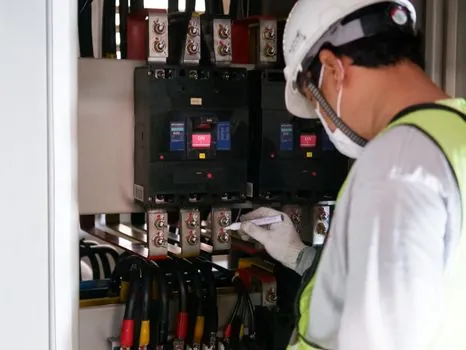
Adding an optional bypass contactor does not relax the safety mark; the bypass path still has to be UL listed, and the supplier of the assembly is required to be the actual manufacturer of the electromechanical power components (bypass contactors, power-distribution circuit breakers) rather than a value-added reseller, so commonality of spares is preserved [S1]. A passive harmonic filter, line reactor, or active front-end should be selected by THDi target at the PCC, not by kVAR rating, and the EMC class C2 evidence from EN 61800-3 should travel with the submittal package [S1][S7].
For hazardous-area cabinets, the certification list expands: ATEX 2014/34/EU or IECEx for the drive itself, plus an enclosure certification (e.g. Ex e, Ex p, or Ex d depending on zone), and the motor nameplate must align to the same zone and gas group. This is also where access control interlocks on the cabinet door have to be coordinated with the safe-torque-off (STO) input on the drive, otherwise the SIL rating of the safety function will not hold up at audit. Two trackable signals for the next procurement cycle: confirm whether the supplier's ISO 9001 certificate is in scope for the actual assembly site (not just a sister plant), and whether the IEEE 519 harmonic analysis is signed by a PE in the project's state or province.
See also our earlier report, Sander selection for demolition work: power, pad, and dust specs.