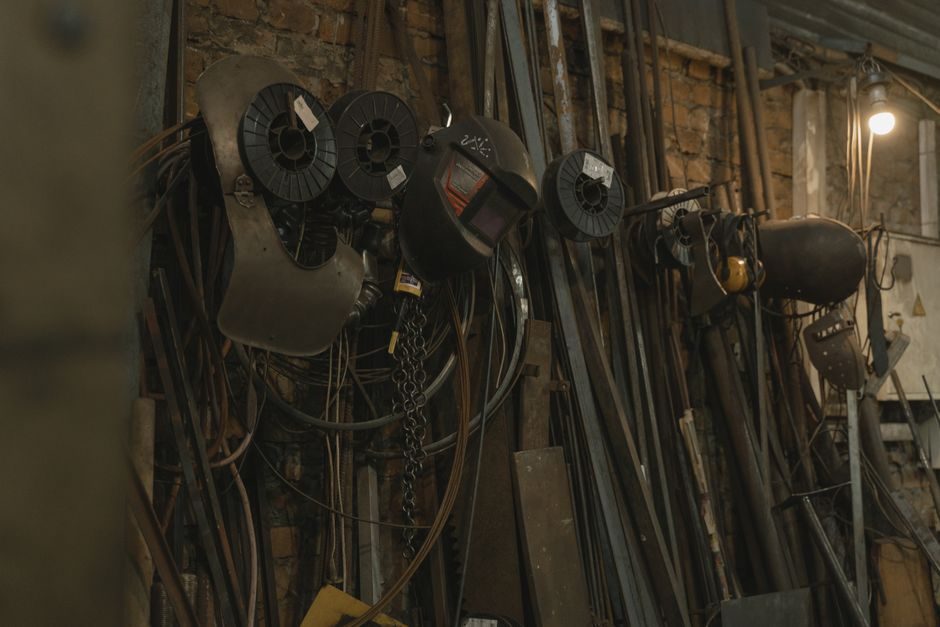
The 2026 welding-robot spot market is structurally tight: FOB pricing on the Kowey industrial-robot line sits at US $38,000-$60,000 per set with continuous-path (CP) electric drive and ISO + CE certification, and minimum order quantity remains 1 set [S1]. Hefei Wanyi's three-model catalog of new electric continuous-path welding/loading/forging robots ships under the same ISO envelope with 1-year after-sales coverage, but no volume discount is published [S2]. With only ~20 active product listings on the Kowey storefront and ~3 on the Wanyi storefront [S1][S2], a single high-volume buyer can absorb visible capacity.
The 2026 demand backdrop explains the squeeze: Allied Market Research values the global robotic welding market at $5,450.5M in 2018 and projects $10,784.4M by 2026, a CAGR of 8.7% from 2019 to 2026 [S6]. That growth runs straight into a physical bottleneck — igm's heavy-engineering floor tracks reach 100 m, and its portal welding units handle components up to 25 m wide by 8 m high for shipbuilding and bridge construction [S3] — so a cell-level shortage at a tier-1 OEM ripples across entire excavator, locomotive, and shipyard bills of material.
Why Lead Time Is the Real 2026 Constraint, Not Sticker Price
CP-controlled 6-axis articulated robots are the dominant welding cell topology because continuous-path interpolation is what lets a single robot lay a multi-pass seam without mid-weld re-teaching; both Kowey and Wanyi list CP as the standard control mode rather than point-to-point [S1][S2]. A buyer who orders 1 set today is queued behind integrators building 25 m × 8 m portal cells, where one heavy-engineering line can consume 4-8 robots in a single shipment [S3]. Lead time on a CP cell typically tracks 30-60 days for the manipulator alone, plus another 30-90 days for the weld package (power source, torch, wire feeder, seam-tracking camera), so realistic 2026 dock-to-dock intervals are 60-150 days for a single-cell delivery and 6-9 months for a multi-cell line.
The 8.7% CAGR projection from 2019 to 2026 [S6] implies installed-base additions that, even on conservative share assumptions, outrun the handful of CP welding-robot brands with global service networks — a classic thin-tail risk where a few integrators carry the load. For sourcing teams, the operational consequence is to place POs on the articulated robot + power-source package 90 days earlier than 2024 norms, not to chase a lower FOB number.
What Actually Drives 2026 Welding-Robot Shortages
Three structural drivers are visible in the spec data, not just in the headlines. First, the heavy-engineering cell footprint: igm floor tracks of up to 100 m and portal units taking 25 m × 8 m components [S3] lock large amounts of CP-robot capacity per project — a single ship-hull or bridge-girder line can absorb what would otherwise be a quarter's worth of small-cell output. Second, the software stack has become a gating item: Panasonic's TAWERS "Weld Navigation" parameter assistant auto-calculates speed, throat depth, and joint-length adjustments from joint type and material thickness, deliberately targeting less-experienced programmers [S5], which is the same labour shortage that is forcing plants to automate in the first place — a self-reinforcing loop. Third, the entry-tier FOB band of $38,000-$60,000/set [S1] is narrow enough that small changes in steel, servo-motor, and reducer input costs swing the whole mid-market band, encouraging vendors to throttle order books rather than discount.
The near-term shock absorbers are limited. Spare-parts inventory, not new-unit output, is what buffers a shortage, and a welding robot cell with no spare torch bodies, wire-feed liners, or seam-tracking sensors is a cell running at 60-70% nominal OEE within weeks of a supply disruption. Procurement teams that have not already dual-sourced the weld-package consumables (contact tips, gas nozzles, dress packs) before the Q4 2026 order window will be the first to feel the squeeze.
Spec Gates: Continuous-Path, Electric Drive, ISO + CE
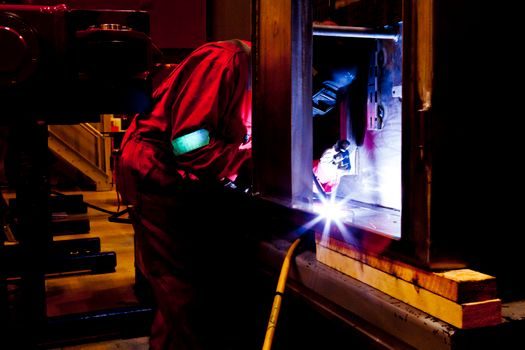
The 2026 spec gate every new welding cell must clear is consistent across the public catalogs: continuous-path control, electric drive, ISO certification, CE marking for European destinations, and a wooden-case transport package sized for ocean freight [S1][S2]. Buyers should treat any quote missing the ISO + CE pair as a hard reject, because a non-ISO manipulator cannot be CE-marked at the cell level without re-testing, which costs more time than the discount is worth. Application coverage on the Wanyi line is explicitly welding + loading + forging [S2] — that "loading + forging" overlap matters: it means the same CP platform is being pulled into forging-cell tenders, which tightens the welding-only allocation. The related coverage of TIG welding machine current modes and industrial applications is worth cross-referencing when the cell is being specified for stainless or thin-gauge work, because a CP robot without a matched AC/DC TIG source cannot hit the parameter envelope the spec calls for.
For heavier fabrications, the cell needs laser-camera seam tracking and adaptive fill — igm's earthmoving cells use laser cameras specifically to absorb position tolerance, seam displacement, and welding distortion on thick-section components [S3]. A quote that omits the laser-camera option for excavator, locomotive, or bridge work should be flagged as under-specified, not under-priced.
Supplier Risk Map: Cluster, Capacity, and the Single-Buyer Trap
The 2026 supplier landscape is a cluster problem. Zhuhai Kowey's Made-in-China storefront lists 20 products with a $38,000-$60,000 FOB band and a 1-set MOQ [S1]; Hefei Wanyi's storefront lists 3 products at the same control-mode and certification envelope [S2]. Those are the visible-tier numbers, but the real capacity sits at integrators like igm whose floor tracks and portal units are engineered to customer drawings [S3], not off a price list. The single-buyer trap is straightforward: a 10-set order placed with one of these vendors consumes 50-100% of a quarter's visible catalog capacity [S1][S2], which is why dual- or triple-sourcing is the only rational 2026 posture.
For comparison, the upstream and downstream exposure of welding robots is detailed in a parallel welding robot upstream and downstream industries 2026 spec map, and a related procurement question — picking between MIG vs arc welding machine specs — is where many spec sheets get quietly diluted, so the upstream signal is worth tracking alongside cell selection. None of the public Made-in-China listings publish installed-base or delivery-backlog numbers, so any market-share figure in this article is omitted on purpose.
Options Comparison: Tier-1 Integrator vs Catalog Cell vs Refurbished

Three options are on the table for a 2026 buyer facing lead-time risk. Tier-1 heavy-engineering integrators (igm-class) deliver floor tracks to 100 m and portals to 25 m × 8 m, with laser-camera seam tracking baked in [S3], but quote lead time is the longest because every cell is engineered to drawing. Catalog cells from Made-in-China vendors (Kowey, Wanyi) ship at $38,000-$60,000/set FOB with CP control, electric drive, and ISO + CE [S1][S2], at 30-60 day manipulator lead time but with a 1-set MOQ that effectively reserves capacity — the trade-off is no custom portal.
The comparison dimensions are: capex per cell ($38,000-$60,000+ for new catalog, lower for refurbished), lead time (catalog shortest, tier-1 longest, refurbished variable), custom envelope (tier-1 only), and service-network reach (tier-1 widest, catalog narrowest outside China). For high-mix small-batch work the catalog cell wins; for shipbuilding, bridge, and large-excavator cells the tier-1 integrator is the only credible option, and a laser welding machine selection map is the right companion document when hybrid laser-arc cells are on the table.
Failure Modes and Limits a 2026 Sourcing Plan Must Cover
The four failure modes to plan around are: (1) manipulator slip — vendors throttle new orders when servo, reducer, or controller allocations get cut, so a "30-day" quote can drift to 90+; (2) weld-package slip — the robot arrives on time but the power source, torch, or seam-tracking camera is back-ordered, leaving a half-commissioned cell; (3) software-stack drift — TAWERS Weld Navigation is published as an in-house parameter assistant that requires the Panasonic controller [S5], so specifying a different power source breaks the auto-parameter pipeline; (4) certification slip — without ISO documentation in the shipment, CE marking at the cell level cannot be closed, which is a hard stop for European end-users [S1][S2]. Buyers who have not contractually pinned a liquidated-damages clause tied to manipulator delivery (not cell delivery) will absorb the slip.
Tracking the next node: the visible signal is the Allied Market Research forecast re-baseline for 2026 [S6] — if the $10,784.4M / 8.7% CAGR [S6] number is revised upward in the next print, the supply squeeze tightens further; if it is revised down, the catalog-tier FOB band on Made-in-China is the leading indicator to watch. Either way, dual-source the manipulator, lock the weld package separately, and pin the seam-tracking option as a priced line item rather than a free inclusion.
The underlying component specifications are covered under dc power supply, and switching power supply.