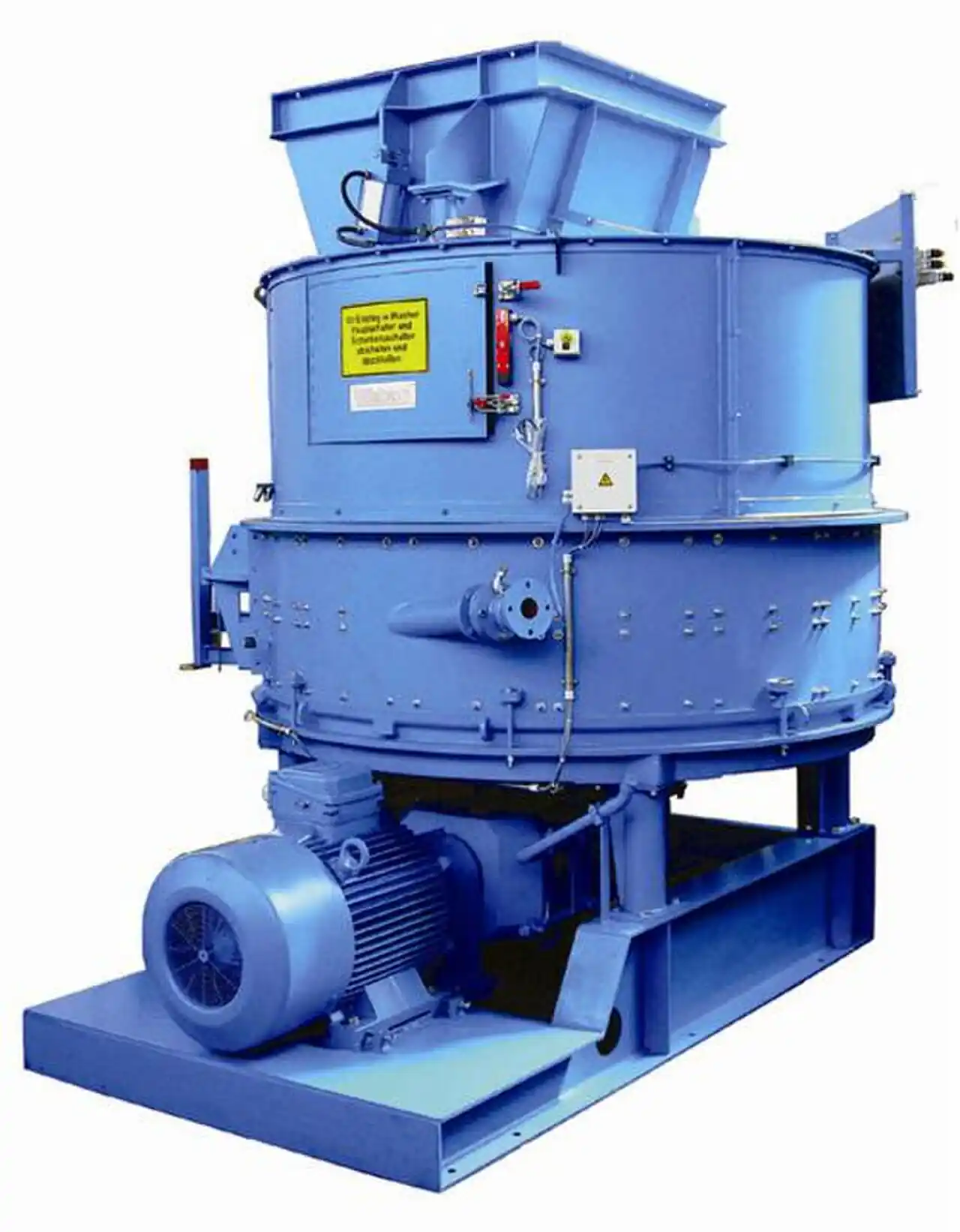
A lime slaker is the unit that turns quicklime into a dosable reagent: pebble or crushed calcium oxide enters an agitated drum or chamber, meets a measured flow of water, and hydrates in a reaction that releases enough heat to bring the mix nearly to a boil, splitting each lump into fine hydroxide particles carried as milk of lime or kneaded into a thick paste. Grit settles out, the product is diluted and held under agitation, and pumps carry it to the injection point. Detention, paste, and ball-mill slakers are its three families, and the slaker is bought together with its grit removal, dilution tank, and vent; Carmeuse's STT literature shows how that equipment fits inside a wider lime storage, feeding, slaking, and pumping train.
It is aimed at the engineer who must specify a lime slaker for a water plant that softens with lime, a wastewater works that neutralizes acidity or precipitates metals, a power or industrial plant that scrubs flue gas, or any process needing a steady supply of fresh calcium hydroxide. Six chapters cover what the slaker does and what is actually being bought, how the hydration reaction and the water ratio set the slurry, which machine type fits which lime and duty, what a supplier data sheet asks for and why, the selection factors and RFQ wording that decide whether the unit delivers its reagent at the promised strength, and the installation, safety, and maintenance a hot alkaline slurry demands.
Five things decide the purchase: the quicklime itself, since grade, reactivity, sizing, and grit set what any slaker can deliver; the water-to-lime ratio and the slaking temperature it produces; the slaker family, detention, paste, or ball mill, that matches the lime and the product the plant wants; grit removal and the slurry storage, dilution, and piping that carry the product without scaling; and the vent and dust control that keep a hot, caustic machine safe to operate. Get those right and the reagent arrives fresh and strong instead of cold, gritty, and crusted.
Chapter 1 / 06
What a Lime Slaker Is and What Is Being Decided
A lime slaker is a continuous chemical reactor packaged as plant equipment. Quicklime, calcium oxide in lumps or granules, is weighed into a slaking drum or chamber at a controlled rate while water is metered alongside it in a fixed weight ratio; each lump absorbs water, swells, and falls apart into fine calcium hydroxide, and the reaction heat raises the charge toward boiling within minutes. The discharge passes a settling zone where coarse grit drops out, spends its detention time in an agitated chamber where the last oxide hydrates, and flows to a slurry tank that keeps the solids in suspension until a pump draws product for dilution and dosing downstream.
Buying a lime slaker means buying a reagent supply statement. The buyer is purchasing a stated mass of available calcium hydroxide per hour, delivered as a slurry or paste of stated concentration and temperature, from a stated quicklime, with a grit removal system that keeps abrasive stone out of the product and a vent that keeps dust and steam out of the room. The strength of that reagent depends on how completely the oxide hydrates before it leaves the slaker, and incomplete hydration shows up later as chemical consumption above theory, as grit and scale in tanks and lines, and as a pH or softening loop that responds slowly to its dose.
Plants slake on site because quicklime is the concentrated form of the chemical. Fifty-six parts of calcium oxide yield seventy-four parts of calcium hydroxide, so a tonne of oxide becomes roughly a third more hydroxide once water is added at the plant, and the buyer pays to ship neither that water nor the drying that bagged hydrated lime has received. Quicklime also keeps well as an oxide when it is dry, while hydrated lime slowly takes carbon dioxide from air and loses strength. The price of the advantage is the slaker itself, with its heat, dust, grit, and scaling, which is why the choice between slaking and buying hydrated lime turns on how much lime a plant uses and how much equipment it is willing to operate.
The duties that pull a slaker into a plant are several. A municipal or industrial water plant practices lime softening, adding calcium hydroxide to precipitate calcium carbonate and magnesium hydroxide and to raise pH, and the precipitate settles in a clarifier, often of the solids contact kind. A wastewater works corrects acidity, precipitates dissolved metals as hydroxides, or adjusts pH before biological treatment or discharge. A power station or incinerator prepares lime slurry for a wet scrubber that absorbs acid gases. Mining, sugar refining, soil stabilization, and construction chemicals take the same reagent. In every case the slaker only makes the chemical; the reaction with the process water happens in equipment downstream.
One machine serves several kinds of buyer. A softening works serving a city runs several slakers, often with a standby, sized on the hardness it removes through the year. A power station slakes for a scrubber and cares most about continuity and grit, because a stalled slaker limits the unit it serves. An industrial plant with an acid effluent buys a package slaker and a single slurry tank to replace hydrated lime that operators lifted by hand. A contractor or a plant with a seasonal duty rents a trailer-mounted slaker and returns it when the job ends. The common thread is a reagent that must be fresh, and the differences are scale and continuity.
Walking the train from tanker to injection point shows what the purchase contains. A tanker blows quicklime into a silo fitted with a bin vent filter, a small pulse-jet bag filter on the silo roof; a bin activator keeps the lime flowing to a rotary airlock and a loss-in-weight screw feeder that delivers weighed lime to the slaker. Water enters through a control valve and a flowmeter in step with the lime. The slaker discharges past its grit separation zone into the detention chamber, the slurry tank below receives the product, and an agitator holds it until a slurry pump or a progressive cavity pump moves it to a ring main or a dilution point nearer the injection point. Every item between silo and injection point belongs to the system, and the RFQ has to say which of them the slaker supplier owns.
Chapter 2 / 06
How a Lime Slaker Does the Work
The chemistry is a single exothermic reaction: calcium oxide plus water gives calcium hydroxide. Each fifty-six parts by weight of oxide combine with eighteen parts of water to give seventy-four parts of hydroxide, so only about a third of a part of water per part of lime is consumed chemically and the rest is carrier. The reaction gives up about 1,140 kJ per kilogram of oxide (490 Btu per pound). It starts at the surface of each lump and works inward through the pore network that calcination left behind, and because the hydroxide occupies more volume than the oxide it came from, the lump crumbles as it hydrates. That crumbling turns hard pebbles into a suspension of fine particles without a separate grinding step.
The heat is the slaker's own furnace. With three and a half to four parts of water per part of lime, the release is enough to raise the charge by roughly sixty to seventy degrees Celsius (about 108 to 126 degrees Fahrenheit) when little heat is lost, so cool well water enters and a slurry well below boiling leaves, commonly in the range of 70 to 85 degrees Celsius (158 to 185 degrees Fahrenheit). With only two to two and a half parts of water the same heat would boil the charge, which is why paste slakers run near 100 degrees Celsius (212 degrees Fahrenheit) and vent steam. The slaking temperature is therefore a direct reading of the water ratio, of the lime's available oxide, and of its reactivity, and operators watch it as the unit's main indicator.
The working parts differ by family but follow the same sequence. A detention slaker feeds lime and water into a slaking drum, a horizontal cylinder turning on rollers, where rotation tumbles the lumps through the water until they break down; the slurry leaves through a screened opening into a separation chamber where the coarsest grit settles, then into an agitated detention chamber for the ten to fifteen minutes that complete hydration. A paste slaker kneads lime and a smaller water flow between two counter-rotating paddle shafts until a stiff, steaming paste forms, and dilutes that paste in a second vessel. A ball-mill slaker replaces the drum with a mill charged with steel balls that crushes the lumps while they hydrate.
Grit is what does not hydrate. It is the core of stone that the kiln never fully calcined, lumps burned so hard that the oxide is dead and slow, and the silica and other minerals that came with the limestone; good pebble lime carries a few percent by weight and poor lime well over ten. Left in the slurry it settles in tanks, wears pumps and valves, and fills dosing lines, so the slaker separates it while the solids are still coarse: the settling zone in the separation chamber catches the largest pieces, and many plants add a cyclone separator, whose underflow drains on an inclined washing screw of the kind a grit classifier uses at a wastewater headworks, lifting the grit into a bin. Grit leaves as a wet sand, not as lime.
Water and lime enter under ratio control because the ratio is the product. The feeder weighs lime, commonly by loss in weight from a small hopper, an electromagnetic flowmeter measures the water, and a control valve trims the flow to hold the set ratio as lime demand changes, with the loop running in the plant PLC. The slaking temperature confirms the result: a fall points to too much water, to cold water in winter, or to lime with less available oxide, and a rise toward boiling points to too little. Feed must also be steady, because a surge of dry lime into a hot drum lumps into balls that hydrate slowly, and a starved drum overheats the small amount of slurry it holds.
Storage and dilution complete the work. Slurry from the detention chamber is thick, roughly 25 to 30 percent solids by weight, too viscous for long lines and for most dosing duties, so water is added at the tank or at the point of use to bring milk of lime to dosing strength. An agitator sized for continuous service keeps the solids suspended, since calcium hydroxide dissolves only to about one and a half grams per liter and everything beyond that settles. The slaker and the tank vent to atmosphere for the steam and water vapor the reaction releases; a centrifugal fan and a dust collector or small wet scrubber catch the lime dust carried with the vapor so that it does not coat the structure around the vent.
Chapter 3 / 06
Lime Slaker Types and Machine Boundaries
Detention slakers are the slurry machines and the most common choice for water plants and scrubber feed. They take pebble lime of fairly uniform size, use roughly three to four parts water per part lime by weight, and slake below the boiling point, so the drum and detention chamber work at atmospheric pressure with a simple vent. Their product is a fluid slurry that grit removal, a slurry tank, and dilution turn into milk of lime. They suit continuous duty with lime of dependable reactivity, they need little power beyond the drum and agitator drives, and they give the operator a slaking temperature that responds quickly to any error in the water ratio.
Paste slakers withhold water. Two to two and a half parts water per part lime is barely enough to wet the hydroxide that forms, so the pug mill produces a stiff paste of about 40 percent solids rather than a slurry, and the reaction heat, concentrated in so little water, holds the charge at boiling and drives off steam through the vent. The paste is diluted in a separate tank to a pumpable concentration. Running hot speeds the hydration of slower lime and yields a thick product that keeps tank and line sizes small, at the cost of a machine built for boiling alkaline paste, a vent that must carry steam, and close control of a charge with little water to spare.
Ball-mill slakers grind and slake in one step. Steel balls in a rotating mill crush the lumps while water hydrates the freshly broken surfaces, so the unit accepts finer and less uniform quicklime, including crushed and pulverized grades that a detention drum handles poorly, and it typically delivers a slurry of finer particles than drum slaking gives. The drive is larger, and the wear parts include the balls and liners. Beside the three continuous families stand batch slakers and mix tanks, the older arrangement in which a weighed charge of lime was slaked in a tank for a longer period and then dumped to a holding tank; they survive at small plants, and packaged units on a trailer bring detention slaking to temporary and seasonal duties.
The boundary with neighboring equipment is worth stating plainly. The lime slaker is not a water softener: that machine removes hardness on ion exchange resin and regenerates with brine, while lime softening is a precipitation reaction that happens in the process water, usually in a solids contact clarifier, and the slaker only prepares the reagent. It is not that clarifier, which this encyclopedia treats as its own purchase. It is not the metering pump or progressive cavity pump that doses the product, although slaker suppliers often package them. And it is not a hydrated lime slurry tank, which stirs pre-hydrated powder into water without reaction heat, grit separation, or a drum; a plant buying hydrated lime has no slaker at all.
Upstream and downstream the slaker sits between two trains of equipment that are each their own purchase. Upstream are the storage silo with its bin vent filter and bin activator, the screw conveyors, a belt feeder at high feed rates, the rotary airlock that keeps moist air out of the silo, and the weigh feeder or loss-in-weight unit that sets the lime rate. Downstream are the slurry tank and its agitator, slurry pumps, dilution water controls, and the injection point, followed by the process the lime serves: the clarifier or gravity thickener that settles lime sludge, a dissolved air flotation unit where light metal hydroxide flocs are floated rather than settled, and a multimedia filter polishing water after softening. Where lime scrubs flue gas, a wet scrubber takes the slurry and produces a calcium sulfite or gypsum sludge.
Water, power, venting, and a few instruments turn the drum into a working unit. The slaker needs a steady supply of relatively clean plant water, power for the drum or mill, agitator, and pumps, a vent stack with its fan, and a drain for washdown inside a containment curb. Instruments are few but each carries a duty: a temperature transmitter in the slaking chamber is the ratio control's feedback, a level transmitter protects the slurry tank, a pH meter at the injection point closes the dosing loop, and a VFD lets the agitator and slurry pump run at the speed the solids need. Wetted parts are stainless steel or coated carbon steel; aluminum, galvanized steel, and brass are excluded because alkaline slurry attacks them. An eye wash station and safety shower within seconds of the drum belong to the same purchase.
Chapter 4 / 06
Key Specification Parameters
A supplier's data sheet for a lime slaker asks about four things, the lime, the water ratio, the temperature, and the product, and every line on it changes something downstream. What follows gives the parameters that appear on detention and paste sheets, as typical ranges drawn from established practice; no supplier's figures are quoted, and the Carmeuse STT literature describes equipment families and the train around them without publishing values of this kind. For a real project the numbers follow from the quicklime the plant has contracted and from the duty the product serves, so read them as the starting point for the supplier's engineering, not as its result. Where a row names two families, the two values belong to detention and paste slakers in that order.
Parameter
Typical range from practice
What it decides
Quicklime grade
high calcium, 90 percent CaO and above
Reactivity; slaker family; hydroxide yield
Lime sizing
pebble for drum types; finer grades to a mill
Feed device; completeness of hydration
Water to lime ratio, detention
3 to 4 : 1 by weight
Slurry concentration; slaking temperature
Water to lime ratio, paste
2 to 2.5 : 1 by weight
Paste consistency; steam venting
Slaking temperature
70 to 85 C (158 to 185 F); near 100 C (212 F) for paste
Speed and completeness of hydration
Detention time
roughly 10 to 15 min
Completion of hydration; chamber size
Slaker discharge solids
roughly 25 to 30 percent; about 40 percent as paste
Tank, pipe, and pump sizes
Dosing concentration after dilution
commonly 5 to 10 percent
Line size; scaling; dosing pump wear
Heat release
about 1,140 kJ per kg CaO (490 Btu per lb)
Temperature rise; vent duty; insulation
Grit in pebble lime
a few percent; over 10 percent for poor lime
Grit bin and washer size; wear
Slurry line velocity
about 1 m/s (3.3 ft/s) or more
Settling in pipes; scale; flushing
Vent and dust control
fan with a dust collector or a wet scrubber
Room cleanliness; dust exposure
Wetted materials
steel, 304 or 316 stainless; no aluminum, zinc, brass
Service life; corrosion
Three lines on such a sheet are worthless without their basis. Capacity quoted in tonnes of lime per day without the lime's available oxide and reactivity is a number for someone else's stone, because a slaker that completes reactive pebble lime may fail to finish slow lime in the same detention time. Product concentration quoted without the water ratio and the slaking temperature says nothing about how much oxide actually hydrated. Grit handling capacity quoted without a grit allowance leaves the plant to discover that poor lime fills the grit bin in hours. An RFQ that demands a slaking test on the actual lime, and a guaranteed temperature curve at the stated ratio, separates engineered offers from assembled ones.
A hot, alkaline, abrasive service dictates the materials. Drums and mill shells are carbon steel with wear liners at the inlet and discharge; detention chambers and slurry tanks are carbon steel with an epoxy coating or stainless steel of the 304 or 316 class, sometimes lined with rubber or plastic; agitator shafts and paddles are stainless; and piping is stainless, carbon steel at generous velocity, or plastics such as polypropylene and high density polyethylene. Lime slurry attacks aluminum, zinc, and copper alloys, so galvanized steel, aluminum castings, and brass fittings stay out of slurry contact. Seals on slurry pumps face grit from any lime, and every wetted surface is assumed to scale eventually.
Chapter 5 / 06
Selection Decision Factors and RFQ Language
Begin with the lime, because a slaker can only finish what the kiln began: grade comes first, and high calcium quicklime, typically ninety percent oxide and above, hydrates fast and completely, while dolomitic lime carries magnesia that hydrates slowly at slaking temperature and suits few slakers. Reactivity comes next, and suppliers state it through a wet slaking test that times the temperature rise of a standard mixture. Sizing decides the machine as much as chemistry, because drum slakers want uniform pebble, a load of fines and dust hydrates prematurely and lumps in the feeder, and only a mill type takes pulverized lime in stride. The lime supply agreement and the slaker purchase belong in the same file.
Duty decides the family and the count. Continuous water or scrubber duty with dependable pebble lime points to detention slakers, with a standby unit or a generous slurry tank so that one machine's maintenance does not stop the plant. A plant that wants a thick product in small tanks, or that receives lime of varying reactivity, looks at paste slakers and accepts the steam and the boiling paste. A plant limited to finer or less uniform lime looks at a ball-mill slaker and pays for its power and wear. Consumption sets the larger question: a small plant may find that a tank for mixing hydrated lime, with no drum, grit, or vent steam, serves its modest daily rate more cheaply than any slaker.
The product the plant needs decides the train behind the slaker. Milk of lime for pH control can be dilute and simple; lime for softening is consumed in proportion to the hardness removed, so the slaker, slurry tank, and dosing pumps follow the softening duty and its range through the year. The distance from slaker to injection point decides how the slurry travels: carried thick and diluted at the point of use, or circulated in a ring main so that it never stands in pipe. Where the lime feeds a scrubber, continuity and grit dominate; where it treats drinking water, the chemical must meet the drinking water additive standard and the dust and vent must stay inside the plant.
Nine questions run through most lime slaker projects. For each, the middle column gives what the buyer should write into the RFQ and the last column shows what goes wrong when it is left blank: a slaker built for another lime, a line that scales, or a guarantee nobody can test.
Decision factor
What the buyer must state
Consequence if left open
Quicklime grade
High calcium or dolomitic; available oxide; reactivity; sizing; grit
Slaker family chosen for the wrong lime
Feed rate
Average and peak lime rate; continuous or batch; standby
Undersized unit; tank drained at peaks
Slaking water
Source; winter and summer temperature; available flow
Ratio control drifts; slaking temperature falls
Product target
Slurry or paste; concentration at slaker and at injection
Scaling lines; worn dosing pumps
Slaker family
Detention, paste, or ball mill preference; alternates allowed
A vendor default that ignores the lime
Downstream duty
pH control, lime softening, metal precipitation, or scrubbing
A guarantee without a boundary
Grit handling
Grit allowance; washing; discharge route and bin
Grit in tanks, pumps, and lines
Vent and dust
Dust control on silo and slaker; steam handling; fan
Coated structure; operator exposure
Materials and safety
Wetted materials; eyewash and shower; containment
Corrosion; burns; spills to drains
An RFQ for a lime slaker has to pin down the lime, the water, and the product. Wording that holds up reads: quicklime grade, high calcium or dolomitic, with available oxide, reactivity, sizing, and grit allowance, at average and peak feed rate; the source and the winter and summer temperature of slaking water; the slurry or paste target, with concentration and temperature at slaker discharge and at the injection point, and the dilution step; the family preferred, detention, paste, or ball-mill slaker, with vendors free to propose an alternative and state its power and water demand; grit removal, washing, and discharge scope; vent, fan, and dust control for slaker and slurry tank; the downstream pH or softening duty the lime serves and the control range it must hold; wetted materials, with aluminum, zinc, and copper alloys excluded; instruments and control interface; and the acceptance basis, a witnessed slaking run on the plant's lime showing the temperature curve and discharge concentration. Naming the equipment on either side, silo and feeder upstream, slurry tank and pumps downstream, lets bidders price the connections correctly.
Offers are read against the lime and the guarantee. A credible proposal states the detention time and slaking temperature it expects at the stated ratio, the drive power, the grit handling capacity, and the water and power consumed per tonne of lime, and it commits to a temperature curve rather than a single number. Where several lime sources are possible, the buyer should have each candidate lime slaked in a test flask or a pilot drum and compare the curves, because the same slaker runs hot on reactive stone and cool on stone from a different kiln. The lowest bid that assumes ideal lime is not the lowest cost of operation, and a slaker bought without a lime guarantee leaves the plant to prove which of the two is at fault.
Cost and lead time follow size, materials, and scope more than slaker family. A drum with a carbon steel shell, a single slurry tank, and standard instruments is the short end; stainless steel wetted parts, a mill with its liners and balls, multiple units with standby, a packaged vent scrubber, and a silo and feeder train in the same order extend both. The long-lead items are the drum or mill shell, the slurry tank, and the gear drives, and a trailer-mounted package shortens delivery for temporary duty. The budget should also carry the plant's share: foundations, containment, water supply, vent stack, eyewash, and the piping to the injection point, which are rarely in the slaker supplier's scope.
Chapter 6 / 06
Installation, Standards, Failure Modes, and Maintenance
Erecting a slaker is wet, hot, dusty work, and layout decides how much of it lands on the operators. The silo stands over the slaker so that lime falls by gravity through the feeder, the slurry tank sits below the slaker's discharge, and both stand inside a curb that holds a spill of milk of lime, which dries to a hard white crust on any floor it reaches. The vent stack rises above the roof line, clear of air intakes and of walkways where drifting dust and steam would fall on people. Water supply, drain, eye wash and safety shower, and hose points for washdown are placed before startup rather than after the first boil-over. In cold climates the slaker room is heated, because a frozen slurry line is a scaled line.
No standard covers a lime slaker end to end; product, chemical, and safety practice govern it instead. The quicklime is bought to AWWA B202, which defines quicklime for water supply service, and its physical properties, slaking behavior among them, are measured by the test methods of ASTM C110. Lime used in drinking water treatment must meet the drinking water treatment chemicals standard, NSF 60, and carry the certification that goes with it. The slaker itself is an atmospheric vessel with no pressure code to meet; its drives, guards, electrical installation, and confined space entry follow the jurisdiction's general machinery, electrical, and occupational safety rules, and the RFQ should name the codes of the jurisdiction rather than inherit them from an old specification.
Most breakdowns trace back to the lime or to the water. Lime that is underburned carries carbonate cores that leave as grit and cut the yield of hydroxide; lime that is overburned hydrates slowly, so particles leave the slaker still oxidic and keep hydrating in tanks and lines, where they grow hard nodules. Too little water, or a surge of very reactive lime, brings the charge to a boil-over that floods the vent with slurry; too much, or cold winter water, leaves the charge cool and the hydration incomplete. Grit fills the bin and backs up into the chamber when it is not removed, and a feeder that loses calibration drifts the ratio while the temperature instrument, crusted with scale, reports it late.
Scale, dust, and standing slurry cause the rest. Lime dust blinds the bin vent filter and the slaker vent, steam condenses in a cold stack and drips back as carbonate scale, and a line left standing after shutdown sets solid. The practice that prevents most of it is simple: keep slurry moving at carrying velocity, flush with water on every stop, keep air out of the slurry tank so that dissolved hydroxide has no carbon dioxide to react with, and keep dust extraction working on the silo and the vent. A slaker that is started, run, and stopped by the same sequence every shift gives few surprises, and the sequence below is the usual one.
Confirm water flow at the set ratio, and confirm that the vent and its dust collector are clear.
Start the drum or mill and the detention chamber agitator, then admit water to the slaker.
Feed lime at a low rate and watch the slaking temperature climb before raising the feed to the design rate.
Check grit discharge and slurry tank level, then start the slurry pump or the ring main.
On shutdown, stop lime first, run water until the discharge runs clear, and flush the slurry lines.
Looking after a slaker means staying ahead of three things: grit, scale, and dust. The cadences below are drawn from common practice and are stated as ranges on purpose, because a plant running poor lime cleans grit far more often than one running good stone; the supplier's manual sets the intervals for a given machine.
Item
Typical action
Typical cadence
Ratio and temperature
Log slaking temperature against lime and water rate
Each shift
Grit bin and washer
Empty the bin; wash the cyclone or washing screw; inspect the discharge screw
Daily to weekly
Slurry lines
Flush after each stop; check pressure drop; descale or replace spools
Each stop; monthly check
Vent and dust control
Clear the stack; clean or renew the dust collector and bin vent filter
Weekly to monthly
Drum or mill
Inspect liners, balls, rollers, and drive oil
Monthly to quarterly
Agitators
Grease; check vibration, shaft, and blade wear
Monthly to quarterly
Feeder and weigh system
Check screw wear; calibrate the loss-in-weight feeder
Quarterly
Instruments
Calibrate flowmeter, temperature, level, and pH instruments
Quarterly to semiannual
Slurry tank
Drain, descale, and inspect the coating under a confined space permit
Annual
Care over the years is mostly record keeping. A plant that logs slaking temperature, water ratio, lime lot, and grit quantity each day sees a change in lime quality before it becomes a plugged line, and a plant that flushes on every stop rarely descales. Lime consumed per unit of hardness removed, or per volume of water treated, is the number that shows whether the slaker is still doing its job; a rising figure on unchanged lime points to scaling, to a softening clarifier running poorly, or to a feeder out of calibration. Retrofitting an older slaker with automatic ratio control, a scrubber on the vent, and a grit washing screw is usually cheaper than replacing the machine.
FAQ
How does a lime slaker work?
A lime slaker feeds weighed quicklime and a metered flow of water into a slaking drum or chamber at a fixed weight ratio, commonly three to four parts water per part lime for a detention slaker. The calcium oxide hydrates to calcium hydroxide in a reaction that gives up about 1,140 kJ per kilogram (490 Btu per pound), heating the charge to roughly 70 to 85 degrees Celsius (158 to 185 degrees Fahrenheit) and breaking the lumps into fine particles. The discharge passes a zone where grit settles, completes its hydration in an agitated detention chamber, and flows to a slurry tank, where it is diluted to dosing strength and pumped to the injection point.
What are the types of lime slakers?
Three continuous families and one older batch form. A detention slaker slakes pebble lime in a rotating drum below the boiling point and produces a fluid slurry, the common choice for water plants and scrubber feed. A paste slaker kneads lime with less water, two to two and a half parts per part, between counter-rotating paddle shafts; the charge stays near boiling, gives off steam, and leaves as a thick paste that a second tank dilutes. A ball-mill slaker crushes the lumps with steel balls while they hydrate, which lets it take finer and less uniform lime. Batch slakers and mix tanks slake a weighed charge in a tank, mostly at small plants.
What specifications matter most on a lime slaker?
Water-to-lime ratio, slaking temperature, detention time, and grit removal. The ratio sets the slurry concentration and, through the reaction heat, the temperature: detention slakers run at roughly 70 to 85 degrees Celsius (158 to 185 degrees Fahrenheit) and paste slakers near 100 degrees Celsius (212 degrees Fahrenheit). The temperature is the operator's direct reading of whether the ratio and the lime are right. Detention time, commonly ten to fifteen minutes in a detention slaker, gives slow particles time to finish hydrating before they reach tanks and lines. Grit removal keeps abrasive stone out of the product, and the vent and dust collector keep lime dust and steam out of the room.
Should a plant choose a detention, paste, or ball-mill slaker?
Start from the lime and the product. Continuous duty with reliable, uniform pebble lime points to a detention slaker, which slakes below boiling, needs modest power, and gives a fluid slurry that is easy to dilute and dose. A plant that wants a thicker product in smaller tanks, or that must work lime of varying reactivity, considers a paste slaker and accepts a boiling paste and a steam vent. A plant limited to finer, crushed, or pulverized lime, or one that wants the finest slurry particles, chooses a ball-mill slaker and budgets for its drive power, balls, and liners. Where consumption is small, a tank for mixing hydrated lime may serve better than any slaker.
Why do lime slurry lines scale, and how is scaling limited?
Calcium hydroxide dissolves only slightly, and the dissolved portion reacts with carbon dioxide from air to precipitate calcium carbonate, a hard scale that water will not dissolve. Lime also settles out of slurry that stands still or moves too slowly, leaving a soft deposit that hardens. Plants limit both by keeping slurry out of contact with air in closed, vented tanks; by carrying the slurry thick and diluting it at the point of use; by holding line velocity at about one meter per second (3.3 feet per second) or more, or by circulating it in a ring main; and by flushing lines with water after every stop. Existing scale is removed mechanically, by rodding or by replacing short spools.
What drives the cost and lead time of a lime slaker?
Capacity, materials, and scope. A single carbon steel detention slaker with one coated slurry tank and standard instruments is the short end; stainless steel wetted parts, a ball-mill slaker with its liners and balls, standby units, a packaged vent scrubber, and a silo, feeder, and pumping train ordered together raise both price and delivery. Long-lead items are the drum or mill shell, the slurry tank, and the gear drives; a trailer-mounted package is the quickest route for temporary duty. The buyer's own costs, foundations, containment, water supply, vent stack, eyewash, and piping to the injection point, sit outside the supplier's price and belong in the same budget.
What safety hazards does a lime slaker present, and which standards apply?
Quicklime and calcium hydroxide are strongly alkaline: dust, splashes, and hot slurry cause chemical burns to skin and eyes, worst where powder meets damp skin or clothing. The slurry leaves a detention slaker at roughly 70 to 85 degrees Celsius (158 to 185 degrees Fahrenheit) and a paste slaker at boiling, and a boil-over can flood the surrounding floor. Lime dust is not combustible, but it irritates the airway. Controls are dust collection on the silo and slaker vents, an eye wash station and safety shower within seconds of the drum, gloves, goggles, and coveralls for anyone opening the chamber, and a confined space permit before tank entry. AWWA B202 and NSF 60 govern the lime itself.