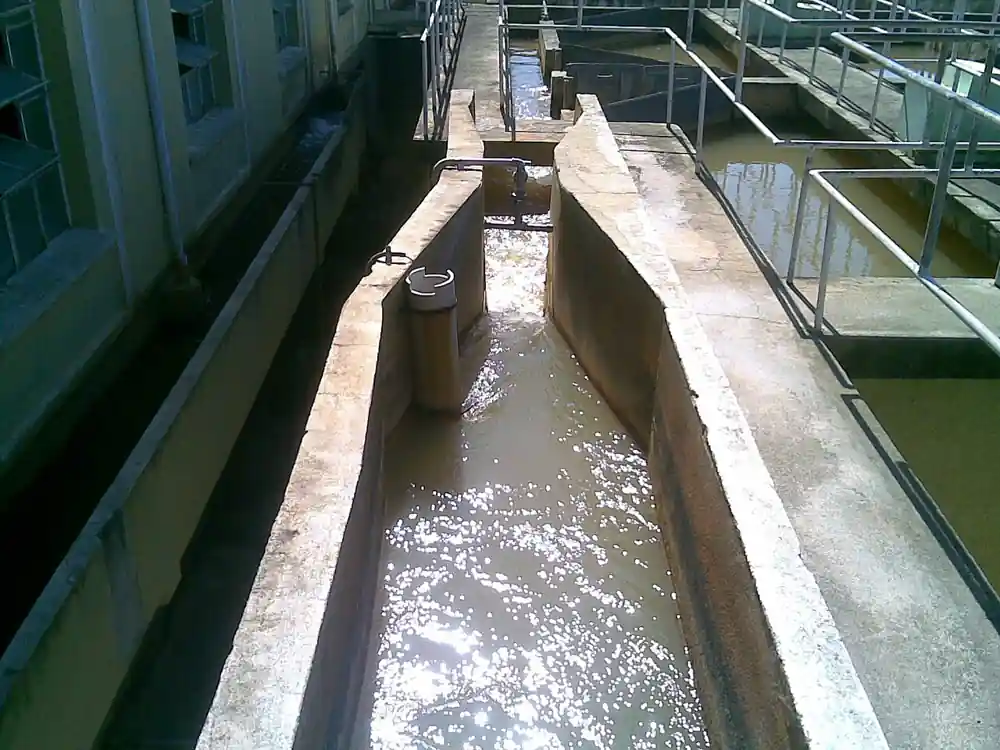
A channel grinder is the machine a wastewater works sets in an open channel or inside a pipe to cut up the solids the flow carries: rags, wipes, plastics, wood, and trash pass between rotating cutters and stationary cutting edges and leave as small pieces that stay in the water. Nothing is lifted out, no screenings bin fills, and the flow carries the cut solids onward to the pumps and processes the unit is there to protect. In-channel grinders, also called comminutors, and in-line grinders in a pipe are its two forms, with dry, submersible, and hydraulic drives; Franklin Miller's grinder selection guide makes the point that a grinder reduces solids and leaves them in the flow, and this page treats the machine, its frame or housing, drive, seals, and reversing control, as one purchase.
The page is for the engineer specifying a grinder for a pumping station wet well, a headworks channel, a force main or sludge line, or a septage receiving station. It covers what the machine does and what a buyer is really paying for, how cutters and clearance shear a rag and what happens hydraulically when they do, which arrangements fit which channel or pipe, what a supplier data sheet asks for and what each figure changes, the selection factors and RFQ wording that decide whether pumps downstream stay free of ragging, and the installation, safety, and maintenance that a machine full of cutting edges in sewage requires.
Four things settle the choice. First the decision before the machine: whether solids should leave the plant as screenings, which is a bar screen's work, or be cut and left in the flow. Then the hydraulics, peak flow against channel or pipe size and the headloss available. Then the cutters, their geometry, clearance, and metallurgy, which decide what size of piece leaves the unit and for how many years. Last the arrangement around the machine: drive type, bypass, isolation, and lifting, which decide how often a jam becomes an overflow and how safely a crew can reach the cutters.
Chapter 1 / 06
What a Channel Grinder Is and What Is Being Decided
The machine is a set of steel edges standing in the path of raw wastewater. Its working part is a stack of rotating cutters alternating with spacer rings on a shaft, or two such stacks side by side turning toward each other, worked against stationary cutters bolted into a frame. A rag, a wipe, or a stick that reaches the stack is caught, pulled between the edges, and sheared into strips small enough to pass the gaps; water and cut solids flow on together. In an open channel the frame sets across the flow between the channel walls. In a pipe the stacks sit inside a flanged housing that replaces a spool of pipe. Either way the product is the same flow with its solids made smaller.
What is bought with a channel grinder is a limit on the size of solids downstream, stated at a peak flow and a headloss, with a jam record the plant can live with. The data sheet promises that no piece larger than some dimension leaves the unit while it is running, and the control system promises to clear most jams by itself; together they let a pumping station use smaller pumps, or a sludge line use narrower equipment, than raw ragging would allow. The guarantee has a sharp edge: the unit removes nothing. Every fiber it cuts stays in the water, so the plant downstream inherits a load of small pieces instead of a bin of whole rags, and that load does not disappear.
Comminution was adopted to avoid handling screenings. A works that cuts its rags has no raked screenings to wash, press, truck, and smell, and for decades small and medium plants ran a single comminutor in the inlet channel in place of a mechanically raked screen. Two things changed that arithmetic. Flushable wipes and other nonwoven products rope together and wind onto pump impellers far more than paper did, which moved grinders into pumping stations as pump protection rather than as a substitute for screening. And processes that recycle solids, digestion with biogas reuse and membrane treatment, punish a plant that shreds its trash and sends it to the digesters, so large new works remove screenings and use grinders in narrower roles.
The duties follow from that history. A pumping station places an in-channel unit at the wet well inlet, or an in-line unit on the force main, so that a sewage pump with a vortex or single-channel impeller runs for months without a ragging outage. A small works fits a comminutor into its existing headworks channel where a screening machine and its handling train would not fit the budget or the room. Sludge lines put an in-line grinder ahead of heat exchangers, presses, and centrifuges, where one rag can stop a machine that costs a day to clean. Septage and grease receiving stations grind hauled waste before storage, and a bar screen is often retained upstream or in the bypass channel.
One machine, several buyers. A municipality replacing two failed comminutors in a forty-year-old channel buys units that fit the old recess without new concrete. A utility fighting wipes across a district of small lift stations buys submersible grinders with automatic reversal and remote alarm. A food processor grinds its effluent ahead of the pumps that feed its dissolved air flotation unit. A works with a sludge train buys in-line grinders for digester heating loops, where a re-formed rag can plug a heat exchanger within days. A contractor building a packaged pump station buys the grinder with the station, from the same supplier, and first sees it work at commissioning.
Following a flow through a pumping station shows what the purchase includes. Sewage enters a channel that an open channel flowmeter may measure on a flume upstream; stop logs or sluice gates close off the grinder channel, and a bypass weir or parallel channel takes the flow when the unit is out. The grinder stands in the channel with its cutters always below water, a small weir downstream holding the level. The wet well follows, an ultrasonic level meter watching its depth, and a submersible pump or a dry-installed sewage pump lifts the flow into the force main. A grinder set in that main has a knife gate valve on each side for isolation.
Chapter 2 / 06
How a Channel Grinder Does the Work
The cut is a shear between two edges with a narrow gap. A fiber that spans the gap is trapped when a rotating cutter passes a stationary one, and it is sliced along the line where the two meet; a piece thinner than the gap slides through untouched. The cut therefore depends on clearance more than on sharpness, which is why the machine keeps cutting after its edges have dulled and stops cutting properly only when wear has opened the gap. The distance between adjacent cutters, set by the spacer rings on the shaft, and the openings of a sizing screen around the stack together fix the largest piece that can leave the unit while it is running.
Geometry does the sizing. On a single-shaft comminutor the shaft carries a column of cutter discs with spacer rings between them, and stationary cutter bars stand in the frame so that each disc turns through a slot between two bars; no straight gap runs through the stack, and a stationary screen surrounds it to hold any oversized object until the cutters have reduced it. Twin-shaft machines stack discs and spacers on two shafts that counter-rotate, the discs of one shaft passing through the spaces between the discs of the other, so each stack cuts against the other. Where flow is large, one stack can be built with a much larger diameter than its mate, which opens the throat and lets bulky objects feed in rather than ride over the top.
Cutter metallurgy decides how long the gap stays narrow. The common material is a precipitation hardening stainless steel of the 17-4 class, commonly heat treated to a Rockwell C hardness in the forties, which holds an edge against cloth and paper while resisting the corrosion of a sulfide-laden wet well; suppliers offer harder or more wear-resistant cutter alloys and carbide-tipped cutters for sewage that carries grit and sand. Frames, screens, and shafts are stainless steel, with more highly alloyed grades optional where chloride or industrial effluent attacks the standard grades. Hardness is not toughness: a cutter that shatters on a bolt does more damage than one that wears, and the choice of cutter material is a trade between the two.
Drives come in three arrangements, and each carries its own seal problem. A dry drive puts the motor and gear unit above the water on the channel wall or deck and reaches the cutters through an extended shaft, with a gland or mechanical seal where the shaft passes into the housing. A submersible drive sits in the wet well as a sealed motor; Franklin Miller lists dry-running and submersible explosion-proof motors of ingress rating IP68 among the drives for its open-channel unit. A hydraulic drive turns the shaft from a hydraulic power unit on the deck. The comminutor answer to sealing is to cantilever the shaft so that no bearing or seal sits in the flow, the seals running instead in an oil bath above the grit.
Hydraulically the grinder is an obstruction with a limited open area. Water must pass through the gaps between cutters and around the stack, so the upstream level stands slightly above the downstream level; the difference is the headloss, small on a clean unit and larger as rags mat across the openings. The unit needs the cutters submerged at every flow, which a small weir or the wet well level downstream usually provides, and it needs an approach velocity that neither drops grit on the upstream invert nor sweeps debris past the frame faster than the cutters can take it. An in-line housing is commonly made larger than the pipe so that its open area is at least that of the pipe bore.
Jams are normal and the control is built around them. A piece of wood, a bundle of wipes, or a lost tool can stall the shaft; the motor current climbs, and the controller, reading that rise, reverses the drive so that the object backs out, then runs forward again. Franklin Miller's open-channel unit is described with jam-sensing control that reverses automatically, and twin-shaft machines work the same way, the stacks backing away from what they were chewing. After a set number of reversals without success the control trips and alarms, and the upstream level rises toward the bypass or overflow. The drive may reverse through its starter or through a VFD, and a motor protection relay stands behind both against a sustained stall.
Chapter 3 / 06
Channel Grinder Types and Machine Boundaries
In-channel grinders, the older name for which is comminutors, are the channel machines. A frame drops into a rectangular channel or mounts on a sole plate between its walls, and the single cutter stack with its stationary cutters sits in the frame so that flow passes horizontally through it; the assembly lifts out whole for service. Units are sized to the channel they serve, and a wide channel takes a larger model, two or more units side by side, or a unit with unequal stacks. Earlier comminutors used a rotating slotted drum standing in the channel and earned a reputation for passing rags and blocking flows; the cutter stack replaced the drum in most makes. Where no channel exists, a packaged manhole with its own molded channel and a submersible drive is lowered into the ground.
In-line grinders are the pipe machines. A flanged housing replaces a length of pipe on a force main, a sludge line, or a hauled-waste line, and the cutter stacks sit inside it across the bore; most are twin-shaft, with the two stacks counter-rotating in a hopper-shaped throat that pulls solids in, though single-shaft in-line units exist for small lines. They serve where there is no open channel, where the line runs under pressure, or where the object to protect sits downstream in a pipe rather than in a wet well. Housings that drop into a mating base let the cutter assembly be lifted out without disturbing the pipe flanges, and versions with a settling pocket trap rocks and metal before they reach the cutters at septage stations.
Drive arrangement divides the machines a second way. A dry-well drive keeps the motor, gear unit, and seals in a ventilated room or on a deck where a technician can reach them, at the cost of a shaft that must pass through the channel wall, or an extended drive shaft, to reach the cutters below. A submersible drive does away with that shaft by placing a sealed motor in the sewage itself; it is compact and safe from flooding, and it must be lifted for any seal or bearing work, which is why submersible units come with guide rails that guide them back onto their seat. Hydraulic drives give the same submerged simplicity where the wet well is classed as hazardous and electric cables in the well are unwelcome.
Boundaries with neighbors should be stated exactly. A channel grinder is not a bar screen: the bar screen intercepts solids on bars and rakes them out of the flow to a wash press or container, while the grinder cuts them and leaves them in, so the screen changes the solids load of the plant and the grinder does not. The two often work in series, a coarse screen taking the large trash and a grinder behind it protecting the pumps, and Franklin Miller's guide is explicit that a grinder does not replace a screen. Nor is it a rotary drum screen, which captures fine solids on a rotating cylinder and removes them, or a grit classifier, which washes and dewaters grit that a grit chamber has already settled. And it is not a grinder pump, the small submersible pump that macerates at its own suction for a low-pressure sewer.
The machine sits in a chain of equipment. Upstream are the sewer or plant inlet, sometimes a bar screen, and the grit channel; downstream are the wet well and its sewage pump, the force main, the clarifier, and the biological stage. The biological stage matters: a sequencing batch reactor and a trickling filter both need rags kept from their diffusers, distributors, and underdrains, and a membrane bioreactor depends on fine screening at 2 to 3 millimeters to keep hair and fibers off its membrane bundles, which grinding does not do. In the sludge train, shredded fibers reach the anaerobic digester, which can neither digest them nor pass them on, and mats of them are removed by hand; a rotary drum thickener ahead of digestion is likely to carry them on with the floc. Works that dose milk of lime, into the wet well for odor control or ahead of the primary clarifier for pH control, prepare it with a lime slaker.
Power, instruments, and access complete the station. The drive needs a three-phase supply and a control panel that starts and stops the unit on upstream level or on a timer, reverses it on a jam, and reports failures to the plant PLC; a soft starter or a VFD spares the gear unit the shock of a direct start. An ultrasonic level meter on the upstream side gives the level that triggers the alarm before an overflow, and an open channel flowmeter on a flume records the flow the unit is handling. Sluice gates and stop logs dry the channel for work. A safety interlock switch cuts the drive when a cover is lifted, an emergency stop stands at the access point, and a gas detector and a fall arrest harness are standard wherever someone works over a wet well.
Chapter 4 / 06
Key Specification Parameters
A grinder data sheet lists the mounting, the channel or pipe it fits, the flow it takes, and the cutters it carries, and each entry constrains the next. The figures below are typical ranges from established practice, because the Franklin Miller product and selection pages and the JWC Environmental overview describe the machines, their materials, and where they are installed without publishing capacities or headloss curves; Franklin Miller's guide adds that sizing, cutter configuration, motors, headloss, and materials are settled with its applications engineers for each project. Treat the ranges as what to expect on a first quotation, then ask for the curve behind the number.
Parameter
Typical range from practice
What it decides
Mounting
in-channel frame; in-line flanged housing
Civil work; bypass; lifting arrangement
Channel width per unit
about 400 to 1,100 mm (16 to 43 in)
Number of units; cutter stack length
Peak flow per unit
about 1,000 to 5,000 m3/h (6 to 32 MGD)
Open area; headloss at the storm
Approach velocity
0.3 to 0.9 m/s (1 to 3 ft/s)
Grit settling; debris carry-in
Headloss, clean unit
0.05 to 0.15 m (2 to 6 in)
Upstream water level; weir height
Headloss, matted or jammed
0.3 m (12 in) or more before alarm
Alarm set point; bypass crest
Shaft speed
roughly 15 to 60 rpm
Cut rate; torque; drive size
Cutter clearance
0.1 to 0.3 mm (0.004 to 0.012 in)
Largest piece that passes; wear limit
Cutter hardness
Rockwell C 40 to 50, hardened stainless
Wear life; resistance to dulling
Output piece size
commonly under 25 mm (1 in)
Protection of downstream equipment
Drive power per unit
2 to 20 kW (2.7 to 26.8 hp)
Supply; starting method
Drive type
dry, submersible (IP68), or hydraulic
Access; hazardous-area compliance
Materials
stainless steel frame and cutters; alloys optional
Life in sulfide and industrial effluent
Some entries deserve a harder look than others. A peak flow rating without the channel width and depth, or the pipe size, it assumes says nothing about the velocity through the cutters or the headloss at that flow. A headloss figure given for clean water will be exceeded on the day rags mat across the stack, so ask for the matted value and the flow at which the upstream level reaches the alarm. A cutter material named without its hardness, and without the clearance the machine is set to, hides how quickly the cut will degrade. And a particle size for the ground solids means little unless the supplier says how it was measured, on which solids, and with how much wear on the cutters.
Construction follows a corrosive, abrasive, rag-filled service. Frames and housings are stainless steel or stainless-clad carbon steel, with more highly alloyed material as an option for industrial effluent; cutters are the hardened stainless and wear-resistant alloys of the previous chapter; shafts run in sealed bearing housings filled with oil; and the channel furniture around the unit, guide rails, sole plates, and lifting bails, is stainless so that it still works after years under sewage. Above the water, where hydrogen sulfide corrodes ordinary coatings, the drive pedestal, guard, and control enclosure are coated for a corrosive atmosphere or made of stainless steel as well. Where the grinder is submerged, every fastener is stainless too, because a rusted bolt can hold a unit in its seat when the hoist tries to lift it.
Chapter 5 / 06
Selection Decision Factors and RFQ Language
The first decision comes before the machine: should the solids leave the plant or stay in it. A bar screen with washing and compaction takes rags and trash out as screenings that go to disposal, which costs a handling train, an odor source, and a truck, and gives digesters, membranes, and heat exchangers a feed with no cloth in it. A grinder costs less to own in the headworks and produces no screenings, and it sends every fiber onward in smaller form. Large modern works usually choose removal at the headworks and reserve grinding for pump stations and sludge lines; small works and pumping stations often choose grinding alone. In many plants both answers are right at once, with a screen upstream and a grinder behind it.
The second decision is the hydraulics of the site. An open channel calls for an in-channel unit sized to the channel width and depth, with the peak flow shared between enough units to keep the headloss inside what the upstream sewer can give. A pressurized line calls for an in-line housing to match the pipe, placed where isolation valves exist on both sides and where the headroom allows the stack to be lifted out. Where neither fits, a packaged manhole brings its own channel. The peak flow sets the size, the average flow sets the running hours, and the gap between them, storm inflow in a combined system, sets how often the unit runs at its limit.
The third decision is the solids and the equipment they threaten. Rags and wipes rope, wrap, and wind; they need a close clearance and a stack long enough that a long strip meets several edges. Wood, bottles, and fallen debris need a deep bite and a frame that feeds bulky objects instead of letting them ride over. Hauled septage brings rocks and scrap iron with it and calls for a settling pocket ahead of the cutters. And the asset to be protected has its own tolerance: a vortex impeller pumps anything that fits its passage, a sludge heat exchanger has passages far narrower than a pump's, and neither is protected by a machine whose cut has widened with wear.
Nine questions cover most channel grinder projects. The middle column says what belongs in the RFQ and the right-hand column names the failure that follows when the buyer leaves it out: a unit that cannot take the storm, a pump that still rags, or a crew that cannot lift the machine out for service.
Decision factor
What the buyer must state
Consequence if left open
Screen or grinder first
Whether solids are removed upstream or left in the flow
A plant that shreds trash it should have removed
Channel or pipe
Channel width and depth, or pipe size and pressure class
A unit that fits neither the channel nor the flanges
Peak flow
Average, peak, and storm flows with approach velocity
Headloss above the sewer's allowance; overflow
Solids
Rags, wipes, wood, grease, hauled waste, tramp
Jams the reverse cycle cannot clear
Protected equipment
Pumps, valves, heat exchangers, presses, or centrifuges
Output size not matched to the asset
Drive arrangement
Dry, submersible, or hydraulic; area classification
A drive that cannot be certified or reached
Bypass and isolation
Bypass channel or weir; sluice gates; stop logs
Every service job stops the flow
Access and lifting
Guide rails, hoist, headroom, cover interlocks
Cutters serviced only by confined space entry
Controls
Level instruments, reverse logic, alarm and trip points
Jams found only after an overflow
Wording for a channel grinder RFQ has to give the supplier the site, the flow, and the solids. It should state: the mounting, in-channel or in-line; channel width and depth, or pipe size, with a dimensioned drawing of the existing structure; peak flow, average flow, and the approach velocity, with the headloss available; the solids type expected, rags, wipes, debris, grease, or hauled waste, and any grit or tramp; whether a screen sits upstream or whether the grinder stands instead, and, if there is no screen, the equipment the grinder alone must protect; cutter material, clearance, and the output piece size required; drive arrangement and area classification; bypass, isolation gates, and the lifting arrangement with guide rails; instruments and the reverse, alarm, and trip sequence; and the acceptance basis, a witnessed run at peak flow with a jam recovery demonstration. Suppliers size grinders project by project, so a buyer who sends a dimensioned site and a flow profile receives quotations that can be compared.
Offers are read on curves and on wear, not on headline flow. A serious quotation carries a headloss curve against flow for the clean and the matted condition, a cutter drawing with the clearance and hardness of each part, a drive rating that states the torque available for starting a loaded stack, and a reversing sequence with its time and attempt limits. Ask for references on sewage of the same character, wipes at a pumping station or greasy sludge on a digester loop, and for the wear life the supplier will stand behind. The cheapest unit is often the one with the shortest cutter stack and the smallest drive, and both reappear later as jams.
Price and delivery follow size, metallurgy, and scope. A single in-channel unit with a stainless steel frame, hardened cutters, and a standard dry drive is the short end; longer stacks for wide channels, multiple units, submersible or hazardous-area motors, hydraulic drives with their power unit, a reversing control panel with a VFD, and guide rails and lifting gear extend both. The long-lead items are the cutter stacks, which are machined and heat treated to order, the gear unit, and a submersible motor of the required certification. The buyer's own costs, channel reconstruction, bypass and gates, power, hoist, and access, sit outside the grinder price and belong in the same budget, while a packaged manhole moves much of that civil work into the supplier's scope.
Chapter 6 / 06
Installation, Standards, Failure Modes, and Maintenance
Setting a grinder is a concrete-and-steel job before it is a mechanical one. The channel must be built to the supplier's recess, width, depth, invert, and the step or sole plate the frame seats on, and it must be level and square, because a frame wedged into a twisted channel lets flow pass underneath and rags slip by uncut. A weir downstream sets the minimum submergence, stop-log grooves or sluice gates let the channel be dried, and the bypass crest is set below the level that floods the lowest property upstream. Guide rails run plumb from the seat to the lifting point, a hoist or lifting frame reaches that point, and covers and gratings over the opening carry interlocks.
Grinders are governed by the rules of the space they sit in rather than by a product standard. In a wastewater wet well or headworks in the United States, NFPA 820 classifies the space and decides whether electrical equipment must be explosion-proof and how the space is ventilated, and the National Electrical Code, NFPA 70, covers the wiring; a submersible motor for such a space is commonly rated IP68 under IEC 60529, the ingress protection code. Guards, emergency stops, and lockout follow the general machine safety rules of the jurisdiction, and entering a wet well or manhole follows the permit-required confined space rule with gas testing and an attendant. The RFQ should name the area classification and the ingress rating rather than leave the supplier to assume a benign one.
Most failures show up first as a rising upstream level. Cutter wear opens the clearance and lets long strips through that wrap on pump impellers downstream; a cutter stack that has loosened on its shaft rattles, hammers the stationary edges, and cracks them. Seals weep, water enters the oil-filled bearing housing, and the bearings fail within weeks of the first emulsion. Rags blanket the upstream face at storm flow faster than the cutters draw them in, the drive jams, the reversals fail, and the level reaches the bypass. In the sludge train the trouble moves downstream: shredded fibers re-form into ropes on digester mixer shafts and heat exchanger plates, far from the grinder that made them.
The routine work is inspection and clearance. Cutters are made to be adjusted or replaced individually, and the check that matters is the gap: a feeler gauge between a rotating cutter and its stationary neighbor, read against the maker's figure for a new unit. Seal oil is drained and watched for water. The reverse function is tested on purpose, and every reading goes into a record that shows the wear rate. The sequence below is the usual one for an in-channel unit with guide rails; an in-line grinder in a manhole or pit adds the confined space steps, and a dry-installed unit adds the removal of the drive before the cover comes off.
Close the upstream and downstream gates, confirm that the bypass is carrying the flow, and lock out the drive.
Lower the wet well or drain the channel until the frame is dry, and test the space for gas before anyone enters it.
Lift the unit along its guide rails with the hoist, or remove the cover on a dry-installed unit, and lock the shaft against turning.
Clean the stack, measure the clearance at several cutters with a feeler gauge, and read it against the maker's wear limit.
Replace worn cutters and spacers as a set, reassemble the stack to the specified torque, and refit the unit on its seat.
Restore the drive, open the gates in stages, run the unit forward and in reverse, and confirm that the level falls.
Keeping a grinder cutting comes down to a few inspections, each simple enough for a maintenance fitter and each aimed at one way the machine fails. Cadences are given as ranges from common practice, because a lift station grinding wipes daily wears its cutters many times faster than a works behind a fine screen; the maker's manual sets the limits.
Item
Typical action
Typical cadence
Cutter clearance
Measure with a feeler gauge; adjust, shim, or replace cutters
Quarterly to semiannual
Seal and bearing oil
Check level; look for water or emulsion; refill
Monthly to quarterly
Reverse and trip logic
Force a simulated jam; verify reversal count and alarm
Monthly
Level instruments
Wipe the ultrasonic level meter face; verify alarm and trip levels
Monthly to quarterly
Stack fasteners
Check stack bolt torque and key fit; listen for rattle
Semiannual
Drive and gear unit
Check oil, leaks, current draw, and mounts
Quarterly
Gates, rails, and bypass
Exercise sluice gates; clear the bypass crest; check rails
Semiannual to annual
Covers and interlocks
Test the safety interlock switch and emergency stop
Quarterly
Trends tell more than any single inspection. A station whose grinder logs more reversals each month is usually wearing its cutters, and one whose upstream level creeps up at the same flow has a mat building or a gate leaking. When jam alarms and pump ragging keep rising on a line that was fitted with a grinder ten years earlier, the honest answer may be a screen instead, because the wipes in the sewage changed after the machine was chosen. A grinder bought as pump protection should be judged by pump availability, and that number belongs beside it in the maintenance record.
FAQ
How does a channel grinder work?
A channel grinder stands across an open channel or inside a pipe and passes wastewater between cutting edges. A stack of rotating cutters alternating with spacer rings turns against stationary cutters in a frame, or two stacks counter-rotate so that each cuts against the other; a rag or wipe caught between the edges is sheared into strips narrow enough to pass the gaps, and a sizing screen holds larger objects until they are cut. The cut depends on the clearance between edges, commonly a few tenths of a millimeter, more than on sharpness. The solids are made smaller and stay in the flow: nothing is removed.
Is a channel grinder the same as a bar screen?
No, and the difference decides the solids balance of a plant. A bar screen intercepts rags, plastics, and trash on vertical bars and rakes them out of the flow to a wash press or container, so the screenings leave the plant and downstream equipment sees cleaner water. A channel grinder cuts those solids into small pieces and leaves them in the flow; there is no screenings handling and no odor from stored screenings, but every fiber travels on to the pumps, digesters, and sludge train. Many plants use both in series, a screen upstream and a grinder behind it, and Franklin Miller's guide states that a grinder does not replace a screen.
What types of channel grinders are there?
By mounting and by drive. In-channel grinders, also called comminutors, set a single cutter stack with stationary cutters in a frame across an open channel. In-line grinders sit in a flanged housing in a pipe, mostly twin-shaft machines whose two counter-rotating stacks intermesh, some with a drop-in cutter assembly and some with a trap for rocks and metal at hauled-waste stations. Packaged manholes with a molded channel and a submersible drive serve sites with no channel. Drives are dry, with the motor on the deck and an extended shaft, submersible, with a sealed motor in the sewage, or hydraulic, with the power unit on the surface.
How much headloss does a channel grinder cause?
Less than a screen when clean, more when rags mat across it. Water must pass through the gaps between cutters, and the upstream level stands above the downstream level by the headloss: commonly in the range of 0.05 to 0.15 m (2 to 6 in) on a clean unit at normal flow, and rising toward 0.3 m (12 in) or more when a mat builds or the unit jams, which is when the level alarm should sound and the bypass should take over. The headloss available is set by the upstream sewer, so peak flow and the number of units are chosen together to keep it within that allowance. An in-line housing is made larger than the pipe.
Do shredded rags and wipes still reach the pumps and digesters?
Yes. A grinder cuts solids and keeps them in the flow, so the pumps and processes downstream receive the same mass of rag and wipe material in smaller pieces, and small pieces often reassemble. Ground fibers rope again on pump impellers, on digester mixer shafts, and in the narrow passages of sludge heat exchangers, and they collect as mats in anaerobic digesters, which can neither digest them nor pass them on. A membrane bioreactor is therefore protected by fine screening rather than by grinding, because a grinder cuts hair and fibers and leaves them in the flow to wrap on the membranes. A grinder keeps large objects off equipment; it does not clean the wastewater of solids.
What should a channel grinder RFQ include?
Start with the site and the flow: the mounting, in-channel or in-line; channel width and depth, or pipe size, on a dimensioned drawing; peak, average, and storm flows; and the headloss available. Then the solids: rags, wipes, wood, grease, or hauled waste, with any grit and tramp. State whether a screen sits upstream or whether the grinder stands instead, and name the equipment it must protect. Add cutter material and clearance, drive arrangement with the area classification, bypass and isolation gates, guide rails and lifting, the reverse and alarm sequence, and an acceptance test at peak flow with a jam recovery demonstration. Suppliers size each grinder to the project, so a complete site package is what makes quotations comparable.
How is a channel grinder maintained, and what safety rules apply?
The work is checking clearances, oil, and the reverse function. Cutter clearance is measured with a feeler gauge and read against the maker's limit, worn cutters are adjusted or replaced individually, seal oil is watched for water, and the jam reversal is tested on purpose; typical cadences run from monthly for the reverse test to semiannual for the stack. Safety comes from isolation and access: gates or valves closed and the drive locked out before any cover is opened, an interlock that stops the machine when the cover lifts, and gas testing, ventilation, and an attendant before anyone enters a wet well or manhole, as the permit-required confined space rule requires. NFPA 820 decides whether motors must be explosion-proof.