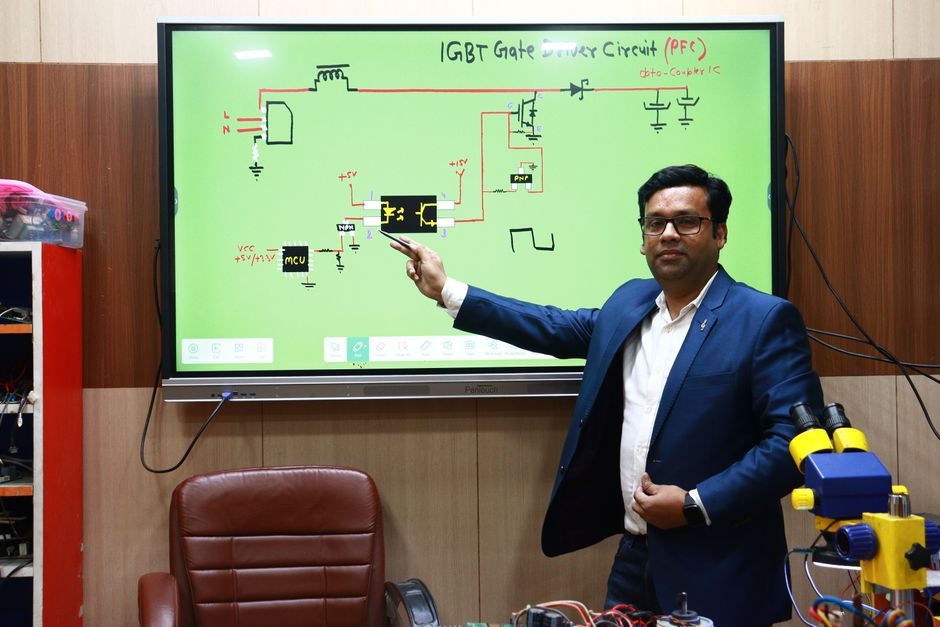
An AC motor started direct-on-line typically pulls 6 to 7 times its rated full-load current during the first half-cycle, with a peak starting torque step that is felt all the way down the mechanical train to the coupling and driven load [S6].
A modern solid-state soft starter in the 5.5 kW to 600 kW window — current range roughly 5.5 A to 50 A per phase, three-phase 400–690 V class — replaces that inrush with a programmable voltage ramp, cuts the locked-rotor current to typically 2–4× FLC, and integrates 12 protection functions covering overload, phase loss, phase reversal, overcurrent and stalled-rotor events [S1][S3].
Why Direct-On-Line Hurts Modern Plant Equipment
Direct-on-line starting of a three-phase AC motor applies full mains voltage, full current and full torque in the same instant. The inrush window is short — usually under 1 second on a small frame — but the electrical and mechanical stress is large: contactor tips arc, supply cables sag, lighting flickers, and the driven load receives a torque shock that can shear belts, score gear teeth, or burst coupling inserts [S6].
The traditional mitigation has been star-delta starting, autotransformer starting, or reactor starting, all of which reduce voltage in fixed steps. Soft starters replace those mechanical tap-changes with back-to-back thyristor pairs (SCRs) per phase, phase-angle-firing the line voltage from a user-programmed initial value up to full voltage across a 1–60 s ramp window [S3][S5].
Soft Starter Spec Bands: What the 2026 Catalog Actually Shows
The published soft-starter product space on 29 June 2026 lists 33 manufacturers offering 75 distinct model series, from 3.5 A three-phase units at 3.8 kW up to 50 A units at 600 kW per device [S1][S2][S3]. The celduc relais SMCV/SMCW family, for example, ships at 3.5 / 16 / 22 / 25 / 30 A and 3.8 / 13 / 19 / 26 kW — a small-frame range for OEM machinery builders [S3].
At the heavy end, the FWI-SS3 series from VTDRIVssE Technology Limited covers 75 kW to 600 kW with a 5.5 A to 50 A current window and an integrated protection package of 12 functions covering start, run, coast and stop [S1]. ABB's PSE generation softstarter, also active in 2026, markets built-in Modbus-RTU fieldbus, coated PCBs for dust and corrosive atmospheres, and a higher starting-current rating per frame size than its predecessor [S4].
AC Motor Starting Methods Compared on Four Decision Criteria
The decision between direct-on-line, star-delta, autotransformer and solid-state soft starter is governed by four criteria that an engineer can score on a panel layout: inrush current, starting torque, footprint/cost, and control granularity. A side-by-side read at 400 V / 50 Hz on a 30 kW four-pole induction motor looks like this: DOL pulls 6–7× FLC and delivers ~1.5–2.5× rated torque; star-delta drops that to roughly 2–3× FLC and 0.5–0.8× rated torque but with a sharp transition step; autotransformer stages 50/65/80% taps for a smoother ride; a soft starter with a 5 s ramp and 60% initial-voltage setting holds inrush around 2–4× FLC while preserving about 0.5–0.8× rated torque continuously [S5][S6].
Granularity is where the soft starter pulls ahead: the initial-voltage percentage, ramp-up time, ramp-down time, current-limit clamp, and kick-start pulse are all field-tunable, often from a HMI or via Modbus-RTU [S4][S5]. A star-delta contactor bank is cheaper to buy but has one fixed voltage transition that cannot be trimmed for a high-inertia fan or a low-slip compressor.
Where a Soft Starter Fits — and Where It Does Not
Soft starters are the right call on constant-speed applications with high inertia or fragile drive trains: centrifugal pumps, HVAC fans, conveyors, mixers, and compressors where the goal is to limit current, mechanical shock, and water-hammer on stop [S5][S6]. They also suit installations where a VFD's braking-regen or precise speed-hold capability is not required, saving the cost differential of roughly 2–4× a comparable soft starter [S6].
They are not the right call when the process needs closed-loop speed control, soft reversal, or a wide constant-torque operating range below base speed — those are VFD or direct-drive servo jobs, as the servo motor selection reference walks through. Soft starters also do not replace motor thermal protection upstream of the drive; the 12 integrated protection functions in modern units overlap with but do not substitute for a dedicated motor protector in heavy-cyclic duty [S1][S5].
Limitations, Failure Modes and Sourcing Constraints
Solid-state soft starters dump harmonic distortion back into the supply bus during the ramp window because the SCRs are chopping the 50/60 Hz waveform. The cell-based design and the integrated bypass contactor in PSE-class units close at end-of-ramp to limit losses, but the ramp itself is not sinusoidal at the motor terminals [S4][S5].
Heat is the other design constraint: SCRs in the 30 A to 50 A class derate above 40 °C ambient unless cabinet ventilation or a heat-spreader plate is added. Supply-chain wise, the 2026 catalog still shows 33 active vendors on DirectIndustry — Danfoss VLT Drives, ABB, Schneider (via CG Drives & Automation / Emotron lineage), DOLD, LEROY-SOMER, celduc relais, NORD and LOVATO are the names appearing most frequently across the 75 model series indexed in May 2026 [S2]. Lead times on the heavy-end 600 kW class still sit longer than on small-frame units, and CoPc-2 conformal coating is now table-stakes for harsh-environment builds [S4].
Standards and Spec Discipline on the 2026 Buy
Three points are non-negotiable on a 2026 specification. First, voltage class — confirm 400 V / 690 V three-phase compatibility against the actual motor nameplate, not the panel label. Second, the protection-function list — at minimum overload, phase loss, phase reversal, overcurrent, and stalled-rotor detection should be in the 12-function package, as the FWI-SS3 series publishes [S1]. Third, the fieldbus interface — Modbus-RTU is the baseline on PSE and most 2026 units; PROFIBUS, PROFINET, EtherNet/IP and DeviceNet gateways are typically plug-in option cards [S4][S5].
For buyers cross-shopping with adjacent plant-equipment categories, the EV production technology reference covers the larger traction-motor sourcing question, while the pressure reducing valve buying guide is a useful sibling read on shutdown-side protection pairing. On the AC motor side, the 2026 catalog of induction, servo and linear motor variants has not consolidated — most plants still source a 3-phase induction frame for soft-starter duty and reserve servo or linear axes for closed-loop positioning.
Trackable signals into the back half of 2026: ABB PSE25/PSE45/PSE60 firmware revisions enabling Modbus TCP and PROFINET IRT gateways, the 2026 Q3 release of any 800 kW-class soft-starter SKU from the existing 33-vendor list, and the next DirectIndustry catalog refresh expected in November 2026 covering frame sizes above 600 kW [S2][S4].