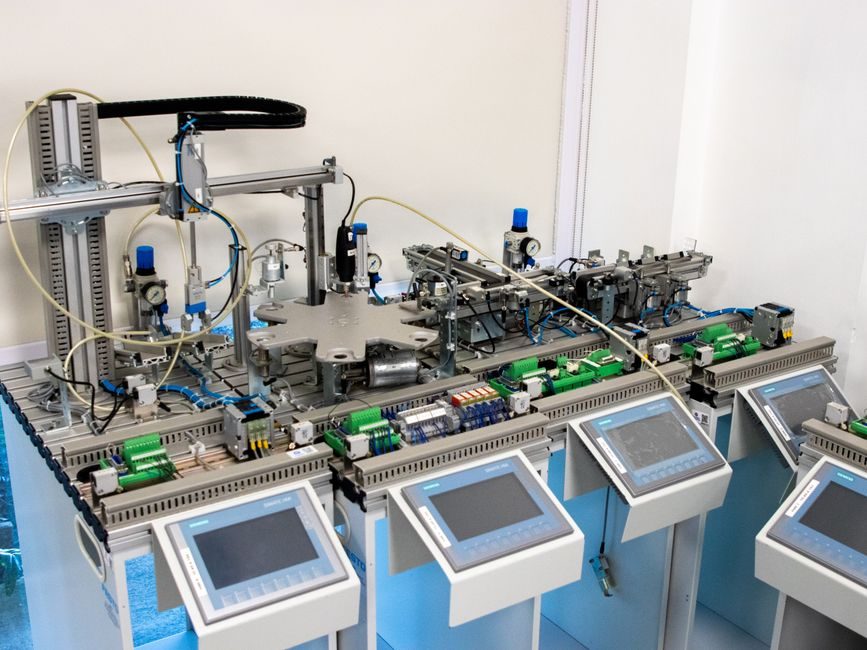
Modern cable and wire smart manufacturing is built on four automated pillars: non-backtwist rigid-frame stranders, AI-vision robotic cable-assembly cells, continuous-ink-jet (CIJ) wire marking, and in-line resistance/capacitance quality control — a stack now visible across Chinese OEM catalogues dated 2026-06 [S1][S3][S7].
The buyer scope is broad: power-cable mills running LV/MV copper and aluminium conductor lines, RF coaxial plants making 50 Ω 8D-FB / 10D-FB base-station feeders, fire-resistant LSZH cable makers (mica-glass-tape constructions), and contract cable-assembly shops serving data-centre, robotics and EV harness customers [S2][S5][S6][S8][S9].
Non-Backtwist Rigid-Frame Stranding: Throughput and Conductor Scope
Backtwist-free rigid-frame stranding is the baseline workhorse for 2026-era smart cable plants, with CCCME-listed OEM machines rated for copper strand, aluminium strand, ACSR, and insulated core lay-up, with optional pressing-roller attachments for compact round conductors [S1].
Process engineers choose non-backtwist frames over tubular stranders for round concentric-lay constructions where residual torque after pay-off would distort downstream insulation extrusion; Chinese strander and twisting-machine builders (e.g. DONGGUAN JUJING) now pair these frames with PLC HMI control panels and servo-driven bobbin take-ups, which is what separates a "smart" 2026 line from a 2010-vintage rewind cell [S3]. Practical spec gate: rigid-frame cage RPM × bobbin count × pre-spiral pitch range, with a separate specification for the backtwist compensation value (typically expressed as a percentage of cage pitch).
Robotic Cable-Assembly and Wire-Harness Cells: AI Vision and Quick-Turn
AI-vision cable-assembly cells are now a standard product line at Chinese and Malaysian OEMs, with cable-assembly manufacturers explicitly listing AI/Data-Center, Robotics, and Automotive as the target verticals alongside 24-72 h quick-turn prototyping [S6].
YZ-Link and similar industrial harness makers cover 6-64 pin IDC sockets, D-sub hoods, flat-ribbon and robotic cable assemblies — a catalogue breadth that only pays off when the upstream cut/strip/crimp station is robot-loaded rather than operator-fed [S8].
Inline Coding, Marking and Traceability
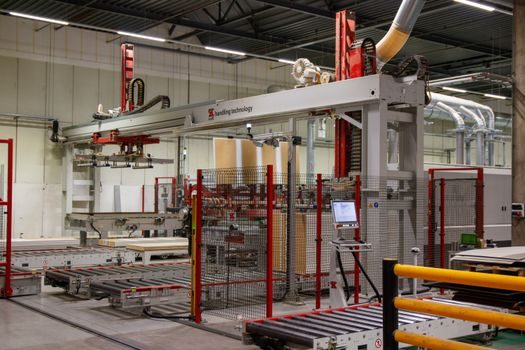
Continuous-ink-jet (CIJ) and wheel/contact printers are the de-facto 2026 marking layer for smart wire and cable lines, with suppliers such as GEM GRAVURE offering dedicated wire-and-cable fluids, bandmarking customisation, QR / Julian code support, and 24/7 field service contracts [S7].
Inline CIJ is preferred over laser marking for PVC, PE and LSZH jacketed cable at line speeds of 100-300 m/min because ink absorption stays readable after the cooling trough, whereas laser contrast on dark-jacketed LSZH often requires a contrasting under-layer. For data-centre and medical cable assemblies, QR-coded lot traceability is increasingly a contractual deliverable, not a nice-to-have [S6][S7].
Smart QC, Sensors and the Spec-Compression Problem
Quality control is the thinnest part of most 2026 cable-plant RFPs, even though defect cost is dominated by insulation eccentricity, conductor resistance drift, and spark-test failures. Smart lines now bundle in-line capacitance/diameter gauges, partial-discharge detection for MV cables, and continuous spark testers operating at 3-15 kV AC depending on insulation wall — but exact test-voltage / sensitivity values must be locked against the relevant cable standard (IEC 60502 for MV power, customer datasheets for harness) before commissioning. [S1]
Spec compression — the temptation to retrofit a 2010 strander with new sensors and call it "smart" — fails on three points: servo bandwidth on the capstan, control-loop latency between dancer and extruder, and the absence of a unified data model. Buyers comparing cable-automation vendors should run a live tap test (measure dancer-loop response time) rather than trust marketing slides. A related 2026 reference on industrial control-cable and robotics harness sourcing is laid out in the Industrial Valve Smart Manufacturing 2026 automation-stack spec gate feature, which covers the same PLC/servo/IPC architecture trade-offs that cable plants now face.
Comparison: Cable-Plant Automation Tiers in 2026
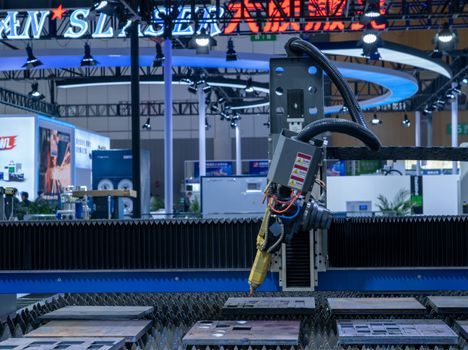
Tier 1 (semi-automatic, lowest capex) is operator-fed cut/strip/crimp with offline CIJ marking — typical for sub-50 k USD harness job-shops. Tier 2 (smart, mid-capex) integrates robotic loading, in-line spark testing, and vision-guided QC at 1-3 million USD per cell, the segment where Chinese strander OEMs are most active [S1][S3]. Tier 3 (AI-native, high-capex) uses AI vision for jacket-defect and conductor-twist classification, predictive maintenance on the capstan motor, and full MES/MRP integration — the explicit positioning of suppliers targeting AI/data-centre cable assemblies [S6].
Selection criteria for choosing between these tiers: (1) mix variability (high SKU count pushes Tier 2/3), (2) defect-cost per metre (medical/EV harnesses justify Tier 3, commodity PVC does not), (3) labour cost per shift, and (4) data-customer contractual traceability requirements. A useful adjacent reference for the upstream process — drawing, stranding, insulation and QC — is the cable and wire manufacturing process walkthrough.
Use Cases: From RF Coax to LSZH Fire-Resistant
RF coaxial cable for base-station antenna feeders (8D-FB / 10D-FB, 50 Ω) is still dominated by hand-tuned extrusion and braiding, but the 2026 product line at Chinese suppliers includes 3D-FB through 10D-FB families with FEP/PE dielectric options at 0.30-1.00 USD/m FOB China for 1,000 m MOQ [S5]. Smart-manufacturing value here sits in braid-angle monitoring and SRL (structural return loss) screening, not robotic assembly.
Fire-resistant LSZH power and control cable — a Malaysian and Chinese specialty — uses mica-glass-tape wraps plus LSZH sheath, with non-armoured 2/3/4-core constructions being the most common building-vertical SKU; smart-manufacturing investments in this segment target mica-tape tension control and sheath-excentricity feedback, since both directly affect IEC 60332-3 and IEC 60331 fire-test performance [S9]. Thermocouple wire and cable (Types K/J/T, fibreglass / polyimide / fluoropolymer insulation rated 121-260 °C) is the most specification-sensitive niche, where traceability per spool and calibration certificates are the buyer-side differentiators [S2].
Limitations, Failure Modes and Standards Watch
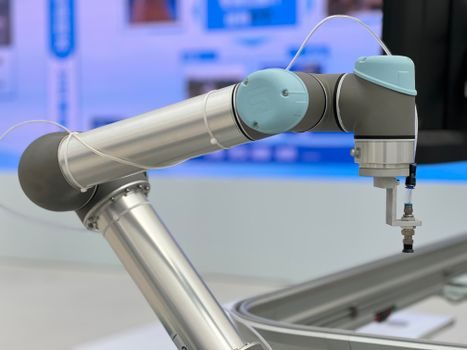
The most common 2026 commissioning failure on retrofitted "smart" lines is dancer-loop oscillation when the upstream extruder surge and the downstream capstan are governed by separate PLCs without a shared motion bus; the fix is a unified EtherCAT/PROFINET motion ring plus a properly tuned PID, not a software patch. A second failure mode is ink-throw on CIJ printers at line speeds above ~250 m/min on LSZH — solved by switching to a higher-surface-tension ink family or to UV-LED pin-marking on the jacket, a pathway the OEM printer catalogues now support [S7].
Standards watch: power-cable design points remain governed by IEC 60502 (LV/MV), with fire performance on IEC 60332-3 (flame spread) and IEC 60331 (circuit integrity under fire); RF coax follows IEC 61196; thermocouple wire follows IEC 60584 / ASTM E230. Smart-manufacturing data-exchange layers (OPC UA, PackML) are referenced through ISA-95 / IEC 62264 rather than cable-specific standards, so buyers should keep the data-model conversation separate from the cable-spec conversation.
Two trackable signals to watch: (1) whether Chinese strander and harness OEMs continue publishing on Made-in-China / CCCME with explicit AI-vision and MES-integration claims through 2026-Q3, and (2) the spread of LSZH smart-extrusion lines into South-East-Asian fire-resistant cable plants, where DNF Cable and peers are already the regional benchmark [S3][S9]. For a related capex-side reference on adjacent industrial automation, the Industrial PC Buying Guide 2026 spec gate covers the IPC hardware that underpins most 2026 cable-plant vision cells.
For component-level specifications, see additive manufacturing material, smart camera, and smart meter.