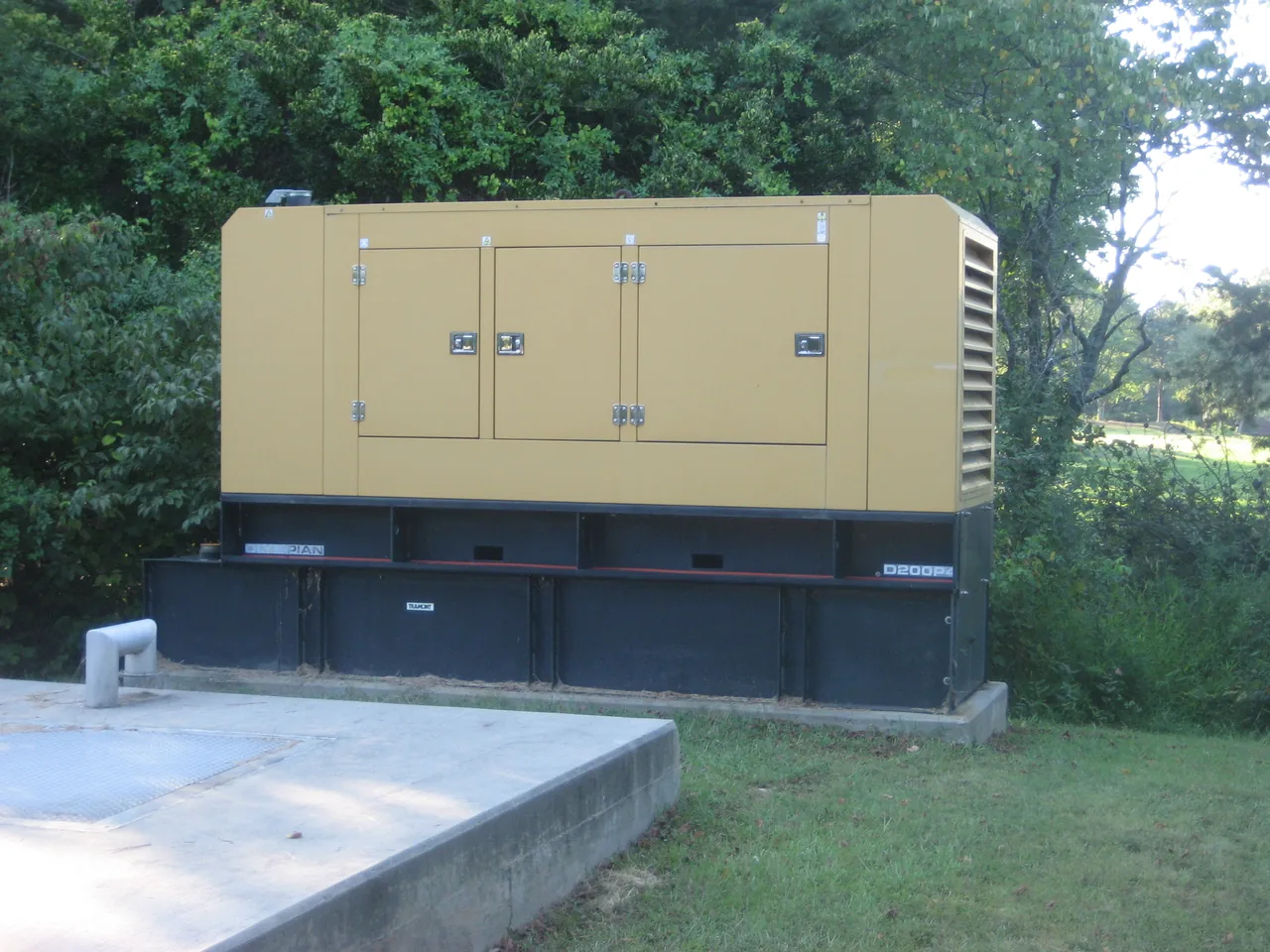
A mounted generator set noise control enclosure is the close fitting housing that a packaged generator set wears: a steel or aluminum shell bolted to the set's base frame or skid, lined with mineral wool or foam, with lined air paths for cooling and combustion air, an exhaust silencer inside the shell or on its roof, lockable doors for service, and lifting points for a crane. It does four jobs at once. It holds the noise of engine, exhaust, cooling fan and alternator inside a heavy, stiff shell with absorbent walls. It keeps rain, dust and snow off the machine. It lets the radiator breathe without drawing its own hot air back in. It gives an operator safe access to the control panel, filters, fluids and battery.
The enclosure is bought with the set, not instead of it. The diesel generator underneath is the machine, with its own rating, fuel consumption and cooling system, and each of those writes a requirement on the housing around it: more heat to discharge, more air to pass, more noise to hold. An enclosure is therefore never chosen on noise alone. The engineer writing the order balances the sound level at the property line against the airflow the radiator needs, the fuel storage the duty demands, the wind, snow and salt of the site, and the clearances the service crew needs to reach the set. Getting that balance right is a matter of working through the principle, the types, the specifications, the selection arithmetic and the acceptance checks in that order.
Five things decide a generator set noise control enclosure. First the noise target, stated as a sound pressure level at a stated distance or as a sound power level. Second the cooling airflow that must pass through lined openings without recirculation or excess fan power. Third the wall build: panel mass, lining thickness and door seals. Fourth the structure, meaning the base frame, lifting points, tank capacity, wind and snow loads. Fifth access and safety around a running machine. These five pull against each other. An order that fixes only the first ends with a set that is quiet on paper and too hot in service.
Chapter 1 / 06
What a Generator Set Noise Control Enclosure Is and How It Works
A generator set is a compact package of noise sources. The engine block radiates combustion and mechanical knock, strongest at low frequency, and it shakes its mounts, which is structure borne noise. The exhaust releases a pulse of high energy at every firing, which is why an unsilenced stack carries furthest. The radiator fan adds broadband noise that rises steeply with fan speed and leaves through the hot air discharge. The alternator adds a tonal whine from its cooling fan and from magnetic forces in its core. A gas engine set changes the character of the exhaust but not the paths. The enclosure treats each path on its own terms: absorption for airborne noise, a silencer for the exhaust, isolation for vibration.
The working principle is the mass law of acoustics. Airborne sound reaching a heavy, stiff and airtight panel bends that panel only slightly, so only a small share of the sound energy reaches the other side, and the loss grows with the surface mass of the panel and with frequency. A close fitting enclosure is therefore built as a sealed shell, and every feature that removes mass or opens the seal costs attenuation. Doors close on a continuous gasket under positive latches, and cable, pipe and duct entries are sealed. The bare shell alone would still be poor: sound energy entering the air gap between engine and wall builds up and leaks out through any weak point.
The lining is what stops that buildup. It is a porous absorber fixed to the inner face of every panel, a blanket or batt of mineral wool with rock wool the common choice, covered by a thin facing of perforated sheet or glass fabric that sheds oil mist and water. Sound enters the tortuous passages and is spent as friction in the fibers. Thickness governs the lowest frequency that is usefully absorbed, and a restrained fill does not settle into the door bottoms. Acoustic insulation in sound enclosures for small and medium sets runs up to 51 mm (2 in.), and an air gap between the blanket and the outer skin carries the absorption further down the band.
Ventilation is where the shell gives up most of its attenuation, because the radiator needs a large, cool airstream. The pusher fan draws ambient air in through a lined inlet at the alternator end, moves it past the engine, and forces it through the radiator core to a hot air discharge in front of the radiator face. Inlet and discharge carry acoustic louvers, banks of absorbent faced blades, or lined plenum boxes, so that fan noise and engine noise follow a lined path. The louvers double as weather protection and must shed driving rain and snow. A vertical discharge throws the hot air above the enclosure, away from people at ground level.
The exhaust is treated by a silencer, a chambered and baffled vessel sized to pass the exhaust flow within the engine's backpressure limit. In small and medium enclosed sets the silencer sits inside the housing, wrapped and shielded so that its heat and shell noise stay inside; larger sets give it a separate compartment. A flexible connector at the engine and a bellows joint at the silencer take up engine movement and thermal growth. The tailpipe ends in a rain cap, the system drains at its low points, and it is supported so that the engine turbocharger carries none of its weight. Extra tailpipe length raises backpressure and must be checked against the engine maker's limit.
Structure borne noise is handled before it reaches the shell. The engine and alternator sit on spring isolators on a base frame of structural steel section, a stiff spine that keeps the two aligned, takes the lifting loads and resists the synchronous shaking of the running set. The enclosure panels are fastened to the same frame and braced so that they do not drum. The package rests on a level, noncombustible pad, or on its own isolators where neighboring structures are sensitive to vibration. An isolator chosen without regard to the mass and speed of the set can amplify motion at resonance, so the set maker's mounts are the default, and a vibration sensor confirms it at commissioning.
Chapter 2 / 06
Generator Set Noise Control Enclosure Types and Structural Variants
A weather protective enclosure, often called a canopy or weather housing, is the basic type. It is a steel shell, commonly 14 gauge, with hinged and lockable doors, air inlet and discharge grilles, rodent guards, drains and an alternator access panel, and an internal exhaust silencer. It carries no acoustic lining. Its value is weather protection and safety: it keeps rain, snow and debris off the set, hides hot surfaces and the exhaust, and keeps unauthorized people out. Noise falls only by the shielding effect of the shell, so on a small or medium set the level at full load still runs from the high seventies to the high eighties dB(A) at 7 m (23 ft).
A sound attenuated enclosure, the acoustic type, is the weather enclosure with a lining and with lined air paths. It adds mechanically restrained acoustic insulation on walls, roof and doors, acoustic louvers or plenums on inlet and discharge, a water shedding film on the hot air path, and usually a larger shell. On the same sets the sound pressure level drops from 78 to 89 dB(A) to 65 to 75 dB(A) at 7 m (23 ft), a reduction of 11 to 14 dB(A). Each further step of attenuation is bought with more lining, more restricted air paths and more weight, which is why makers grade their acoustic housings in steps.
Materials and site executions separate the variants. The shell is primed and painted steel, or aluminum alloy sheet at about 3.2 mm (0.125 in.) where weight and salt matter. Aluminum enclosures are the recommended choice for high humidity and coastal salt, and lighter: on a small set the aluminum housing takes about 113 kg (250 lb) off a package of 1274 kg (2809 lb) in steel. Coastal executions add marine coatings and stainless steel fasteners. Wind rating belongs to the type: a steel weather housing is designed for 150 mph (241 kph), and aluminum sound housings are certified to 186 mph (299 kph) on some models and 181 mph (291 kph) on others. Hurricane executions add impact rated panels.
The subbase fuel tank is a structural variant. It is a rectangular, double wall tank under the skid: the inner tank sits inside an outer one that holds the fuel if it leaks, and specifications commonly ask for 110 percent containment. It adds 406 to 914 mm (16 to 36 in.) to package height, and capacities run from 424 L (112 gal) to 5742 L (1517 gal). Fittings include a lockable fill, a normal vent, emergency relief vents on both tanks, a fuel gauge, a low fuel level switch that alarms at 50 percent, a leak switch in the basin, an electrical stub up area, and lift lugs for spreader bar lifts.
Two further forms complete the family. A retrofit enclosure is built to fit an existing open set: measured from the set's outline drawing, made in panels, and bolted around the set on site when a plant has to reduce its noise. A containerized power module is the form for larger sizes: a frame with the size and handling geometry of a freight container, the set, silencer and radiator in one compartment, fuel in another, and switchgear behind its own doors; medium voltage sets carry a gas circuit breaker in that compartment. Both forms keep the same lined walls, lined air paths and a silenced exhaust, at a scale a person can enter only when the set is stopped.
The boundaries are best drawn by what it sits between. The diesel generator is the machine inside, with its own ratings, fuels and controls; this page treats only its housing. An air intake noise control enclosure is the component on the engine's air cleaner that silences intake roar; one part inside the housing, not the housing. A machine noise control housing is the general class of close fitting housings built around any loud machine, and a generator set enclosure is the member of that class engineered around one packaged set. A walk in acoustic room or a building for a set is outside this page: it is entered, and its walls are structure rather than sheet.
Chapter 3 / 06
Key Specification Parameters and Standards
Sound performance is stated two ways. A sound power level describes the acoustic energy the set radiates. A sound pressure level is what a meter reads at a stated distance: usually the logarithmic average of A weighted levels at 7 m (23 ft), at full load, at four positions or more often eight around the perimeter, measured in free field over a reflecting ground plane. An arithmetic mean of decibel values reads low, by two and a half decibels on one documented example. Targets are also set band by band, and the low bands are the hardest to meet: residential surroundings are often held to 81 dB from 20 to 75 Hz and 54 dB from 1200 to 4800 Hz.
Three standards anchor the datasheet. ISO 8528-10 specifies the noise test codes for a reciprocating engine driven generating set: how the sound power level of the set and the emission sound pressure level at its workstation are determined. ISO 8528-1 classifies the application, rating and performance of a set for continuous, peak load and standby duty; a sound figure is valid only at the stated rating. IEC 60034-1 covers the rating and performance of the alternator as a rotating electrical machine. Around them sit the fire code rules for emergency power and fuel storage, the safety listing for the generator assembly, the rules for double wall tanks, and the ingress protection and NEMA enclosure rating of the control compartment.
The rest of the datasheet describes a lifted, fueled, wind loaded package. Dimensions and weight set the crane, the pad and the delivery route: a small set with tank and steel housing measures about 2320 x 1077 x 1980 mm (91 x 42 x 78 in.) and weighs 1274 kg (2809 lb), while a 300 kW set with a large tank stretches to 5588 mm (220 in.) and 4644 kg (10238 lb) in steel. Usable volume at full load runs from 24 to 96 hours nominal. Service clearance adds to the footprint: at least 1 m (3.3 ft) on all sides plus the width of the hinged doors.
Parameter
Typical value or range
What it decides
Sound pressure level, weather enclosure, at 7 m (23 ft)
78 to 89 dB(A)
Whether the site limit can be met without lining
Sound pressure level, sound attenuated enclosure, at 7 m (23 ft)
65 to 75 dB(A)
The enclosure grade needed for the site noise limit
Acoustic lining thickness
up to 51 mm (2 in.)
Low frequency absorption and shell size
Panel material
14 gauge steel or 3.2 mm (0.125 in.) aluminum
Weight, salt resistance and cost of the shell
Wind load rating
150 mph (241 kph) steel; up to 186 mph (299 kph) aluminum
Structural adequacy for site wind
Base tank capacity
424 to 5742 L (112 to 1517 gal)
Running time between refueling calls
Full load running time on base tank
24 to 96 h nominal
Refueling frequency and fuel logistics
Tank height added to the set
406 to 914 mm (16 to 36 in.)
Overall height, fill height and wind area
Low fuel level alarm
at 50 percent of tank
Time left to arrange a refueling
Spill containment at the fill
18.9 to 28.4 L (5 to 7.5 gal)
Compliance with spill control rules
Service clearance around the set
at least 1 m (3.3 ft) plus door swing
Footprint and access for maintenance
Snow package rating
to minus 20 degrees Celsius (minus 4 degrees Fahrenheit)
Cold climate operation with the enclosure closed
Silencer attenuation, residential class, 125 to 500 Hz
25 to 32 dB at 23 m (75 ft)
Exhaust noise reaching the boundary
Package weight, small set with steel housing and tank
1274 kg (2809 lb)
Crane size, pad design and transport
Chapter 4 / 06
Selection and Duty Calculations
Selection runs in a fixed order. The noise limit at the receiver sets the enclosure target, the heat of the set sets the airflow, the airflow sets the size of the openings, and the openings set how much shell and lining are left to hold the noise.
Start at the receiver. Find the limit at the property line or the building wall, and work back to the enclosure. Sound from a compact source in open air falls by about 6 dB for each doubling of distance, so a limit of 65 dB(A) at 50 m (164 ft) allows about 82 dB(A) at 7 m (23 ft) in free field. The target is then stated as a logarithmic average at the reference distance and checked band by band, because a set that meets an A weighted limit can still breach an octave band limit in the lowest bands, where engine firing energy sits and attenuation is least. A margin of a few decibels belongs in the purchase, for aging lining.
Airflow comes second. The radiator has to pass its full load heat, and the enclosure adds resistance in front of the fan and behind it: inlet louvers, the path around the engine, the radiator core and discharge louvers. For room installations a common rule makes the inlet opening 1.5 times the radiator face area and the outlet not less than the face area, and louvers with narrow vanes restrict flow more than those with wide vanes. The same holds for enclosure openings, where acoustic louvers have a free area well below their face area. Pressure loss rises with the square of airflow and fan power with its cube, so a small restriction costs fan power, and a fan slowed to cut noise moves less air.
Hot air recirculation is the failure this calculation guards against. If wind blows the discharge plume back into the inlet, or a wall traps it, the set draws air it has already heated, and it derates or trips on high coolant temperature. The discharge should throw the hot air up and away, inlets should face away from the prevailing wind where the site allows, and nothing should stand closer than the height of the radiator face in front of the discharge. Enclosed sets are designed to work in the open air, so a set that must sit in a corner needs its airflow checked. A remote air cooled heat exchanger takes radiator noise and heat out of the enclosure.
Fuel storage is sized from the running time the duty requires. Full load fuel consumption comes from the set's data, and tank volume follows from the hours, rounded up to a standard size and checked against usable rather than nominal volume. Base tanks on small and medium sets hold from 24 to 96 hours at full load, and integral tanks are not practical for prime power or where a fuel truck hose cannot reach the fill. The tank must be double wall with 110 percent containment, have normal and emergency venting, a lockable fill with spill containment, and a low fuel alarm at half empty. Reserve capacity must also cover the refill interval the site can rely on.
The site then decides the execution. Coastal and offshore sites call for aluminum panels, marine coatings and stainless fasteners; deserts for high ambient derating, dust screens and a light colored finish; cold climates for a snow package qualified to minus 20 degrees Celsius (minus 4 degrees Fahrenheit), an engine immersion heater as block heater, battery heating, heat tracing cable on fuel lines, and an air preheater for starting. Wind, snow and seismic loads confirm the frame and its anchors, with certified ratings for hurricane and seismic zones. Options worth carrying are an engine fluid containment basin, a high fuel level alarm, a fire valve on the fuel supply, remote fuel level readout, a status beacon, and a control compartment heater against condensation.
Decision factor
What the buyer fixes
What it changes
Noise limit at the receiver
Level allowed at the boundary, or octave band limits
Enclosure grade, lining thickness, shell size
Basis of the sound data
Logarithmic average at 7 m (23 ft), full load, 8 positions
Comparability of quotations; the acceptance test
Cooling airflow
Radiator heat rejection, site ambient, altitude
Opening area, louver type, fan power, recirculation risk
Clearances, door swing, cable entry, earthing points
Footprint, compartment layout, alarm list
Lifting and transport
Package weight, crane capacity, delivery route
Frame design, lifting points, shipping split
Controls and options
Remote fuel readout, status beacon, heaters, containment
Control compartment size and auxiliary power
Chapter 5 / 06
Installation, Maintenance, and Typical Failure Modes
An enclosure is installed as one lifted package and commissioned as part of the set. Most of what decides whether it performs is done before the first start: how it is set down, how it is connected, and what is measured on the day of the load test.
Lifting and setting down come first. The package is lifted only from its designated lifting points, with a spreader bar so that the slings stay near vertical, never from the engine or alternator lifting points, and nobody stands under the raised load. Lifting eyes and lugs are checked before every lift for damage and tightness. The pad is level and noncombustible, and the frame is leveled on jacking screws before shims or grout are finished. It is set down with at least 1 m (3.3 ft) on all sides, more where doors open, and nothing in front of the hot air discharge. The enclosure is not a step or a store: nobody climbs it, and no fuel, oil or cleaners are kept against it.
Connections follow the designed paths. Power cables enter through the stub up area from below or through a cable gland in the terminal compartment, each control cable is kept apart from its power cable, and cable tray or conduit is supported on its own so that no pull reaches the terminals. The frame, doors, tank and control compartment are bonded and connected to the site earth, with a grounding resistance of 5 ohms or less where a guide specification applies, proven with an earth ground tester. The fuel fill and vent are brought to an accessible point, with the vent raised above the fill and a spill box at the connection. The exhaust tailpipe stands on its own bracket so that its weight never loads the turbocharger.
Commissioning proves the quiet set is also cool and safe. Before the start, every door is closed on its seal and latched, and the louvers are checked for packing, debris and ice. With the set at full load, the air entering the enclosure is compared with the outdoor ambient: a clear rise signals recirculation, and the crew looks for the wall or wind direction that causes it. The sound level is measured at the reference distance with a calibrated sound level meter at the specified positions, and the exhaust and alternator compartment are scanned for hot spots with a thermal imager. Alarms are tested by drawing the tank down to its low level point and by pressing the emergency stop.
Close and latch every door; confirm that seals seat and panels are secure.
Clear louvers and screens of debris, packing and ice.
Confirm bonding and earthing of frame, doors, tank and control compartment.
Run to full load and compare inlet air temperature with the outdoor ambient.
Measure sound pressure at the reference distance at each specified position.
Test the low fuel, leak detection and emergency stop functions.
Maintenance is mostly inspection: a housing has few wearing parts and many ways to lose what it was built to do. At each visit the screens and louvers are cleaned of dust, leaves and snow, door seals are checked for tears, latches are lubricated, and the basin and muffler drains are opened. Lining is inspected for settling, tearing, oil soaking and water staining, and a panel that rings or rattles is refastened. Paint damage is touched up before corrosion takes hold; on older units an ultrasonic thickness gauge confirms that lower panels are sound. Alarm contacts and engine heaters are tested, lifting points are inspected before any move, and anyone servicing a running set with doors open wears a hearing protector.
Overheating at full load is nearly always recirculation or blocked airflow. A measured level that has crept up by several decibels points to damaged or saturated lining, a door that no longer seals, or a silencer whose internals have failed. Rattles and drumming come from loose panel fasteners or a failed isolator, and they are found with a vibration analyzer on the frame and on the panels. Corrosion starts where water sits: door bottoms, the tank basin and the frame under the fuel fill. Water in the control compartment, condensation on the alternator, or a battery that will not hold a charge in cold weather usually means that a heater or a door seal has failed.
Item or failure point
Symptom or occasion
Action
Inlet and discharge louvers
Dust, leaves or snow on the screens
Clean at each visit; confirm the free area
Door gasket and latches
Noise rise, water or dust inside
Replace the seal, adjust the latch, refasten the panel
Acoustic lining
Tears, settling, oil or water staining
Refit or replace blanket and facing
Hot air path
Coolant temperature rise at full load
Find the recirculation; clear the discharge
Base tank and basin
Leak alarm, fuel in the basin, bottom corrosion
Test the alarms, inspect the tank, touch up coating
Exhaust tailpipe and rain cap
Soot streaks, water at the muffler drain
Clear the cap, open the drain, check the support
Earthing and bonding
Failed continuity or earth resistance test
Rebond frame, doors and tank; retest
Lifting points
Before every lift or move
Inspect eyes and lugs for damage and tightness
Chapter 6 / 06
Industry Applications and Procurement Checks
Enclosed sets serve wherever a standby or prime power source must stand close to people or to a boundary. Hospitals and care homes take the most attenuated housings with critical class exhaust silencers, beside wards that cannot be closed. Data centers run enclosed sets in rows outside the building, each started by its automatic transfer switch when the utility fails. Water and wastewater plants, airports, mines, and oil and gas facilities use sound attenuated enclosures in corrosive, dusty or classified areas, where the field wiring may need an explosion proof junction box. Construction sites and rental fleets move canopied sets from site to site, which puts a premium on lifting points, lockable doors and a full shift of fuel.
Cost and lead time are driven by grade, material and paperwork. Each step from a weather housing to a high attenuation housing adds lining, longer lined air paths and a bigger shell. Aluminum costs more than steel per panel and saves weight. Certified executions, for hurricane wind, impact or seismic restraint, carry engineering and test costs, and custom tank sizes, colors or layouts add design time. The long lead items are the shell, the silencer and the tank, so a standard enclosure on a standard tank is the quickest route. A quick quotation follows from the figures that fix the design: sound level at the reference distance, tank hours, enclosure material, wind and snow loads, and the options list.
The submittal package is where compliance is proven. Ask for an outline drawing with dimensions, weights, lifting points and clearances; the sound data with its measurement basis, meaning positions, distance, load and averaging method under ISO 8528-10; the tank certification for double wall construction and venting; certificates for wind, impact and seismic ratings where the site needs them; and the installation and operation manuals. Guide specifications commonly require start up by a field engineer and a functional acceptance test under load to close the contract. Spares to order with the set include door seals and latches, louver screens, lining and facing material, panel fasteners, heaters and their control circuits, and the fuel level and leak alarms.
A purchase order for a generator set noise control enclosure should state, as a minimum, the following. The set rating, and the duty rating at which the sound figure is guaranteed. The sound pressure level at 7 m (23 ft) as a logarithmic average at full load, or a sound power level, with octave band limits where a code sets them. The enclosure grade and panel material, with lining thickness and the coating system for the site atmosphere. The overall dimensions, weight, wind, snow and seismic ratings and the lifting arrangement. The base tank capacity and the running hours it must give, with containment, venting, fill, spill and alarm provisions. The cable entry openings and the earthing points. The winter, containment and monitoring options. The standards the set is built to, naming ISO 8528-1, ISO 8528-10 and IEC 60034-1 where they apply, and any listing required for emergency power service. Ask the supplier for the measurement report behind the sound figure, the clearance and airflow requirements in writing, the delivery split, the start up arrangements, and the spare parts held for the life of the set.
FAQ
How does a generator set noise control enclosure reduce noise?
The enclosure works on three paths at once. Its heavy, stiff, sealed shell of steel or aluminum panels reflects most of the airborne noise back inside, and a lining of mineral wool or foam absorbs the sound energy in the air gap, so little leaks out through the walls. The cooling air inlet and hot air discharge pass through acoustic louvers and lined plenums that absorb fan and engine noise. The exhaust passes through a silencer. Vibration is kept out of the shell by spring isolators under the engine and by a stiff, braced base frame. A weather enclosure has the shell but not the lining, and is louder.
What is the difference between a weatherproof and a sound attenuated generator enclosure?
A weatherproof enclosure, or canopy, is an unlined steel shell. It keeps weather and people away from the set but attenuates noise only by shielding; on small and medium sets they measure about 78 to 89 dB(A) at 7 m (23 ft) at full load. A sound attenuated enclosure is the same housing with acoustic insulation up to 51 mm (2 in.) on walls, roof and doors, lined air paths and an insulated discharge. On the same sets it measures 65 to 75 dB(A) at 7 m (23 ft). The acoustic type costs more, weighs more and restricts airflow, so its cooling path is checked at full load.
What sound level should I specify for an enclosed generator set?
Start from the limit that applies at the nearest receiver, at the property line or a building wall, then set a target at a reference distance that meets it with a margin. In free air, sound pressure falls by about 6 dB per doubling of distance. Specify the level at 7 m (23 ft) as a logarithmic average of positions around the enclosure at full load, with the measurement made under ISO 8528-10. Sound attenuated enclosures on small and medium sets typically reach 65 to 75 dB(A) there. Where a code sets octave band limits, check the low bands, because engine firing energy below 75 Hz is the hardest to hold.
How much space does an enclosed generator set need around it?
Plan at least 1 m (3.3 ft) of clear space on all sides for service access, and add the width of the hinged doors. Keep the area in front of the hot air discharge clear to at least the height of the radiator face, so that the plume can rise without being trapped by a wall or fence. Leave room for the fuel truck to reach the fill and for the drain to be reached. A larger tank and a higher grade of enclosure add height, so lifting height and cable routes change. Doors need to open fully for oil, filter, battery and alternator service, and nobody should have to climb the housing.
What maintenance does a generator set noise control enclosure need?
Maintenance is inspection rather than repair. At each visit clean the louvers of dust, leaves and snow, check door seals for tears, lubricate latches, and open the basin and muffler drains. Look over the lining for settling, tearing, oil soaking and water staining, and refasten any panel that rattles. Touch up paint damage before corrosion starts, and on older units check panel and tank thickness. Test the low fuel and leak alarms, the engine and control compartment heaters, and the emergency stop. Before any move, inspect the lifting points. A noise rise of a few decibels at the reference distance usually means a failed seal or lining.
What affects the cost and lead time of a sound attenuated generator enclosure?
Cost rises with the grade of attenuation, because each step adds lining, longer lined air paths and a larger shell, and with the exhaust silencer grade. Aluminum panels cost more than steel and save weight. Certified executions for hurricane wind, impact or seismic restraint add engineering and testing, and any nonstandard tank size, coating, color or layout adds design time. The shell, the silencer and the base tank are the long lead items. A standard enclosure on a standard tank is the quickest to deliver. Lead time also depends on the options list: winter packages, containment and alarms are built in before the shell is closed.
Which standards apply to a generator set noise control enclosure?
Noise is measured by ISO 8528-10, which specifies test codes for the sound power level of a generating set and for the emission sound pressure level at its workstation. ISO 8528-1 classifies the application, rating and performance of the set, and a sound figure is valid only at the stated rating. IEC 60034-1 covers the rating and performance of the alternator. Emergency power installations also follow the fire and electrical codes for standby power and fuel storage, which govern tank venting, containment and clearances, and the set may carry a safety listing for generator assemblies. The control compartment has its own ingress protection rating. Local noise rules set the limit the enclosure has to meet.