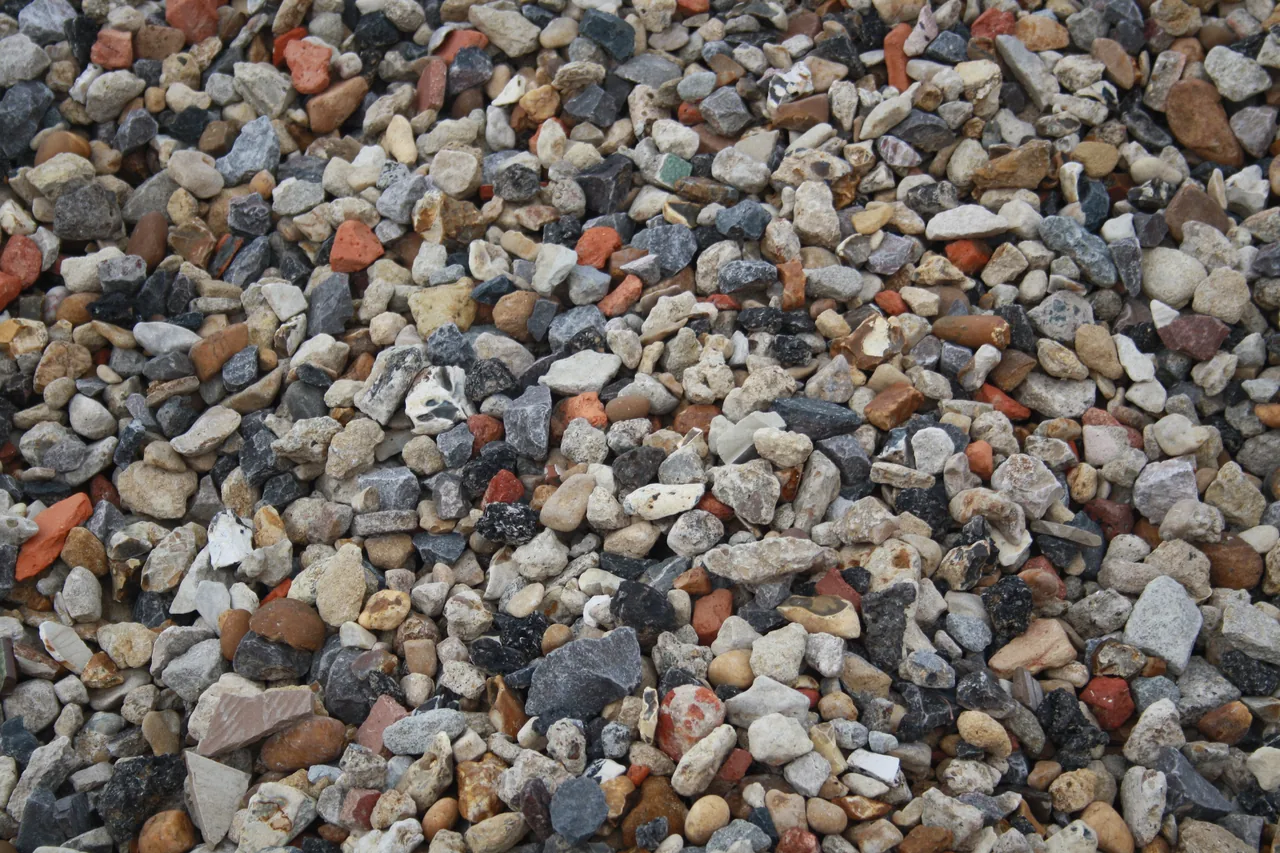
Recycled aggregate is mineral material won by crushing and screening construction and demolition waste: concrete from demolished structures and pavements, masonry and brick, and, where allowed, reclaimed asphalt pavement. Concrete is the principal source and gives the coarse product known as recycled concrete aggregate. The plant grades the crushed material into coarse and fine fractions, takes out steel, soil, wood, plastic and gypsum, and sells each fraction against a declared grading and declared properties. It replaces part of the natural aggregate in new concrete at a ready-mix concrete plant, serves as unbound and hydraulically bound base, and fills and drains behind structures. What a load contains, and how it behaves in a mix or a base layer, follows from the waste it came from and from the plant that processed it.
The buying decision concentrates on what the material contains and how constant that stays from load to load. A coarse aggregate crushed from a sound old pavement and a coarse aggregate crushed from mixed demolition rubble share a name and little else, so density, water absorption and cleanliness have to be declared and tested for each source. The specifying engineer decides which constituent class the material must meet, which size fraction and grading the application needs, which limits apply to chlorides, sulfates, gypsum and alkali-reactive constituents, and what share of natural aggregate it may replace. The product is a bulk mineral commodity delivered by the tonne, and the work of buying it well lies in fixing source, class and test evidence.
Five things decide a recycled aggregate purchase. First the source and composition, because clean crushed concrete and mixed demolition waste are different products under one name. Second the grading, which sets whether a fraction fits a concrete mix, a base course or a filter layer. Third water absorption and density, which write the mix water and the yield. Fourth the limits on chlorides, sulfates, gypsum and foreign material, which decide where the material may serve. Fifth the consistency of supply, shown by factory production control records and test reports. Fix those five and the material behaves as a specified product rather than as crushed rubble.
Chapter 1 / 06
What Recycled Aggregate Is and How It Is Produced
The defining feature of a recycled concrete aggregate particle is that it is two materials in one. A particle crushed from demolished concrete carries its original natural aggregate under a skin of hardened cement mortar that stayed attached through the crusher. That adhered mortar is lighter and more porous than the stone it covers, and the volume of mortar per particle sets every property that matters: absorption rises in step with the mortar volume, density falls in step with it, and the particle abrades more readily than the stone alone. The mortar share varies from particle to particle, so a graded coarse product is a blend of clean stone, partly cleaned stone and pieces that are mortar only. That blend, rather than any single value, is what a buyer receives.
Production begins when a load of demolition material, the rubble that demolition hammers and breakers cut from slabs and walls, reaches the plant gate. The load is inspected on receipt and again after tipping, soil and undersize are scalped off, and the acceptable concrete and masonry is fed by excavator or apron feeder to a primary jaw crusher, where most of the reinforcing steel is liberated and caught by a magnetic separator. A secondary stage, usually a cone crusher or an impact crusher, brings the material to its final size. Vibrating screens split it into fractions, an air sifter lifts off paper, plastic, wood and joint sealant, and pickers on a conveyor sorting line remove glass, gypsum board and other debris. A final sieving confirms the grading before each fraction is carried by belt conveyor to a clean, drained stockpile.
The choice of crusher decides how much mortar stays on the stone and how many fines are made. A jaw crusher accepts feed of 24 in (610 mm) or more, generates fewer fines than other machines and releases rebar and dowels from the slab, which makes it the usual primary unit. An impact crusher takes feed of 12 in (305 mm) or less and breaks mortar and stone together, so it makes more fines and is normally kept for secondary crushing. Impact and cone crushers strip mortar more effectively and yield an aggregate closer to the original coarse aggregate of the source concrete. Crushing clean pavement produces roughly 1 to 2 percent finer than the No. 200 (0.075 mm) sieve, and excavators scraping foundation material while lifting broken concrete add more.
Steel leaves the material in stages. Reinforcing bars, dowels and mesh are torn loose in the primary crusher and drawn off by the magnet over its discharge belt, and further magnetic separators stand after the later crushing and screening stages to catch fragments that were still buried in a particle. The recovered rebar is a separate output, and catching it is what keeps the steel content of the product low enough for concrete and unbound base. Non-ferrous pieces such as aluminum and copper conduit respond to no magnet; an eddy current separator ejects them, or they go with the hand-picked rejects. A recycled aggregate with visible steel on the stockpile is a sign that a magnet has failed or has been switched off.
Grading turns crushed rubble into a product. Recycled aggregate is sold in the same size fractions as natural aggregate: an all-in material from 0 to 32 mm, sized on a rotary drum screen, for road construction, backfill and other unbound uses; a coarse material in conventional sizes up to 20 to 25 mm for concrete; and a fine material up to 4 mm that replaces part of the sand. The sieve analysis is the reference test for grading; the European method, EN 933-1, washes and sieves the sample and applies to every aggregate up to 90 mm nominal size. Fine fractions carry more clay, soil and gypsum than coarse ones, because weak material breaks into small pieces first, so most standards allow less fines in a recycled aggregate than in a natural one.
Adhered mortar content falls as particle size rises. Smaller fractions hold a higher share of mortar, and in the fine material most particles are mortar rather than stone, which is why the fine product absorbs more water and performs worst in concrete. Coarse aggregate produced from concrete waste averages 2327 kg/m3 (145 lb/ft3) oven-dried density, a 24-hour water absorption of 4.9 percent and a Los Angeles abrasion loss of 32.5 percent. Coarse aggregate from mixed demolition waste averages 2167 kg/m3 (135 lb/ft3), 7.2 percent absorption and 36.5 percent abrasion loss, and both fine fractions absorb between 9.3 and 9.5 percent. Crushing also leaves microcracks in the particles, an angular shape and a rougher texture than gravel, and these raise water demand, lower strength and improve the bond with new paste.
Chapter 2 / 06
Recycled Aggregate Sources and Types
Concrete waste gives the highest class of recycled aggregate. It comes from demolished pavements, foundations and precast rejects, and its particles are concrete, mortar and the original stone. Aggregate made from it usually holds more than 70 percent concrete and stone together, most often more than 90 percent, with brick making up most of the remainder. Old pavement is the best source of all, because it was made to a public specification and its service history is recorded. The quality of the source concrete passes straight into the product: strong, sound pavement made with sound stone yields an aggregate that can go back into concrete, while weak, cracked or alkali-reactive source concrete yields an aggregate that carries the same weakness forward.
Mixed construction and demolition waste gives a coarser product with masonry in it. Coarse aggregate made from mixed waste after sorting typically holds 65 to 85 percent concrete and stone, 10 to 35 percent clay and calcium-silicate masonry from fired brick and similar units, up to 2 percent glass, 0 to 2 percent bituminous material and occasionally as much as 10 percent, and under 2 percent of everything else. Brick particles are flaky, weak and often porous, and glass is smooth and flaky; both raise the water demand and lower strength. The masonry share is what separates a concrete aggregate from a general recycled aggregate. A high brick content suits unbound base, fill and backfill, and most rules for structural concrete admit only material with a small brick share.
Reclaimed asphalt pavement is the third source and behaves unlike the first two. It is material milled from the surface of a road or ripped out full depth and broken into slabs, and every particle is coated with aged bitumen, so it leaves the crusher as black, sticky chunks rather than clean stone. Its relevant measures are binder content and gradation, not mortar, and its chief value is the binder it brings into a new asphalt mix. A small share of bituminous material is tolerated in recycled aggregate for concrete, commonly 1 percent in the highest class and 5 percent in the second. Reclaimed asphalt destined for new hot asphalt is managed as a binder-bearing raw material rather than as aggregate, and that route follows rules of its own.
Processing and end use split one stream of waste into several products. A mobile crusher with a single screen on the demolition site usually makes an all-in product for base and fill; a fixed plant adds washing, air sifting, picking and a second crushing stage, and yields the clean coarse fraction that concrete needs, while washing lowers dust and chloride at the cost of a waste water stream to be treated. Unbound material for subbase, capping, fill, pipe bedding and drainage is the largest tonnage; concrete aggregate, limited in most countries to the coarse fraction of concrete waste, is the smallest and most processed; reclaimed asphalt is a feedstock for asphalt plants. Beyond conventional plant, pilot techniques such as electrodynamic fragmentation, infrared sorting and density separation in a jig concentrator are being tried. Each class has its own product standard and test schedule.
Two neighbors bound the product. Natural aggregate is dug, dredged or quarried and carries no attached mortar; every difference described here follows from that one fact. Artificial aggregate is manufactured from raw materials such as clay, shale, fly ash or blast-furnace slag by heating, expanding or pelletizing, and it is sold as a made product with a designed density, not as a recovered one. Recycled aggregate sits between demolition on one side and its users on the other: concrete for paving and structures, unbound and cement-stabilized pavement layers, fill and asphalt. The crushers, screens, conveyors, magnets and sifters that make it are standard mineral processing machines and are specified on their own. The waste sorting rules and landfill practice that decide what reaches the plant gate are outside its scope.
Chapter 3 / 06
Recycled Aggregate Specifications and Standards
Three groups of properties are declared for a recycled aggregate, and all three start from grading. The geometrical group is the particle size distribution, the fines content and the shape; recycled particles are more angular, elongated and flaky than gravel, which raises water demand but bonds well to new paste. The physical group is oven-dried density, saturated surface dry density, water absorption, resistance to fragmentation in the Los Angeles abrasion test and freezing and thawing resistance. Density sets the yield of a batch by weight, absorption sets how much mixing water the aggregate will take after it leaves the plant, and abrasion loss shows whether a coarse fraction will survive hauling, compaction and wear. Density and absorption are read together, because both follow the share of adhered mortar.
The compositional group decides where the material may serve, and the one buyers under-specify. The constituents of a recycled aggregate are classified as concrete and mortar (Rc), unbound stone (Ru), masonry (Rb), bituminous material (Ra), glass (Rg), other materials (X) and floating materials. Two classes recommended in the aggregate-use annex of the European concrete standard, in its 2013 text, set the limits. Class A holds at least 90 percent Rc, at least 95 percent Rc plus Ru, at most 10 percent Rb, 1 percent Ra, 1 percent X plus Rg and 2 percent floating material; class B relaxes these figures to 50, 70, 30, 5, 2 and 2 percent. United States paving recommendations of 2009 add gypsum to 0.5 percent by weight, asphalt concrete to 1 percent by volume, glass to zero and chlorides to 0.6 lb/yd3 (0.36 kg/m3) of concrete.
Standards divide by end use rather than by origin. EN 12620, the European specification for aggregates for concrete, covers aggregates processed from natural, manufactured or recycled materials above 2000 kg/m3 oven-dried particle density, admits recycled aggregate between 1500 and 2000 kg/m3 with caveats, and requires factory production control. EN 13242 covers aggregates from natural, manufactured or recycled materials for unbound and hydraulically bound layers. ASTM C33/C33M specifies concrete aggregates in the United States and lists crushed hydraulic-cement concrete among the permitted coarse aggregates. For recycled material specifically, EN 933-11 is the reference classification test for the constituents of coarse recycled aggregate, EN 933-1 the reference sieve analysis, and EN 1744-1 the reference chemical analysis of aggregates.
Parameter
Typical value or limit
What it decides
Coarse fraction for concrete
Up to 20 to 25 mm
Largest coarse size concrete mixes take
Fine fraction
Up to 4 mm
Sand replacement; most mortar and impurities
All-in material, unbound use
0 to 32 mm
Road construction, backfill and fill
Oven-dried density, coarse, concrete waste
2327 kg/m3 (145 lb/ft3), mean
Batch yield by weight
Oven-dried density, fine, concrete waste
2065 kg/m3 (129 lb/ft3), mean
Water demand when fines are used
24-hour water absorption, coarse
4.9% concrete waste; 7.2% mixed waste
Batch water correction and prewetting
24-hour water absorption, fine
9.5% concrete waste; 9.3% mixed waste
Why fine fractions are limited in concrete
Los Angeles abrasion loss, coarse
32.5% concrete waste; 36.5% mixed waste
Survival in hauling, compaction and wear
Fines from crushing clean pavement
1 to 2% passing the No. 200 sieve
Washing or air cleaning before use
Constituents, class A
Min 90% Rc; min 95% Rc plus Ru; max 10% Rb, 1% Ra, 1% X plus Rg, 2% floating
Highest grade for concrete
Constituents, class B
Min 50% Rc; min 70% Rc plus Ru; max 30% Rb, 5% Ra, 2% X plus Rg, 2% floating
Lower grade with wider exposure limits
Gypsum, asphalt and chloride limits
Gypsum 0.5% by weight; asphalt 1% by volume; chloride 0.6 lb/yd3 (0.36 kg/m3) of concrete
Sulfate attack, air entrainment, corrosion
Chapter 4 / 06
Recycled Aggregate Selection and Mix Calculations
Selecting a recycled aggregate runs in five steps: qualify the source, fix the absorption and moisture correction, set the replacement ratio for the application, adjust the mix, and close with trial batches. Each step narrows what the next one has to settle.
Qualification starts with the source and its history. Concrete from a known pavement or structure that met a public specification has a recorded strength and aggregate type, and an aggregate made from it normally needs only the routine tests for grading, density, absorption and abrasion. The sulfate soundness test is left out, because its solutions attack the old cement paste and give mass losses that say nothing about service durability. Material from multiple or unknown sources needs a fuller investigation, because variability in the source passes straight into the concrete. Where the source may be alkali-reactive or liable to freeze-thaw distress, the assessment of alkali-silica reaction risk applies, and petrographic examination of the old concrete shows how far a reaction has already run. Most agencies hold recycled aggregate to the same quality requirements as natural aggregate and add contaminant limits for non-agency sources.
Water is the calculation that gets recycled aggregate concrete wrong. The aggregate absorbs more than natural stone does, so the batch has to supply water that the aggregate will drink after mixing. The free water of each fraction is its measured moisture content minus its absorption; the batch controller at the concrete batching plant deducts that free water from the added water, and the mass and moisture of the fraction come from the weigh feeder or belt scale record and from oven-dried samples or an in-line moisture analyzer. Two habits keep the correction stable: the stockpile is sprinkled, or the material is run through a log washer, so that it arrives close to saturation. Estimates from the 1970s put the extra water for equal workability at about 5 percent with coarse aggregate alone and 10 to 15 percent with coarse and fine together.
The replacement ratio follows the application and the exposure. Coarse recycled concrete aggregate has served as 100 percent of the coarse aggregate in paving, and blending it with natural aggregate is the usual way to cut the mortar load. The fine fraction should stay near 30 percent of the fine aggregate or be left out. National limits in Europe tie the ratio to exposure and strength class: one country allows 30 percent coarse aggregate in reinforced concrete at strength class C30/37 and 50 percent in non-reinforced concrete, another allows 45 percent of total aggregate in mild and carbonation exposures, 35 percent where chlorides act and none under chemical attack. Where chloride ingress governs, most regions bar recycled aggregate from reinforced concrete unless testing validates it, and the strength class is typically capped at C30/37 or C35/45.
Mix design changes follow from those limits. Lowering the water to cement ratio by 0.05 to 0.10, recommended since 1984, offsets the loss of strength and permeability, and a water-reducing concrete admixture brings the target slump at that lower ratio. Supplementary cementitious materials such as low-calcium fly ash and slag refine the pore structure and, with lithium compounds, mitigate alkali-silica reaction. An alternative is the equivalent mortar volume method: the adhered mortar is measured, the new mix is proportioned to hold the same total mortar volume as the reference natural aggregate mix, and cement and sand fall accordingly. Air entrainment needs care, because the old mortar carries its own air voids; a 1983 study measured air content up to 0.6 percent higher than in a companion mix, and for high-absorption aggregate the volumetric method replaces the pressure method.
Unbound and asphalt duties call for different checks. In unbound base, subbase, capping and fill the aggregate is judged on grading, abrasion loss and cleanliness, spread in layers and compacted by a road roller; pipe bedding and drainage layers need a washed coarse material low in fines so that the bed stays permeable. In hydraulically bound base the same material takes a small dose of cement. Reclaimed asphalt pavement is judged on binder content and gradation. United States practice recorded in 2011 kept the virgin binder grade below 15 percent reclaimed asphalt, dropped one grade softer from 15 to 25 percent and used blending charts above 25 percent; fractionating it into coarse and fine stockpiles, down to the 4.75 mm (No. 4) or 2.36 mm (No. 8) sieve, steadies the feed and allows more.
Decision
Question to settle
What it depends on
Source
Concrete waste, mixed waste or reclaimed asphalt?
Parent material and sorting before crushing
Constituent class
Class A or class B?
Rc, Ru, Rb, Ra, Rg and floating content
Size fraction
Coarse, fine or all-in?
Concrete, base or fill duty; fines limited in concrete
Grading
Which sieve band and fines limit?
Application standard and the natural sand it blends with
Density and absorption
What oven-dried density and 24-hour absorption?
Mortar share; sets batch water and yield
Replacement ratio
How much coarse, how much fine?
Exposure class, strength class, national rules
Contaminants
Gypsum, chlorides, glass, wood, asphalt?
Air entrainment, sulfate attack, corrosion
Evidence
Which test reports and control records?
Test frequency and traceability of each load
Chapter 5 / 06
Recycled Aggregate Quality Control, Handling and Failure Modes
A recycled aggregate leaves the plant as a controlled product only when sampling, testing and factory production control run together, and it reaches the mixer unchanged only when it is stored with care. The failure modes of both stages are mechanical and avoidable.
Sampling is the weak point, because a stockpile segregates and a recycled one varies with every load of waste that fed it. Samples are taken during production or from the stockpile at random points, each one is tested on its own to show the spread of binder content or grading, and the remainders are combined into a single representative sample for mix design. To characterize a reclaimed asphalt stockpile, a minimum of 5 and preferably 10 or more individual samples are taken, and a project that draws on more than one stockpile tests each one. The European classification of constituents is a reference test for type testing and disputes; factory production control may use a quicker method once a working relationship with the reference method has been established. Reclaimed asphalt samples for mix design are oven dried to constant mass first.
Test frequency is set by the standard and by what the results show. Under the European factory production control schedule, grading is tested once per week, particle density and water absorption once a month, the classification of constituents once a month, water-soluble sulfate once a month, and Los Angeles abrasion, sulfur compounds, chlorides and the influence of the aggregate on cement setting time twice a year. The producer defines the production week and the production day from throughput, raises the frequency when results are marginal or close to a limit, and may lower it only with automated plant, consistent sources and a quality system that watches the process closely. Equipment is calibrated and maintained, staff are trained in sampling and testing, and a purchaser can ask for the results of the testing regime on each product.
Factory production control is the management system that holds the product inside its declared properties. It starts before any waste is accepted: each site writes acceptance criteria that list the waste types and codes, the source, the supplier and the hauler it will take, and every load is inspected visually on receipt and again after tipping; loads that fail are rejected, quarantined or sent for disposal, and a record is kept. A method statement of production describes the inputs, the equipment and every stage from acceptance to the product stockpiles, and a manual covers plant maintenance and adjustment, control of subcontractors, staff training and record retention. The aggregate must be made to a recognized standard, need no further processing for its intended use and stay identifiable up to the point of sale.
Storage is where good aggregate deteriorates. Fractions are stockpiled separately by source and size on a paved, drained base and built up in layers to limit segregation, with soil, vegetation and construction debris kept away. Recycled concrete aggregate is best stored damp: sprinkling keeps it close to saturation, which steadies the water demand at the mixer. Slump can still fall on a long haul in a concrete mixer truck, and adding water on site to restore it breaks the water to cement ratio, so a set-retarding admixture and a prewetted stockpile are the proper answers. Reclaimed asphalt holds water and drains poorly, so it is stored under a roof or on a sloped paved surface, heavy plant is kept off it, and the 8 to 10 in (203 to 254 mm) crust that forms on the pile is broken by skimming with a wheel loader.
Failure mode
How it shows
Corrective action
Variable source
Grading and strength drift between loads
Qualify each source; stockpile by source; test more often
High fines and dust
Harsh mix, higher water demand, weak bond
Wash or air blow; tighten the fines limit
Gypsum
Sulfate expansion and spalling of concrete
Keep plaster out; test water-soluble sulfate
Chlorides
Corrosion risk in reinforced concrete
Restrict to non-reinforced or tested uses; wash
Alkali-silica reaction
Expansion cracking from reactive source concrete
Fly ash, slag or lithium; lower the ratio
Air content misread
Freeze-thaw damage despite a passing reading
Volumetric method; apply the aggregate correction factor
Recycled Aggregate Applications and Procurement Checks
Unbound layers take the largest share of recycled aggregate. Subbase, capping and general fill under roads accept all-in and coarse material with masonry in it, and a 2016 survey found unbound base to be the predominant use of recycled concrete aggregate. Hydraulically bound base and lean concrete take the same material with a small dose of cement; on one California freeway rebuilt in 2020, the lean concrete base and the permeable base were made entirely from the old pavement blended with 20 to 25 percent of the existing base material. Mobile crushers usually supply these lower grades, which avoids hauling the rubble away and hauling fill back. Recycled aggregate certified for the unbound standard is common across Europe, while material certified for concrete is scarce in many countries.
New concrete is the demanding application and the one that takes the coarse product. In pavement, coarse recycled concrete aggregate has gone in as the whole of the coarse aggregate, and on a Colorado express lane project completed in 2019 it replaced 38 percent of the conventional coarse aggregate by volume at a 28-day flexural strength of 700 psi (4.8 MPa). Shoulder concrete in Georgia carried 81.1 percent recycled aggregate, fine and coarse, blended with 18.9 percent natural sand to fix a sticky trial mix. The limits are those of the material: elastic modulus falls and drying shrinkage rises with the mortar content, so slabs use smaller panel sizes, and holding the strength class usually costs extra cement or admixture. It is placed like any paving concrete and needs careful curing with water or a concrete curing compound.
Asphalt recycling is the other large outlet. Reclaimed asphalt pavement is milled from the surface of a road at a uniform speed, or broken out full depth and crushed from slabs by horizontal impact, hammer mill or jaw and roll crushers, and it yields a black aggregate carrying its own aged binder, so it lowers the virgin binder demand of the new mix. A long-term pavement study found that pavements with up to 30 percent reclaimed asphalt performed like pavements built with none. State practice recorded in 2011 allowed 10 to 20 percent in surface courses under medium and heavy traffic and 20 to 50 percent in base and binder courses. A smaller top size raises the dust content and limits how much can be used while void and dust-to-binder criteria are met. The new mix is then laid with an asphalt paver.
An order for recycled aggregate should state six things. The source and composition, with the constituent class and the maximum shares of masonry, bituminous material, glass, gypsum and floating material. The size fraction and grading envelope, with the fines limit for the application. The declared properties: oven-dried and saturated surface dry density, 24-hour water absorption, Los Angeles abrasion loss and, for the exposure, freezing resistance, water-soluble sulfate, chlorides and the alkali-silica reaction assessment. The test reports behind each value, with the sampling method, the test frequency and the date of the last result. The factory production control evidence: the acceptance criteria for incoming waste, the method statement of production, the delivery papers that identify producer, site, quantity, standard and batch, and the statement that the product is made to the named standard. Finally the supply terms: the replacement ratio agreed with the concrete producer, the moisture state on delivery, the stockpile from which loads are drawn, and the right to reject loads that depart from the declared grading, cleanliness or moisture.
FAQ
What is recycled aggregate and how is it made?
Recycled aggregate is mineral material made by crushing and screening construction and demolition waste, mainly demolished concrete and masonry and, where allowed, reclaimed asphalt pavement. At the plant, soil and undersize are scalped off, a jaw crusher breaks the slabs, a cone or impact crusher brings the material to size, and screens split it into coarse and fine fractions. Magnets, air sifters and picking stations remove steel, wood, plastic and gypsum. The fractions are sold against a declared grading and declared properties and used to replace part of the natural aggregate in concrete, base, fill and asphalt.
What types of recycled aggregate are there?
Three cover most of the market. Recycled concrete aggregate comes from clean concrete waste, usually holds more than 90 percent concrete and stone, and is the type accepted as coarse aggregate for new concrete. Mixed recycled aggregate comes from sorted demolition waste with 10 to 35 percent brick and masonry and serves unbound base, fill and backfill. Reclaimed asphalt pavement is black, binder-coated material recycled mainly into new asphalt. Sizes follow the same fractions as natural aggregate: coarse material up to 20 to 25 mm for concrete and base, fine up to 4 mm, and all-in from 0 to 32 mm for road and fill work.
Which specifications matter most?
Grading comes first, then density and water absorption together, because both follow the share of adhered mortar on the particles. Coarse aggregate from concrete waste averages about 2327 kg/m3 oven dry and absorbs 4.9 percent of water in 24 hours; the fine fraction absorbs 9.5 percent. Los Angeles abrasion loss runs near 32.5 percent for clean coarse material and 36.5 percent for mixed waste. Constituent classes then limit masonry, bituminous material, glass, gypsum and floating matter, and chlorides are limited to 0.6 lb/yd3 of concrete in United States paving practice. EN 12620 and EN 13242 are the European product standards and ASTM C33/C33M the United States specification for concrete aggregates.
How much natural aggregate can recycled aggregate replace?
It depends on the fraction and the exposure. Coarse recycled concrete aggregate has replaced 100 percent of the coarse aggregate in paving mixtures, and a 38 percent replacement by volume served on a large express lane project. The fine fraction is usually held near 30 percent of the fine aggregate or left out, because it carries most mortar and impurities. National rules in Europe tie the ratio to exposure: one limits reinforced concrete to 30 percent coarse aggregate and allows 50 percent in non-reinforced concrete; another allows 45 percent of total aggregate in mild exposures but none under chemical attack. Where chloride ingress governs, use in reinforced concrete is barred unless testing supports it.
How should recycled aggregate be stored and checked on site?
Store fractions separately by source and size, and keep soil, wood and debris off them. Recycled concrete aggregate is best kept damp by sprinkling, so that it does not take water from the mix after batching; measure its moisture often and correct the batch water for free moisture. Reclaimed asphalt holds water and should be covered and kept clear of heavy plant. Ask the producer for current test results, normally grading each week, density and absorption each month, and abrasion, sulfates, chlorides and setting time twice a year, and for the factory production control records showing how incoming waste was accepted.
What drives the cost and lead time of recycled aggregate?
Haul distance comes first: the product travels by truck, and a mobile crusher at the demolition site avoids hauling rubble out and aggregate back. Source selectivity comes second, because only the concrete share of the demolition stream yields the concrete-grade product and the rest leaves as lower grades. Processing comes third: a second crushing stage, washing, air sifting and hand picking add cost but produce the fractions that concrete and drainage need. Testing and certification add more. Lead time depends on plant throughput, on the number of stockpiles a plant must build before a consistent product is ready, and on the waste acceptance rules and permits at the site.
Is recycled aggregate safe, and which standards apply?
Yes, when its source is controlled and its limits are met. The concerns are chemical rather than hazardous: gypsum from plaster causes sulfate attack in concrete, chlorides threaten reinforcement, alkali-reactive source concrete can carry expansion into a new mix, and dust from handling calls for suppression and protection. Stockpile runoff from concrete aggregate is alkaline and must be contained. The product standards are EN 12620 for aggregates for concrete and EN 13242 for unbound and hydraulically bound layers in Europe, and ASTM C33/C33M for concrete aggregates in the United States. EN 933-11 classifies the constituents, EN 933-1 measures grading and EN 1744-1 covers chemical analysis.