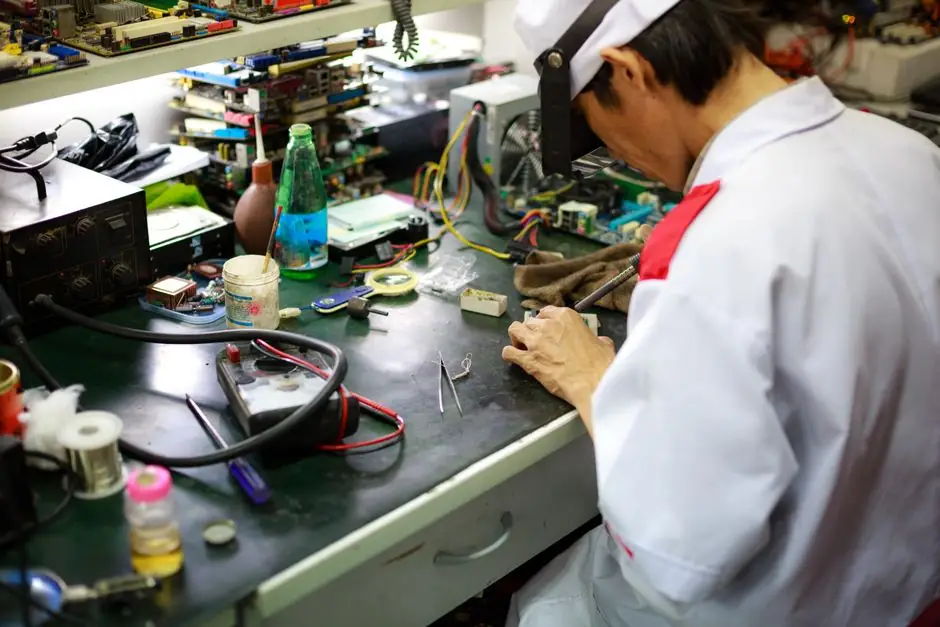
Z2Data tracked nearly 474,000 electronic components reaching end-of-life in 2023, and about 30% were discontinued without a product change notice [S2].
An effective plan for industrial electronics covers the design, production and field-support phases, using lifecycle reviews, product change notices, last-time buys and controlled redesigns to preserve continuity [S2][S3].
Scope of an Industrial Electronics Obsolescence Plan
Component obsolescence management is the continuous monitoring of part lifecycles, assessment of availability risk and planned response before an item becomes difficult to source [S1][S4]. It applies to original equipment manufacturers supporting industrial automation, energy, transportation, test and measurement, agriculture, heavy equipment and defence products, as well as operators maintaining legacy equipment [S2][S5].
The planning horizon must match the supported product. An industrial control panel can remain in service for 20 years, while a medical device may remain in production for 10 years after launch, even though their internal components have much shorter production runs [S2]. The industrial PC, HMI panel, industrial router and industrial modem categories all depend on electronic parts that can disappear from the market before the complete system reaches end-of-life [S2].
Obsolescence is not limited to a formal end-of-life notice. Availability may begin to decline before suppliers issue a final notice, so monitoring must include supply conditions, manufacturer portfolio decisions and market-demand shifts as well as product change notifications [S4].
Build the BOM Risk Baseline
The first deliverable is a controlled inventory containing each component’s manufacturer part number, description, quantity, lifecycle status, approved sources, lead time, affected assemblies and field-service demand [S1][S6]. Obsolescence management involves monitoring component lifecycles, assessing availability risks, and implementing strategies that support long-term product availability and production continuity.
Prioritise single-source parts, parts with long replenishment lead times and components embedded in safety, control or communications equipment. For an industrial switch, industrial relay or industrial UPS, the scoring record should connect component exposure to production volume, installed base, field failures, contractual support obligations and the cost of a complete redesign [S3][S4].
Lifecycle status is a design input, not a procurement footnote. Availability often begins to decline before suppliers issue formal end-of-life notices for electronic components. This stage should establish a named owner for each critical component and record the next review date, approved risk disposition and evidence required to close the action [S3][S4].
Compare the Three Main Responses

The main responses differ materially in engineering burden, cost and supply duration.
Alternate sourcing is not automatically interchangeable. Footprints that accept multiple qualified packages or reserve board space for a likely substitute can shorten future conversion, while single-source parts need an individual disposition before production starts [S2]. Replacement parts must be checked and tested for safety, and obsolete-market purchases require heightened controls because constrained supply can increase counterfeit exposure [S1][S4].
Design for Controlled Substitution
Lifecycle selection should favour multi-sourced components and industry-standard packages where the product architecture permits [S2]. A pushbutton pilot light or counter meter may be simple at the operator interface, but its internal electronics can still carry long-term supply exposure, so package strategy and sourcing depth belong in the original design review [S2].
For boards with constrained layout, reserve footprint-compatible locations for likely alternates, or design footprints that can accept more than one package. Identify single-source parts during schematic review and assign a mitigation path before tooling or volume production freezes [S2]. This reduces redesign scope without treating every alternate as drop-in equivalent.
Each proposed alternate must pass an engineering equivalence review covering electrical ratings, timing, memory, pinout, thermal performance, firmware dependencies, mechanical dimensions and applicable regulatory requirements. Many components inside products with long production lives have much shorter production runs, so component obsolescence management is needed to keep those products buildable, serviceable, and supported. The industrial display and industrial buzzer should be assessed at the assembled-product level, including display timing, alarm output, enclosure fit and functional safety impact.
Execute Last-Time Buys and Redesigns
Once risk is confirmed, the response must be time-bounded and approved before sourcing conditions deteriorate. Reactive management leaves fewer options, shorter lead times and less time to test alternatives, while time-pressured decisions expose the organisation to counterfeit parts, unplanned requalification and missed customer commitments [S4].
A last-time-buy package should state the supported demand window, quantity calculation, supplier, unit price, purchase-order date, inspection method, storage location, retirement date and approval owner [S2][S3]. The objective is not unlimited hoarding; it is a controlled bridge to the chosen next state, with obsolete stock tracked until consumption or formal disposal [S3].
For a redesign, use the validated alternate where electrical and mechanical equivalence can be demonstrated. Where it cannot, update the schematic, layout, firmware, bill of materials, test limits and service documentation, then complete the required safety and functional verification before release [S2][S3]. The plan should preserve traceability from each end-of-life notice to the affected serial-number range, replacement instruction, spare-part allocation and customer notification decision.
Legacy Equipment Requires a Separate Decision Path
Unsupported industrial electronics should not be handled through the new-production obsolescence process alone. Legacy systems combine component shortages with wear, failed assemblies, regulatory changes and loss of OEM support, making emergency purchases less predictable and more expensive [S5]. The decision must cover continued operation, redesign, replacement, remanufacture, strategic spare allocation and eventual withdrawal from service.
Legacy assets can sometimes be sustained by correcting design faults, remanufacturing unsalvageable assemblies and integrating newer-generation resistors, capacitors, diodes, transistors or integrated circuits [S5]. These interventions still require engineering verification of performance, reliability and compatibility. The expected life of the equipment and its mean time between failures should be included in the support decision rather than treating every operational unit as an indefinite repair obligation [S5].
Where the installed base includes operator controls or safety functions, an emergency stop button or other shutdown device must remain functionally suitable after any modernisation. Components that no longer have traceable specifications should not be accepted as automatic substitutes, and any change affecting safety performance requires the applicable engineering validation before deployment [S1][S5].
Governance, Evidence and Decision Thresholds

The plan should operate through four controls: scheduled BOM reviews, notice intake, risk classification and documented disposition. A practical cadence is an annual review plus a review before each major build, with heightened checks for critical or single-source components [S2]. Every decision should retain the notice, market assessment, qualification evidence, quantity justification, responsible owner and approval date.
Three thresholds determine urgency. First, a confirmed EOL notice requires an approved bridge or redesign. Second, falling availability without a formal notice requires supplier and market verification before committing to a last-time buy. Third, an unverified broker or obsolete-market part requires inspection, traceability and safety testing before use because counterfeit exposure rises when normal channels are constrained [S1][S4].
Performance can be tracked with operational indicators rather than generic activity claims: number of critical parts without a current lifecycle status, number of affected assemblies lacking a mitigation plan, age of the BOM review, lead time to close an EOL action, proportion of alternates with completed qualification and inventory remaining after the planned support window. These measures expose unresolved risk without treating the number of monitored parts as proof of continuity [S3][S6].
Closing paragraph: begin the next control cycle by exporting the active BOM, assigning every single-source and EOL-affected part an owner, and setting a dated review for critical industrial relay and industrial UPS assemblies. Track two hard signals through the next build: any increase in unnotified discontinuations and any critical part left without a qualified bridge or redesign.