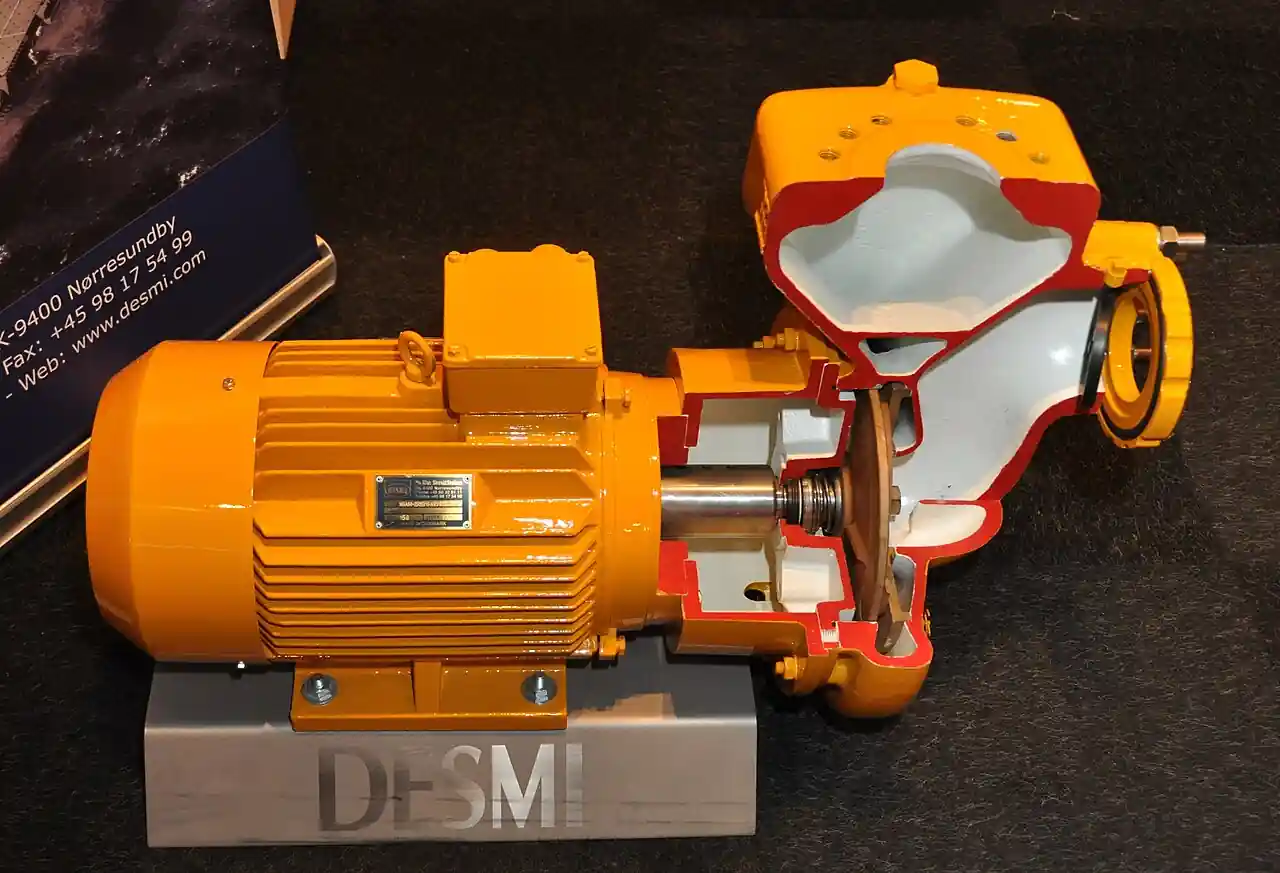
A jet pump is a device with no moving parts that moves a fluid by spending the pressure energy of a second fluid. Motive liquid, usually water at 2 to 8 bar from a centrifugal pump or a plant header, accelerates through a converging nozzle; at the nozzle exit its static pressure falls below the suction pressure, so the suction fluid is drawn in; momentum transfer in the mixing throat accelerates the entrained stream; and a diverging diffuser converts the velocity of the mixture back into pressure, discharging it at a level between suction and motive pressure. Industry calls the same machine an eductor, an ejector, or a liquid jet ejector depending on the shop, and this page treats all four names as one product family, the liquid jet pump.
Procurement engineers meet these devices as tank mixing eductors that keep solids suspended without an agitator, as sump and pit dewatering units that move liquid with no electricity in the pit, as priming eductors that pull vacuum on the casing of a large pump before start, as solids transport eductors moving sand, scale, and drilling cuttings, and as the deep well jet pump on rural water systems, where the jet assembly sits down the well and a surface centrifugal pump supplies the motive pressure. The decision this page settles is whether the duty is an eductor duty at all, which of the seven type families fits, and what the RFQ must state so the maker performance tables can be applied honestly: motive flow and pressure, suction lift, discharge head, and the entrainment ratio the process needs. The answer lands as an RFQ line set, and every chapter below feeds that line set so the station is bought, not hoped for.
This page treats the jet pump as a purchasing object: how momentum exchange sets the entrainment ratio, what maker performance tables actually promise, which of the seven type families fits tank mixing, priming, dewatering, solids, and deep well duty, and how motive circuit, materials, and installation details combine into a defensible RFQ. It is written for engineers who issue purchase specifications, not for readers who want a brochure summary.
Chapter 1 / 06
What a Jet Pump Is and What Is Being Decided
The machine is three pieces of static metal doing a pump's work. A converging nozzle takes motive liquid at pressure and turns pressure head into velocity head. A suction chamber surrounds the nozzle exit, where the high velocity jet and its low static pressure draw in the suction fluid, liquid or gas, and a converging mixing throat blends the two streams while momentum passes from the fast jet to the slow suction flow. A diverging diffuser then decelerates the mixture and recovers pressure, typically to a discharge pressure well below motive pressure but well above suction pressure. There is no shaft, no seal, no bearing, and no motor at the point of transfer; the only rotating machine in the system is the motive centrifugal pump standing safely somewhere else, and that single fact explains most of the family's niche applications.
What is actually being decided in this purchase is a duty class and a set of table numbers. Eductors are bought from performance tables, not from efficiency curves: the maker tabulates, for each size, what motive flow and motive pressure produce what suction flow at what lift and what discharge head, and the buyer's job is to state four numbers accurately, motive pressure available, suction lift, discharge head, and required entrained flow, so the table can be read without interpolation excuses. The purchase also commits the buyer to the motive circuit, a strainer, an isolation valve, a pressure gauge, and usually a dedicated small pump, because a jet pump fed dirty water or starved pressure is a nozzle repair kit. The type family choice, tank mixing, dewatering, priming, solids, scrubbing, or deep well, sets the internal geometry, and the material choice sets the corrosion envelope.
The naming deserves one paragraph of housekeeping because it causes real procurement errors. Jet pump is the family name this page uses; eductor is the water and process industries' word for the same static device; ejector is the general engineering term, and liquid jet ejector specifically names units pulling gas or vapor with a liquid motive. The steam jet ejector, which uses steam as motive and dominates vacuum systems in process plants, is a separate branch with its own standards lineage and is not covered here; where its governing practice matters to sizing culture, this page cites it. The deep well jet pump is not a separate machine at all but an application architecture: a jet assembly lowered into the well, fed by a two pipe loop from a surface mounted centrifugal pump, and sold as a packaged water system.
Standards honesty comes early on this page because buyers ask for a specification anchor that does not exist. No single ISO or API product standard governs liquid jet eductors; the sizing source of truth is the maker performance bulletin, of which the Schutte and Koerting Bulletin 2M pattern for water jet eductors is the classic example, and the tabling culture descends from the Heat Exchange Institute standards for steam jet ejectors, the HEI practice that fixed how motive, suction, and discharge conditions are stated and tested. A datasheet that quotes a performance table without stating the motive conditions behind it has quoted nothing, and an RFQ that cites HEI lineage plus a named bulletin is the strongest specification available in this product class.
The RFQ should state the station, because an eductor never works alone. The motive line needs a Y strainer ahead of the unit, since a scaled or grit-loaded nozzle is the primary failure mode; an isolation valve so the strainer can be serviced; and a pressure gauge at the motive inlet, because every performance claim in the bulletin is conditional on that gauge reading. The discharge line needs a check valve so the siphon does not run backward through the eductor at shutdown. Where the motive comes from a dedicated pump, the pump's own suction conditions and strainer belong on the same purchase order, and chapter 6 returns to each of these station details with the installation rules attached.
Chapter 2 / 06
How Momentum Exchange Does the Pumping
Walk the flow path. Motive liquid arrives at the nozzle at, say, 4 bar and modest velocity; the converging nozzle accelerates it to high velocity, and by Bernoulli's exchange its static pressure at the nozzle exit falls below the pressure in the suction chamber. The suction fluid, pushed by its own upstream pressure, enters the chamber and is caught by the jet. The two streams enter the converging mixing throat, where the jet shears into the suction flow and momentum passes between them: the motive stream slows, the suction stream accelerates, and the mixture leaves the throat at an intermediate velocity. The diffuser then widens gradually, a half angle of roughly 5 to 10 degrees to keep the boundary layer attached, and the deceleration converts velocity head back into pressure head. The outlet pressure is intermediate: the device is a pressure divider, not an amplifier.
The headline numbers are modest and should be stated before anything else. Momentum exchange efficiency for well made water jet eductors runs roughly 20 to 35 percent, meaning only that fraction of the motive energy rate arrives in the combined stream; the rest leaves as turbulence and heat. The entrainment ratio, usually written N and defined as suction flow divided by motive flow, reaches about 0.75 to 1.5 at low suction lift and modest discharge head, and falls as either lift or discharge head rises, because both load the momentum balance the same way. Maker bulletins of the Bulletin 2M class publish water jet eductors with suction capacity up to those ratios at favorable conditions, and every honest selection reads the table at the worst condition, not the best.
The geometry has cousins in the flow measurement aisle, and the relationship is worth one paragraph because it fixes the physics in a specifier's memory. A venturi tube is the same converging, throat, diverging profile used in reverse intent: the measurement element spends a pressure difference to infer a flow rate, while the jet pump spends pressure to entrain a flow. A flow nozzle contracts and accelerates a stream to create a measurable drop, and an orifice plate flowmeter does the same with a sharp plate; each of those devices throttles fluid that a pump somewhere had to pressurize. The eductor is the only member of the family that puts the acceleration to work moving a second stream, which is why it tolerates fluids that destroy instruments and why its internals, unlike the measurement cousins, are built as replaceable wear parts.
A worked example fixes the scale. A typical textbook pattern from Bulletin 2M style tables: a 1-1/2 inch water jet eductor, fed motive water at about 30 psi, roughly 2 bar, at roughly 30 gpm, about 6.8 m3/h, against 10 ft of suction lift and 10 ft of discharge head, entrains on the order of 20 to 30 gpm of suction water, an entrainment ratio near 1. The numbers are quoted as a pattern, not a certified row; the point of the example is proportion, that a modest eductor moves its own motive flow again as suction at gentle conditions, and that doubling the discharge head can roughly halve the entrained flow. Verify against the maker table for the exact size and conditions before the number enters a specification.
Cavitation and lift limits close the physics. Suction lift is bounded by atmospheric pressure minus vapor pressure: at sea level with cool water the practical ceiling for any suction device sits near 8 to 9 m, and hot water, altitude, or a fouled motive circuit eats that margin fast. The motive side has its own starvation mode: when the supplying centrifugal pump cavitates or its suction strainer loads up, motive pressure sags, the nozzle exit pressure rises relative to design, and entrainment collapses quietly long before anything drips. This is why the pressure gauge at the motive inlet is a specification item rather than an accessory: it is the single instrument that separates a healthy eductor from a starved one.
Two behaviors finish the mechanical picture. First, an eductor in reasonable service runs quiet, with no rotating parts and no pulsation, which matters next to analyzers and in buildings; the noise it does make, a moderate hiss at the mixing throat, scales with motive pressure. Second, the device is symmetric in failure: wear enlarges the nozzle and throat, the jet loses velocity, and capacity decays gradually rather than failing catastrophically, so a quarterly capacity check catches the trend a year before the station is in trouble. Both behaviors follow from the same static simplicity, and both are arguments in the selection chapter that follows.
Chapter 3 / 06
Types, Construction, and Duty Boundaries
Tank mixing and circulation eductors are the volume product. A small eductor, or a ring of them, is mounted through the tank wall or lowered on a drop pipe; motive liquid from a modest centrifugal pump loop entrains tank contents and ejects a plume several times the motive flow, blending, homogenizing, and keeping solids in suspension. In many tanks an eductor array reduces or eliminates the mechanical agitator, removing the mixer seal, gearbox, and crane access from the maintenance budget, and in covered or hazardous tanks it removes an electrical penetration from the vessel. Motive for this duty is typically 2 to 4 bar, and the plume pattern, axial or radial, is a maker selection parameter.
Sump, pit, and trench duty is the second family. The eductor hangs in the pit, fed by a surface water supply, and empties the pit into a drain or sump header with no electricity in the hole, which is the entire point where the pit sits inside a classified area or collects flammable liquid: the transfer is intrinsically safe because there is no ignition source at the point of pumping. The same hardware serves construction dewatering and emergency flood response, since the eductor tolerates debris that would stop a trash pump and runs dry without damage. For continuous duty the energy cost favors a submersible pump or a dedicated sewage pump on the drain header, and the selection chapter draws that line honestly; an air operated diaphragm pump competes where compressed air is at hand and the liquid is clean enough for its ball valves. For intermittent, hazardous, or debris laden duty, the static device wins on survivability.
Pump priming eductors are the third family and the quiet workhorse of power plants and water works. A small water jet eductor connected to the casing vent of a large pump pulls vacuum and floods the casing before start, replacing priming valves or a dedicated vacuum system; on cooling water and fire duty, where the pumps stand idle for weeks, a priming eductor with a motive line from the plant water system is simpler than the alternatives, a self priming pump in the size class of the main unit does not exist, and a full vacuum pump installation, whether a liquid ring vacuum pump skid for the house or a compressed air vacuum generator at each unit, is capital and maintenance the eductor avoids. The same pattern evacuates siphon lines and drains condenser water boxes during outages, and the eductor's indifference to wet steam and carryover is why it outlives more delicate priming hardware in those services.
Solids and slurry transport eductors, sometimes called sand eductors or hopper eductors, move what pumps chew. Sand, grit, mill scale, drilling cuttings, and crystallized sludge are drawn from a hopper or pit and propelled through the mixing throat; the flow path has no close-running impeller to erode, and the hardened or ceramic lined internals are replaced as wear parts. Continuous abrasive hoisting at high tonnage still belongs to a proper slurry pump, but intermittent grit removal, tank desludging, and well development duty run for years on an eductor that costs a fraction of the machine it replaces, and a progressive cavity pump on sticky sludge feed complements it where the material will not flow to a suction chamber at all.
Two more families complete the type map. Gas scrubbing and fume extraction eductors use the liquid jet as both motive and contactor: the entraining stream scrubs, absorbs, or condenses the gas it pulls, so venturi contactors of this class appear on acid fume, chlorine scrubbing, and evaporator systems with no moving parts at the corrosive point. Deep well jet pumps, the domestic architecture described in chapter 1, package a jet assembly plus a surface centrifugal pump on a two pipe system; a shallow well single pipe arrangement lifts about 7 to 8 m at sea level, while the deep well two pipe arrangement pushes from below and serves wells in the 15 to 25 m class reliably. The jet assembly is the same eductor physics, shrunk and tuned for well duty, and its wear parts are the nozzle and venturi sleeve in the down hole package.
Construction is standardized across the families even though the geometries differ. Bodies come in bronze for water duty, cast iron for utility service, 316L stainless for chemical and coastal work, Alloy 20 and Hastelloy C for acid and chloride service, and PTFE lined variants for the aggressive end. The nozzle and diffuser are replaceable internals in every serious design, held in bodies that open through spanner nuts on small sizes or flanged splits on large ones; connections run threaded NPT to about DN 80 and flanged up to about DN 400 on the largest tank and solids units. Pressure and temperature envelopes follow the body material and gasket set, with 10 to 16 bar motive typical and higher classes on request; the material choice is the corrosion decision, and the size choice is the performance table decision.
Dewatering, hazardous area transfer, flood response
N near 1 at low lift
No electricity in pit; motive hose and strainer required
Pump priming eductor
Casing vacuum on large pumps, siphon filling
Gas suction, liquid motive
Prime time versus casing volume; vacuum connection detail
Solids and hopper eductor
Grit, sand, scale, cuttings transport
Lower N, solids loaded
Hardened or ceramic internals as wear parts; flush connection
Scrubbing and fume eductor
Gas motivation plus contact in one body
Gas to liquid ratio per scrubber design
Material for the gas chemistry; mist eliminator downstream
Deep well jet assembly
Domestic and small community water, 15 to 25 m wells
Two pipe push from below
Packaged with surface pump; nozzle and venturi spares
Shallow well jet unit
Suction lift to 7 to 8 m at sea level
Single pipe suction
Atmospheric and vapor pressure limits govern, not the maker
Chapter 4 / 06
Key Specification Parameters and Sizing Practice
The table below decodes the datasheet lines that decide whether a quoted eductor matches the duty. Each row is purchase defining; the paragraphs after the table explain what to demand and what a weak answer looks like.
Attribute
Typical range or options
What it decides
Size and connection
Threaded NPT 1/2 to 3 inch, about DN 15 to DN 80; flanged to DN 400
Motive and suction flow class and the performance table row that applies
Motive pressure
2 to 8 bar typical; higher classes on request
The pressure the motive pump or header must actually deliver at the nozzle
Motive flow
Set by size and pressure per maker table, e.g. 30 gpm at 30 psi on a 1-1/2 inch unit
Motive pump sizing and water consumption where motive is not recirculated
Entrainment ratio N
0.75 to 1.5 at low lift, falling with lift and discharge head
Suction flow obtained per unit of motive flow, read at worst case conditions
Suction lift capability
7 to 8 m practical ceiling at sea level, cool water
Whether the duty is physically possible, never mind the catalog claims
Discharge head
Intermediate between suction and motive pressure
The elevation and line loss the mixture must overcome after the diffuser
Corrosion envelope for motive plus suction mixture chemistry
Internals
Replaceable nozzle and diffuser, hardened or ceramic on solids duty
Wear part policy and the capacity decay the maintenance plan manages
Temperature envelope
Per body and gasket set, roughly 100 deg C plus on metal units
Motive and suction temperatures, vapor pressure, and gasket rating
Performance basis
Named maker bulletin, HEI lineage tabling practice
What the quoted numbers are conditioned on and how they were tested
Sizing practice reads differently from pump selection, and the difference must be stated in the RFQ. There is no best efficiency point and no curve to ride: the maker table takes motive pressure and flow, suction lift, and discharge head, and returns the suction capacity at that condition, so the buyer's four input numbers must be the worst credible case, the lowest header pressure on a busy day, the highest pit level drawdown, the foulest discharge line. Then N is checked as a sanity ratio: a duty demanding N above roughly 1.5 at meaningful lift is asking the physics for more than it holds, and the honest fixes are a larger motive flow, a higher motive pressure, or two eductors in parallel. Where motive flow must be accounted, for example on once through plant water, the consumption line of the table becomes a cost line in the specification.
The worked pattern from chapter 2 extends across sizes, and the representative values below show the shape of a Bulletin 2M style family. The numbers are a textbook pattern for orientation, not a certified row from any one maker: read them as proportions and verify against the bulletin before a specification number is committed.
Size, representative
Motive pressure
Motive flow
Condition
Entrained flow, typical pattern
1/2 inch eductor
30 psi
about 5 gpm
10 ft lift, 10 ft head
4 to 6 gpm
1 inch eductor
30 psi
about 14 gpm
10 ft lift, 10 ft head
11 to 16 gpm
1-1/2 inch eductor
30 psi
about 30 gpm
10 ft lift, 10 ft head
20 to 30 gpm
2 inch eductor
30 psi
about 50 gpm
10 ft lift, 10 ft head
35 to 50 gpm
3 inch tank eductor
30 to 40 psi
about 110 gpm
tank mixing, no lift
plume 3 to 5 times motive
The motive circuit is half the purchase and deserves its own paragraph. Where a dedicated motive pump is needed, it is a small centrifugal pump selected for the table's flow at the table's pressure plus line losses, with its own suction strainer and, on hazardous duty, a magnetic drive pump or other sealless option to keep the sealed equipment count down; on small or high pressure specialty eductors a gear pump can supply steady motive at low flow, and for micro dosing loops a metering pump provides pulse free high pressure motive if the eductor is tuned for it. The motive line instrumentation is not optional: the Y strainer, the isolation valve, and the pressure gauge at the inlet, plus an orifice plate flowmeter or a flow nozzle on the motive line where consumption accounting or commissioning verification matters, turn the performance table from a promise into a measurement. Every one of those items was named in chapter 1 as part of the station; here they become datasheet rows with sizes.
Materials and certificates close the specification. The wetted set is body, nozzle, diffuser, and gaskets, and the corrosion decision must cover the mixture, not just the motive, because the suction stream defines the chemistry after the mixing throat. Alloy bodies are certified to EN 10204 3.1 material certificates on serious orders, flanged units are drilled to ASME B16.5 or EN 1092, and the performance basis line names the bulletin and its revision so that five years later a replacement unit quotes against the same table. A datasheet that names none of these, body material, internals policy, drilling standard, and bulletin revision, is a price tag, not a specification, and the parts will arrive mismatched to the station they were bought for.
Chapter 5 / 06
Selection Decision Factors and RFQ Language
The decision sequence below runs as a checklist in a specification meeting, and each step eliminates a class of quotations before any price comparison starts.
Confirm the duty class from the chapter 3 table: mixing, dewatering, priming, solids, scrubbing, or well water; the geometry follows the class.
State the four sizing inputs at worst case: motive pressure available, suction lift or pressure, discharge head, and required entrained flow.
Read the maker table at those conditions and check the entrainment ratio N stays under roughly 1.5; above that, resize motive or split the duty.
Set the chemistry of the mixture, motive plus suction, then pick the body material and internals: bronze, iron, 316L, Alloy 20, Hastelloy C, or lined.
Decide the motive source: plant header, dedicated centrifugal pump, or sealless pump on hazardous duty, and list its flow and pressure on the RFQ.
Specify the station hardware: strainer, isolation valve, motive pressure gauge, discharge check valve, and straight discharge run.
Fix the wear policy: replaceable nozzle and diffuser as cataloged spares, hardened or ceramic internals on solids duty.
Fix the evidence: named performance bulletin and revision, material certificates EN 10204 3.1 on alloy bodies, drilling standard, and HEI lineage tabling practice.
Against the neighboring technologies, the honest comparison runs as follows, and it belongs here in the selection chapter rather than in the page title. A centrifugal pump moves liquid with shaft energy at efficiencies an eductor cannot approach, and on continuous clean duty the centrifugal machine wins every hour it runs; the jet pump trades that efficiency for static simplicity, intrinsically safe transfer, and debris tolerance. For vacuum duty, a vacuum generator is the compressed air Venturi cousin, the right tool for spot vacuum at a workstation where compressed air is cheaper than a pump; a liquid ring vacuum pump is the correct instrument for sustained deep vacuum with large gas loads, as is a mechanical vacuum pump on skids needing quick pull down; the eductor primes pumps and pulls process vacuum only where liquid motive is already at hand. On chemical metering, a metering pump owns accuracy and a diaphragm pump owns general transfer; an eductor mixes and moves but never meters. On sludge and slurry, a progressive cavity pump owns thick sticky feed, a slurry pump owns continuous abrasive hoisting, and the eductor owns intermittent grit and desludging where impellers die. In sumps, a submersible pump owns continuous level control, and the sewage pump owns the wet well; the eductor owns the hazardous, remotely powered, or debris ridden pit. A self priming pump solves simple lift duty without a separate motive circuit and should be checked first where the duty is clean. Where a sealless recirculation loop is already needed for other reasons, a magnetic drive pump feeding both process and eductor motive consolidates the sealed equipment count, and on oil and lubricant service a gear pump supplies steady high pressure motive at flows no centrifugal stage reaches efficiently. And the venturi tube on the line measuring the flow is a reminder that the same physics family serves measurement where the jet pump serves transport. Choose the combination the duty needs, not the type a supplier has on promotion.
The application map below turns that comparison into a table the project file can carry.
Application
Construction to specify
Check before order
Tank mixing, solids suspension
Tank eductor array, 316L or lined body, dedicated motive loop
Plume pattern versus tank geometry; motive pump flow at nozzle
Hazardous area sump transfer
Pit eductor, no electricity in pit, surface motive and strainer
Area classification of motive pump; bonding for static
Large pump priming
Priming eductor on casing vent, plant water motive
Prime time versus casing volume; vacuum connection size
Solids size and loading; internals as cataloged spares
Acid fume scrubbing
Scrubbing eductor, Alloy 20 or PTFE lined, mist eliminator
Gas to liquid ratio; downstream separation
Deep well water supply
Packaged two pipe jet system with surface centrifugal pump
Static level and drawdown against 15 to 25 m class limit
Continuous clean transfer
Centrifugal or submersible pump, not an eductor
Energy cost of 20 to 35 percent efficiency on 8000 hours a year
The RFQ block should be written once and reused. A complete block reads: quantity, size, and connection type, threaded or flanged with drilling standard; duty class from the type table; the four sizing inputs at worst case, motive pressure and flow available, suction lift or pressure, discharge head, and required entrained flow; motive source described, header, dedicated pump, or sealless pump, with its flow and pressure; entrainment ratio expected at those conditions from the named bulletin; mixture chemistry with solids loading and particle size; body and internals materials with hardened or ceramic option where applicable; gasket set and temperature envelope; station hardware listed, strainer, isolation valve, pressure gauge, discharge check valve; spares, one nozzle and diffuser set per unit, and evidence, the named performance bulletin with revision, EN 10204 3.1 certificates on alloy bodies, and drilling per ASME B16.5 or EN 1092. A quotation returned without the bulletin reference or the motive conditions behind each number is incomplete at any price, and the steam ejector family, where a later page covers it, is out of scope here: this RFQ buys a liquid jet machine with liquid jet tables behind it.
Chapter 6 / 06
Installation, Standards, Failure Modes, and Maintenance
Installation quality decides whether the internals reach their catalog life, and the rules are short because the machine is short. Keep the Y strainer on the motive line immediately upstream of the unit: scale, weld bead, and grit are what plug and score nozzles, and the strainer is cheaper than the internals it protects. Fit the isolation valve between header and strainer so the strainer cleans without shutting the plant, and mount the pressure gauge at the motive inlet where it reads the truth the performance table is conditional on. On the discharge side, the check valve stops the siphon from backflowing through the eductor at shutdown, and a straight discharge run of 5 to 10 pipe diameters lets the diffuser recover its pressure before the first elbow spends it. Support the body on its connections, not the reverse, and on flanged units bring the bolts up crosswise in stages to the gasket maker's stress.
Commissioning turns the table into a measurement. Record the motive pressure and, where the consumption matters, the motive flow from an orifice plate flowmeter or the installed metering, then measure the entrained flow against a level change in the pit or tank, and compare both with the bulletin values at the same conditions. A unit that entrains 20 percent under the table is either starved at the motive, restricted at the suction, or loaded at the discharge, and the commissioning record is what separates the three causes when the same symptom appears in year five. On priming eductors, log the prime time against casing volume once, and treat a doubling of that time as the maintenance trigger defined below. File the commissioning numbers with the bulletin revision: that file is the baseline every later capacity check is read against.
Failure modes in service follow a short and predictable list. Nozzle erosion is the leader on abrasive duty: the throat and nozzle enlarge, the jet loses velocity, and entrainment decays gradually, remedied by replacing the internals, which is why they were specified as cataloged spares. Plugging is second, scale or solids lodging in the nozzle, prevented by the motive strainer and cleared through the body opening on spanner nut designs. Motive starvation appears when the supplying centrifugal pump loses suction or its strainer loads: motive pressure sags on the gauge, entrainment collapses quietly, and the fix belongs to the pump, not the eductor. Deep well packages fail on prime, and the cause is almost always a leak in the suction piping admitting air rather than wear in the jet assembly; a foot check of the drop pipe joints precedes any parts order. Cavitation of the motive circuit shows as noise and vibration at the pump and erratic eductor output, and it is resolved by fixing the pump suction conditions, never by resizing the eductor.
Maintenance intervals scale with duty severity, and the parts budget is small on purpose. On clean water duty, clean the motive strainer on a schedule, read the pressure gauge monthly, and run a capacity check quarterly against the commissioning record; internals last years. On solids and grit duty, inspect internals at every shutdown and replace on the capacity trend rather than the calendar, keeping one nozzle and diffuser set per unit in stores. Tank mixing arrays get the same checks annually along with the plume observation that costs nothing and catches a plugged unit visually. Hazardous pit eductors are inspected on the same entry permit as everything else in the pit, which is exactly their maintenance advantage: one body, no motor, no bearings, and nothing to grease. Every check writes one line into the station record, and that record is what converts the next RFQ from a guess into a specification.
The standards frame closes the page honestly. No single ISO or API product standard governs liquid jet eductors; the specification anchors are the maker performance bulletins, the HEI Heat Exchange Institute tabling and testing lineage inherited from the steam jet ejector practice, and the generic hardware standards that the station draws on, ASME B16.5 or EN 1092 drilling, EN 10204 3.1 material certificates, and the pump standards that govern the motive centrifugal pump standing behind the whole system. Cite the bulletin and its revision by name in the purchase order, attach the commissioning record as the acceptance baseline, and the burden of proof sits with the supplier, which is where it belongs.
FAQ
What is the difference between a jet pump and a centrifugal pump?
A centrifugal pump adds energy with a rotating impeller on a shaft, sealed and motor driven at the liquid. A jet pump, or eductor, has no moving parts at the point of transfer: it takes high pressure motive liquid from a separate pump, accelerates it through a nozzle, and uses momentum exchange to entrain a second stream. Momentum exchange efficiency runs roughly 20 to 35 percent, so the jet pump trades efficiency for simplicity, intrinsic safety, and tolerance of nasty fluids.
How deep can a jet pump lift water?
A shallow well jet arrangement on a single pipe lifts about 7 to 8 m at sea level, the same atmospheric limit that binds every suction pump. A deep well jet pump puts the jet assembly down the well and returns through a second pipe, so the motive column pushes from below, and practical service reaches 15 to 25 m. Beyond that class, a submersible pump set in the well is the correct architecture, and no nozzle refinement changes the physics.
What motive pressure and flow does an eductor need?
Plant and municipal water pressure of 2 to 8 bar covers most industrial eductors, supplied by a small centrifugal pump or the water header. Sizing comes from the maker table, not from formulas: a typical textbook pattern is a 1-1/2 inch unit at 30 psi motive and roughly 30 gpm entraining 20 to 30 gpm against 10 ft of lift and 10 ft of head. Always verify the exact row for your conditions before the number enters a specification.
Why has my eductor lost capacity?
Check the internals first. Nozzle and diffuser erosion enlarge the passages, detuning the momentum exchange, and capacity falls long before anything leaks; replacement internals restore it. Scale or solids plugging the nozzle is the second cause, prevented by the motive line strainer. Third, motive starvation from a loaded suction on the supplying pump drops motive pressure. A pressure gauge at the motive inlet separates all three causes in minutes.
Can jet pumps be used in hazardous areas?
Yes, and that is one of their strongest niches. The eductor body carries no electricity, no motor, and no spark source, so the transfer is intrinsically safe in explosive atmospheres while the motive pump and its controls sit outside the classified zone. Flammable liquid transfer, tank mixing in solvent service, and pit emptying inside classified process areas are standard applications. Ground the piping for static, and confirm the motive pump meets the area classification.
Jet pump or submersible pump for sump emptying?
Use a submersible pump when duty is continuous, efficiency matters, and the liquid is kind to a motor. Use an eductor when the sump sits in a hazardous or remotely powered area, when the liquid is abrasive or stringy enough to destroy an impeller, or when motive water is already at hand. The eductor tolerates running dry and buried debris; the submersible pump wins on energy cost every hour it runs, so the choice follows duty cycle.
What maintenance does a jet pump need?
Very little, which is the point. The eductor has no bearings, seals, or rotating parts; the wear items are the nozzle and diffuser internals, treated as consumables in abrasive service. Keep the motive strainer clean, watch the motive pressure gauge, and run a periodic capacity check against the commissioning value. Deep well packages need suction pipe leak checks, since an air leak breaks prime long before anything visible fails.