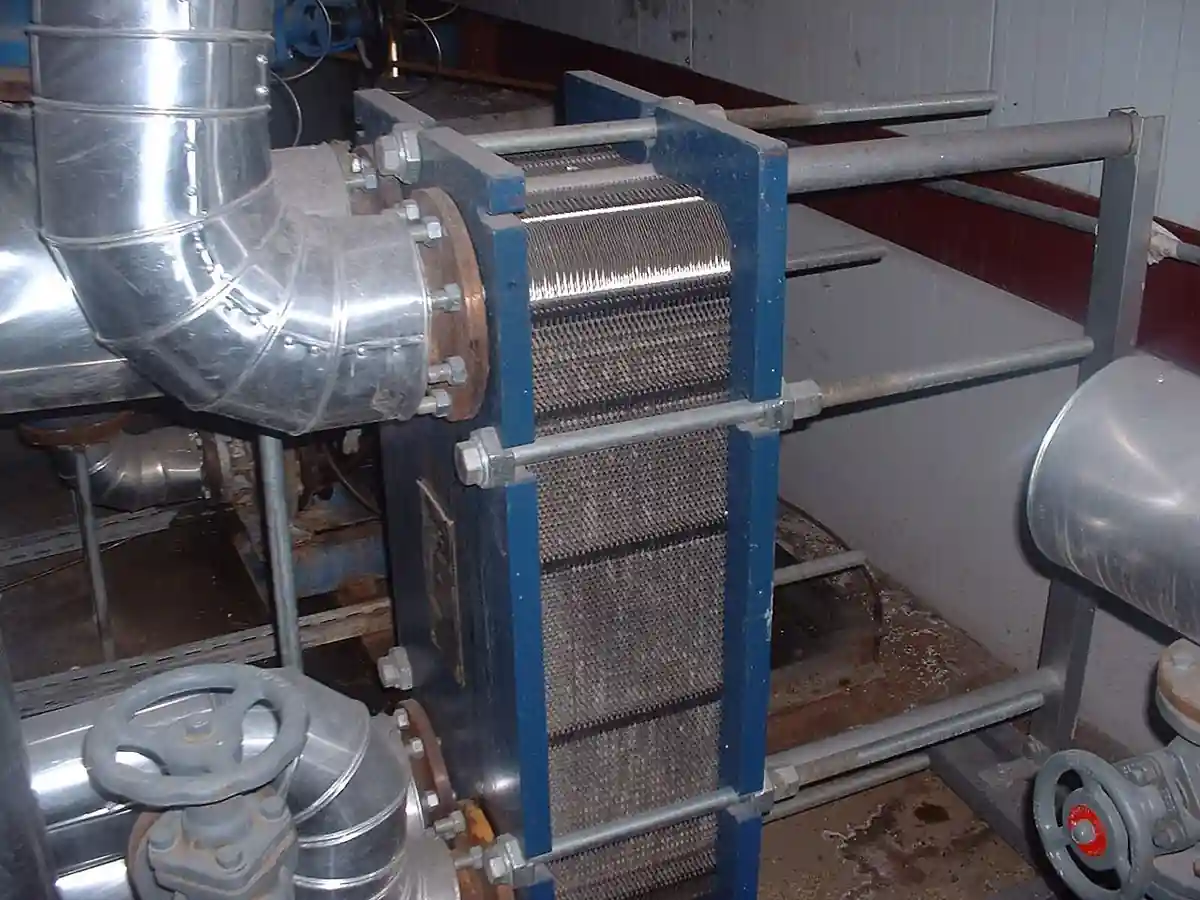
A printed-circuit heat exchanger, PCHE, is a compact exchanger whose flow passages are chemically etched into thin metal plates and the plates then diffusion-bonded into a solid block, a core with no gaskets, no brazing filler, and no joints except the metallurgical bond of the parent metal itself. Passage dimensions are on the order of a millimeter or two, giving heat transfer area densities far beyond shell-and-tube construction, and the bonded block holds pressures and temperatures that brazed aluminum plate-fin cores cannot, which is why the design dominates high-pressure gas duty, supercritical CO2 cycles, hydrogen service, and offshore footprint-constrained plants. Vacuum Process Engineering's diffusion-bonded exchanger literature and supercritical CO2 cycle tutorials from the sCO2 community are representative references, and this page treats the complete core, headers, nozzles, and mechanical design, as the purchasing object.
This page is written for the engineer specifying a printed-circuit heat exchanger for a hydrogen or electrolyzer plant, an sCO2 or advanced power cycle, an LNG or gas processing duty, or any process where pressure and temperature exceed what gasketed or brazed compact designs tolerate. It works through what the machine is and what is being bought, how etched passages and diffusion bonding make the performance, which core designs fit which duties, the parameters that appear on vendor data sheets, and the selection factors and RFQ language that decide whether the core delivers its duty for a fouling and inspection regime the plant can actually run.
The decision concentrates in five places: the fluids and their duty, temperature approach, pressure, and allowable pressure drop, the design pressure and temperature the core must hold, which the bonding makes possible and the passage design must survive, the fouling character of the streams, because millimeter passages are unforgiving, the materials against the chemistry, stainless, nickel alloy, titanium, and the stream count and arrangement, one core can carry several streams in designed proximity. Get those right and the core size, the header design, and the qualification scope follow with little freedom.
Chapter 1 / 06
What a Printed-Circuit Heat Exchanger Is and What Is Being Decided
The machine this page describes starts as flat metal plates, typically a millimeter to two thick, onto which a photoresist and etchant routine carves the flow pattern, channels a millimeter or two across, straight, zigzag, or discontinuous fin shapes by design, in an arrangement the thermal designer lays out stream by stream. The etched plates are stacked in the designed sequence and diffusion-bonded, held at high temperature under pressure in a furnace until the plates grow together into a single block of parent metal, and the block then receives headers, nozzles, and lifting and mounting provisions; multiple blocks weld into larger cores when a single block's size limit binds. The finished core is monolithic: there is no gasket to blow, no braze to creep, no tube-to-tubesheet joint to leak, and its integrity is the integrity of the metal itself.
What is being decided when a PCHE is purchased is a thermal duty at a stated approach and pressure drop, held at a design pressure and temperature, in a core whose fouling behavior the streams' cleanliness supports. The buyer is purchasing a stated heat load between defined stream conditions, hot and cold inlet states to outlet targets, with guaranteed pressure drops on each side, in a pressure envelope that commonly reaches several hundred bar and temperatures that run from cryogenic to several hundred Celsius by material, with a passage geometry the vendor designs to the duty. Everything on the vendor data sheet, core dimensions, plate count, passage type, area density, exists to support those guarantees, and the honest vendor quotes the passage hydraulic diameter and the design margin, not only the block size.
The PCHE sits in the compact exchanger family with defined neighbors. It is not the plate fin heat exchanger, the brazed aluminum block whose fins and parting sheets make the same compactness at cryogenic temperatures but whose braze limits pressure and temperature, and that machine's own page in this encyclopedia states the boundary explicitly. It is not the gasketed plate heat exchanger, the framed plate pack whose elastomer gaskets cap pressure and temperature in the other direction. It is not the shell-and-tube heat exchanger, the tube-bundle-in-shell workhorse whose pressure capability it matches or exceeds at a fraction of the volume, though the tube bundle remains the answer for fouling and two-phase slurries the etched passage cannot tolerate. Each neighbor has its page; this one is the etched, bonded, gasket-free core.
Different buyers buy the same core for different fluids. A hydrogen plant cools and recovers heat around a steam methane reformer or an electrolyzer, where a hydrogen electrolyzer's gas streams and power electronics cooling run at pressures and densities that suit bonded cores. An advanced power cycle, supercritical CO2 test and demonstration plants, uses PCHEs as recuperators and gas coolers, where the sCO2 recuperator's duty at high pressure across a small temperature pinch is the application that made the technology famous. Gas processing and LNG plants use them in gas-gas service and as vaporizers, an lng vaporizer duty's compact sibling, gas turbine fuel conditioning skids preheat fuel gas in bonded cores, and offshore platforms use them wherever deck space is priced by the square meter. Compressor stations cool high-pressure gas after each stage, and the recuperator or feed heating duty of process plants rounds out the field.
The economics deserve their own paragraph because the PCHE sells footprint and material efficiency, not first cost. Area densities run several times shell-and-tube, so a duty that fills a skid of tubular hardware becomes a block a person can move, and in weight-sensitive and space-sensitive installations, offshore, skid-mounted process plants, that reduction pays immediately. Against it stands a higher cost per square meter of surface, a delivery that includes bonding cycle time, and a fouling intolerance that can convert a cheap core into an expensive one if the stream carries solids or fouling precursors. The honest comparison prices the duty, the installed space, and the cleaning consequence together, and the buyer whose stream is clean and whose space is expensive finds the core cheap at any price per meter.
A short tour of named duties makes the core concrete. At an sCO2 pilot, a bonded recuperator returns compression heat to the turbine stream at several hundred bar with an approach no tube bundle could afford in the volume allowed. At a hydrogen refueling station, a PCHE precools gas flowing to vehicle tanks against refrigerant in a block the size of a shoebox. At an offshore gas platform, gas-gas cores exchange heat between production and injection streams in a module footprint a shell-and-tube train could never occupy. At a compressor skid, an intercooler between an axial compressor or centrifugal compressor stage and the next takes discharge gas to design temperature at pipeline pressure. Each duty names the same knobs, passage geometry, pressure, approach, and cleanliness, with sizes that scale while the bonded physics barely changes.
Chapter 2 / 06
How Etched Passages and Bonding Do the Work
The heat transfer is microchannel discipline. A passage a millimeter or two across has a hydraulic diameter one to two orders below a tube's, and the heat transfer coefficient scales inversely with it, so film coefficients rise steeply; area density, square meters of surface per cubic meter of core, rises with it, and the compactness the machine is known for is arithmetic on those two facts. The passage shape tunes the trade: straight channels give lower pressure drop and easier cleaning, zigzag and serrated passages trip the boundary layer and add transfer at the price of pressure drop and fouling sensitivity, and discontinuous fin patterns push further along the same curve. The designer's canvas is the etch mask, and the design freedom it gives explains why two cores of identical size can be different machines.
Diffusion bonding is the enabling manufacture. In the furnace, under heat and pressure, the asperities of adjacent plate surfaces creep and merge until the joint line disappears and the stack is one piece of metal, with joint efficiency at or near parent metal; the process is slow, atmosphere controlled, and the reason lead times and prices carry a premium. The bond's quality is verifiable, ultrasonically and by sectioning witness coupons, and its qualification belongs in the purchase scope. The same furnace cycle bonds the passage walls that must contain the design pressure, so the mechanical design, the passage as a pressure vessel wall, and the manufacture are inseparable, which is why the vendor's bonding record, not the brochure, is the qualification.
Thermal arrangement follows the etch layout. Streams pass through the core in counterflow, crossflow, or multipass patterns drawn by the designer plate by plate, and multiple streams can share one block, a cold stream, a hot stream, and a reheat or boil stream interleaved, so a single core replaces two or three conventional exchangers and their interconnecting piping. Headers distribute each stream from its nozzle to its plates, and header design, the manifolds' taper and the plate-to-plate flow balance, is where maldistribution hides; a core with perfect plates and a poor header loses approach in the field. The buyer's protection is the vendor's header design method and its verification, and a performance test at acceptance closes it.
Fouling is the physics the buyer must respect. The same small passages that give the coefficients give no room for deposit, and a stream that scales, polymerizes, carries corrosion product, or drags particulates will plug a core that a shell-and-tube would shrug at. The design answers are honest ones: filtration upstream at a rating the passage size dictates, passage selection biased to straight channels for marginal streams, chemistry control that keeps fouling precursors in solution, and clean-in-place provisions, flushing connections and compatible solvents, engineered at purchase rather than improvised after the first upset. Streams known dirty belong in other machines, and the selection discipline is knowing which stream you have.
Pressure and temperature capability come from the block. A bonded core of stainless or nickel alloy routinely carries design pressures in the hundreds of bar, with published designs beyond five hundred, and temperatures from cryogenic service, where the block's uniform thermal mass resists thermal shock, to six hundred Celsius and beyond by alloy; the same envelope in a gasketed machine is impossible and in a brazed core is limited by the braze. Thermal cycling tolerance is a design matter, the uniform monolithic core cycles better than dissimilar-metal joints, but cycling rates and ramp limits belong in the specification, and the vendor's cycle test data belongs in the bid.
Degradation has a short honest list. Fouling and plugging, already described, lead it. Corrosion follows the material choice, and the small passages give corrosion no tolerance the tube bundle's wall thickness would buy time with; a material selected by a corrosion table rather than by the stream's actual chemistry is a gamble with a blocked core as the stake. Erosion at header entries and passage bends sets a velocity ceiling the designer respects. Bond defects, the manufacture's rare failure, are caught by the qualification and inspection regime, not by operating statistics, which is why that regime is the purchase's quality core.
Chapter 3 / 06
Core Types, Duties, and Machine Boundaries
Passage families name the internal types. Straight-channel cores run parallel millimeter channels end to end, the low pressure drop, fouling-tolerant end of the range, suited to condensing and clean single-phase duty. Zigzag or S-channel cores fold the channel to trip the flow and add transfer coefficient, the general-purpose single-phase design. Discontinuous fin and serrated patterns interrupt the channel repeatedly for maximum coefficient, at the highest pressure drop and fouling sensitivity, used where approach temperature is precious and the stream is clean. The vendor's thermal design chooses per stream, and a multi-stream core may mix passage families, hot zigzag against cold straight, within one block.
Arrangement families name the block. Counterflow single-block cores serve the majority of single-phase duties, cold and hot streams interleaved along the block. Crossflow cores pass streams at right angles, common where pressure drop on one side is precious, and multipass internal headers fold streams through the block two or three times. Multi-stream cores interleave three or more streams, and large duties weld several blocks into banks, manifolded as one exchanger. Surface treatment variants, enhanced boiling surfaces and condensation stripes etched into the plate, extend the design into phase change duty, vaporizers and condensers, that older compact designs could not reach.
Material families follow the chemistry. Stainless cores serve clean industrial gases and sCO2 development duty at moderate temperature. Nickel alloys, the 625 and 718 families, serve high temperature and aggressive service, sour gas, hot hydrogen, and the high-strength pressure envelope of the top of the range. Titanium serves seawater cooling and offshore duty; duplex and superduplex serve oil and gas chemistry. The etch and bond process runs on all of them, and the buyer's material selection follows the corrosion engineer's assessment, not the vendor's default stock, with the qualification scope, plate certificates, bond coupons, and pressure test, attached to whichever alloy is chosen.
The duty boundaries against the neighbor machines deserve precision, because the compact field is crowded and each machine has its page. Against the brazed plate fin heat exchanger, the PCHE buys pressure and temperature at the price of etched-channel fouling sensitivity where the brazed fin core's aluminum excludes it anyway. Against the shell-and-tube, it buys footprint and coefficient where the stream is clean, and concedes fouling, two-phase slugging, and mechanical cleaning access where it is not. Against the gasketed plate pack, it buys pressure and temperature that elastomers cannot seal and concedes the opened-plate cleanability that makes gasketed machines the food and municipal standard. The air cooled heat exchanger rejects heat to air where the PCHE exchanges between streams; the two share plants, not duties.
Adjacent process equipment completes the plant picture. Upstream, knockout drums and separators guard the core with their liquid and particulate removal, a knockout drum before a gas-gas core being ordinary good practice, and filtration, from a self cleaning filter or cartridge set by stream class, stands between marginal streams and the etch. Downstream, turboexpanders, reciprocating and centrifugal compressors, and the process hardware of hydrogen plants, electrolyzers and reformers, give the core its duties. In viscous and fouling chemical service the neighbors diverge instead, a jacketed reactor with its utility jacket, a spiral heat exchanger for sludges, a double pipe heat exchanger for small duties, or a scraped surface heat exchanger where the product fouls any wall it meets, and the honest selection sends dirty duty to those machines and clean duty to the bonded core. Within the PCHE's own family there is one species, etched and bonded, and the RFQ should state fluids, conditions, and cleanliness rather than ask for compactness and hope.
Chapter 4 / 06
Key Specification Parameters
The vendor data sheet for a PCHE centers on duty, conditions, and passage design, and each number carries a purchase consequence. The table below lists the parameters that recur across manufacturers' quotations, with typical ranges for the main classes; values for a specific project come from the process design and the vendor's thermal run, and the ranges here are orientation, not a substitute for a designed selection.
Parameter
Typical range
What it decides
Design pressure
to 500 bar and beyond by alloy
The pressure class only bonding reaches
Design temperature
-200 to +600 C by material
Alloy family; qualification scope
Passage hydraulic diameter
0.5 to 3 mm
Coefficient, fouling sensitivity, cleanability
Area density
500 to 2,500 m2/m3
Footprint and mass per unit duty
Thermal approach
1 to 5 K in close designs
Duty value; cycle efficiency in power service
Pressure drop allowance
kPa to tens of kPa per stream by design
Passage pattern; compression or pumping cost
Stream count per core
2 to 4 typical, more by design
Block consolidation; header complexity
Block size limit
vendor specific, blocks banked beyond
Single core versus manifolded bank
Three of these numbers deserve the buyer's suspicion when they arrive without a basis. Approach temperature quoted without the pressure drop it was bought at flatters the design, and the pair is the trade. Passage size quoted as a single figure hides the pattern, a straight millimeter channel and a serrated millimeter channel are different machines to a fouling stream. Design pressure quoted without the temperature it applies at, or the cycle count behind it, leaves the qualification vague, and the buyer should ask which code case and which test witnessed it. An RFQ that fixes stream conditions, cleanliness class, and code jurisdiction separates engineered offers from assembled ones.
Materials and construction follow the chemistry and the code. Plate and block materials carry mill certificates, and welds, headers to nozzles, blocks into banks, follow the pressure code's welding regime with the qualified procedures that implies; the diffusion bond itself carries the vendor's qualification, witness coupons sectioned and tested with each production lot. Instruments, thermowells and pressure taps, land in the headers or dedicated plates, and lifting, mounting, and insulation supports complete the mechanical scope. Hydrotest and, where the code or buyer asks, helium leak testing close the manufacture, and the data book is the deliverable a code purchase is really buying.
Chapter 5 / 06
Selection Decision Factors and RFQ Language
Selection starts with the streams, not the catalog. The process design fixes each stream's composition, flow, and end states, the value of approach temperature, and the pressure drop budget; the cleanliness of each stream, particulate, scaling, polymerization potential, decides whether the etched passage is admissible at all, and where it is marginal, filtration scope and passage pattern move together. The envelope, design pressure and temperature with cycling, fixes the material family; the space and weight economics, offshore, skid, or plant, decide whether the compactness premium pays. A buyer who has not characterized the stream cleanliness has not started the selection.
The alternatives belong in the study rather than in habit. For clean high-pressure gas and power cycle duty the PCHE has few rivals at the envelope's top; below it, the brazed plate fin core, the shell-and-tube train, and the welded plate pack compete on price and delivery, and the compact core must win on footprint and approach. For dirty streams the comparison ends early and the fouling-tolerant machines win; the selection discipline is running that check before the premium is paid. Multi-stream consolidation, one bonded core replacing two exchangers and their piping, is the PCHE's structural advantage and should be priced in the comparison, not discovered after it.
The table below organizes the decision into the factors that recur across projects, with the questions the buyer should be able to answer before the RFQ goes out. Each row is a place where an incomplete answer turns into an underspecified core and an availability argument later.
Decision factor
What the buyer must state
Consequence if left open
Stream definition
Composition, flow, end states for every stream
Thermal design assumed; guarantees void
Cleanliness
Particulate, scaling, chemistry fouling potential per stream
Plugging risk unbudgeted; CIP absent
Envelope
Design pressure and temperature, cycling profile
Alloy and qualification wrong
Approach value
Target approach and pressure drop budget per stream
Design point unfixed; offers incomparable
Stream layout
Streams to consolidate into one core
Consolidation benefit lost
Code jurisdiction
Pressure code, test regime, data book scope
Requalification or acceptance failure
Delivery
Bonding lead time, spares philosophy, block banks
Schedule surprises; no spare strategy
RFQ language for a PCHE should name the streams and the basis of guarantee. A workable specification states: each stream's composition, mass flow, inlet state, and target outlet state; required duty with the approach and pressure drop basis; design pressure and temperature with cycle profile and upset cases; cleanliness class and the filtration or straining provided upstream; material family with the corrosion basis; passage pattern expectations and clean-in-place provisions; code jurisdiction with the qualification and data book scope, bond coupons, hydrotest, and leak testing; block banking and nozzle arrangements; and the acceptance basis, a witnessed thermal performance test at the stated conditions where the duty warrants it. Naming the plant neighbors, the hydrogen electrolyzer or steam methane reformer the core serves, the turboexpander or compressor train it cools, and the knockout drum guarding its inlet, lets the vendors bid the interfaces as well as the block.
Chapter 6 / 06
Installation, Standards, Failure Modes, and Maintenance
Installation is a lifting and piping job with a cleanliness core. The core arrives as a welded block with nozzles, is set on its supports with the thermal growth allowances its monolithic stiffness actually needs, and the piping lands with the strain limits any pressure vessel demands; supports and guides follow the vendor's loads, not the pipefitter's habit. The critical pre-commissioning step is cleanliness commissioning: the upstream systems blown and flushed, filters verified, and the core's own first hours monitored for differential pressure, because the passage's first fouling event should be a measured one. Dry-out and inerting follow the stream chemistry, and slow thermal ramps on first heat follow the vendor's cycle limits.
Standards for these machines are pressure-code driven. The block is designed to the jurisdiction's pressure vessel code, ASME or the applicable national framework, with the design cases the code requires, and the diffusion bond carries the vendor's qualification procedure agreed with the buyer's inspectorate; materials carry mill certification, welding follows qualified procedures, and hydrotest plus the agreed leak test close manufacture. Thermal performance rating is vendor methodology, and the acceptance test, where specified, is agreed in the contract rather than assumed from a standard. Any edition reference in project documents should be checked against the current issue at purchase rather than copied from an old specification.
The recurring failure modes are fouling first and everything else rarely. A rising pressure differential across a stream is the plugging signature, and the response ladder is chemistry adjustment, solvent or back-flush within the vendor's allowances, and, in the worst case, core replacement, because mechanical cleaning of etched passages is not a field operation. Corrosion follows the material-versus-chemistry mismatch and announces itself the same way, rising differential and changing performance. Erosion at header entries follows velocity excursions. Bond or weld defects are qualification-caught, not operating statistics, and a core that passes its data book rarely fails by manufacture. Freeze and hydrate duty, where the stream carries water, adds the low temperature fouling modes wax and hydrate that the process chemistry must prevent.
Maintenance planning is monitoring driven with long clean intervals. The table below lists the checks with the typical cadence a plant will schedule, assembled from common practice; actual intervals follow the stream cleanliness and the duty's severity and should be set from the plant's own trending.
Item
Typical action
Typical cadence
Differential pressure per stream
Trend against clean baseline
Continuous to weekly
Thermal performance
Compute duty and approach from plant data
Weekly to monthly
Upstream filtration
Service filters, verify integrity
Per differential, monthly check
Clean in place
Solvent or flush per vendor allowances
On differential trigger
Nozzles and supports
Inspect loads, growth, insulation, corrosion
Annual
Leak surveillance
Cross-stream contamination monitoring by analysis
Continuous to monthly
Data book retention
Keep qualifications for code life
Permanent record
Long term care is chemistry and trend discipline. A PCHE that runs clean is nearly maintenance free, its only wear surface the fluid itself, and the plants that do best are those that treat stream chemistry and filtration as part of the exchanger's specification, monitoring differential and approach the way a plant monitors a bearing's vibration. Retrofit opportunities, additional cores in banks for turndown or expansion, and replacement on a planned outage rather than a forced one, are scheduled from the trend record. The plant that buys the data book, runs the trends, and respects the chemistry owns an exchanger whose failure modes are all preventable, which is the quiet argument for the bonded core in the first place.
FAQ
What makes a printed-circuit heat exchanger different from a plate-fin heat exchanger?
Both are compact blocks, but the manufacture differs fundamentally. A PCHE etches passages into solid plates and diffusion-bonds them into a gasket-free block of parent metal, so it holds pressures to several hundred bar and temperatures that brazes cannot. A plate fin heat exchanger bonds aluminum fins and parting sheets with brazing filler, giving high compactness at cryogenic temperatures but limited pressure and temperature by the braze. The PCHE buys its envelope with premium cost and fouling-sensitive passages; the brazed core serves the cryogenic and moderate-pressure duties this one does not.
How does diffusion bonding work and why does it matter?
Etched plates are stacked and held in a furnace under heat and pressure until the plate surfaces creep together and the joint line disappears, making the stack one piece of metal with near parent-metal strength. It matters because the pressure-containing walls of the millimeter passages are those bonds, so the core's integrity is metallurgical, not mechanical, with no gasket, braze, or tubesheet joint to fail. The bond's quality is verified by witness coupons and sectioning in the qualification, which is why the vendor's bonding record is the real qualification in a purchase.
What pressures and temperatures can a PCHE handle?
Design pressures commonly reach several hundred bar, with published designs beyond five hundred, and temperatures run from cryogenic to six hundred Celsius and above depending on alloy. Stainless cores serve the middle of the envelope, nickel alloys extend temperature and strength, and titanium serves seawater duty. The exact capability is alloy and design case specific, so the envelope belongs in the RFQ with the cycling profile, not as a single catalog number quoted without a basis.
Are printed-circuit heat exchangers suitable for fouling streams?
Only with discipline. Passages one to two millimeters across tolerate far less deposit than a tube, so streams that scale, polymerize, or carry particulates will plug a core that a shell-and-tube would tolerate. The workable pattern is clean streams by design, upstream filtration rated to the passage size, straight-channel patterns for marginal fluids, chemistry control, and clean-in-place provisions engineered at purchase. Known-dirty fluids belong in fouling-tolerant machines, and the honest selection sends them there.
Can one PCHE core handle more than two streams?
Yes, multi-stream cores are a signature capability. Because the etch mask lays out every plate, three or four streams can be interleaved in one bonded block, hot, cold, and reheat or boil streams exchanging heat in designed proximity, so a single core replaces two or three conventional exchangers and their interconnecting piping. Header design and flow balance grow more complex with each stream, and the acceptance test matters more, but the consolidation is real money in footprint and piping.
Why are PCHEs used in supercritical CO2 power cycles?
The sCO2 recuperator duty is high pressure on both sides, several hundred bar, with a small temperature approach that recovers compression heat to the turbine side, and it must fit in a compact power block. That combination defeats shell-and-tube on approach and footprint and brazed cores on pressure, and it is exactly what etched, diffusion-bonded passages deliver. The sCO2 community's tutorials and pilot hardware have made the recuperator the application most identified with the technology.
What should a PCHE RFQ include?
State each stream's composition, flow, inlet state, and target outlet, the required duty with approach and pressure drop basis, design pressure and temperature with cycling and upset cases, stream cleanliness class and upstream filtration, material family with the corrosion basis, passage pattern expectations and clean-in-place scope, the pressure code jurisdiction with qualification and data book requirements, block banking arrangements, and the acceptance basis including any witnessed performance test. Naming the plant interfaces, the electrolyzer, reformer, compressor train, or knockout drum, lets vendors bid the connections as well as the core.