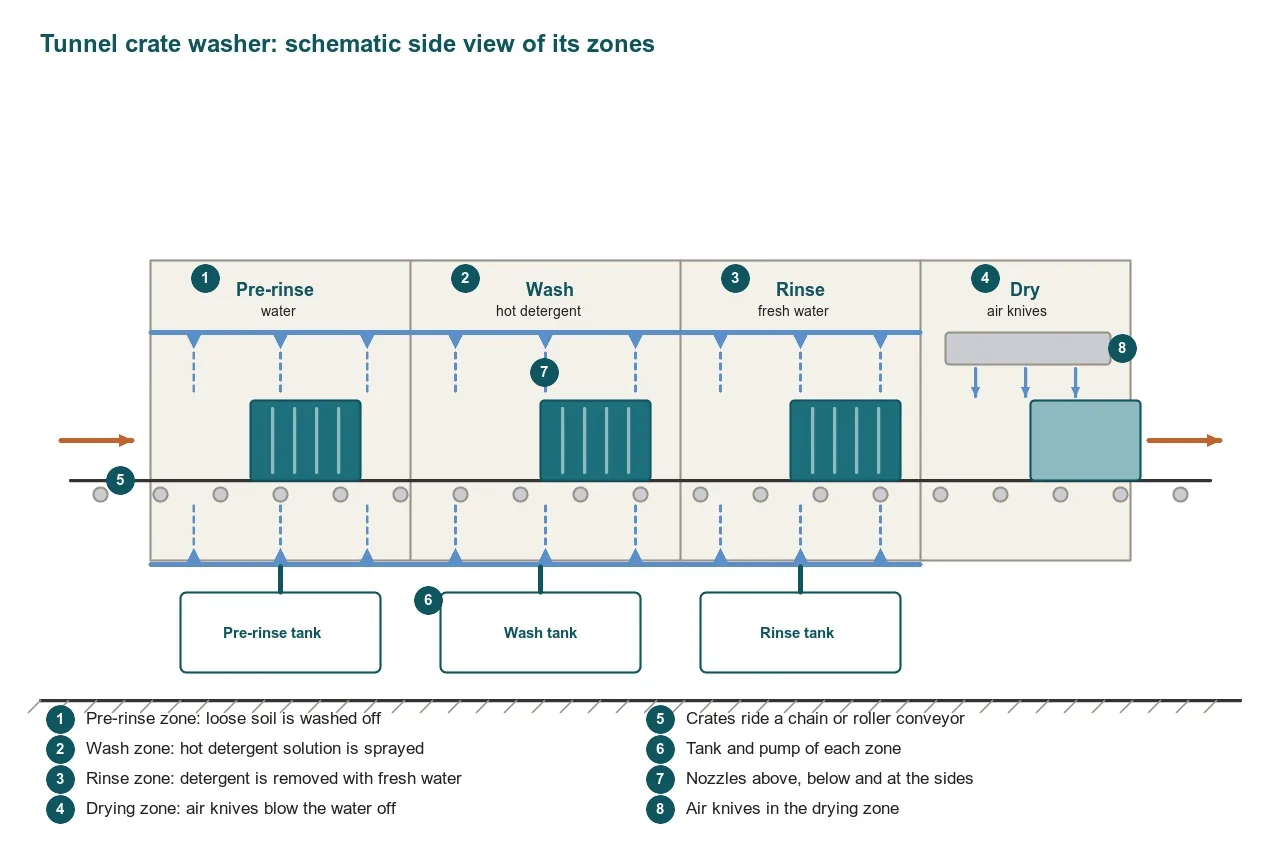
A crate washer is a machine that cleans reusable rigid containers, plastic crates, trays, bins, totes and pallet boxes, between one use and the next. The containers travel on a conveyor through a long tunnel divided into zones, and in each zone they are sprayed from above, below and the sides: first a low-temperature pre-rinse that strips blood, protein and loose debris, then a wash with hot water and detergent, then a rinse with fresh water, and often a blow-off with warm air. Pumps, tanks, heaters and filters sit in the frame beneath the tunnel. The machine is bought as a standalone unit for a wash room or built into a packing line, and its job is to return a defined number of clean, dry crates every hour.
Cleaning inside that tunnel rests on four variables that the buyer balances against each other: chemistry, mechanical force, temperature and time. A shortfall in one has to be paid for by the others, so a washer run cold needs stronger detergent or a slower chain, and a washer run fast needs hotter water or harder spray. What the machine leaves behind matters as much as what it removes: residual detergent, a film of soil in a crate corner or a puddle in the bottom of a crate carries the next load of product into a contamination event. The crate washer therefore sits inside the plant's sanitation program, and its temperatures, detergent strength, water use and cycle records are audited with the rest of the process.
Diagram: SpecForge original drawing of a tunnel crate washer and its zones, made for this page.
The purchase concentrates on five items and one arrangement. Crate size and hourly throughput fix the tunnel length and chain speed. The zone count, with a temperature for each zone, fixes the cleaning result. Fresh-water use per crate and the connected heating load fix the running cost. The conveyor, nozzle and tank design fixes how long the machine stays clean between stops. A buyer who states those five, names the soil and asks for the per-crate figures in writing has defined most of the machine, and the rest of the datasheet follows.
Chapter 1 / 06
What a Crate Washer Is and How It Works
The load carriers a crate washer takes are rigid containers: a stacking crate, a bakery tray, a fish box, a turnover box, a 200 or 300 liter bin on wheels. One tunnel washer family accepts crates up to 600 x 400 mm (about 24 x 16 in) in plan and 100 to 375 mm (4 to 15 in) high, on a track 400 to 600 mm (16 to 24 in) wide. The soil is whatever the carrier has carried: blood and protein in a meat plant, fat in a dairy, dried dough in a bakery, field dirt in a packing house, labels and glue in a distribution center. The washer must remove all of it, leave no detergent behind and hand back a crate dry enough for the line.
Cleaning moves through zones of increasing cleanliness, each at the temperature its soil needs. A pre-wash at about 30 to 40 degrees Celsius (86 to 104 F) flushes out blood, protein and coarse dirt, and it is kept cool: from about 48 degrees Celsius (118 F) protein clots and sticks to the plastic. The main wash follows at roughly 50 to 65 degrees Celsius (122 to 149 F), with detergent so that fat lifts and the bacterial count of the wash tank stays low; the data lines list a set point of 70 degrees Celsius (158 F). The last zone rinses with fresh hot or cold water, an after-rinse of 80 degrees Celsius (176 F), to strip detergent and disinfectant residue and warm the crate for drying.
The water circuit repeats in every wash zone. A centrifugal pump draws from a tank under the tunnel, pushes it through a filter that catches what the nozzles must not swallow, and sends it to the spray arches; zone pump motors commonly run from 1.5 kW to 15 kW (2 to 20 hp), and a multistage pump serves the zones that need pressure rather than volume. The water falls back into the heated tank and the loop closes. The falling spray agitates the tank, keeping solids suspended for the filter. Soil leaves through the filter, through a weir that carries scum and floating fat to the drain, and through the fresh water that enters at the rinse end and flows back toward the wash tank, so the cleanest water meets the cleanest crate. A bag filter or a cartridge filter polishes the loop.
Nozzles do the mechanical work, and their layout is a compromise between coverage and impact. Flat fan types with wide included angles, commonly about 30 to 120 degrees, cover a crate side from a few positions; solid jets concentrate the flow into a narrow stream that strikes dried-on dirt, set in rows aimed at the corners and the bottom ribs. Arches stand above the conveyor, between the chain strands below it and along both sides, spaced so that the cones overlap slightly at the crate surface. Spray pressure at the wash nozzles is commonly 1 to 3 bar (15 to 45 psi), enough to reach the ribs without misting. The orifice is small, so a grain of scale turns a cone into a stray jet and leaves an unwashed stripe; click nozzles that pull out by hand are soaked in descaling solution and put back without tools.
Heat reaches the tanks in three ways: electric immersion heaters, 3 kW to 18 kW each on industrial washing machines and 12 kW or 30 kW element sets on crate washers; steam injected into the water or passed through a coil or a shell-and-tube heat exchanger, with a steam trap on the condensate outlet; or hot water through a coil. A plate heat exchanger can return heat from the discharged rinse water to the incoming fresh water. In the last zone a blower unit drives air through shaped nozzles so that the jet rakes across the crate like an air blade and strips the water from every side; air-knife units are fed by a regenerative blower, and the air is warmed, partly by recirculation, to about 50 degrees Celsius (122 F).
Control sits in a programmable logic controller with an operator panel. It sequences the fill, the heat-up, the conveyor start and the dose pumps, and it watches the machine through instruments: a temperature sensor in each tank, a level switch or probe that stops the pumps and heaters before a tank runs dry, a pressure gauge on each pump outlet and a flow meter on the fresh-water feed. Where detergent strength matters, a conductivity meter reads the wash liquor and a pH meter confirms the alkaline or acid set point, and the metering pump follows that reading instead of a timer. A data logger stores the readings of each batch, so the cleaning record can be shown to an auditor.
Chapter 2 / 06
Crate Washer Types and Structural Variants
The common type is the single-file tunnel washer, built in sizes graded by crates per hour. One such ladder runs from a machine 2.5 m (8.2 ft) long for up to 170 crates per hour to one 7.9 m (25.9 ft) long for up to 1120 crates per hour. The three smallest sizes have a main wash zone and an integrated rinse only; the three larger ones add a pre-wash zone, and the five larger sizes take an optional blow-off unit. The roof stays at 1.6 m (5.2 ft), except on the smallest model at 2.1 m (6.9 ft): a longer tunnel holds more zones or a longer dwell.
What carries the crate is the first structural choice. A chain conveyor with a plastic conveyor chain, maintained link by link, is the standard for crates and trays; a mesh-belt conveyor carries lids, insert trays and loose parts that fall between chain links. Roller conveyors feed the infeed and take the discharge, typically in 1 m (3.3 ft) sections. The tunnel is sheet stainless steel on adjustable feet, with a sloped roof and hinged doors that open to every spray arch; every door is interlocked, and a door opened during a cycle stops the machine at once. Transport is continuous at a fixed speed; an indexing conveyor, which halts in each zone, suits a robot-loaded line or a zone that needs a soak.
For bins and totes the shape changes. A stationary bin washer is a cabinet with a door: the operator wheels in a 200 or 300 liter bin (53 or 79 gallons), closes the door, and spray arms inside wash, rinse and drain the bin through a timed program while a fan extracts the vapor. One such machine handles up to 20 bins per hour at 5 liters (1.3 gallons) of water per bin. The same cabinet form, made smaller, is the batch washer for racks of small parts. Batch machines trade throughput for flexibility: every load gets the same timed cycle whatever its shape, and changes with a selected program for a different container.
Options turn one tunnel into several machines. A sticker-removal zone adds high-pressure mills, driven by their own pump and filter unit, that cut labels and glue from two or four sides of each crate; its water passes through three filters, a rotating wedge-wire screen, a stationary wedge-wire screen and a micro-filter, before it is reused. A blow-off unit adds the drying zone. Steam extraction and heat recovery cut the load on the room's ventilation and on the heater. Dosing pumps for the cleaning agent and the rinse agent are offered in conductive and inductive versions. A camera system can inspect every crate for cleanliness and damage, and the machine can be built for one-person operation.
The water scheme decides how much fresh water a machine uses. The simplest layout holds one tank: rinse water falls into the main wash tank and refreshes it, and fresh water enters only as the rinse. A second tank separates pre-wash from main wash, so the dirtiest water is confined to one loop and dumped more often. The final rinse is drawn from a small heated tank pressurized by the water line during the rinse, or from a pumped rinse where the building's water pressure is low, and it can be run hot to help drying. A rinse controller meters fresh water to the crates passing, which keeps consumption near the rated figure when the line runs below full speed.
The crate washer is defined by what it cleans, and three neighbors are often confused with it. A tank cleaning machine cleans the inside of tanks and vessels with spray heads, not loose containers. Self-cleaning filters and strainers clean liquids, not crates: they remove solids from a stream in place and belong inside a washer's water loop, not beside it. Conveyors, packing machines and a palletizer are the equipment around the washer: a case packing machine takes clean trays from the washer's outlet and the palletizer stacks washed crates at the end of the line, but neither cleans anything. Washing utensils by hand at a sink, and clean-in-place systems for process plant, are outside this machine.
Chapter 3 / 06
Crate Washer Key Specification Parameters and Standards
The datasheet of a crate washer is short, and almost all of it falls into four groups, shown in the table with typical values. Geometry comes first: the largest crate the tunnel accepts and the track width that centers it. Then the capacity figures: crates per hour, water per crate, tank volumes and pump capacity. Then the temperatures of each zone and the heating method with its connected load. Last come the utilities: water pressure at the inlet, steam pressure, supply voltage and drain size. The ranges are typical of catalog offerings and installation sheets and serve for a first layout; a machine is finally sized to the crate population and the soil it is bought for.
Three figures deserve a question when they arrive without their basis. Water consumption per crate, commonly 0.3 to 0.5 liters (0.08 to 0.13 gallons), counts fresh water only; the volume recirculated through the nozzles is many times larger and is what the pumps and filters are sized for. A zone temperature is a set point with a tolerance: the description of one machine family puts the main wash at roughly 50 to 65 degrees Celsius (122 to 149 F) and its data lines list a set point of 70 degrees Celsius (158 F), so the tolerance and the recovery time belong in the inquiry. Throughput is stated for a full, evenly spaced train of one crate size, and mixed sizes fed by hand rarely reach it.
Four standards and a regulation shape the specification. EN 1672-2 gives the hygiene and cleanability requirements for food-processing machinery and also covers equipment used for other purposes where cleanability is required, the clause that reaches a crate washer itself, whose tanks and spray arches must be cleanable. EN 1672-1 lists the significant hazards of commercial and industrial food-processing machines; by its own scope it does not cover machines that package food or machines used in agriculture and animal rearing. ISO 14159 states hygiene requirements for machine design wherever hygiene risks to the consumer can occur, and ISO 12100 gives the risk assessment and risk reduction method behind every safeguard. In the United States, 21 CFR Part 117 binds the processor through clauses on water quality, floor drainage and food-contact materials.
Parameter
Typical range or rating
What it decides
Crate envelope accepted
up to 600 x 400 x 300 mm (about 24 x 16 x 12 in)
Tunnel cross-section and nozzle spacing
Throughput, single-file tunnel
170 to 1120 crates per hour
Tunnel length and chain speed
Throughput, double-line tunnel
2240 to 5600 crates per hour
Lanes and floor width
Fresh-water use, per crate
0.3 to 0.5 liters (0.08 to 0.13 gallons)
Water supply, drain and sewer load
Pre-wash temperature
about 30 to 40 degrees Celsius (86 to 104 F)
Protein removal without clotting
Main wash temperature
about 50 to 65, set point 70 degrees Celsius (122 to 158 F)
Selection turns a crate population and a soil into three numbers and a list: a tunnel length, a chain speed, a fresh-water flow, and the zones that must sit inside that length. The calculations below are the ones to run before asking a builder to quote.
Start with the crate and the hour. Measure the largest container and weigh one loaded; guide rails, nozzle spacing and drive size follow. Count the crates that must be washed in the busiest hour, not the shift average. Chain speed follows from count and pitch: crates per hour times pitch in meters, divided by 60, gives meters per minute, so 170 crates per hour on a 0.6 m (2 ft) pitch is 1.7 m/min (5.6 ft/min) and 1120 crates per hour is 11.2 m/min (36.7 ft/min). Dwell in a zone is its length divided by that speed, and the zones together give the time inside, typically between 0.5 and 3 minutes for a crate. A mixed fleet needs one guide-side width, or it will jam.
Soil decides the zones. Protein and blood, the load of a meat, poultry or fish plant, call for a cool pre-wash that flushes before heat can clot the protein, followed by a main wash hot enough to melt fat. Dairy and bakery fat needs the hot alkaline main wash. Field dirt in harvest crates needs volume and settling space more than heat. Labels and tape need the high-pressure sticker-removal zone. A plant that runs several products takes the union of these needs, which is why the longer tunnels add zones in a fixed order: pre-wash, main wash, sticker removal, rinse, blow-off. The number of tanks follows the same logic, one loop per temperature and soil level, the dirtiest loop dumped most often.
Water and energy follow from the count. Fresh-water demand is the hourly crate count times the consumption per crate, so 1120 crates per hour at 0.3 to 0.5 liters (0.08 to 0.13 gallons) each asks for roughly 340 to 560 liters (90 to 148 gallons) per hour of supply and drain. The startup load raises the tanks to temperature, mass times specific heat times temperature rise: a 350 liter (93 gallon) tank raised by 55 degrees Celsius takes about 22 kWh at 4.2 kilojoules per kilogram per degree, which a 30 kW element delivers in about 45 minutes and a 12 kW element in nearly 2 hours. The running load replaces what cold crates, make-up water and the tank surface take away; ask for it in kilowatts. Chemical use is asked for the same way, in milliliters of detergent per crate.
Materials are chosen for the cleaning chemicals as much as for the water. The frame, tunnel and tanks are stainless steel sheet and sections, grade 304 in most machines, with continuous welds dressed smooth and no crevices or threads where soil can lodge; the US regulation asks the same of food-contact seams. Drain points sit at the lowest point of every tank, and every surface is sloped so that water runs off, because a washer that holds water grows biofilm faster than the crates grow soil. Where the water is hard, a water softener ahead of the machine protects nozzles and heaters from scale. The elastomer seals must resist the alkali and the acid the plant uses, since a seal that softens leaks and traps soil.
Typical installation data for industrial washing machines show the order of magnitude: incoming water at 60 psi static and 25 psi flow (about 4.1 and 1.7 bar), a pressure reducing valve where the flow pressure exceeds 30 psi (2.1 bar), incoming water between 120 and 140 degrees Fahrenheit (49 to 60 degrees Celsius), and steam at 15 to 80 psi (1.0 to 5.5 bar). Footprint follows the tunnel: 2.5 x 1.2 m (8.2 x 3.9 ft) to 7.9 x 1.24 m (25.9 x 4.1 ft), plus 1 m (3.3 ft) roller conveyors at each end and clearance for the doors. Power is three-phase, 400 V and 50 Hz in one catalog family, so the buyer states its supply and asks for the connected load.
Decision factor
What to establish
How it changes the machine
Crate envelope
Largest container; loaded weight
Track width, tunnel section, drive
Peak throughput
Containers in the busiest hour
Tunnel length, chain speed, lanes
Soil type
Protein, fat, field dirt, labels
Zones, temperatures, sticker removal
Drying needed
Dry to the touch or fully dry
Blow-off unit, air knives, heated air
Water and sewer
Supply, drain capacity, hardness
Rinse control, water softener, dumps
Heat source
Steam, gas or electricity
Elements, coil or injection; load
Verification
Visual check, swabs, recorded data
Cameras, logging, calibration points
Space and access
Footprint, end conveyors, door clearance
Tunnel length, doors, lifting plan
Growth
Containers per hour in five years
Zone length bought up front
Chapter 5 / 06
Crate Washer Installation, Maintenance, and Typical Failure Modes
A crate washer is a wet, hot, chemical machine, and most of what goes wrong with it starts with the room it stands in or with the small parts the water touches. Installation, a short daily routine and an eye on five failure modes keep it running.
Installation starts with the floor. The machine stands on adjustable feet, leveled so that every tank drains to its outlet; the floor is laid to falls with drainage, because a washer in a room without drainage works in a pool, and the US regulation asks for drainage wherever water is discharged on the floor. The unit is placed for access for cleaning and service, so the dirty and clean sides of the wash room sit at opposite ends. The water line matches the machine connection or exceeds it, with a shut-off valve, a Y strainer and a pressure reducing valve near the inlet, and backflow protection between the rinse feed and any drain line. Steam lines get unions and traps, and the room gets extraction for vapor.
Routine maintenance is short but daily. Floats and level probes are cleaned every day, because a film of fat on a probe makes it read water where there is none and lets a heater start dry. Filter screens are removed and washed when dirty, the dirt container of the filter is emptied, and nozzles are checked for a straight, even cone. The chain is inspected for worn links and replaced link by link, the guide rails are wiped, and the detergent and rinse-aid drums are watched for a change in dose. Instruments are calibrated at the interval the plant's food safety plan sets. Work inside the tunnel follows lockout: the machine is switched off, drained and allowed to cool before anyone enters.
Five failures account for most unplanned stops. Scaled nozzles, from hard water dried on the orifice, break a solid cone into stray jets and leave unwashed stripes. A worn conveyor chain stretches, crates sit loose on the guides and jam at a zone boundary. Heat exchanger fouling, scale on the heating surface, lengthens the heat-up until the washer starts cold. Foam, from too much detergent or from protein-rich soil, fills the tank, reaches the pump and makes it lose prime. Dirty filters and screens choke the flow, the pressure at the nozzles falls, and the spray no longer reaches the crate corners. Each shows first as falling pressure or a slow heat-up, and each is cheaper to prevent than to cure.
The washer cleans crates, and something has to clean the washer. Soil that the filters do not catch settles in the tank corners, sticks to the walls above the water line and grows biofilm in dead ends and the gap behind a seal. The machine is therefore emptied, drained and cleaned on a set interval, and where a part cannot be reached by spray it is taken apart, because a surface that is only splashed is not cleaned. After cleaning and sanitizing, the tanks, arches and tunnel are left to drain and dry, since a wet machine held warm grows bacteria between shifts. A food safety program applies it to any food-contact surface: clean as needed, sanitize, let dry.
Stop the infeed and run the tunnel empty, then switch off and lock out the heaters, pumps and drive.
Drain every tank, skimming scum and floating fat from the weir first.
Remove and clean the filter screens, nozzles and spray arches; soak scaled parts in descaling solution.
Wash the tank interiors, the tunnel walls and the floor under the machine, and clean the probes.
Refill, heat to the set points and check the dose with the conductivity meter before any crate is admitted.
Verification proves the result. The first check is visual, by eye or by a camera system that flags soil and damage on each crate; one such system uses five cameras and reaches a verdict in about a second. The second is chemical and microbiological: swabs of defined spots on the crate, the tank wall and the spray arch, read for residual organic soil by a rapid luminometer or cultured for bacteria by a laboratory, against limits the plant has set. The US regulation asks for chemical, microbial or extraneous-material testing where necessary to identify sanitation failures, and for environmental monitoring by collecting and testing environmental samples where an environmental pathogen is a hazard requiring a preventive control, with monitoring records reviewed within 7 working days.
Failure or task
Symptom or interval
Cause and action
Scaled nozzles
Stray jets, unwashed stripes
Hard-water scale; soak or replace; soften the water
Worn conveyor chain
Crates sit loose, jam at zone boundaries
Stretched links; replace link by link
Heat exchanger fouling
Slow heat-up; washer starts cold
Scale on the heating surface; descale
Foam
Foam over the tank rim; pump loses prime
Overdose or protein soil; reduce dose; defoamer
Dirty probes and floats
Heater starts with a dry tank
Fat film on the probe; clean daily
Loaded filter screens
Spray pressure falls at the nozzles
Soil load; wash the screens; empty the dirt container
Low water pressure
Short fill, poor rinse coverage
Supply below the inlet requirement; check line and valve
Residual detergent
Slippery crates; foam in the rinse
Short rinse or excess dose; check flow and dose
Biofilm in the washer
Slimy tank corners; failed swabs
Insufficient cleaning; drain, clean and dry on schedule
Chapter 6 / 06
Crate Washer Industry Applications and Procurement Checks
Meat, poultry and fish plants are the home of the crate washer, because their crates carry blood and protein that must be flushed out cool and washed out hot every day. Dairies wash milk crates, trays and cheese molds; bakeries wash trays, pans and proofing baskets; fruit and vegetable packing houses wash harvest crates and bins carrying field dirt. Large pools of returnable crates are where double-line tunnels of 2240 to 5600 crates per hour earn their place. Poultry integrators wash live-bird crates in line machines built from rugged stainless plate and profile for the dirt and the hours of a receiving dock. Outside the food industry, logistics pools and parts manufacturers wash plastic totes and returnable transport items on the same machines.
In the plant the washer is a wall between dirty and clean. Crates arrive from the lines and go back to the filling and packing area, and the washer sits across that path with its infeed on the dirty side and its outlet on the clean side. A one-person operation feeds the infeed from one end. The room needs extraction for vapor, drainage and wash-down walls, and floor enough to hold a few hours of dirty crates and a few hours of clean ones, because the washer runs continuously while the lines start and stop. Where the plant keeps a crate pool, the washer's throughput is set by the pool's turnaround, not by the peak of one line.
Cost and lead time follow from size and from the options that change the frame. The tunnel length sets the weight of stainless sheet and the number of zones. The blow-off unit adds fans and a section of tunnel; the sticker-removal zone adds a high-pressure pump and three filters; the camera system adds software. Electric heating raises the connected load and switchboard cost, while steam heating moves that cost to the boiler. Replacing a machine is planned around production: a small washer can be swapped within a single day, while a large tunnel is installed over a weekend or after the old washer has been moved aside. A washer cannot be stretched later without considerable alteration, so zone length for growth is cheaper bought up front.
An inquiry for a crate washer should state: the crate, bin and tote dimensions and the smallest dimension that sets nozzle spacing; the peak containers per hour; the soil, with the worst case; the zones required and the temperature for each; the fresh-water use per crate in liters, the energy use in kilowatt-hours per thousand crates, the connected load in kilowatts and the heat source, steam, gas or electricity; the water hardness and whether a softener is included; the stainless grade, surface and weld finish of the food-contact and splash areas; the footprint with the infeed and outlet conveyors; the controls, with the points logged and for how long; the standards the machine is built to, EN 1672-1, EN 1672-2, ISO 14159 and ISO 12100; the verification the plant will run; and the spares to be held, nozzles, chain links, filter screens, seals and probes. Ask for a wash trial with the plant's own soiled crates, and make acceptance a measured test at the stated throughput.
FAQ
How does a crate washer work?
Crates travel on a chain or roller conveyor through a tunnel in zones. An optional pre-wash at about 30 to 40 degrees Celsius (86 to 104 F) flushes out blood, protein and loose dirt. The main wash sprays them with hot detergent solution, typically 50 to 70 degrees Celsius (122 to 158 F); the water is pumped from a heated tank and filtered. A final rinse with fresh water removes detergent, and many machines end with a blow-off of warm air. Each zone uses cleaner water than the one before, so soil never returns to the crate.
What types of crate washer are there?
The main type is the single-file tunnel washer, built from a machine 2.5 m (8.2 ft) long for 170 crates per hour to one 7.9 m (25.9 ft) long for over a thousand; the smallest have a wash and a rinse zone, larger ones add a pre-wash zone, and double-line versions run to 5600 crates per hour. A mesh-belt tunnel washer takes lids and small parts. For bins and totes, the stationary cabinet or batch washer wheels the container in and sprays it through a timed wash, rinse and drain program. Options include sticker removal, blow-off and steam extraction.
Which specifications matter most?
Start with the crate envelope and the throughput in crates per hour. Then read the zone list with a temperature for each zone and the fresh-water consumption per crate, commonly 0.3 to 0.5 liters (0.08 to 0.13 gallons). The pump capacity per zone says how hard the spray hits the crate. The heating method and its connected load set the running cost and the heat-up time. Last come the utilities: water pressure at the inlet, steam pressure, the electrical supply and the drain. A temperature without a tolerance, or a throughput without a crate size, leaves one of these open.
How do I choose the right size?
Count the crates that must be washed in the busiest hour, not the shift average, and measure the largest container. Chain speed is that count times the crate pitch, divided by 60; the time a crate spends in each zone is the zone length divided by that speed. Choose the zones from the soil: a cool pre-wash for protein and blood, a hot alkaline main wash for fat. Size the fresh-water supply and the drain for the hourly volume, and the heater for a cold start. Plan the footprint with roller conveyors at both ends.
What installation and maintenance does it need?
Set the machine on adjustable feet, level it so every tank drains, and provide a floor laid to falls with drainage and a water line matching the machine connection, with a strainer and a pressure reducing valve. Each day, clean the level probes and floats, wash the filter screens and inspect the chain for worn links. At a set interval, drain the tanks, descale the nozzles, clean tank interiors and calibrate the instruments. The common failures are scaled nozzles, a stretched chain, a fouled heat exchanger, foam from overdosing and dirty filters, and all show first as falling spray pressure.
What drives the cost and lead time?
Tunnel length is the first driver, which sets the weight of stainless steel and the number of zones, each with its pump and spray arch. Options change the frame: a blow-off unit adds fans and a section of tunnel, a sticker-removal zone adds a high-pressure pump and filters, and a camera system adds software. Electric heating raises the connected load and switchboard cost, while steam heating moves the cost to the boiler. Lead time lengthens with these additions and with custom crate sizes. A washer cannot be extended later without considerable alteration, so zone length for future growth is cheaper bought early.
What safety and hygiene standards apply?
In Europe, EN 1672-1 lists the significant hazards of food-processing machines, and EN 1672-2 sets hygiene and cleanability requirements; by its own scope EN 1672-1 does not cover machines that package food or farm machinery. ISO 12100, the general standard for risk assessment and risk reduction, applies to every machine, and ISO 14159 gives hygiene requirements for machine design where hygiene risks to the consumer can occur. In the United States, 21 CFR Part 117 binds the processor through clauses on water quality, floor drainage and food-contact materials. On the machine, safeguards are guards and interlocked doors on the hot spray zones, an emergency stop, and a level probe that stops heaters before a tank runs dry.