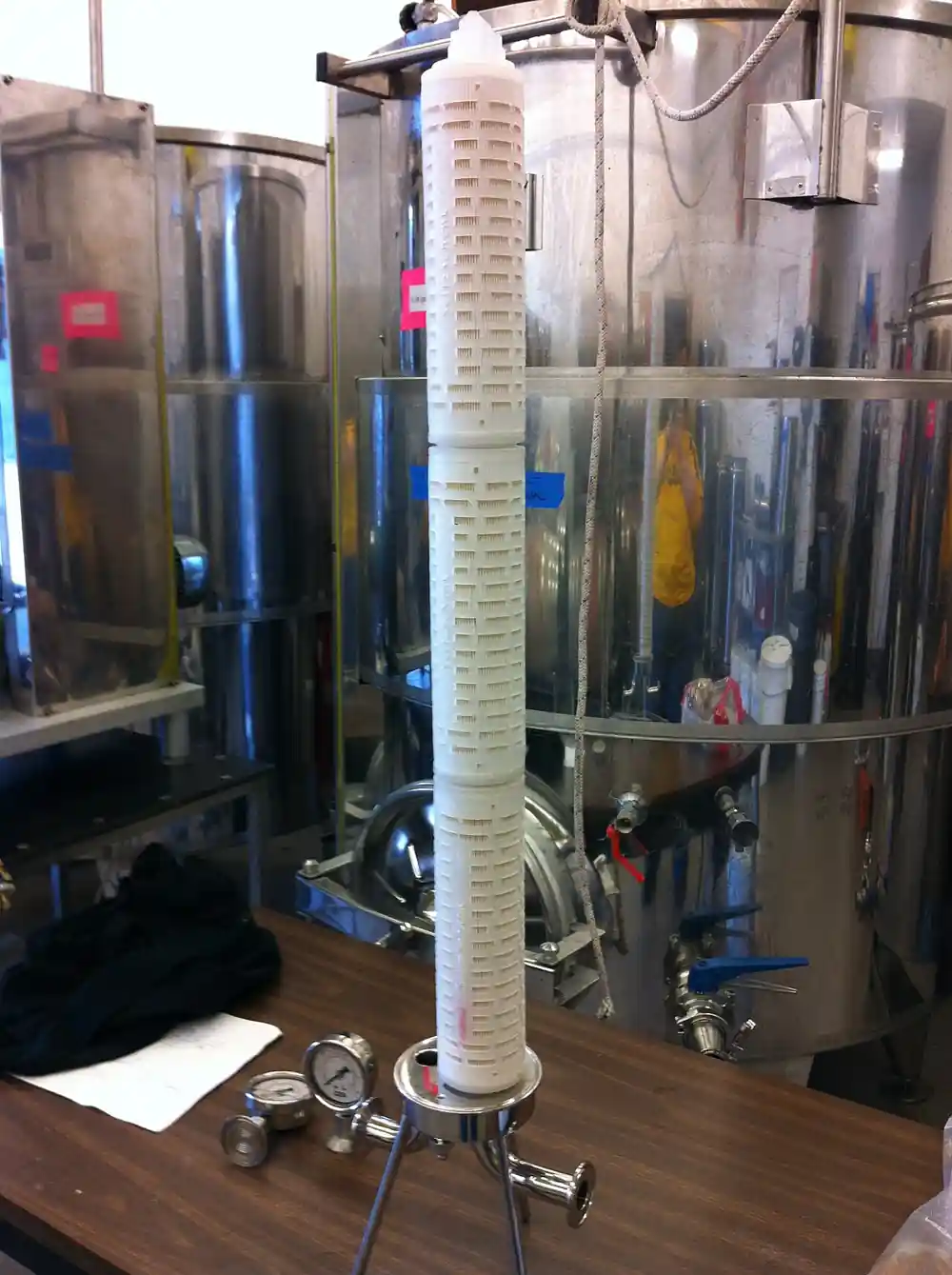
A cartridge filter is a filter whose working part is a rigid or semi-rigid replaceable element: a cylinder of filter medium, bonded to end caps and strong enough to hold its shape, that seals into a housing so that all of the liquid or air passes through the medium. The element form, not the duty, defines the machine, and it serves two families that otherwise share very little. In liquid service a pleated, wound, melt-blown, membrane, or sintered cartridge sits in a pressure housing on water, chemical, beverage, and pharmaceutical lines. In dust service a tall pleated cartridge sits in a pulse-jet dust collector and is cleaned on line by compressed air. Donaldson's cartridge filter literature documents the dust-collector family, and this page treats both.
The page is for the engineer who has to choose one of these machines and write the order for it: a single water housing, a multi-round vessel, a bank of spin-on filters on a lube line, or a cartridge collector serving a welding station. The chapters that follow define the product and the purchase, show how the element and its housing do the work, sort the liquid and dust types from their neighbors, list the parameters that recur on datasheets, give the selection factors and RFQ language, and end with installation, failure modes, and maintenance. Figures for liquid process cartridges, and the envelope, area, air-to-medium ratio, pressure-drop and pulse-air figures for dust-collector cartridges, come from established filtration practice and are stated as typical ranges; the MERV ratings, temperature limits, fine-fiber diameter and penetration reduction for dust-collector cartridges come from the Donaldson literature listed in the sources.
Five things decide a cartridge filter purchase. First the element form, because a nominal depth cartridge and a fine-fiber dust cartridge are different products that share a name. Second the rating and the test behind it, which set what the filtrate or the exhaust contains. Third the medium area against the flow, which writes pressure drop and pump or fan energy. Fourth the dirt load against the cleaning method, change-out for liquid and pulse-jet for dust, which writes the consumable and labor bill. Fifth the seal between element and housing, where unfiltered fluid or dust escapes unnoticed. Get those five right and the filter stays a routine consumable.
Chapter 1 / 06
What a Cartridge Filter Is and What Is Being Decided
The defining feature is the element, and its details are worth stating because they separate a cartridge filter from the equipment it is confused with. A filter cartridge is built as a self-supporting cylinder: a sheet or bed of medium, a core or cage that keeps the pack from collapsing, end caps that close the pack, and a seal face that mates to the housing. The housing divides the dirty side from the clean side at that seal. A bag filter keeps its medium soft and held by a basket, a strainer stops only coarse debris with a screen, and a self-cleaning filter keeps one screen and washes it in place. A cartridge filter is the machine in which a formed element is spent and replaced, and the whole purchase is about choosing that element and the vessel that holds it.
On the liquid side the cartridge filter is a clarification and protection device, used as a depth pre-filter where solids are light and as a polishing stage after coarser equipment. A cartridge housing is placed after the bulk of the solids has been settled, screened, or filtered out, and it takes the stream the rest of the way: clarifying process water, keeping fines out of a reverse osmosis train or a heat exchanger, brightening a product before packaging, or standing as the last barrier before a fill line. Industrial filters as a family list liquid process cartridges from 0.2 to 100 micron, from coarse sediment beds to sterilizing membranes. Flow per element is small, so a housing holds one cartridge or many in parallel, and the pressure drop across the housing is the signal that says the element is loaded.
On the dust side the machine is the cartridge dust collector, and the cartridge is its consumable heart. Tall pleated cylinders, open at one end and closed at the other, seat by their open end on a tubesheet, with the mouth gasketed to a collar, mounted upright or lying horizontally. A centrifugal fan pulls dusty air around the outside of the cartridges, the air passes inward through the medium and out through the open end to the clean-air plenum, and the dust stays on the outside as a cake. Compressed-air pulses break that cake off while the collector runs. The solids fall into a hopper and leave through a rotary airlock without stopping the fan.
What is being decided is a cleanliness statement, a pressure statement, and a consumable plan, bought together. The cleanliness statement is the rating with its test behind it: a micron figure and an efficiency for liquid, a MERV or particulate-matter efficiency for air. The pressure statement is the flow each element passes at a stated pressure drop when clean, and the pressure drop at which it is declared spent. The consumable plan is how often elements change, how long a change takes, and who will supply the replacements in ten years. A vendor who quotes a rating without its test, or a collector size without its air-to-medium ratio, has left one of the three statements open.
Buyers choose the same element form for very different reasons. A power or water plant engineer buys depth and pleated cartridges as guard filters ahead of reverse osmosis and ion-exchange beds, where the target is keeping colloid and silt off expensive membranes. A food or pharmaceutical engineer buys pleated membrane cartridges validated for bacterial retention, with extractables documents and an integrity test on every element. A machine builder buys a spin-on filter on a hydraulic-fluid or lubrication line to hold an oil cleanliness code. A metalworking plant buys a cartridge collector to capture weld fume, grinding dust, or thermal spray powder below the limits set by its permit and its ventilation system. The medium follows the buyer; the element form does not change.
A cartridge filter is a consumable inside a durable shell, and its economics follow from that. The housing or collector is bought once and outlives hundreds of elements; the element is bought again and again, and its unit cost is multiplied by the frequency the duty forces. A rating finer than the process needs, an element sized at its catalog maximum flow, or a pre-filter skipped to save capital all shorten element life and raise the bill. On the dust side the same arithmetic runs in a different currency: fan energy against pressure drop, compressed air against pulse frequency, and disposal against the dust the cartridges hold. Standard element dimensions keep that bill contestable, because a standard-size cartridge can be bought from more than one maker.
Chapter 2 / 06
How a Cartridge Filter Does the Work
Filtration happens in the medium, and a cartridge filter gets it done in two different ways. Depth media capture particles through the thickness of a wall: wound yarn, a melt-blown fiber bed, or sintered stainless powder, where a particle following a tortuous path sticks to a fiber or lodges in a pore. Surface media stop particles at or near the upstream face: a pleated sheet of microglass or polymer, a membrane with defined pores, or a fine-fiber layer laid on a substrate. Depth gives dirt-holding capacity and a gradual rise in pressure drop. Surface gives a sharper cut and releases its cake when pulsed or backwashed. Many cartridges combine the two, a sturdy substrate carrying its finest layer on the side that faces the dirt.
A liquid filter cartridge is an assembly, and every part of it has a failure to contribute. The medium is pleated or formed around a rigid core, usually polypropylene or stainless steel, that carries the collapse load; support layers keep the pleats apart; end caps of polypropylene, polyester, or metal close the pack at both ends and are bonded to it by adhesive, welding, or both. The seal is either a flat gasket compressed by a spring-loaded plate in the housing or one or two O-ring grooves molded into the end cap, with elastomer O-rings pressed against a housing adapter. Liquid enters outside the cartridge and leaves through the core. A gasket left out, a groove nicked, or an O-ring rolled during installation opens a bypass path that no rating can close. The element's media and rating tests are the subject of the filter element page.
Pleating is what makes the form useful. A ten-inch cartridge two and a half inches in diameter holds roughly 0.4 to 0.7 square meter (4 to 7.5 square feet) of medium when pleated, and a forty-inch cartridge holds four times that. More area means lower face velocity for the same flow, which brings a lower clean pressure drop, a longer run before the terminal pressure drop, and better capture, because a slow stream gives a particle more chances to reach a fiber. Pleat geometry is a compromise: tighter pleats add area but pack dirt at the pleat roots, so heavily loaded duties use wider spacing and fewer pleats. A dust collector cartridge carries the same geometry further, with pleats running nearly the full height of a tall cylinder.
The housing is a pressure vessel with one job: make all of the flow pass through the element. A single-cartridge housing is a tube with a cover, an inlet on the side, an outlet at the bottom, a vent at the top, and a drain at the low point. Multi-round housings seat many cartridges between two tubesheets and hold them down with springs so the seals stay compressed as pressure fluctuates. A plain pressure gauge on the inlet only shows that the line is live. The operating signal is the differential pressure across the housing, read on a differential pressure gauge or transmitter with taps upstream and downstream, and a cloudy sample at the outlet shows a bypass that the instruments missed. The vent matters more than it looks: air trapped in a housing blocks part of the medium and lets it run dry.
In a cartridge dust collector the air path is chosen to protect the medium as much as to clean the air. Dirty air enters through a baffled or tangential inlet that slows it and drops the coarsest particles straight into the hopper before they can scour the cartridges. The air then turns upward or across and passes from outside to inside through the pleats, where dust builds as a thin cake. That cake is itself a filter, finer than the bare medium, which is why collection efficiency rises during the first hours of service and why a collector pulsed harder or more often than its pressure drop calls for emits more dust than one pulsed on demand. Pressure drop rises with the cake, and the fan moves a slightly smaller volume as resistance grows, so the trend of pressure drop against time is the collector's state of health.
Pulse-jet cleaning removes most of that cake without stopping the fan. A compressed-air header over the clean-air plenum feeds a blowpipe aimed at the open end of each cartridge, with a venturi nozzle at the mouth. When a diaphragm pulse valve opens, triggered by a solenoid valve from a timer or a pressure switch, a blast of about one tenth of a second at roughly six bar (90 psi) jets into the cartridge. The blast drags a much larger volume of surrounding air with it, reverses the flow through the medium for an instant, flexes the pleats outward, and cracks the cake off. The dust falls to the hopper. Cleaning fires row by row, on a timed interval or on demand when pressure drop reaches a set point, and it normally leaves a thin residual cake that starts filtering again at once.
Chapter 3 / 06
Cartridge Filter Types and Machine Boundaries
Liquid depth cartridges are the lowest-cost type and the workhorse of pre-filtration. A string-wound cartridge spools cotton, polypropylene, or polyester yarn around a core in a diamond pattern; a melt-blown cartridge builds a graded bed of fine polypropylene fiber on a mandrel, coarser outside and denser toward the core. Both are rated from about one to one hundred micron, and the rating is nominal: the maker states a removal percentage at that size, commonly fifty to ninety percent, without an agreed test behind it. Pleated surface cartridges fold a sheet of microglass, polypropylene, polyester, or cellulose into a star and bond it to end caps. Their rating can be absolute, ninety-nine percent or more at the stated size under a controlled challenge, which is what polishing duties and pre-membrane protection need.
Membrane cartridges carry the finest ratings in the family. A microporous film of polyethersulfone, PVDF, polyamide, or PTFE is pleated with support layers and bonded into a cartridge rated from about 0.04 to 1 micron; the 0.2 micron grades used on pharmaceutical water are validated to retain a bacterial challenge and are integrity tested one by one. Sintered metal cartridges take the other route: 316L stainless steel powder or fiber is fused into a rigid porous cylinder rated from about five to two hundred micron. Metal survives several hundred degrees Celsius, steam sterilization, and aggressive chemistry, and it can be backwashed and reused, which matters when the fluid is hot or the catalyst being recovered is valuable. Both types hold little dirt and need a coarser stage in front of them.
A spin-on filter is a mounting style rather than a different medium. The element is pleated inside a steel can that screws onto a fixed head, seals on one gasket at its base, and is discarded whole. The style dominates hydraulic, lubrication, and fuel lines because a change needs no tools and leaves the oil system closed to dirt. Its element is rated by the ISO 16889 multipass test, which reports a beta ratio at a stated particle size, and it is chosen to hold the oil at a target ISO 4406 cleanliness code that protects a servo valve downstream. The head usually contains a bypass valve that opens before the element collapses, so a clogged spin-on filter starves nothing; once the valve opens, part of the oil runs past the element unfiltered until it is changed, which is why a bypass indicator belongs in the order. The precision filter leaf explains the rating method in full.
Dust-collector cartridges are classified by medium and treatment. Plain cellulose paper is the economy grade, rated near MERV 10 on the ASHRAE 52.2 test and limited to about eighty-two degrees Celsius (180 F). Synthetic media reach about MERV 12. A fine-fiber layer, often called a nanofiber layer, on the substrate raises efficiency sharply: Donaldson lays an electrospun web of fibers 0.2 to 0.3 micron in diameter on cellulose or spunbond polyester to catch submicron dust at the surface, rates those cartridges MERV 14 and 15, and reports initial penetration cut by as much as ninety percent. A PTFE membrane on polyester reaches MERV 16 and handles moist, hygroscopic, or agglomerative dust. Flame retardant treatment is offered on several cellulose grades, and a carbon-impregnated substrate lets a cartridge bleed off static charge on combustible dust.
The liquid-side boundary is drawn by what the stream needs. A bag filter takes high solids and coarse-to-medium duty above roughly one micron at a low cost per unit of contaminant; a cartridge filter is bought for a stated absolute rating, for cuts below one micron, for very high cleanliness, and for low fiber release. A precision filter is defined by its rating method, a micron figure paired with an efficiency figure, so fine pleated and membrane cartridges qualify on their absolute ratings and depth cartridges only when the maker states the efficiency behind the micron figure, while dust-collector cartridges are cartridge filters that are not precision filters. A basket strainer or a duplex strainer is normally bought for debris of roughly seventy-five micron and above, although mesh-lined baskets go finer, and it should sit upstream, not in place of the cartridge. Slurries too rich for a bag or cartridge belong in a filter press, a candle filter, or a pressure leaf filter, and large water flows in a multimedia filter or a settling stage.
The dust-side boundary is loading and stickiness. A bag filter built as a baghouse takes heavy, fibrous, or hot dust across thousands of bags at gas volumes no cartridge collector would take; the cartridge collector takes fine dust at light to moderate loading and answers with a compact body, high efficiency per unit of footprint, and fast element changes. A cyclone separator in front of either removes the coarse fraction, and a wet scrubber takes over where dust is sticky, hotter than the medium allows, or accompanied by gas that must be absorbed. On the liquid side the cartridge sits between a coarse stage and a sensitive user: a strainer and then a centrifugal pump upstream, a reverse osmosis train, an ultrafiltration loop, or a filling line downstream. Droplets need a coalescing filter and dissolved organics an activated carbon filter; neither is particle filtration.
Chapter 4 / 06
Key Specification Parameters
The datasheet for a cartridge filter is short, and almost every line on it is one of the parameters in the table below. On the liquid side the rating is a micron figure with an efficiency and a test; the dimensions are the standard length and outside diameter that the housing accepts; and the flow, clean pressure drop, terminal pressure drop, and collapse rating describe the pressure statement. On the dust side the efficiency is a MERV from the ASHRAE 52.2 test or an ISO 16890 particulate-matter efficiency; the dimension is the cartridge envelope that fits the tubesheet; and the air-to-medium ratio, pressure drop, and pulse-air pressure describe the cleaning statement. The ranges are typical of catalog offerings. They are orientation for a first layout, not a substitute for the element maker's efficiency and pressure-drop curves.
Three figures on that datasheet should be challenged when they arrive without their basis. A micron rating printed without its efficiency and test is a label; the precision filter leaf explains why two nominal cartridges of the same rating can behave very differently. A MERV quoted for the medium alone says nothing about the collector, since efficiency falls when a cartridge is torn, mis-seated, or pulsed too hard. A flow rating quoted at a viscosity other than the process fluid hides the pressure drop the buyer will pay, because pressure drop rises with viscosity and a cold stream can multiply it. The honest datasheet gives the efficiency curve, the medium area, and a pressure-drop curve against flow at a stated viscosity or air volume, and those three belong in the request before any price is discussed.
Materials of construction set the chemical and temperature envelope, and the weakest part sets the limit. Liquid cartridges use polypropylene medium, cores, and end caps to about eighty degrees Celsius, polyester to about one hundred thirty-five, fluoropolymers beyond that, and 316L stainless steel for the sintered type; the elastomer in the O-rings and gaskets, commonly EPDM, silicone, or a fluorocarbon, often runs out of temperature or chemical resistance before the medium does. Housings are 304 or 316L stainless steel for food, pharmaceutical, and chemical duty and coated steel for utilities. Dust cartridges use cellulose or polyester paper, steel or molded end caps, a molded gasket at the open end, and flame retardant or conductive treatments where the dust requires; the usual ceiling is about eighty-two degrees Celsius (180 F), and synthetic and aramid grades reach about one hundred thirty-five to one hundred seventy-seven (275 to 350 F).
Parameter
Typical range
What it decides
Liquid rating, micron and efficiency
0.04 to 100 micron
Cleanliness of the filtrate; stage in the treatment train
Dust cartridge efficiency
MERV 10 to 16
Outlet dust concentration; size of the collector
Liquid cartridge length
10 to 40 in (250 to 1,000 mm)
Medium area per round; housing depth
Liquid cartridge outside diameter
2.5 in (63 mm) standard; 4.5 in (114 mm) big-bore
Flow per round; housing bore
Dust cartridge envelope
about 13 x 26 in (324 x 660 mm)
Tubesheet pattern; collector size
Medium area per dust cartridge
20 to 25 m2 (215 to 270 sq ft)
Air-to-medium ratio; cartridge count
Flow per ten-inch liquid cartridge
0.3 to 1.5 m3/h (1.3 to 6.6 gpm)
Number of rounds; pump head
Air-to-medium ratio, dust duty
0.3 to 1.2 m/min (1 to 4 ft/min)
Pressure drop; pulse frequency
Terminal differential, liquid duty
1.5 to 2.5 bar (22 to 36 psi)
Change-out point; collapse margin
Clean pressure drop, dust duty
75 to 250 Pa (0.3 to 1 in wc)
Fan energy; baseline for the trend
Pulse air pressure
6 to 7 bar g (90 to 100 psi)
Cleaning force; valve and receiver specification
Collapse rating, spin-on element
10 bar class (150 psid)
Bypass setting; structural safety
Maximum operating temperature
82 C (180 F); to 177 C (350 F)
Medium choice; need for gas conditioning
Liquid housing pressure rating
10 bar g (150 psi)
Vessel code; wall thickness and closure
Chapter 5 / 06
Selection Decision Factors and RFQ Language
Selection starts with the fluid and the contaminant, on whichever side of the family the duty falls. For a liquid, record the chemistry, the pH, the temperature, the viscosity, and the particle size distribution and concentration; a particle size analysis of a real sample is worth more than any estimate. The target rating comes from the downstream tolerance: what a membrane, a nozzle, a valve, or a product specification can accept. For air, identify the dust by process, find its particle size, density, abrasiveness, stickiness, and combustibility, and measure or estimate the inlet loading in grams per cubic meter. The contaminant profile decides whether a cartridge filter is the right machine at all; only after that does the medium choice begin.
On the liquid side, match the medium to the target and then stage the train. Depth cartridges take bulk solids cheaply; pleated surface cartridges set an absolute cut; membrane cartridges polish or sterilize; sintered metal handles hot, aggressive, or catalyst-bearing streams. A common plant runs a bag filter or a depth cartridge in front of a fine pleated or membrane final stage, because the coarse stage carries the mass and lets the expensive element run for months. Size the housing for the number of rounds the flow needs at roughly half the catalog flow per element, erring toward more rounds rather than fewer, since area is the cheapest way to buy life. Then choose the housing style: single-round for pilot and low flow, multi-round for process flow, a duplex pair with a changeover valve where the line cannot be stopped for a change, clamp connections for food and pharmaceutical lines, and a code-stamped vessel where pressure requires one.
On the dust side, the dust writes the medium and the loading writes the collector. Fine, dry, nonfibrous dust such as weld fume, toner, or pharmaceutical powder calls for a fine-fiber or membrane medium at a high MERV. Abrasive dust such as shot blast grit calls for a tough substrate, an inlet that keeps grit off the cartridges, and enough area to keep face velocity low. Fibrous or agglomerative dusts, lint from textiles, or powders from grain and food call for wide pleat spacing so the pulse can clear the pleat roots. Hygroscopic or sticky dust is the wrong application for plain cellulose and polyester cartridges; a membrane or wide-pleat cartridge rated for it is the first choice, and a wet scrubber is the answer where even that blinds. The buyer then sets the air volume, the air-to-medium ratio, the collector style, and the inlet position, and insists on a stated outlet concentration.
Combustible dust turns the collector into a piece of safety equipment. Fine organic and metal dusts burn explosively, and a collector is by nature a vessel that concentrates them. The response is a system rather than an accessory: conductive media and bonded, grounded cartridges so that charge cannot accumulate; flame retardant treatment where the dust and the standard require it; explosion venting or suppression sized by an engineer; isolation devices so a flame cannot travel back through the duct; and spark detection at the inlet where the process gives off embers. The NFPA combustible dust standards, and the ATEX directives in Europe, set the requirements, and the cartridge is one conductive link in a chain that includes the collector body, the duct, and the hopper. Resistance to ground is measured after installation, not assumed from the datasheet.
Each row of the decision table below is a question that has to be answered before an RFQ is sent, and each is a place where an answer left open turns into an oversized collector, an element that does not fit its housing, or a running cost that nobody budgeted for. The first five rows apply to both families and decide the element; the rest decide the vessel, its cleaning, its safety case, and its supply. A buyer who cannot fill a row from plant data should treat that row as the next piece of engineering to buy, because a vendor asked to guess will guess toward the catalog.
Decision factor
What the buyer must state
Consequence if left open
Fluid
Liquid or air; chemistry, pH, viscosity, dew point
Micron with efficiency and test; MERV or outlet concentration
Cleanliness or emission limit not met
Flow
Volume per hour with peaks; air volume per cartridge
Undersized vessel; high pressure drop
Temperature
Operating and maximum; need for cooling or gas conditioning
Medium softens or scorches; seals leak
Housing or collector style
Rounds, vessel code, connections; tubesheet and inlet position
Element does not fit; site rework
Cleaning and change-out
Terminal differential; pulse settings; who does the work
Labor and downtime unplanned
Combustible dust
Declare it; conductive media, venting, isolation
Safety case missing; permit refused
Supply continuity
Standard dimensions; second source; certificates
Locked to one maker for spares
Energy and disposal
Fan or pump power; disposal of spent elements and dust
Running cost and waste handling unpriced
An RFQ for a cartridge filter should open with four lines: the fluid, liquid or air; the contaminant and target rating, with the efficiency and the test that prove it; the flow and temperature, with peaks and excursions; and the housing or collector style, whether a single or multi-round housing, a spin-on head, or a cartridge dust collector. The rest of the specification adds: the medium and all wetted materials, with extractables or compliance documents for regulated service; element dimensions and end-connection code; the number of elements and the medium area per element; clean and terminal pressure drop; the vent, drain, and differential pressure taps; for a collector, the air volume, air-to-medium ratio, pulse-air pressure, hopper, and discharge; the applicable pressure, sanitary, and combustible dust standards; and the acceptance basis, an efficiency test, a seal leak check, and a witnessed change-out.
Chapter 6 / 06
Installation, Standards, Failure Modes, and Maintenance
Installing a liquid cartridge housing is mostly about clearance, cleanliness, and the seal. Set it where the cover can open and a spent cartridge can be lifted out straight, with its length plus a hand's width of headroom above, and where the drain reaches a gully. Pipe the inlet, outlet, vent, and drain so that no pocket can hold dirt, and take the differential pressure taps across the housing, not around a valve. Flush the line before the cartridges go in, because installation debris blinds new elements faster than the process does. Seat each cartridge on its adapter or knife-edge, fit springs and hold-down plate, close the cover, and tighten bolts or clamp evenly. For a collector, the same rules apply to the tubesheet: gaskets clean and undamaged, every cartridge seated, band clamps tight.
A cartridge dust collector is installed as an air-handling system. Set the body level on a base that carries a full hopper, connect the inlet duct so that its direction agrees with the inlet baffle, bolt down the fan and the discharge, and bring in compressed air that is dry and clean through an air dryer and an air receiver sized for the pulse demand. Commissioning then proves four things: the fan turns the right way, the measured air volume matches the design, each pulse valve fires in sequence at the set pressure, and the clean side of the tubesheet stays free of the dust streaks that betray a leaking gasket. Record the clean pressure drop at the design air volume. In both families that first reading is the baseline against which every later decision to change or to clean is made.
No single standard covers a cartridge filter end to end; the applicable documents come in families by duty. Liquid housings follow the pressure vessel rules of the jurisdiction, commonly the ASME Boiler and Pressure Vessel Code or the European Pressure Equipment Directive, and food and pharmaceutical housings add sanitary practice such as 3-A and EHEDG with materials accepted for food contact. Hydraulic and lubrication elements are rated by the ISO 16889 multipass test, checked for collapse by ISO 2941, for fabrication integrity by ISO 2942, and for material compatibility by ISO 2943. Membrane cartridges for sterile duty are validated by a bacterial retention test such as ASTM F838. Dust-collector cartridges carry a MERV under ASHRAE 52.2 or an efficiency under ISO 16890, and a collector on combustible dust follows the NFPA combustible dust standards. The current edition of each is confirmed at purchase.
The recurring failures are few, and each has a signature. In liquid housings the commonest is bypass at the seals: an O-ring twisted on installation, a flat gasket omitted, a cartridge not pressed home on its seat, or a hold-down spring relaxed, seen as a filtrate that never clears or clears and clouds again. Running past the terminal pressure drop collapses the medium or pushes captured particles downstream. A cartridge incompatible with its fluid swells, sheds fiber, or releases extractables that foam or contaminate. In collectors the commonest failure is blinding, where oily, hygroscopic, or very fine dust packs the medium until pulses no longer bring the pressure drop down. A ruptured diaphragm leaks air continuously and cleans poorly, a pinched gasket leaves a dust streak on the clean side, and abrasive dust wears holes in the pleats that face the inlet.
Maintenance is planned around the pressure drop trend. The readings are logged by hand or by the control system, set against the clean baseline, and acted on at the terminal value rather than at a calendar date, because element life varies widely with the solids load. Spares are stocked against the lead time and checked against the housing before they are needed, since a cartridge of the right length with the wrong end connection is no spare at all. The numbered steps that follow describe a liquid change-out, and the table after them lists the recurring items with the cadence common practice uses; the element maker's interval and the plant's own trend take precedence over both. Spent liquid cartridges leave as industrial waste unless the solids they hold make them hazardous, and the dust a collector has caught sets the same classification for its cartridges, so the RFQ asks what the captured material is and prices its disposal route.
Isolate the housing, stop and lock out the feed pump, and vent the pressure to atmosphere before any cover is opened.
Drain the housing through the drain valve and, on hot or hazardous service, rinse it as the plant procedure requires.
Open the cover evenly, lift out the spent cartridges, and bag them for disposal or for recovery of the captured solids.
Inspect the seat, the adapter, the O-ring grooves, the springs, and the hold-down plate, and wipe each clean with a lint-free cloth.
Fit new gaskets or O-rings, wet them with the process fluid or clean water, and lower each cartridge squarely onto its seat.
Close the cover to the maker's torque, vent the housing while it fills slowly, check for leaks, and record the clean pressure drop at the rated flow.
Item
Typical action
Typical cadence
Differential pressure trend
Read and log across the housing or the tubesheet
Every shift to daily
Liquid cartridge change-out
Replace at terminal differential; vent; record new clean drop
Weeks to months by duty
Dust cartridge change
Replace when pulsing no longer restores pressure drop or emission rises
Six months to two years
Pulse system
Test diaphragm pulse valves, solenoids, and timer sequence; check air pressure
Monthly to quarterly
Seals and gaskets
Inspect O-rings, gaskets, hold-down springs, and band clamps
Each change-out
Housing and collector body
Inspect for corrosion, liner damage, hopper and airlock leaks
Quarterly to annual
Instruments
Verify gauge and transmitter zero; test alarm and pressure switch
Quarterly
Outlet quality
Check turbidity, particle count, or stack opacity against the baseline
Daily to weekly
Grounding and bonding
Verify continuity of cartridges, body, and duct on combustible dust duty
Each change-out and annual
FAQ
How does a cartridge filter work?
A cartridge filter pushes liquid or air through a rigid, self-supporting cylinder of filtration medium sealed into a housing, so nothing passes around it. In a liquid housing the fluid enters outside the cartridge, travels inward through the medium, and leaves through the core; particles stay behind in a thick fiber bed or on a pleated sheet or membrane. In a cartridge dust collector a fan draws dusty air around the outside of pleated cartridges and clean air leaves through their open ends. Liquid elements are swapped at a set pressure drop; dust cartridges are cleaned on line by short compressed-air pulses and replaced only when pulsing no longer restores them.
What types of filter cartridges are there?
Liquid service has four media types and one mounting style. Depth cartridges, string-wound or melt-blown polypropylene, are inexpensive and nominally rated from about one to one hundred micron. Pleated cartridges fold microglass or polymer sheet for absolute ratings. Membrane cartridges in polyethersulfone, PVDF, or PTFE rate from 0.04 to 1 micron and include sterilizing grades. Sintered stainless steel cartridges take hot and aggressive fluids. A spin-on filter is a pleated element sealed in a can that screws onto a hydraulic or lube head. Dust-collector cartridges are tall pleated cylinders of cellulose, synthetic, fine-fiber, or membrane medium, some with flame retardant or conductive treatment.
What micron rating should a cartridge filter have?
Start from the most sensitive item downstream, then state the efficiency and the test with the number. Sediment pre-filtration ahead of a reverse osmosis train commonly uses five micron depth or pleated cartridges; beverage and fine chemical clarity usually calls for one to five micron; sterilizing and high-purity water uses 0.2 micron membrane. Below roughly one micron, specify an absolute rating of at least ninety-nine percent removal at the stated size under a named test, because a nominal figure there can mean half the particles pass. Hydraulic spin-on elements are rated by beta ratio under the ISO 16889 multipass test instead of by micron alone. A rating finer than needed only costs pressure drop and element life.
When is a cartridge filter the better choice than a bag filter?
Let the solids load and the cut size decide. A bag filter is the better buy when a lot of solids have to be removed and the cut is coarse to medium, roughly one micron and above, because one bag holds many times what a cartridge holds and is swapped in a minute. A cartridge filter earns its place when the cut must sit below one micron with a guaranteed efficiency, when the filtrate must be very clean or free of fiber, or when the stream runs clear enough that cartridges last. Putting a bag or a depth cartridge first and a pleated or membrane cartridge second often costs less over a year than either stage alone.
When should a filter cartridge be changed?
When the pressure drop across it says so. Every housing or collector should have a reading across the element, taken by gauge or transmitter, and every change should end with the clean value written down. Liquid cartridges come out at the terminal differential the maker states, commonly between one and a half and two and a half bar. Dust cartridges are not replaced on a schedule: they stay until the pressure drop will not come back down after pulsing once a pulse or fan problem has been ruled out, or until a stack test or visible emission shows they are passing dust.
What affects the cost and lead time of a cartridge filter?
The vessel is a one-time purchase; the elements are the running cost. Element price climbs with the medium, from melt-blown and string-wound through pleated polymer and microglass to membrane and sintered metal, and again with validated documents such as bacterial retention and extractables reports. How long an element lasts, which its rating, area, and the stage ahead of it set, multiplies that price more than anything else. Pump or fan power against pressure drop, labor per change, and disposal of spent elements and collected dust complete the yearly bill. Lead time is short for standard sizes that several makers list, and long for special media, large vessels, stamped housings, or conductive cartridges.
Which standards apply to cartridge filters?
There is no single cartridge filter standard, so the RFQ has to name the ones that fit the duty. Ask for the pressure vessel code on any liquid housing, sanitary design rules on food and pharmaceutical units, and the ISO 16889 multipass rating with its collapse, integrity, and compatibility checks on hydraulic elements. Sterilizing membrane cartridges need a validated bacterial retention test. For dust cartridges request the MERV from the ASHRAE 52.2 test or an ISO 16890 efficiency, and a stated outlet concentration on the collector. Combustible dust service brings the NFPA combustible dust standards or ATEX with it, which cover grounding, venting, and isolation. Name the edition in force when the order is placed.