A basic oxygen furnace (BOF), also called an LD converter, refines blast-furnace hot metal with oxygen in a tiltable vessel lined with refractory. Scrap can form part of the charge. Oxidation lowers the bath's carbon content and changes the steel and slag chemistry. The steel is tapped into a ladle and can receive additional treatment in a separate facility.
A converter purchase starts with delivered heat size, hot-metal and scrap availability, product grades and the expected heat cycle. Those requirements define the vessel, lance, optional bottom blowing, steel transfer, refractory access and the equipment that collects and treats off-gas.
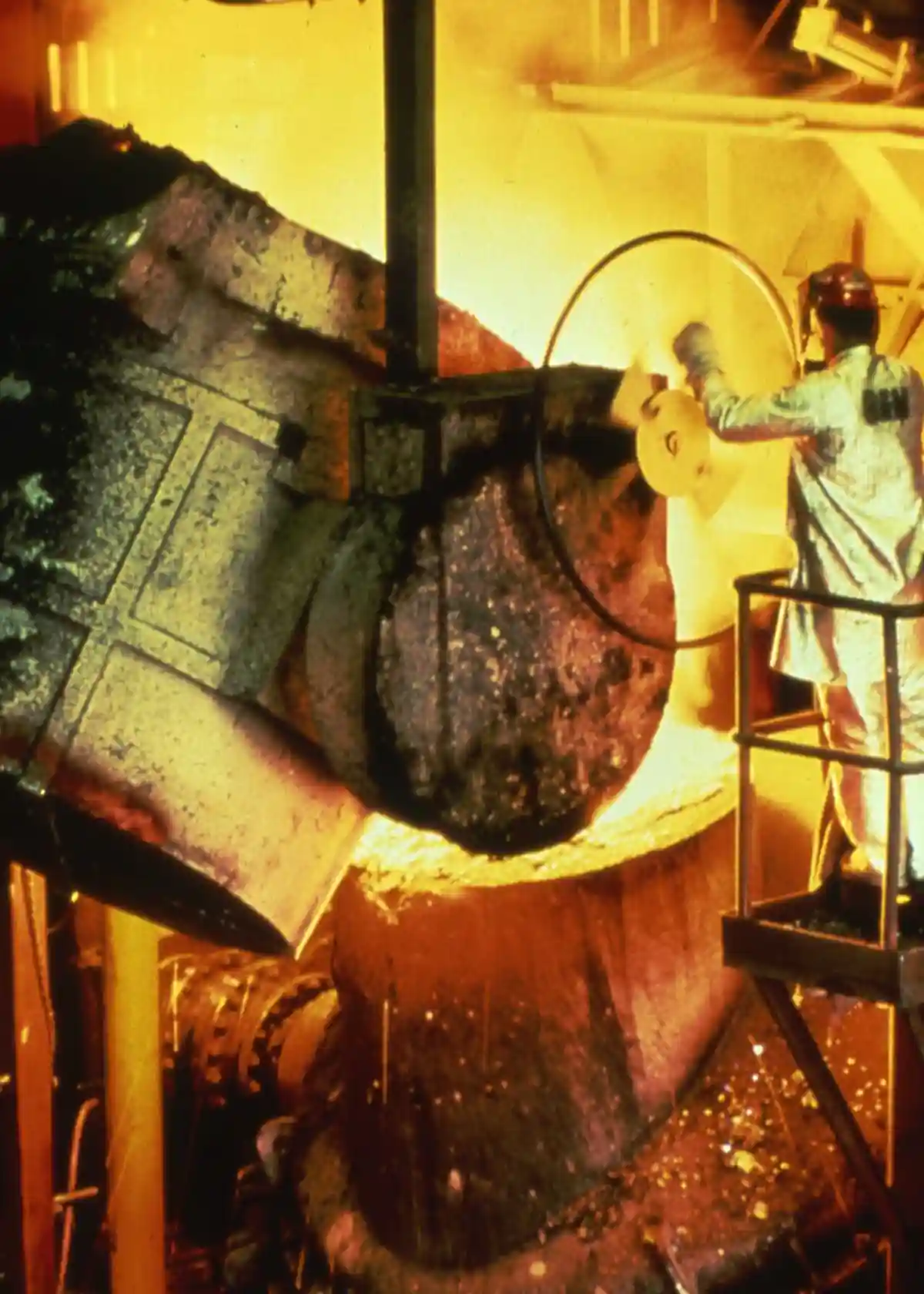
Refractory-lined foundry ladle tilting to pour molten metal. Context photo: Unknown author, Public domain via Wikimedia Commons.
Compare a BOF by the quantity and condition of steel delivered over an agreed operating pattern. Vessel size, feed mix, endpoint control, maintenance time and gas treatment all enter that result.
Chapter 1 / 06
What a Basic Oxygen Furnace Supplies
A basic oxygen furnace (BOF) is a tilting, refractory-lined steelmaking converter. A conventional integrated mill supplies hot metal from its ironmaking facilities and adds an agreed mix of scrap and other charge materials. Oxygen blown into the converter removes much of the dissolved carbon and oxidizes other elements. The molten steel is then tapped into a ladle. The names LD converter and BOF refer to this process family; modern offerings include top-blown and combined-blowing versions. Primetals identifies LD with Linz-Donawitz and describes combined blowing as the use of bottom tuyeres alongside a top lance [2].
The buyer can purchase a vessel replacement or a full converter plant. A vessel-only package might supply a new shell to make existing machinery fit for continued service. A new converter plant can include the trunnion support, tilting system, lance equipment, charging and tapping aids, controls, refractory engineering, off-gas collection and gas treatment. Define where reticulated oxygen, hot metal, scrap, flux, utilities and steel are transferred. A plant throughput guarantee places interface obligations on the equipment that happens to be procured separately. It should be clear whether gas treatment or downstream steel transfer capacity is included in that obligation.
The central production unit is a heat, which is the batch of steel produced through one converter cycle. The requested heat size should be defined by the quantity of steel tapped or transferred, as applicable. A charge weight, a finished heat weight, and a nominal geometric volume are different measures. Specify annual production separately, using a realistic count of heats and planned interruptions. That calculation includes converter schedule, heat cycle, hot-metal availability, delays downstream and maintenance allowances. A furnace sized to make a larger heat may increase waiting time if a receiving ladle, crane or downstream treatment stand cannot handle it at the expected cadence.
The charge mix affects thermal balance and product chemistry. Hot metal carries sensible heat and contains carbon and other elements whose oxidation contributes heat. Scrap uses heat as it warms and melts. The usable scrap share varies with hot-metal temperature and chemistry, scrap properties, process design and quality requirements. A supplier should show how agreed feed cases affect productivity, treatment times and yield. The owner should define which materials can be supplied routinely and which are future options, since their presence in a model alone does not make them available to the charging floor.
The converter is upstream of secondary metallurgy. A casting ladle receives steel after tapping and is an independent purchase and handling constraint. A vacuum degassing unit may perform later treatment for particular grades, with defined temperature and chemistry at its inlet. An electric arc furnace obtains much of its heat electrically and is selected against different feed and utility balances. An induction furnace or a holding furnace addresses a different melting or holding duty. Defining these boundaries early avoids attempting to buy a downstream metallurgical result solely from a converter vessel.
Project term
What to specify
Why it changes the order
Heat size
Liquid steel mass at a defined transfer point
Sets converter, ladle and steel transfer duty
Annual capacity
Delivered steel under named production and outage assumptions
Cannot be inferred without line and shop timing
Hot metal
Temperature and analysis at delivery plus actual supply pattern
Drives available heat and refining workload
Scrap
Quantity envelope, grade mix, cleanliness and charging characteristics
Affects heat balance, logistics and grade compatibility
Converter package
Scope for vessel, mechanics, cooling, oxygen, automation and off-gas
Separates equipment delivery from plant responsibility
Early economic models should say where they credit yield, recovered energy and unavailable time. Liquid metal left in slag or lost with dust affects yield, whereas steel delayed on a transfer route may affect throughput without changing a single heat's chemistry. Different accounting choices give different calculated benefits from the same piece of equipment. Ask the project team to define useful liquid steel and designate a weighing or reconciliation point. Each proposed improvement can then be traced to a measurable result instead of a modeled number that combines several incompatible boundaries.
Chapter 2 / 06
Charge, Oxygen Blowing and Tapping
Hot metal arrives from ironmaking through the plant's handling route. The charge preparation system has to accommodate the types and delivery rates of material used in the guaranteed cases. Scrap density and dimensions influence bucket filling and movement even when two charges have equal weight. Give the converter vendor the owner-defined envelope for charge characteristics, limits on contaminants and temperature, approved logistics, and handling constraints. Peak demand on charging equipment can differ greatly from the annual average. Jointly model vessel, ladle and crane occupancy before promising a sustained tap-to-tap interval.
During the blow, a water-cooled lance supplies oxygen in the conventional top-blown arrangement. Oxidation removes carbon as gas, creates heat and changes the bath and slag composition. Flux provides the basis for a basic slag that helps capture certain undesirable constituents, particularly phosphorus subject to the practice and chemistry. Refining efficiency depends on contact and mixing as well as on oxygen delivery. A vendor's quote should connect the expected outcomes to its proposed lance, vessel geometry, process model, reagents and operating envelope. It should make clear which end-point properties remain for secondary metallurgy.
The flux system is an equipment package in its own right. The converter tender needs the required quality and handling properties of lime and other materials, their storage and delivery conditions, and the approved method of tracking weight by heat. Measurement accuracy at the feeders can matter when the process model relies on those weights. A lime slaker at a utility or gas treatment system converts lime into slurry for its specific service. That is different from specifying the solid flux the converter needs. Keep consumable requirements and logistics consistent with the physical stream to which they apply.
The chemistry and temperature targeted at blow end have to meet the conditions for tapping and later processing. Initial feed selection and a process model establish a predicted endpoint. Measurements such as a sublance sample or a bath-temperature result can update the predicted endpoint or confirm a measured state, depending on the system design. An instrument feature should be evaluated by usable results and timing on the scheduled heat, rather than treating automated measurement as a guarantee of chemistry. The quote should describe sample validity criteria, calibration, time taken, and how unavailable data are handled by the approved control design.
Tapping is the transfer of molten steel through the converter's tap hole into the ladle. Slag separation and carryover control matter because an excessive slag burden can affect the next refining step and change steel losses. Some suppliers offer mechanical or pneumatic slag-control equipment and an associated detection and sequencing system [1, 2]. A buyer should identify the receiving ladle geometry, allowable delivery condition and evidence for slag performance. An end-point target achieved in the bath is distinct from the condition measured downstream. Test definitions need both locations if the agreement includes steel quality across the transfer.
The converter tilts for functions such as charging, tapping, slag removal and maintenance. The drive and support assembly must accommodate vessels, lining and product loads over defined states, as well as the specified positioning and availability. A duty table should identify loads, cycles and where dynamic factors apply. The correct AC motor and variable-frequency drive in a vendor's arrangement still depend on the complete mechanical and electric duty, including brakes, position feedback, command permissions and safe-state design. Procurement should specify inspection and acceptance at the drive-and-vessel level, beyond an individual motor factory test.
Tap-to-tap time is a shop measure that combines multiple phases and delays. Blowing time is one element. Waiting for charge, weighing, ladle availability, sampling, chemistry correction and slag handling can all change it. A bid that guarantees a nominal production sequence should give a takt analysis that identifies which time segments are installed equipment duties, which depend on service levels from the owner, and how the handling resources are shared by converters. An isolated fast heat is valuable demonstration evidence but differs from a repeatable result across scheduled heats and the declared production mix.
Chapter 3 / 06
Top Blowing, Combined Blowing and Converter Design
In a top-blown converter the oxygen lance supplies the oxygen jet above the bath. Vessel geometry, headroom, lance travel, lance inspection, and safe retraction all affect how the physical plant fits the shop. Successful reuse of an existing shop requires a dimensional and mechanical survey as well as a process comparison. The top lance assembly and exchange route must fit the actual structure, including duct and hood positions, maintenance clearances, lift points, and equipment the shop cannot relocate. Establish what remains from the existing converter before choosing a vessel design to match a previous nominal rating.
Combined blowing adds bottom elements to the top-lance process. Depending on implementation, bottom injection can be primarily for stirring with an inert gas, or the design can involve additional oxygen and distinct equipment. Design details vary by supplier. Mixing changes the relation between modeled and measured bath condition, and the bottom equipment has service needs and associated wear. Ask the bidder to identify each gas and its purpose, required quality and availability, bottom refractory interface, inspections, and guarantee basis. A gas connection described only as bottom blowing is insufficient to compare a maintenance plan or an endpoint result.
The value of a combined system depends on measurable metallurgical and operational results. It may improve bath uniformity or performance at a specified endpoint, but the benefits depend on the relevant grade and operating case. Materials, gas use, extra instrumentation, duration of bottom component service, and replacement dependencies belong in lifecycle comparisons. Ask for case-by-case demonstrations or credible reference installations with matching conditions. Evidence from a melt shop whose hot-metal chemistry and feed mix resemble the project is more informative than an isolated claim describing maximum improvement across a supplier portfolio.
The converter shell and refractory should be examined together. The refractory design needs room for the specified lining without erasing the usable vessel volume, and the vessel shape influences available charge space and off-gas collection. Shell thickness and deformation tolerance, lining access, refractory movement and inspection records should be reflected in design documentation. Availability forecasts should state how the vessel is relined, how long critical exchange work is expected to take, and which resources must come from the owner. For a new shop an exchange concept can improve schedule resilience only if the access path, spare asset and planned crews really exist.
Modernization may replace the converter and its support ring, upgrade a lance system, improve off-gas handling or add a more capable process model. Each physical change can shift the limiting item. For example, an increase in available charge quantity is ineffective when the tapping ladle cannot accept it or the gas-cleaning system cannot manage the new loading. A controls change can reduce measurement or decision delay even where the heat size remains constant. Ask for a plant-wide constraint map with known measured points and named responsibilities. Build the modernization guarantee against the constraint actually addressed.
Configuration
Primary difference
Evaluation focus
Top-blown LD converter
Oxygen supplied from the lance above the bath
Available lance geometry, mixing, maintenance and endpoint performance
Combined blowing
Bottom injection or stirring complements the top lance
Gas duties, refractory life, mixing evidence and product mix
Vessel and support revamp
Reuse of substantial existing shop equipment
Fit-up, fatigue condition and unchanged limits at interfaces
Full converter plant
Converter, control and supporting equipment designed together
Site integration, gas handling and sustained shop production
Gas system modernization
Existing vessel retained under agreed production cases
Retrofit collection, cleaning, utility and emission acceptance
Nominal vessel class does not provide general authority to vary the feed beyond conditions accepted by the licensor and owner. A hot-metal supply change may affect peak oxygen requirements or slag burden. Different scrap can carry residual elements that are difficult to remove by the intended steelmaking route. Specify which combinations of charge rate and chemistry are approved for production and state what additional requalification would be required for planned future feed options. This gives the owner a realistic flexibility envelope and protects it from assigning a purchased converter an unsupplied upstream capability.
Chapter 4 / 06
Key Specifications and Performance Evidence
Start a BOF bid with a baseline heat recipe envelope, delivered steel size, endpoint definitions and annual shop assumptions. Give high and low extremes only where they can occur jointly, and state which conditions are normal, which are guarantees and which are development cases. The seller must show selected equipment, outlet requirements and utilities against those same cases. A reference campaign on one steel grade cannot by itself prove another grade and feed envelope. The value of a common test basis is that several qualified suppliers can propose different design approaches with directly comparable steel and environmental obligations.
Bid parameter
State in the request
Ask for evidence of
Heat mass
Steel at the receiving point and maximum approved charge
Weight reconciliation and operation on agreed production cases
Hot metal and scrap
Temperature, chemistry, normal and limit supplies
Thermal and material balance over representative heats
Endpoint
Carbon, phosphorus, temperature and test responsibility as applicable
Sample method, location and agreement with downstream delivery
Cycle and annual capacity
Heat count, operating hours, campaign outages and delays
Sustained shop model and measured series of representative heats
Blowing
Top or combined arrangement, gas interface and required grade envelope
Verified gas availability, lance mechanics and process performance
Refractory
Lining concept, loss allowances and maintenance assumptions
Inspection plan and documented campaign comparison
Off-gas and utilities
Emission, water, oxygen and recovered gas basis
Installed tests on named modes and accepted boundary conditions
Availability
Definitions for planned and unplanned delay and owner exclusions
Reported events matched to a common shop time model
A supplier's annual output claim should be restated as accepted tonnes per heat multiplied by completed heats across the available production time. Correct for quality holds, stated owner queues, maintenance and production transitions in the same way across candidates. Inspect assumptions for steel grades likely to need further actions before tapping. In a multi-converter shop define how interruptions to a shared crane, gas-cleaning train or downstream unit count. Statistical reporting over representative operation may be needed for the business case to reflect scheduling rather than choosing the fastest observed heat.
Compare productivity in paired time and material ledgers. The time ledger tracks waits, active equipment duty, test intervals and maintenance against stable definitions. The material ledger tracks charge, steel tapped, steel accepted at the receiving point, and declared losses. One supplier may offer a shorter cycle with higher scrap handling demands, while another models a higher yield from a slower practice. The owner needs to know which physical resources and grades support each claim. Have the proposal identify sensors and source records for both ledgers so that the measured denominator can be reconstructed after the acceptance campaign.
Specify oxygen plant or header capacity and quality separately from lance demand. An oxygen supply plant or equivalent site infrastructure must deliver the required gas at the approved boundary. Bottom stirring and purging can use separate utilities. A nitrogen supply is considered only in a process where the gas is suitable for the duty and grade. A supplier should list their quality, pressure, capacity and reliability criteria. An auxiliary air receiver and air compressor handle compressed air where specified and belong on their own schedule. No utility meeting a nominal volume value automatically meets a critical metallurgical duty.
Measurements used for steel quality require method, sampling position and reading time. A disposable immersed thermocouple may measure liquid steel temperature in a specified instrument system. An infrared thermometer sees the particular surface it is aimed at and is a different measurement suited to particular locations. A temperature transmitter in a cooling circuit has an even different field purpose and may support equipment protection. Request a matrix of measurands, instruments, locations and valid ranges. Make it explicit which value determines the contractual result and what review applies when a measurement is unavailable or outside calibration.
Refractory wear is best related to known conditions of the campaign. The expectation for a specific grade mix or practice is more meaningful than a single claimed record number. Define how the shell and lining are inspected, what limits the end of a campaign, and which repair or downtime counts against availability. A new plant may want a defined period to establish a sound campaign baseline. Ask which engineering consumables, furnace exchange equipment, spare lance assemblies, hot repair materials and inspection capabilities are in scope, because the cost to maintain a heat schedule includes their logistics and availability.
Chapter 5 / 06
Off-Gas, Utilities and Plant Selection
Converter gas originates during refining and carries dust and heat. It can contain substantial carbon monoxide under conditions that depend on the process and gas handling design. Primary off-gas collection serves the converter mouth and blowing cycle. Secondary collection may serve other release points and periods, such as charging or tapping, in the approved shop layout. These are different duties with different flow and loading profiles. A contract stack limit and test method should name the applicable points and operating conditions rather than combining dissimilar services into a single extraction total that cannot be reproduced.
The gas cleaning choice is part of the converter package comparison. Primetals lists wet and dry primary dedusting and carbon monoxide gas recovery as distinct parts of its LD converter offerings [2]. An appropriately designed wet scrubber has water and solids handling dependencies, while a suitable electrostatic precipitator or other dry equipment has its own performance and safety envelope. A bag filter can be part of a suitable secondary dust-extraction arrangement where the gas properties allow. A centrifugal fan for shop ventilation must be selected for its actual gas conditions, instrumentation and duty. These examples should be assigned to actual equipment on the vendor flow diagram.
Gas recovery is a decision to create a usable plant fuel stream under specifically permitted conditions. It needs compatible collection, gas quality measurement, distribution, an available receiver, and a safe route whenever recovery is unavailable. An industrial burner on a specified downstream consumer has to meet the agreed fuel specifications. A flare or other gas disposal arrangement is an independent protection and environmental interface where part of the approved design. Ask the vendor to distinguish recovery from cooling and cleaning, show where recovered gas is credited, and state the amount the receiving plant can actually take through the shop cycle.
Cooling and heat recovery affect the investment and availability. A cooling tower or other cooling infrastructure serves only the circuits and water quality for which it is designed. A centrifugal pump in a critical cooling service must fit the actual hydraulic and redundancy basis. A site may separately evaluate heat recovery such as steam generation through a suitable off-gas cooling or heat recovery system. A conventional steam boiler still has its own utility scope. Quantify cooling, auxiliary power, waste treatment and useful recovered heat at the same operating pattern when comparing alternatives.
Define exhaust and environmental parameters in forms that can be checked. Concentration and mass emission are different ways to report a quantity, and each depends on operating and reference conditions. Specify which modes are covered, how startup and interruption are treated, and where representative measurements can be made. A gas analyzer requires the right species, range, matrix and sample system for each gas duty. A zirconia oxygen analyzer may suit a compatible combustion measurement, but its name alone does not establish suitability for CO-rich process gas. Require evidence that process measurement, emissions monitoring and protection functions each have a compatible design.
Write the request for quotation around heat size, annual capacity, hot-metal and scrap envelopes, oxygen and stirring design, secondary metallurgy arrangement, and gas cleaning and recovery duties. Mark plot, crane and access interfaces, required engineering standards and testing responsibilities. Compare a greenfield quote against plant-wide logistics. For a revamp send surveyed dimensions and histories of known bottlenecks so suppliers can price real mechanical work and a shutdown plan. Ask which lines of the overall guarantee depend on equipment supplied by the site. This is often the difference between a mechanically complete unit and an available steelmaking shop.
Chapter 6 / 06
Automation, Integrity and Shop Acceptance
Converter automation commonly separates machine controls from process calculations. A PLC may implement equipment control in a vendor design, and an HMI may display validated states, requests and diagnostics. A higher-level process model can use weights, chemistry and temperature to predict or assess the heat condition. Identify what is measured, what is predicted, and which change depends on an approved operator action or protective function. Specify heat identifiers, times, units and valid-data status in archives to connect an endpoint claim to the actual charge and equipment state, even if the commercial dashboard is eventually replaced.
The procurement review should require an independently reviewed safety design and site approval for equipment involving molten metal, oxygen, water and combustible or toxic gases. Cooling circuits must have defined boundaries and credible failure cases. A control valve can manage a process flow under its stated conditions, while a safety relief valve is selected for a particular protected pressure scenario. Neither device substitutes for the full safety design. Ensure that safeguards, verified instrumentation, access control and maintenance arrangements appear in the formal deliverables and are exercised under approved test plans by the responsible plant organization.
Factory inspections and verification of installed operation serve different purposes. It is reasonable to inspect fabrication, load-critical welds, drive components and control cabinet inputs at factory stages. Actual cycles need as-installed evidence for fit, motion, interlocks, installed cooling and utility availability, extraction performance and downstream coordination. A controls simulation may verify data paths, including missing measurements and unexpected timing, while live operation warrants the allowed production and test cases. State how changes during installation enter the record so that drawings and evidence available at turnover describe the system that the shop actually accepted.
Observation
Useful evidence
Procurement or handover implication
Slow heat cycle
Chronology separating charge, blow, sampling, tapping and waits
Shows whether process or shared resources limit output
Scatter at blow endpoint
Feed data, valid bath samples and logged process predictions
Separates process capability from data and model effects
Accelerated lining wear
Inspection by location and campaign conditions
Connects refractory and mechanical obligations to plant history
Variable gas recovery
Gas quality and timing, rejected intervals and receiver availability
Distinguishes recovered energy from theoretical fuel potential
High secondary dust burden
Measurements by release point and installed extraction state
Checks the required collection duty during actual handling stages
An acceptance series should contain representative heats under the agreed feed and shop conditions. Establish which down-times are exclusions, how the clock is started and ended, which sampling and weighing values govern, and who approves corrections. Separate equipment availability from integrated output if portions of the shop are still commissioning. Report which gas and environmental measurements were recorded during the same heats and which modes were tested separately. Nominal vessel mass and a working motor can both be verified while the annual steel and off-gas claims remain open until the contractual evidence is available.
A service and spares review is especially useful when a readily replaceable component depends on a single shared machine for exchange. Ask the supplier to document the time and access needed for lance or drive component replacement, identify lifting equipment, and show the effect of unavailable specialist labor on the maintenance program. Review equipment commonality across converters, because common parts can reduce inventory while shared lifting or handling resources can create simultaneous delays. The owner should be able to tie planned replacement intervals and inventory decisions to the production model and the defined refractory campaign, with responsibility for verifying each assumption.
Turnover should cover service records, refractory campaign tracking, shell and tilting inspection points, lance and gas-system care, critical spares and metrology. Shop personnel need access to the allowed operating envelope, validated controls documentation and the basis for the reserve capacity of shared systems. Schedule a review after an initial representative period to check whether purchase assumptions about scrap and hot metal, heat duration or gas use reflect actual production. Retain auditable heat records and component identifiers so improvements and changes can be attributed to the original duties rather than to anecdote.
FAQ
Is an LD converter the same as a basic oxygen furnace?
For the conventional primary steelmaking process, LD converter and BOF identify the same equipment family. Commercial offerings may use only a top oxygen lance or also use bottom blowing or stirring. When comparing two BOF packages, state the actual blowing arrangement, gas duties and inputs, instead of assuming the same name indicates identical equipment.
Why is scrap added to hot metal?
Scrap contributes iron units while absorbing heat as it warms and melts. The acceptable share depends on the hot metal, scrap quality, thermal balance, process arrangement and required steel chemistry. Ask suppliers for performance with named charge cases and observed or guaranteed results. A scrap percentage alone cannot establish that the delivered steel will meet the grade or temperature.
What does a combined-blowing arrangement add?
It adds a means of gas injection at the converter bottom to complement the top lance. The bottom hardware and gases vary with the design, which may focus on mixing or include additional oxygen duty. Compare endpoint performance, maintenance, refractory implications, and the availability of the specific utilities. An improvement established on one charge case may not transfer to another.
How should converter capacity be specified?
State liquid steel per heat at an identified transfer point and the required useful annual output. Give operating days, maintenance, grade mix, hot-metal and scrap supply, downstream constraints and handling assumptions. Tap-to-tap time must be defined with a consistent cycle boundary. These data allow a supplier to compare repeated shop performance against the requested output instead of quoting vessel size alone.
What is the difference between primary and secondary off-gas collection?
Primary collection captures gases generated by the process at the converter mouth, particularly during the blow. Shop secondary collection addresses releases from other locations or operating phases such as charging and tapping where the layout calls for it. They have different loads and may use different cleaning arrangements. The acceptance schedule should state the relevant points, tests and conditions.
What happens to the steel after tapping?
It is received in a ladle and may undergo secondary metallurgy, such as temperature adjustment, alloying or vacuum treatment, according to the grade and plant design. The converter end point and the receiving condition after tapping are separate specification points. Set acceptance for chemistry, temperature, quantity and slag carryover at the agreed locations so each facility has a clear responsibility.
Can a replacement converter increase shop output by itself?
Only where its capacity or reliability is an actual shop constraint and adjoining systems have adequate margin. Hot-metal supply, scrap charge handling, ladles, tapping, extraction and secondary metallurgy can each cap output. A revamp bid should identify a measured limitation, rate the connected systems, and establish an installed test that distinguishes improvement to the converter from changes elsewhere.