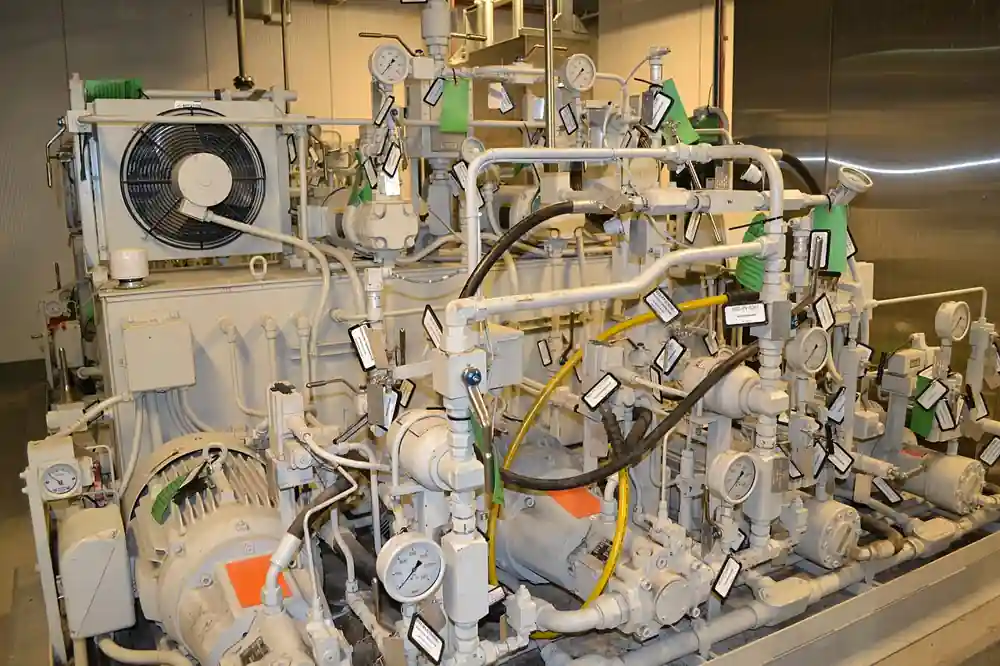
An isomerization unit changes the shape of a molecule, not its size. It takes the light naphtha cut, pentanes and hexanes, and bends their straight carbon chains into branched isomers with the same carbon count and a much higher octane, over a platinum-bearing catalyst under hydrogen. Almost nothing is cracked: the datasheet for one commercial chlorided alumina catalyst quotes liquid yields typically above 99 percent by volume. The unit is small by refinery standards, a feed and effluent exchanger train, a charge heater, one or two reactors, a hydrogen recycle loop, a stabilizer, and in some designs a column that returns unconverted normal hexane to the reactors. The EPA's refining emission factors list isomerization among the processes that rearrange molecules; that list and the datasheet are the sources behind this page, which treats the whole train as the thing bought.
A buyer's first question is what the feed is. The C5/C6 cut arrives from a hydrotreater, and its split between pentanes and hexanes, its benzene, and anything heavier than hexane decide how much octane the unit can add. Next come the catalyst family, chlorided alumina running cold or zeolite running hot, and the flow scheme, once-through or with a recycle column. Last come the hydrogen supply and the purity the feed must be held to, since both decide how long the catalyst lasts. The chapters below follow that order. Where a figure comes from the catalyst datasheet the text says so; the rest are the ranges common practice gives, not design values for a particular unit.
Four decisions carry most of the purchase of an isomerization unit: the feed, since the C5 to C6 split and the benzene and C7+ it carries set the octane headroom; the catalyst family, which sets reaction temperature, feed purity, and whether chloride has to be handled at all; the flow scheme, once-through for simplicity or recycle for octane; and the hydrogen supply and feed pretreatment, where most feed upsets begin and where most of the unit's day-to-day operating trouble lives.
Chapter 1 / 06
What an Isomerization Unit Is and What Is Being Decided
Seen as equipment, an isomerization unit is a hydrogen loop around one or two beds of catalyst. Hydrotreated C5/C6 naphtha is dried, mixed with recycle hydrogen, heated through a feed and effluent exchanger train and a charge heater, and passed down through the reactors. The effluent gives up its heat, cools, and separates into hydrogen-rich gas, which a compressor returns to the feed, and liquid, which goes to a stabilizer. The stabilizer takes off the small amount of gas and liquefied petroleum gas that cracking produced; its bottoms are isomerate. A recycle design adds one more column between stabilizer and reactors, and hydrogen makeup enters the loop where the recycle gas is at its lowest pressure.
Branching raises octane because knock depends on how easily a fuel ignites from heat alone. A straight chain ignites early, before the spark wants it to; a branched chain of the same carbon count resists that self-ignition. The research octane ratings show the size of the effect: normal pentane is rated about 62 and isopentane about 92, normal hexane about 25, its monobranched isomers in the low to mid seventies, and 2,3-dimethylbutane about 100. No other refinery reaction adds so much octane to so cheap a feed while keeping every carbon atom in the gasoline pool, which is what the near total liquid yield means in practice.
What is being decided is an octane number with a yield and a catalyst life attached. The refinery states the feed cut, its pentane to hexane split, and its rate, and asks for the research octane of the isomerate at the start of the cycle and at the end, for the liquid yield, and for the hydrogen the unit will need. The scheme, the catalyst, the reactor volume, and the column behind the stabilizer all follow from that octane. Because the reaction settles at an equilibrium, the guarantee is really a statement of how close to equilibrium the catalyst will bring the feed, and for how long it will keep doing so.
Two regulatory pushes made the unit common. The first was the removal of lead, which left refiners hunting for octane in light naphtha that had been blended straight. The second was the cap on benzene in gasoline: benzene sits in the light naphtha range, so refiners began cutting the naphtha splitter lower to keep it away from the reformer, and then had to do something with the benzene-rich light cut. The platinum in an isomerization catalyst saturates that benzene to cyclohexane, and the datasheet for one chlorided catalyst claims complete saturation for typical feeds, which makes the unit a benzene control tool as well as an octane one.
Refineries buy the unit for different reasons. One short of octane after a lead or benzene rule change buys it for the cheapest octane in the pool. One with surplus hydrogen from a catalytic reformer adds it to lift light naphtha that was being blended straight. One building a naphtha complex puts it beside the hydrotreater and the splitter from the start. And one with a naphtha rich in pentanes may stop at a small once-through C5 unit, since turning normal pentane, rated about 62, into isopentane, rated about 92, pays back quickly even in a single pass. The feed slate, not the catalog, tells a refinery which of these it is.
The economics are an octane gap against a hydrogen and catalyst bill. Isomerate is worth the difference between its octane and the feed's, multiplied by the barrels, with almost no volume lost. Against that stand the hydrogen consumed in saturating benzene and in the little cracking that occurs, the power of the recycle compressor, the fuel for the charge heater, and the catalyst, platinum on a support that a chlorided unit may keep on line for years. The scheme sets the capital: a once-through unit is among the cheapest octane units in a refinery, and each recycle column adds steel and reboiler duty for a few more numbers.
Chapter 2 / 06
How Reactors, Hydrogen, and Columns Do the Work
The chemistry is a skeletal rearrangement helped by two functions on one catalyst. The platinum function dehydrogenates a paraffin to an olefin, the acid function of the support takes the olefin to a carbocation and rearranges its skeleton, and the platinum function hydrogenates the branched olefin back to a paraffin. The net reaction gives off a little heat and stops at an equilibrium that favors branched isomers more strongly the colder the reactor runs. That is why the catalyst family matters: an active catalyst can be run cold and still approach equilibrium, and a colder reactor approaches an equilibrium richer in branched product. Hydrogen is recycled to keep the metal clean, not because the main reaction consumes it.
Pentanes and hexanes behave differently enough that the feed split is a design variable. Normal pentane has one branched isomer worth making, isopentane, and a moderate equilibrium conversion; hexane has several, and the one with octane near 100, 2,3-dimethylbutane, is a minor part of what the equilibrium allows, most of the product being monobranched isomers in the seventies. In practice n-hexane reaches a higher equilibrium conversion than n-pentane, but the last octane numbers from hexane require recycling the normal molecules. The cyclic compounds that arrive with the C6 cut, benzene, cyclohexane, and methylcyclopentane, are saturated and partly rearranged rather than cracked, and cyclohexane, already rated about 83, gains little from the reaction itself.
The reaction section passes feed and recycle hydrogen as a mixed vapor and liquid stream through fixed beds at low temperature and at a pressure commonly between 15 and 40 bar gauge (218 to 580 psig). Feed and recycle hydrogen pass through shell-and-tube heat exchanger trains against reactor effluent, then through a fired heater that trims the reactor inlet temperature, which is raised through the cycle as the catalyst ages. Reactors are downflow and adiabatic, one or two in series, with a temperature transmitter at each inlet and outlet and a differential pressure transmitter across each bed. Effluent is cooled and a separator drum splits it into recycle gas and liquid. A centrifugal compressor circulates the gas on a large unit and a reciprocating compressor on a small one.
Two catalyst families divide the duty. The chlorided alumina type carries platinum on alumina made strongly acidic by chloride; it is very active at low temperature and gives the highest octane per pass, but the chloride is volatile and must be replaced continuously by injecting an organic chloride into the feed, which decomposes on the catalyst. The zeolite type carries platinum on a mordenite-type zeolite whose acidity is built in; it runs hotter, tolerates far more water and sulfur in the feed, and loses activity to coke that can be burned off in place, but at its higher temperature it reaches a poorer equilibrium and cracks more. The datasheet for one chlorided catalyst describes a trilobed extrudate with a nominal diameter of 1.6 millimeters, one sixteenth of an inch.
Poisons differ between the families and dictate the feed pretreatment. A chlorided catalyst is stripped by water, which carries chloride off the support and can be restored by more injection and dry feed; it is held down by sulfur, which suppresses activity until clean feed returns; and it is damaged more lastingly by nitrogen and by arsenic, which attach to the acid and metal functions. Feed is therefore dried, commonly on a molecular sieve dehydrator, and held to water, sulfur, and nitrogen in the low parts per million and arsenic in parts per billion. A zeolite catalyst tolerates more of all of these. In both cases a hydrotreater upstream removes sulfur and nitrogen and saturates olefins before the feed arrives.
After separation the liquid is finished in a stabilizer, a trayed column that takes hydrogen, methane, and the liquefied petroleum gas made by cracking overhead and leaves isomerate as bottoms. In a recycle design the isomerate then passes to a deisohexanizer, which takes normal hexane overhead, with most of the methylcyclopentane, and returns them to the reactors, leaving a bottoms product made of the branched hexanes. Its reboiler duty is the main energy cost of the recycle scheme. A unit built for pentanes can do the same with a deisopentanizer, which draws isopentane overhead and returns normal pentane from its bottoms, and one process replaces distillation with molecular sieve separation of normal paraffins.
Chapter 3 / 06
Flow Schemes, Catalyst Types, and Machine Boundaries
A once-through unit is the simplest type: feed, reactors, stabilizer, isomerate, with nothing returned but hydrogen. Per pass it converts enough normal pentane to make a useful gain and leaves much of the normal hexane unconverted. It suits a feed rich in pentanes, a refinery that needs a few octane numbers rather than the maximum, and any site that wants the least capital and the fewest columns. Chlorided catalysts are commonly run this way, and the datasheet for one of them lists processing of C4, C5, and C6 feeds with relatively high benzene and heavier cyclic content, a volumetric yield above 99 percent, and benzene saturation.
A recycle unit adds a column that sends the low octane molecules back. With a hexane-rich feed the column is a deisohexanizer; with a pentane-rich feed it is a deisopentanizer; a unit treating both may carry both. Separating normal paraffins on molecular sieves instead of by distillation is a third route and reaches the highest octane of all. Each step buys octane with capital, reboiler duty, and plot, and the usual target is the scheme that meets the gasoline pool's need at the lowest octane that suffices, because isomerate beyond what the pool can absorb earns nothing at the refinery gate. In practice most recycle units are built for hexanes, because that is where the unconverted octane sits.
Types are also named by the feed cut. A C5-only unit takes the light cut a naphtha splitter draws and works the large pentane gain. A C6-only unit takes the hexane cut, often one drawn low to carry benzene out of reformer feed, and is where a deisohexanizer earns its reboiler duty. A combined C5/C6 unit takes the whole light naphtha and is common as a new build. The catalyst datasheet notes that its grade suits feeds with a high concentration of benzene and heavier cyclic hydrocarbons, and that where those are low a catalyst with less platinum should be considered, so the feed cut and the catalyst grade are chosen together.
Catalyst families name the other set of types. A chlorided alumina unit is recognized by its chloride injection skid, its feed drier, and a reactor inlet temperature that starts low, commonly 120 to 200 degrees Celsius (about 250 to 390 degrees Fahrenheit); its catalyst is replaced after a long cycle rather than regenerated, and the datasheet for one grade reports very long life against others of its class. A zeolite unit is recognized by a hotter reactor, commonly 230 to 320 degrees Celsius (about 450 to 610 degrees Fahrenheit), a simpler feed specification, and the ability to burn coke off the catalyst in place with a mixture of inert gas and air. The same flowsheet serves either family.
Boundaries keep this unit from being confused with neighbors whose names sound alike. It is not catalytic reforming, which runs naphtha much hotter over a platinum or rhenium catalyst to make aromatics and hydrogen, as the EPA's description of that process has it; isomerization runs colder, keeps paraffins paraffins, saturates benzene instead of making it, and borrows hydrogen rather than making it. It is not a steam-methane-reformer, the fired plant that makes hydrogen from natural gas, though such a plant may supply it. And it is not the hydrotreater that cleans its feed, whose own page already describes a pretreater as the unit protecting a downstream catalyst, nor the fired heater that trims its reactor inlet or the centrifugal compressor of its hydrogen loop, parts with entries of their own.
Connections place it in a naphtha complex. Light naphtha comes from the crude unit's splitter, is hydrotreated, dried, and sometimes passed over an arsenic removal bed, and its stabilizer may be a packed tower in some designs. Hydrogen comes from a catalytic reformer's surplus gas, from a steam-methane-reformer whose carbon dioxide is removed by an amine unit, or from a hydrogen-electrolyzer where power is cheap and reformer gas is not to be had. Safety relief valves and rupture disks discharge to a knockout drum and the flare. The same light-ends sorting that sends C4 olefins to an alkylation unit sends pentanes and hexanes here. The drier and the guard beds sit between the hydrotreater and the reactors.
Chapter 4 / 06
Key Specification Parameters
The data sheet for an isomerization unit is short, and most of its rows describe the feed. The table that ends this chapter gives feed purity, reaction conditions, yield, catalyst properties, and octane. Only three kinds of figure in it come from a source: a liquid yield typically over 99 percent by volume, the extrudate size, and the bulk density are printed on the datasheet for one chlorided alumina catalyst, whose bulk density is listed at 785 to 835 kilograms per cubic meter (49.0 to 52.1 pounds per cubic foot). Reaction temperatures and pressures, feed and product octane, contaminant limits, chloride injection, and catalyst life are ranges common practice gives, wide because licensors differ and because neither cited source prints them.
The specification that sells the unit is the octane gain, and it follows from the feed. A light naphtha with a research octane commonly of 60 to 69 leaves once-through at commonly 80 to 84 and with a deisohexanizer recycle at commonly 85 to 88, a gain of roughly fifteen to twenty-five numbers depending on feed and scheme. A pentane-rich cut gains less in total but reaches it cheaply. Temperature sets how far the equilibrium goes: every degree colder moves the equilibrium toward branched isomers, which is the chlorided catalyst's whole advantage, and the reactor inlet temperature is raised through the cycle only to hold conversion as activity falls. Benzene in the feed is saturated, not lost.
Materials are ordinary because the fluids are mild. Carbon steel serves the reactors, exchangers, and most of the stabilizer, and hydrogen service at these pressures and temperatures needs no special alloy. The exceptions come from chloride: when a chlorided unit over-injects, or when water and chloride meet in the stabilizer overhead, hydrogen chloride forms and corrodes carbon steel, so that overhead system is watched and in some designs built in a resistant alloy. A recycle column runs hotter than the stabilizer and is still carbon steel. The catalyst is the most valuable material in the unit, platinum on a support delivered in drums and charged under a licensor's procedure.
Parameter
Typical catalog range
What it decides
Feed
hydrotreated C5/C6 naphtha
Octane headroom; pretreatment scope
Feed contaminants
commonly a few ppm water, sulfur, nitrogen; ppb arsenic
Catalyst life; chloride balance
Reaction temperature, chlorided catalyst
commonly 120 to 200 C (about 250 to 390 F)
Equilibrium conversion; heater duty
Reaction temperature, zeolite catalyst
commonly 230 to 320 C (about 450 to 610 F)
Equilibrium conversion; cracking
Reactor pressure
commonly 15 to 40 bar g (218 to 580 psig)
Vessel thickness; compressor size
Liquid yield
typically over 99 percent by volume
Volume of isomerate made
Catalyst size, one chlorided grade
1.6 mm extrudate
Pressure drop; mass per reactor volume
Catalyst bulk density, same grade
785 to 835 kg/m3 (49.0 to 52.1 lb/ft3)
Mass of catalyst charged
Feed research octane
commonly 60 to 69
Gain available
Isomerate octane, once-through
commonly 80 to 84
Blending value of the product
Isomerate octane, with recycle
commonly 85 to 88
Blending value; column cost
Benzene in isomerate
saturated almost completely on chlorided catalyst
Gasoline benzene compliance
Chloride injection
continuous, at ppm level in feed
Activity; downstream corrosion
Hydrogen consumption
small; makeup only
Hydrogen source sizing
Chapter 5 / 06
Selection Decision Factors and RFQ Language
Selection starts with the C5/C6 feed assay. The pentane to hexane ratio decides whether once-through will do: a pentane-rich cut gains a great deal in one pass and a hexane-rich cut does not. Benzene content matters twice, because it is saturated at a small hydrogen cost and because the catalyst datasheet claims complete saturation only for typical feeds. C7+ material is a liability, since it cracks to gas and liquefied petroleum gas and lays coke, so its content belongs in the specification with a maximum. Water, sulfur, nitrogen, and arsenic come next, because together they choose the catalyst family. A feed low in benzene may suit a catalyst with less platinum, the datasheet suggests.
The once-through or recycle choice is then a matter of how much octane the gasoline pool needs. A once-through unit has one column, the stabilizer, the least capital, and the lowest utility bill, and it leaves normal hexane and some normal pentane in the product. A recycle unit adds a deisohexanizer or deisopentanizer with its reboiler duty and recovers those molecules on a second pass, for several more octane numbers. The comparison to make is the cost of those numbers here against their cost as purchased octane or as alkylate, and a feed slate that will grow heavier in hexanes argues for leaving room for the column.
The chloride-management or zeolite preference decides the operating temperament of the unit. A chlorided alumina catalyst gives the most octane at the lowest temperature and asks in return for a dry, clean feed, a chloride injection system with its metering pumps, and operators who understand that a water upset is answered with more chloride, not less. A zeolite catalyst asks for less and gives less per pass: it runs hotter, needs the recycle scheme to reach the same octane, tolerates feed upsets, and can be regenerated in place. Where the upstream hydrotreater cannot guarantee a very clean feed, the zeolite choice removes a whole class of shutdowns.
The target octane and the hydrogen supply close the technical list. The target should be written as a research octane at a stated feed assay and a stated point in the catalyst cycle, with the motor octane beside it, because branched paraffins show little gap between the two and that flatness is part of their value. Hydrogen is needed only in makeup quantities, but its purity sets how much recycle gas must be purged, and its source sets the plot: reformer gas arrives by pipeline, a steam-methane-reformer is a plant of its own, and a hydrogen-electrolyzer trades fuel for power. The hydrogen partial pressure in the loop is set by the recycle, and the recycle ratio is a licensor's figure that the buyer should see written down.
Pretreatment and downstream disposition finish the selection. The buyer states what the hydrotreater delivers and who owns the drier, the arsenic bed, and the feed filter, because each protects the catalyst and each has been the cause of a shortened cycle. The stabilizer's overhead gas and liquefied petroleum gas need a route to treating and to the fuel gas or LPG pool. If the isomerate is bound for summer gasoline, its vapor pressure matters, since isopentane is more volatile than the pentane it replaces. Control valve and relief sizing follow the hydrogen loop's pressures rather than the liquid system's. A liquefied petroleum gas stream carrying olefins from cracking may need treating before it leaves the refinery.
Each row below pairs an isomerization decision with what the buyer must state and with what a licensor will assume if it is left blank: a feed without a benzene figure, a target without a point in the cycle, or a hydrogen supply without a purity all come back as a guarantee written in the licensor's favor.
Decision factor
What the buyer must state
Consequence if left open
Feed assay
Pentane to hexane split, benzene, C7+ content, rate
Scheme and octane gain guessed
Feed contaminants
Water, sulfur, nitrogen, arsenic after hydrotreating; drying and guard beds
Catalyst life shortened; chloride unbalanced
Target octane
Research and motor octane at a stated point in the cycle
Guarantee written at start of run only
Flow scheme
Once-through, deisohexanizer, deisopentanizer, or sieve recycle
Column added later at higher cost
Catalyst family
Chlorided alumina or zeolite; willingness to handle chloride
Temperature and feed purity mismatched
Hydrogen supply
Source, purity, pressure, makeup rate
Purge losses and compressor size wrong
Benzene duty
Benzene reduction required from the unit
Gasoline pool benzene target missed
Downstream
Route for stabilizer gas and LPG; isomerate blending
Offgas flared; vapor pressure mismatch in blending
An isomerization RFQ has to pin down the feed before it names a catalyst. A bid-ready specification states: the C5/C6 feed assay and benzene/C7+ content, with the pentane to hexane split, the rate, the water, sulfur, nitrogen, and arsenic left after hydrotreating, and the drying and guard beds in the buyer's scope; the target octane, as research and motor octane of the isomerate at a stated point in the catalyst cycle, with the liquid yield expected; the once-through or recycle intent, and the column or sieve separation acceptable; the chloride-management or zeolite preference, with the chloride injection system, feed drier, and overhead alloy either included or excluded; the hydrogen source, purity, and pressure at the battery limit; the stabilizer and recycle column duties and where the overhead gas and liquefied petroleum gas go; utilities; and the acceptance basis, a performance test on the stated feed with octane, yield, and the catalyst activity trend measured against the guarantee.
Chapter 6 / 06
Installation, Standards, Failure Modes, and Maintenance
Installation is a matter of keeping things dry and clean. Reactors, exchangers, the charge heater, the separator, the compressor, and the stabilizer fit on a compact plot; piping is dried before catalyst is charged, and the catalyst itself is loaded under the licensor's procedure, since broken extrudates raise pressure drop. Commissioning circulates nitrogen and then hydrogen to dry the system and activate the catalyst, brings the temperature up slowly, and introduces feed only when the loop's moisture reading is low enough. In a chlorided unit the chloride balance is established in the first days on line and then held steady. A feed upset in those first weeks costs more activity than the same upset a year later.
Standards are those of any low-temperature, medium-pressure hydrogen loop. Vessels follow the jurisdiction's pressure code, the ASME Boiler and Pressure Vessel Code in the United States; piping follows ASME B31.3; the charge heater follows the fired heater practice of API 560; and vessels and piping are inspected in service under API 510 and API 570. Hydrogen at these temperatures is not the high-temperature hydrogen attack service of a severe hydrotreater, so carbon steel is accepted. No standard governs the catalyst or the process; the licensor's design manual is the reference, and the RFQ should name the editions of the codes current at purchase. Chloride service, where it occurs, is managed by the licensor's metallurgy rather than by a public code.
The recurring failure modes are quiet ones. A water upset through a chlorided unit strips chloride, activity falls, and the reactor inlet temperature is raised to compensate, spending cycle life until the chloride balance is restored; too much injected chloride has the opposite fault, putting hydrogen chloride into the stabilizer overhead and corroding it. Arsenic or nitrogen breakthrough from a failing upstream bed deactivates the metal or the acid function for the rest of the cycle. Coke lays down slowly: it is burned off a zeolite catalyst and simply tolerated on a chlorided one. A loss of recycle hydrogen lets olefin intermediates polymerize to coke on the metal. And a recycle column runs hot enough that its corrosion circuits are inspected at every turnaround.
What operators watch is the reactor inlet temperature and the moisture and chloride balance. Thermocouples at each bed inlet and outlet show the exotherm and the temperature rise needed to hold octane as the catalyst ages. A moisture analyzer on the dried feed and a dew point transmitter on the recycle gas warn of water before it reaches the catalyst. The chloride injection rate is set by the conversion the laboratory reports, where a gas chromatograph gives the isomer distribution each shift and a gas analyzer the hydrogen purity of the recycle gas. A level transmitter on the separator and stabilizer and a flow meter on each feed complete the panel.
Maintenance on an isomerization unit is light between turnarounds and concentrated on keeping the feed clean. The cadence column below reflects common practice; the licensor's manual and the local inspection rules set the dates.
Item
Typical action
Typical cadence
Reactor temperatures
Trend inlet and outlet thermocouples; note the rise needed to hold octane
Continuous
Feed moisture
Check the analyzer against a laboratory sample; regenerate or change the drier
Daily check, drier per cycle
Recycle gas
Track dew point and hydrogen purity; adjust the purge
Continuous to daily
Chloride injection
Verify metering pump rate and chloride inventory
Daily
Product conversion
Run gas chromatograph on feed and isomerate for the isomer split
Daily to weekly
Bed pressure drop
Compare each bed against its clean baseline
Weekly
Feed guard beds
Replace arsenic and sulfur adsorbent before breakthrough
Per bed life
Zeolite regeneration
Burn off coke with inert gas and air when the temperature limit is reached
Every few years
Exchangers and columns
Clean the train; inspect stabilizer overhead and reboiler for chloride corrosion
Turnaround
FAQ
How does an isomerization unit work?
It bends straight molecules into branched ones without changing their size. Hydrotreated and dried C5/C6 naphtha mixes with recycle hydrogen, heats through exchangers and a charge heater, and flows down through platinum-bearing catalyst at low temperature and at a pressure commonly of 15 to 40 bar gauge (218 to 580 psig). On the catalyst a paraffin becomes an olefin, its carbon skeleton is rearranged on the acid sites, and it is hydrogenated back to a branched paraffin. The effluent separates into recycle gas and liquid, and a stabilizer takes off the small amount of gas and liquefied petroleum gas made by cracking. The bottoms are isomerate, with a research octane commonly of 80 to 84 in a once-through unit.
Chlorided or zeolite catalyst: what changes?
Temperature, feed purity, and upkeep. A chlorided alumina catalyst runs cold, commonly 120 to 200 degrees Celsius, gives the most octane per pass, and needs a dry, clean feed plus continuous injection of an organic chloride to keep its acidity; water strips the chloride and more injection restores it. A zeolite catalyst runs hotter, commonly 230 to 320 degrees Celsius, tolerates far more water and sulfur, and can be regenerated in place by burning off coke, but reaches a poorer equilibrium and leans on a recycle column for the same octane. Yields are near total on both. The feed the hydrotreater can guarantee usually decides between them.
What specifications matter most in an isomerization unit?
Start with the feed: the pentane to hexane split, the benzene and C7+ content, and the water, sulfur, nitrogen, and arsenic left after treating. Then read the octane, commonly 60 to 69 research for the feed and 80 to 84 once-through, 85 to 88 with a deisohexanizer recycle. Liquid yield is typically over 99 percent by volume. Reaction conditions follow the catalyst, commonly 120 to 200 degrees Celsius for chlorided alumina and 230 to 320 for zeolite, with pressure commonly 15 to 40 bar gauge. Last come the hydrogen supply, its purity, and the chloride injection rate if the unit is chlorided.
Once-through or recycle: how do I choose?
By the octane the gasoline pool needs and the hexanes in the feed. A once-through unit has only a stabilizer, costs least, and leaves much of the normal hexane and some normal pentane unconverted, which suits a pentane-rich cut and a modest target. Adding a deisohexanizer returns normal hexane to the reactors for several more octane numbers at the price of a column, its reboiler duty, and plot; a deisopentanizer does the same for normal pentane, and molecular sieve separation reaches further again. Compare the cost of those numbers with purchased octane, and leave room for the column if the feed will grow heavier in hexanes.
What inspection and maintenance does an isomerization unit need?
Less than most refinery units, provided the feed stays clean. Operators trend reactor inlet and outlet thermocouples for the slow rise that means aging catalyst, watch a moisture analyzer on the dried feed and the dew point of the recycle gas, and check the chloride injection rate daily on a chlorided unit. The laboratory runs a gas chromatograph on feed and product for the isomer split. Guard beds that remove arsenic and sulfur are changed before they break through. A zeolite catalyst is regenerated in place every few years by burning off coke; a chlorided catalyst is replaced at the end of a long cycle. Exchangers and the stabilizer overhead are inspected at turnarounds.
What drives the cost and lead time of an isomerization unit?
The catalyst and the columns. Platinum on a chlorided alumina or zeolite support is a large share of a small unit's cost and is purchased against a licensor's procedure. A recycle design adds a deisohexanizer or deisopentanizer, a tall column with a reboiler, and a larger plot. Feed pretreatment, the drier, guard beds, and a chloride injection system if required, adds skids and instrumentation. The recycle compressor, a centrifugal machine on a large unit or a reciprocating one on a small one, and the charge heater are the long lead items. Hydrogen from a new steam-methane-reformer or a hydrogen-electrolyzer would dominate the estimate.
What safety and standards apply to isomerization units?
The hazards are hydrogen under pressure and light hydrocarbon, plus hydrogen chloride where a chlorided unit carries chloride into its stabilizer overhead. Vessels follow the ASME Boiler and Pressure Vessel Code and piping ASME B31.3, with in-service inspection under API 510 and API 570; the charge heater follows API 560 for fired heaters. Temperatures are low enough that carbon steel is accepted throughout except where wet hydrogen chloride forms. Relief valves and rupture disks discharge to a knockout drum and the flare, and the hydrogen loop is purged and pressurized with nitrogen before catalyst activation. Organic chloride injection is a closed system handled under the licensor's procedure.