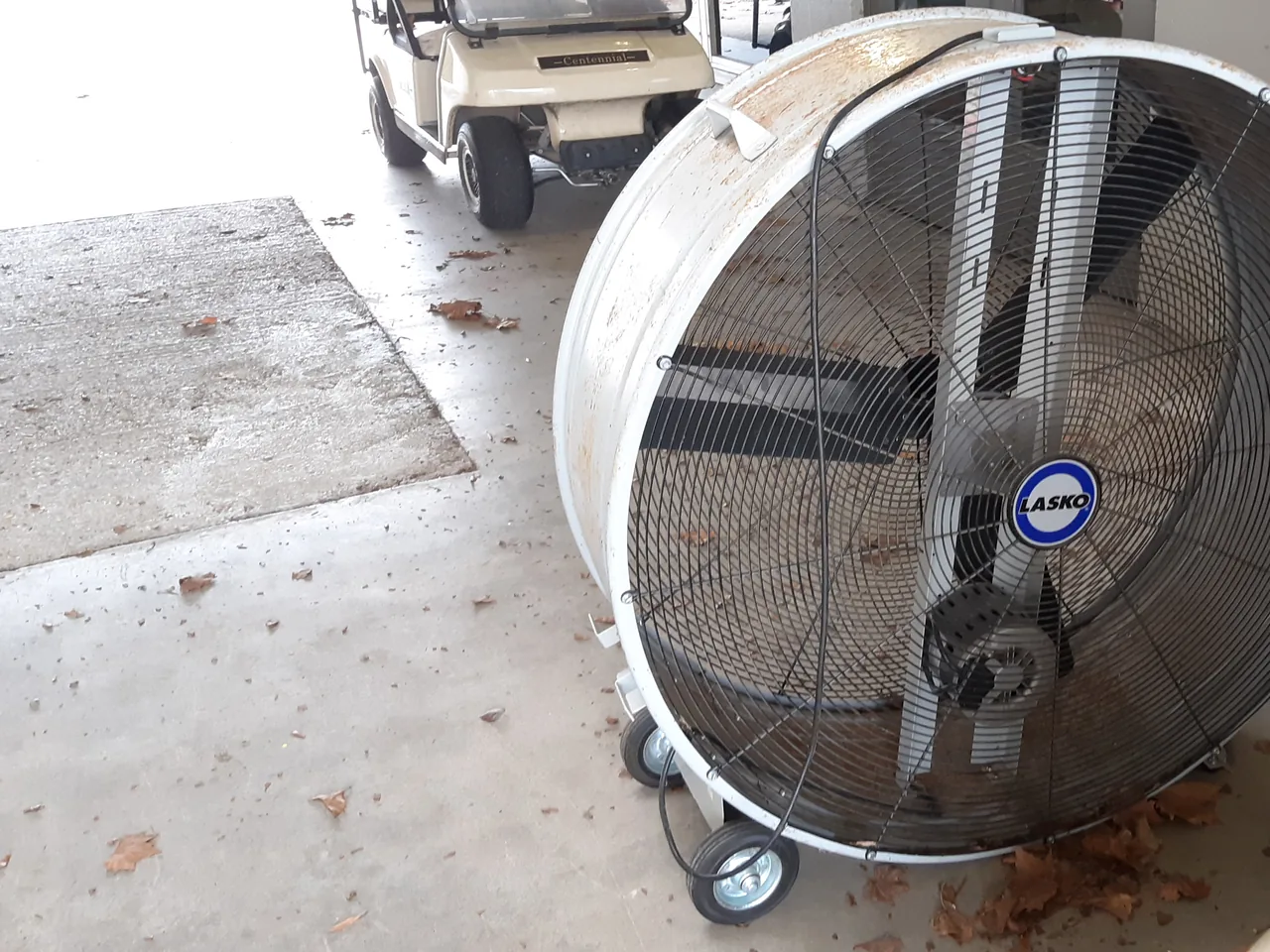
An air circulator is a fan that has no provision for connection to ducting and no pressure boundary separating its inlet from its outlet, so it works against zero external static pressure loss and discharges a jet into open space. That is the definition in ANSI/AMCA 230, the laboratory standard written for the class, and it covers pedestal and bench heads, wall and ceiling mounted heads, barrel and drum fans, and high volume low speed ceiling fans several meters across. The jet is aimed at people, at machinery, or at product. It cools an operator, dries a freshly washed part, pushes stale air out through an open doorway, or folds warm ceiling air down into the occupied zone of a warehouse.
What follows serves the engineer who must pick one of these fans, position it on site, and write the purchase order. It opens with how the jet does its work and why moving air cools, sorts the structural types, lists the parameters that recur on data sheets, and works through the sizing rules together with the point at which each rule of thumb stops being true. Installation, maintenance, failure modes, applications, and purchasing checks follow. Performance figures and catalog ranges come from the ANSI/AMCA standard, the Department of Energy fan system sourcebook, OSHA regulations, and the manufacturer documents listed in the sources; values from general practice are marked as typical.
The buying decision concentrates in four places. First the air speed at the point of use and the distance to it, because throw, not the headline airflow figure, decides whether a fan does its job. Second the type and mounting, which set where the jet can be aimed and who can reach the blades. Third the guard, the electrical supply, and the motor protection, where safety and reliability are decided. Fourth the speed control and the input power, because fan power falls with the cube of speed and the duty rarely needs the top setting.
Chapter 1 / 06
What an Air Circulator Is and How It Works
An air circulator is a fan with no provision for connection to ducting and no pressure boundary between inlet and outlet, so it works against zero external static pressure loss and throws a jet into open space. That is the definition in ANSI/AMCA 230, the laboratory standard for the class, and it separates the circulator from every ducted fan. The job is to move air where people, products, or machines are: across a workstation to keep an operator cool, over a wet part to dry it, out through a doorway to exchange stale air, and from roof to floor in a high bay to mix stratified air. None of these duties needs pressure. Each needs air speed over a target.
The working part is an axial impeller. Each blade is an airfoil set at a pitch angle, and as it turns it generates aerodynamic lift the way a propeller does, in the words of the Department of Energy sourcebook, and adds kinetic energy to the air through the swept disc. The air leaves with some swirl and forms a jet whose core keeps close to the impeller diameter for several diameters. ANSI/AMCA 230 treats this as an exchange of momentum. Thrust is the reaction force from the change in momentum of the air through the fan, measured on a load cell or with standard weights rather than by tracing velocities with an anemometer.
The jet does not stay the size of the impeller. Its edge is a layer of shear that breaks into turbulence, and as it travels it drags surrounding air along with it. ANSI/AMCA 230 calls this entrainment and warns that a velocity traverse taken downstream of a fan is inflated by it, so it places any direct measurement about one or two blade chords behind the impeller. In a room the result is a stream that grows in volume and loses speed as it goes. A circulator sets more air in motion than its data sheet delivery states, at a speed that falls below what anyone can feel beyond a finite distance. Throw is that distance, counted from the guard.
Moving air cools people by two routes, and both depend on air speed. The first is evaporation. Sweat cools only as it evaporates, and it evaporates faster when air moves across the skin. The heat stress manual of the Occupational Safety and Health Administration makes the point with its own instrument: the wet bulb of a heat stress meter, it explains, shows greater sweat evaporation potential when wind speed increases and less when the air holds more moisture. The second route is convection: a warm body loses heat to cooler air faster when fresh cool air keeps reaching the skin. The fan lowers no air temperature. It raises the rate at which heat leaves whatever stands in the jet, so its benefit fades as the air grows hot or humid.
Material responds by the second route alone unless its surface is wet. Spot cooling of a motor or a weld fixture works by sweeping away the warm layer of air on the surface and replacing it with cooler room air, so the heat removed rises with the temperature difference and with air speed. Drying works by evaporation and depends on the humidity of the air as much as on its speed: a circulator blowing humid air over a wet surface dries it slowly. Here the circulator parts company with a chiller or an air conditioner, which take heat out of the air itself. It only moves heat and moisture around; in a closed room it ends by stirring air as warm as the air it takes in.
In a room the jet organizes the air into a pattern. A pedestal unit throws a narrow, fast stream that runs along the floor or across a bench. A large ceiling fan pushes a broad, slow column downward that spreads over the floor, climbs the walls, and returns along the roof, and the specification for one such line describes the result as thorough mixing that achieves thermal equalization. In a high bay, that column folds the warm air banked under the roof into the occupied zone, which is the destratification duty. Because the fan adds no outside air, exchange happens only when the jet pushes indoor air out of one opening while outdoor air enters through another.
Chapter 2 / 06
Air Circulator Types and Structural Variants
The pedestal circulator is the portable member of the family: a guarded head on a height adjustable column and weighted base, tilting and usually oscillating, with bench and floor heads carrying the same impeller and motor on a low stand. One industrial catalog lists wall and pedestal heads from 16 to 30 in. (0.41 to 0.76 m) in diameter, the 18 to 24 in. heads with a three speed motor turning at 1400, 1200, and 1000 rpm and the 30 in. head listed at 1400 rpm, drawing 90 to 250 W, the smaller heads rated at 110 to 140 m3/min and the larger at 263 to 370 m3/min. The same catalog offers larger fixed pedestal units for workstation cooling behind a close mesh guard, on an optional heavy iron base.
Wall and ceiling mounted heads take the impeller off the floor. A wall circulator bolts to a bracket and swings on a joint so the jet can be aimed, and a ceiling mounted head hangs from a bracket or a pendant. Both keep cords off the floor and the blades out of the path of trucks, at the price of fixed coverage. The catalog above rates its wall heads to the same duty as its pedestal heads and lists hanging drum units in 18 to 24 in. (0.46 to 0.61 m) sizes. Where the air holds flammable vapor or combustible dust, the hazardous location version uses an explosion-proof motor, an explosion-proof junction box, and wiring rated for the area in place of the standard motor and rotary switch.
The barrel or drum fan is the housed head in its plainest form: an impeller inside a continuous barrier, here a cylindrical steel shell, which the standard distinguishes from a ring by a width greater than 20 cm (8 in.). ANSI/AMCA 230 names the type a cylindrical air circulating fan, also known as personnel cooler, high velocity fan, or portable cooler. The drum sets the impeller low and sends the jet along the floor, a throw the catalog places closer to the floor than a stand type gives, and the shell shields the blades from impact. Noise is the price: the same catalog rates a 24 in. (0.61 m) floor fan at 64 dB and a 30 in. (0.76 m) unit at 68 dB, both at 1400 rpm.
High volume low speed fans are ceiling fans scaled up. The standard separates a ceiling fan from a horizontal head by a ratio of blade span to maximum rotation rate above 1.524 mm per rpm (0.06 in. per rpm) and draws the line for the large diameter type at a blade tip diameter of 216 cm (84.5 in.). The impeller is meters across and the column of air is wide and slow. One manufacturer's specification for a line spanning 6 to 12 ft (1.83 to 3.66 m) gives a top speed of 164 rpm for the two smallest sizes and 84 rpm for the 12 ft unit, power consumption from 110 to 270 W, and a brushless direct current motor that runs in either direction.
The boundary against neighboring machines is pressure. A centrifugal fan is built to move air through ductwork, coils, filters, and other resistance, and it is rated for airflow at a stated static pressure by the ducted test method of ANSI/AMCA 210. An air circulator is rated in free air, at zero external pressure, by ANSI/AMCA 230, and it stops being useful as soon as anything is fixed to its outlet. It sits between the building and the people in it: a ventilation system supplies and removes air, a chiller or an air conditioner lowers its temperature, and the circulator moves that treated air, or untreated room air, to where a person or a process feels it.
Chapter 3 / 06
Air Circulator Key Specifications and Standards
A circulator data sheet runs to a page, and its lines are the parameters in the table that follows. Diameter means the blade tip diameter, which the standard requires to be measured to within 0.5 percent of its true value. Airflow is the free delivery figure, the volume the fan moves with nothing attached. Air speed at a distance states how fast the jet still travels at a stated point, the number that governs cooling. Speed, motor power, and noise complete the mechanical picture; oscillation sweep, guard opening, electrical supply, and enclosure rating complete the installation picture. The ranges below are those of the catalog and specification documents in the sources. They orient a first selection, not the choice of a specific product.
Three of those figures deserve challenge when they arrive without their basis. A free delivery airflow should say whether it was calculated from a measured thrust under ANSI/AMCA 230 or arrived by another route. A noise level in dB(A) should state the distance and speed of measurement: the one data sheet that lists dB(A) at every speed spans 8 dB between its low and high settings, and the large ceiling fan specification places its sound sensor 5 ft (1.5 m) above the floor and 20 ft (6.1 m) from the fan center. An air speed figure should state its distance. One catalog states a minimum peak velocity at 10 and at 12 times the blade sweep, which a buyer can check with an anemometer.
Standards for the product fall into three groups. For performance, ANSI/AMCA 230 is the laboratory method for air circulating fans: it covers heads with an input power of 125 W or more and ceiling fans of any power, and it reports airflow, efficacy in cubic feet per minute per watt, and for large ceiling fans the ceiling fan energy index at 100 percent and at 40 percent of maximum speed. ANSI/AMCA 300 gives the reverberation room method for fan sound testing, and ANSI/AMCA 204 covers balance quality and vibration levels. For electrical safety, IEC 60335-2-80 states particular requirements for fans of household and similar use, up to 250 V on single phase and 480 V otherwise, but excludes appliances intended exclusively for industrial purposes. For the workplace, the guarding rule at 29 CFR 1910.212 and the noise rule at 29 CFR 1910.95 apply.
Parameter
Typical range or rating
What it decides
Impeller or blade diameter
16 to 30 in. (0.41 to 0.76 m) portable and wall heads; 6 to 12 ft (1.83 to 3.66 m) large ceiling fans
Throw and coverage
Free delivery airflow
110 to 370 m3/min (3,900 to 13,100 cfm)
Volume moved in free air; ask whether it comes from a thrust test to ANSI/AMCA 230
Air speed at a distance
200 to 275 m/min (656 to 902 ft/min) at 10 blade sweeps
Cooling at the point of use
Speed
860 to 1400 rpm in 2 or 3 steps; 1 to 164 rpm for ceiling fans
Airflow, noise, and power
Motor power
90 to 270 W; 1/6 to 1/4 hp (0.12 to 0.19 kW); 0.7 hp (0.52 kW) for ceiling fans
Supply circuit, running cost, speed control
Noise
64 to 75 dB(A) at top speed, 24 to 30 in. heads
Acceptance by people in the jet
Oscillation
90 degree sweep, or fixed with tilt
Workstations served by one head
Guard opening
Wire gap 10 mm (0.4 in.) or less
Finger safety within reach
Electrical supply
120 V single phase; 230 V; 208 to 230 V; 415 V three phase
Circuit, isolator, controller wiring
Motor protection and enclosure
Built in thermal overload protection; totally enclosed motor; IP55 weatherproof heads
Tripping outdoors and when stalled
Speed control
2 or 3 speeds; variable speed with building system link
Airflow steps and links to heating and cooling
Ambient limits
Drive electronics from minus 10 up to 50 degrees Celsius (14 to 122 degrees Fahrenheit); 0 to 95 percent humidity, non-condensing
Suitability for hot, cold, and damp sites
Installation interface
Airfoils at least 10 ft (3.05 m) above the floor; drops of 1 to 10 ft (0.3 to 3.05 m); fire shutdown within 90 s
Structural fixing, clearances, fire wiring
Energy metric
Efficacy in cfm per watt; ceiling fan energy index at 100 and 40 percent speed
Energy use between sizes
Chapter 4 / 06
Air Circulator Selection and Duty Calculations
Selection starts from the target rather than from the fan: a required air speed at a place, or a required area of coverage, from which diameter, speed, mounting, and number of units follow. The five duties below each rest on a rule of thumb, and each rule is followed by the point at which it fails.
For occupant cooling the sizing quantity is air speed at the workstation. The rule of thumb is that a circulator stays effective out to about 10 times the blade diameter. The industrial catalog cited above states its guarantee in those terms: a minimum peak air velocity of 200 to 275 m/min (656 to 902 ft/min) at 10 times the blade sweep, falling to 150 to 200 m/min (492 to 656 ft/min) at 12 times the sweep. The coverage radius for one head is therefore about 10 diameters, and a 30 in. (0.76 m) head reaches roughly 25 ft (7.6 m). Its limit is that this is a centerline peak: the jet is slower at its edges, obstructions break it, and a person off the axis receives far less.
Spot cooling of a machine and drying of product are sized the same way. The target is a surface, so the jet should cover the width of the part at a useful speed: the jet keeps close to the impeller diameter near the outlet, so the area it covers grows with the square of the blade diameter, and the catalog delivery rises from 110 m3/min (3,900 cfm) for a 16 in. (0.41 m) head to 370 m3/min (13,100 cfm) for a 30 in. (0.76 m) head. The fan then sits as close as the guard and safe access allow, because the jet is fastest and narrowest at its outlet. For a long bench, several small heads aimed at each station beat one large head aimed along the line.
For air exchange through a doorway the familiar rule is air changes per hour, found by dividing the volume of outside air delivered in an hour by the room volume. Its limit is written into the definition: an air circulator supplies no outside air. It exchanges room air only when placed to push indoor air out of one opening while outdoor air enters through another, so its published airflow overstates the exchange rate. As an upper bound it still shows the scale. The full 370 m3/min (13,100 cfm) of a 30 in. head, were it all outdoor air, would replace the air in a room 10 m by 10 m by 4 m (33 by 33 by 13 ft) about 55 times an hour, far above any ventilation target.
High volume low speed fans are sized by floor area: divide the floor area by the affected area of one fan, then space the fans on the maker's grid. The specification cited on this page gives, for its 6 to 12 ft (1.83 to 3.66 m) line, an industry spacing of 28 to 48 ft (8.5 to 14.6 m) and a maximum affected area of 1,400 to 4,000 ft2 (130 to 370 m2), the 12 ft unit taking the largest of each. Its metric areas do not convert from its foot figures, so the areas here are converted directly. The affected area is a ceiling, larger than the square the spacing describes, so the grid governs. The figures assume open floor; racks, mezzanines and ductwork cut the column of air. The method ignores ceiling height and heat load, so a hot, high bay may need closer spacing.
Speed, power, and energy follow the fan laws. Airflow varies in direct proportion to speed, pressure with the square of speed, and power with its cube, and the Department of Energy sourcebook notes that a 20 percent speed reduction cuts fan power by 50 percent. One 30 in. floor fan data sheet shows the real curve: 1040 rpm and 255 W on high, 902 rpm and 200 W on medium, 860 rpm and 154 W on low. A three speed motor with a rotary switch gives these steps; a variable frequency drive on a three phase motor, or the built in drive of a large ceiling fan, gives any point between. The limits are motor efficiency, which falls when a motor runs far below its rating, and the throw lost at low speed.
Decision
What to establish
Rule and its limit
Occupant cooling
Air speed needed at each workstation and the distance to it
Useful speed to about 10 blade sweeps; a centerline figure, less off axis
Spot cooling and drying
Size of the surface and its heat or moisture load
Cover the part at the closest safe distance; drying also depends on humidity
Air exchange
Room volume and the outside air flow required
Air changes per hour equal outside air per hour over room volume; a recirculating jet supplies none
Destratification
Floor area, ceiling height, and the heat source
Floor area over affected area per fan, on the maker's spacing; no allowance for racks or height
Type and mounting
Floor space, structural support, and reach of the blades
Pedestal for flexibility, wall or ceiling head for fixed coverage, drum for floor level throw
Speed and power
Airflow steps required and hours spent at each
Power varies with the cube of speed; motor efficiency drops far below rated load
Noise
Background level and exposure time
85 dBA starts hearing conservation and 90 dBA is the 8 hour limit; ask for the datasheet distance
Environment
Water, dust, corrosive fumes, or flammable vapor
IP55 heads outdoors; hazardous location motors and enclosures where the air is classified
Energy
Input power and efficacy at the speed actually used
Efficacy in cfm per watt under ANSI/AMCA 230; the controller's power is counted
Fire interface
Sprinkler type and the fire alarm contacts available
Shutdown within 90 seconds of sprinkler activation; air velocity limits for early suppression sprinklers
Chapter 5 / 06
Air Circulator Installation, Maintenance, and Typical Failure Modes
Installation is where most circulator troubles are planted: a fan aimed at nothing, fastened to nothing, or guarded by nothing. The paragraphs below follow an installation from placing the unit to the first reading of air speed, and the table pairs each maintenance task with the failure it prevents.
Placement comes first. A pedestal unit stands on a flat floor, its column kept low when the head is raised. Wall and ceiling heads hang from a structural member such as a joist or a beam, and the large ceiling fan specification requires proof that the member can carry the weight and the operating load. The same document requires the airfoils to sit at least 10 ft (3.05 m) above the floor, keeps obstacles clear of it, and fits a steel safety cable to its lowest point. In a sprinklered space the same specification shuts the fan down within 90 seconds of sprinkler activation and holds it to the air velocity limits set for early suppression fast response sprinklers.
Guarding is the one installation item that regulation addresses directly. The OSHA machine guarding rule, 29 CFR 1910.212, requires guarding against hazards such as rotating parts, requires guards to be affixed to the machine where possible, and that a guard offer no hazard itself. A circulator meets it with a wire grille on both faces and a shroud around the blade tips, and one industrial catalog states its guard opening as a wire gap of 10 mm (0.4 in.) or less. ANSI/AMCA 230 lets an impeller be tested with or without a guard but requires a guard sold with the fan to be fitted for the rating. A bent, cut back, or missing guard is a stop work defect, and a fan within reach of a forklift needs a barrier.
The electrical supply sets the motor and its control gear. Portable heads run on single phase, 120 V on one data sheet and 230 V in the industrial catalog, from a three speed fully enclosed motor with automatic thermal overload protection and a rotary switch. Larger heads take totally enclosed fan cooled motors for 415 V, three phase, 50 Hz supply, and a three phase asynchronous motor needs a contactor and a thermal relay or a motor protector in place of a rotary switch. The large ceiling fan takes 208 to 230 V, single or three phase, through an integrated drive, with a fused disconnect, in practice an isolating switch with fuses. It also accepts a stop command from the fire alarm control panel or from smoke, flame or heat detectors, and it is compatible with an emergency stop button.
Maintenance is short, and the sourcebook lists its items: bearing lubrication and replacement, belt tightening and replacement where the head is belt driven, motor repair or replacement, and fan cleaning. Cleaning counts for most, because a circulator runs in open room air and pulls dust, mist, and lint through the guard. Build up on the blades is rarely even, and the sourcebook notes that the resulting imbalance brings performance loss and wear in the drivetrain. An anemometer reading at a fixed point and speed is the quickest trend of blade fouling. Small heads use sealed, prelubricated ball bearings that are replaced when noisy rather than regreased, and the sourcebook warns that over greasing interferes with ball motion and may cause overheating.
The failure modes follow from these parts. Imbalance shows first as a pedestal that walks across the floor; a vibration meter trends it, a vibration analyzer separates imbalance from a bearing defect, and a repaired large impeller goes back to a dynamic balancing machine. Bearing noise is a whine that rises with speed. Motor overheating shows as an overload protector that trips, a housing checked with an infrared thermometer, or a winding that fails an insulation resistance tester; running current read with a clamp meter separates a failing motor from a weak supply. Noise is checked against the OSHA rule: 85 dBA averaged over 8 hours starts a hearing conservation program and makes hearing protectors available, and 90 dBA is the limit for a full 8 hour shift.
Isolate the circuit, confirm voltage, phase, and frequency against the motor nameplate, and prove the protective earth with an earth ground tester.
Place or mount the unit, set the aim, and restore the maker's clearance at the inlet and outlet.
Fit the guard, the safety cable, and any barrier, then turn the impeller by hand.
Start on the lowest speed, confirm rotation, and read the running current with a clamp meter.
Measure air speed at the point of use and the speed in rpm, and record both with the input power from an energy meter.
Task or symptom
Cause or check
Action
Blade cleaning
Dust and lint build up, uneven from blade to blade
Clean all blades at one time; trend air speed or vibration
Vibration, pedestal walking
Imbalance from dirt, a bent blade, or a loose hub
Clean, straighten or replace the blade, rebalance a large impeller
Bearing noise
Whine or rumble that rises with speed
Replace sealed bearings; grease others as the maker states, never over greasing
Motor tripping
Overload protector opening, hot housing, low voltage, dust on the motor
Read current and voltage, clean the motor, test the winding insulation
Guard damage
Impact by pallets or trucks, a grille cut back
Out of service until the original guard is refitted
Weak airflow
Loaded blades, inlet blocked by stock or a wall, wrong rotation
Clean, restore inlet clearance, correct rotation on three phase units
Cord, plug, and earth
Cut insulation, loose pins, lost protective earth
Test earth continuity and insulation resistance before reuse
Tighten hardware and inspect cable and controller at the maker's interval
Fire interface
Fan still running after sprinkler activation
Wire the stop command from the fire alarm panel; shutdown within 90 seconds
Chapter 6 / 06
Air Circulator Industry Applications and Procurement Checks
Warehouses and distribution centers are the home of the large ceiling fan, and the duty there is twofold. In warm weather a slow column of air over the floor gives the people picking and packing a gentle breeze that raises the evaporation of sweat. In cold weather a fan run slowly in reverse pushes the warm air collected under the roof back down among the racks, so the heating plant runs less. Control belongs in the order: a thermostat or a temperature switch that runs the fan only when conditions at the floor call for it, a temperature sensor hung at working height rather than at the roof, and a controller that the building management system can reach.
Workshops, welding bays, and loading docks use the portable heads. A welding bay adds radiant heat from the arc, and the OSHA heat stress manual lists reflective shields among its engineering controls; a pedestal circulator set to blow across the welder rather than across the weld adds evaporative cooling without disturbing the shielding gas. A loading dock is open to the weather for much of the day: a wall head or a drum fan aimed along the dock leveler moves the air trapped between the door and the trucks, and it should stand where a forklift cannot back into it. In any bay where dust or mist is generated, the jet is aimed to carry contamination away from the breathing zone, not across it.
Livestock buildings and greenhouses form the agricultural market. The standard lists the livestock cooler and the cow cooler among the common names of air circulating panel fans, the type mounted directly on a panel, an orifice plate, or a ring, and in a barn these hang over the stalls to give animals the same rise in evaporation that a worker feels. Greenhouse operators use rows of small unhoused heads, which the standard calls horizontal airflow fans, to keep air moving between the crop and the glass. Both settings are wet, dusty, or corrosive, so the buyer asks for a motor and enclosure rated for washdown, such as the IP55 weatherproof heads the catalog offers for use without shelter, and outdoor seating areas add misting lines to the same heads.
The purchase order for an air circulator should state the duty and the place, and then the numbers. State what the jet has to do: the air speed required at each workstation or surface and the distance from the fan to it, or the floor area and ceiling height for destratification. State the mounting, floor, wall, ceiling, or beam, the structure available, and the minimum height above the floor. State the electrical supply with its voltage, phase, and frequency, the plug or isolator, and the motor protection required. Ask the supplier for the free delivery airflow and the basis on which it was measured, preferably a thrust test to ANSI/AMCA 230; for air speed at a stated distance; for noise in dB(A) with the distance and speed of measurement; for the guard opening; for the enclosure rating; and for the speed control and any fire alarm interface. Ask which safety standard the product is certified to, and for the installation manual, the spare parts list, and the lead time. Acceptance is a site measurement of air speed and running current against the stated figures.
FAQ
How does an air circulator cool a room?
It does not lower the air temperature. It raises the rate at which heat leaves whatever stands in its jet. The axial impeller throws a stream of air that drags surrounding air along as it travels, so more air moves than the data sheet states. Across a person, the moving air speeds up the evaporation of sweat, which is why the Occupational Safety and Health Administration lists cooling fans among its engineering controls for heat stress. Across a machine or a product, it replaces the warm air on the surface with cooler room air. The benefit fades as the air grows hotter or more humid, and in a closed room the fan only redistributes heat.
What types of industrial air circulator are there?
The family has four practical forms. Pedestal and bench heads are portable, height adjustable, and usually oscillate through 90 degrees. Wall and ceiling mounted heads fix the jet along an aisle or over a bench and keep the floor clear. Barrel or drum fans set the impeller inside a cylindrical steel shell that stands on the floor and throws along it. High volume low speed fans are large ceiling fans, 6 to 12 ft (1.83 to 3.66 m) across in the line cited on this page, turning at up to 164 rpm and affecting up to 4,000 ft2 (370 m2) each. Hazardous location versions use an explosion-proof motor and rated enclosures.
Which specifications matter most on an air circulator?
Air speed at a distance matters more than the headline airflow figure, because throw decides whether the jet reaches the person or the part. After that come diameter, which sets throw and coverage; speed in rpm and the number of speed steps; motor power in watts; and noise in dB(A) with its measurement distance stated. One industrial floor fan data sheet lists 7,400 cfm (about 12,570 m3/h) at 1040 rpm and 255 W on high, falling to 4,980 cfm at 860 rpm and 154 W on low, with noise falling from 75 to 67 dB(A). The free delivery airflow should be backed by a test to ANSI/AMCA 230.
How do I size an air circulator?
Start from the target. For cooling, find the air speed needed at the point of use and its distance. The catalog cited here guarantees a peak of 200 to 275 m/min (656 to 902 ft/min) at 10 times the blade sweep, so coverage is about 10 diameters. For air exchange, divide the outside air flow per hour by the room volume to get air changes per hour, noting that a recirculating fan supplies no outside air. For destratification, divide the floor area by the affected area of one large ceiling fan, 1,400 ft2 (130 m2) to 4,000 ft2 (370 m2), and space them 28 to 48 ft (8.5 to 14.6 m) apart.
How is an air circulator installed and maintained?
Place the unit on a firm floor or fix it to a structural member, aim the jet at the target, and keep the inlet and the outlet clear. Large ceiling fans need airfoils at least 10 ft (3.05 m) above the floor, a steel safety cable, and a fused isolator on the supply. Where blades are within reach, the guard must be in place and undamaged. Maintenance is short: clean the blades before dust builds up unevenly and causes imbalance, listen for bearing noise, and never over grease bearings. A fan that trips its overload protector, walks across the floor, or has a bent guard should be taken out of service until it is repaired.
What drives the cost and lead time of an air circulator?
Diameter is the first driver, because it sets the size of the impeller, the guard, the motor, and the shipping volume. Motor type is the second: a three speed single phase motor is the common build, a washdown or hazardous location motor adds cost, and a large ceiling fan carries a motor with an integrated electronic drive in place of a simple motor and switch. Controls come next, from a rotary switch to a variable speed controller with building system links and a fire alarm interface. Structural mounting, drop lengths, and safety hardware add to a ceiling installation. Lead time lengthens for certified hazardous location versions, unusual voltages, and large diameters that travel as freight.
What safety rules and standards apply to air circulators?
For guarding, the OSHA rule at 29 CFR 1910.212 requires guards against rotating parts that create no hazard themselves, so any fan within reach needs an intact guard; one catalog states a wire gap of 10 mm (0.4 in.) or less. For noise, the rule at 29 CFR 1910.95 sets 85 dBA averaged over 8 hours as the level that starts a hearing conservation program and 90 dBA as the 8 hour limit. For product safety, IEC 60335-2-80 covers fans of household and similar use, not appliances built only for industry. For performance, ANSI/AMCA 230 defines the laboratory test. Where sprinklers protect the space, large ceiling fans must shut down on sprinkler activation, within 90 seconds in the cited specification.