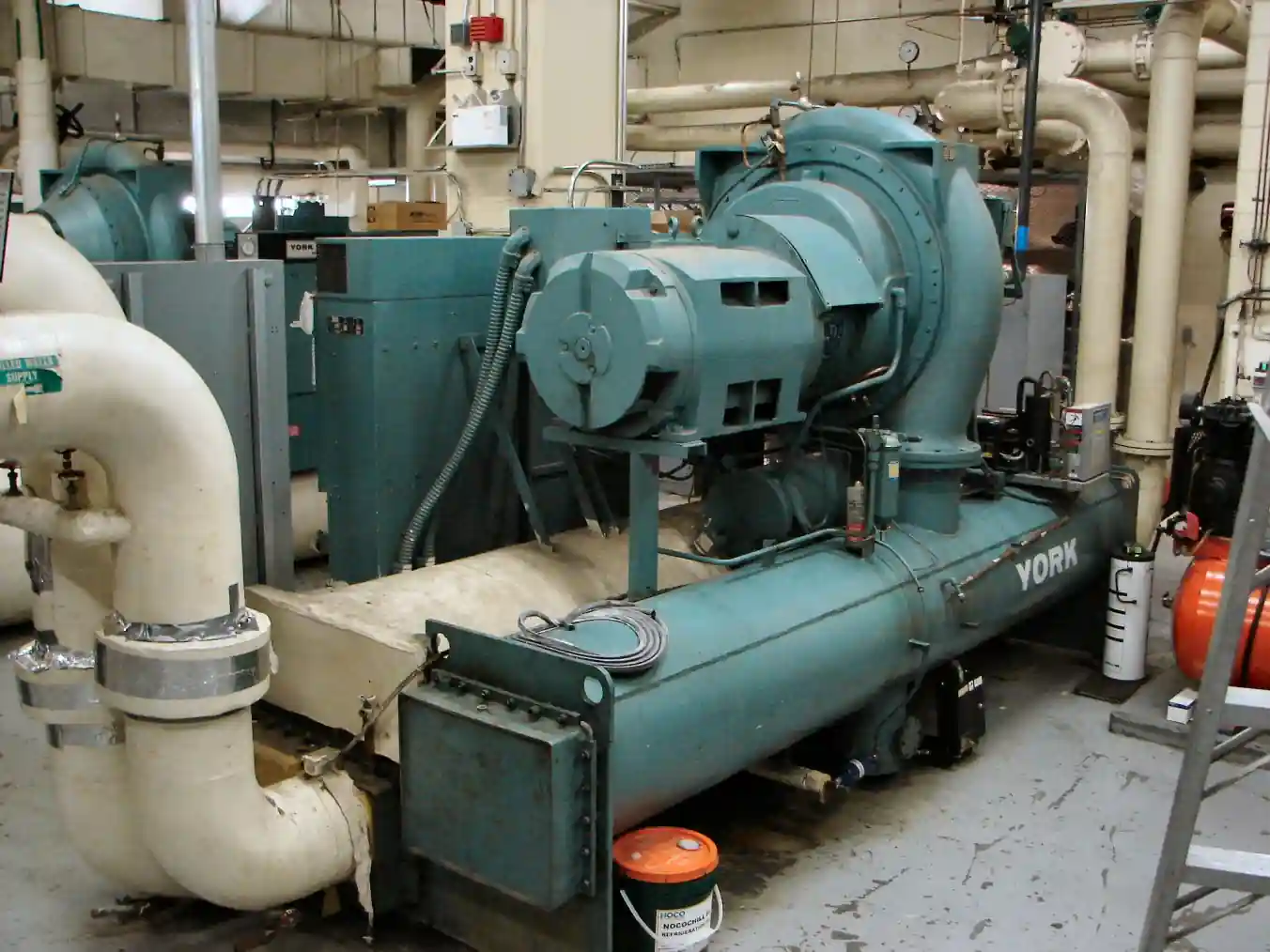
An industrial heat pump is a packaged vapor compression machine that takes low grade heat from a waste stream, a cooling loop, or a water source and lifts it to a process temperature high enough to be useful again, typically 60 to 160 degrees C depending on refrigerant and cycle design. Instead of rejecting condenser heat to ambient like a chiller, it deliberately delivers that heat to a process hot water, cleaning, drying, or low pressure steam demand. The machine is bought to cut fuel burning by multiplying each kilowatt hour of electricity into two to five kilowatt hours of delivered heat.
This page treats the industrial heat pump as a purchasing object: what sets the output temperature ceiling, how source and sink temperatures define the lift and the coefficient of performance, which refrigerants and compressors match which duty, how high temperature machines differ from standard hot water units, and which specification lines a buyer must fix before comparing offers. It is written for plant, energy, and process engineers evaluating waste heat recovery projects in food, chemical, pulp, wastewater, and general manufacturing plants.
The buying decision concentrates in six places: the source temperature and its turndown, the sink temperature the process actually needs, the resulting temperature lift that sets the coefficient of performance, the refrigerant and compressor family that sets the ceiling, the part load behavior across the production week, and the electrical supply available. Fix those and offers become comparable.
Chapter 1 / 06
What an Industrial Heat Pump Is and What Is Being Decided
An industrial heat pump moves heat uphill. A compressor raises the pressure of a working fluid so that it condenses at a temperature above the process requirement, releasing heat into the process stream, then expands and evaporates it at a temperature below the waste stream, absorbing heat that would otherwise be rejected. The electrical input to the compressor is the only purchased energy, and the ratio of delivered heat to that input, the coefficient of performance or COP, is the single number that decides project economics. A machine lifting 35 degree C cooling water to 70 degree C process water might return a COP of 4 to 5, while the same machine lifting to 120 degrees C for low pressure steam may return 2 to 2.5. The buyer is really deciding how much lift to buy.
The category sits between two neighbors that must not be confused with it. A packaged chiller is a cooling first machine: its product is chilled water, and any heat recovery is a secondary configuration, even though reversible heat pump chillers exist as a chiller variant. A cooling tower or a dry cooler rejects heat to ambient and recovers none of it. The industrial heat pump is the authority page for machines whose product is the delivered heat itself, whether the source is process condenser water, wastewater treatment effluent, factory exhaust, or a river or aquifer. When a plant already owns a cooling loop, the heat pump converts that loop from a cost center into a heat source, and the two systems share water rather than compete.
What is being decided at purchase is rarely a single machine. It is a system integration: which waste stream to tap and how constant its temperature is, which process demand to serve and how its profile matches, whether to add a backup boiler in series, and how the machine behaves when either side changes. A heat pump sized for the average load runs efficiently but leaves peak duty to the boiler, while a machine sized for peak load spends more hours at poor part load efficiency. Buyers who fix only capacity and output temperature, then accept whatever machine the vendor maps onto it, are the ones whose measured COP disappoints the energy model.
The economic frame also belongs in the decision. Delivered heat cost is the electricity price divided by the seasonal COP, compared against the fuel price divided by boiler efficiency. When electricity is three times the fuel price per unit energy, a COP above roughly 3.5 breaks even against an 90 percent efficient gas boiler at the margin; when power is cheaper or fuel is expensive or carbon is priced, the break even COP falls. Two identical machines can be a strong investment in one tariff regime and a poor one in another, so the RFQ must state the tariff, the running hours, and who carries the performance risk on seasonal COP.
Scale matters too. Industrial machines arrive as skids from roughly 100 kilowatts thermal to beyond 20 megawatts thermal, with screw, scroll, reciprocating, centrifugal, or oil free turbocompressors depending on size and refrigerant. Below roughly 300 kilowatts the market is dominated by scroll and reciprocating packages over standard refrigerants; above one megawatt, screw and centrifugal machines over ammonia or new low GWP HFO blends dominate, and the engineering shifts from appliance buying to plant engineering with custom evaporator and condenser selection.
Chapter 2 / 06
How the Vapor Compression Cycle Sets COP and Lift
The coefficient of performance follows the temperature lift almost mechanically. For an ideal cycle, COP equals the absolute condensing temperature divided by the temperature difference between condensing and evaporating; real machines achieve 50 to 65 percent of that ideal depending on compressor efficiency, exchanger approach temperatures, and superheat and subcooling losses. Every kelvin of extra lift costs COP, and every kelvin of approach temperature in the evaporator or condenser acts exactly like extra lift. This is why heat pump specifications quote source and sink temperatures, not just capacity: a 700 kilowatt machine at 35 to 70 degrees C and a 700 kilowatt machine at 50 to 95 degrees C are entirely different engineering efforts.
Approach temperature is the quiet budget item. A flooded evaporator with a 2 kelvin approach buys back real COP compared with a 5 kelvin direct expansion coil, and a condenser designed for 3 kelvin approach versus 6 kelvin does the same on the hot side. The buyer sees this in the specification as the temperature difference between leaving source water and refrigerant evaporating temperature, and between leaving hot water and condensing temperature. Machines quoting suspiciously good COP at tight lifts often carry generous exchanger area, which is capital spent to save operating energy. Asking for the COP breakdown at three operating points, design, 75 percent, and 50 percent load, exposes how much of the headline number is exchanger area and how much is compressor marketing.
Two stage and cascade cycles extend the reach. When the lift exceeds what one compression stage can deliver at acceptable discharge temperatures, a two stage screw or centrifugal machine with intercooling, or a cascade with two refrigerants, splits the work. High temperature machines delivering 100 to 160 degrees C for steam or hot oil replacement use these architectures along with refrigerants whose critical points sit above the condensing temperature, because a cycle operating near or beyond the critical point, as transcritical CO2 machines do, changes its behavior entirely: there is no condensation on the high side, only gas cooling, and the heat delivery temperature glides.
The waste heat source sets the floor. Common industrial sources are chiller or refrigeration condenser water at 25 to 40 degrees C, wastewater treatment plant effluent at 10 to 25 degrees C, engine jacket and exhaust heat at 80 to 95 degrees C, drying exhaust at 40 to 60 degrees C, and data center or compressed air cooling loops at 30 to 45 degrees C. The lower and more variable the source, the more the machine spends hours at high lift. Source turndown deserves a specification line of its own: if the waste stream falls to half flow or 10 kelvin colder on winter nights, the machine must either modulate, stage, or ride on a buffer tank, and the control philosophy decides which.
The sink sets the ceiling and the revenue. Process hot water between 60 and 95 degrees C serves clean in place, bottle washing, pasteurization, space heating, and boiler feedwater preheat, and is the volume market. Demands between 95 and 120 degrees C, like clean steam for sterilization or hot water for chemical rinsing, need high temperature machines. Above 120 degrees C, up to roughly 160 degrees C today, machines deliver low pressure steam or pressurized hot water for evaporation, drying, and distillation duties, and each added 10 kelvin shrinks the vendor list sharply while the COP falls toward 2. Matching the true process temperature, not the boiler nameplate temperature, is the cheapest engineering available: most processes specified for 90 degree C hot water actually settle at 75 to 80, and that reduction alone can lift COP by 15 to 25 percent.
Cycle and refrigerant family
Typical output range
Typical COP band
Where it wins
Single stage HFO or R-32 machine
60-75 C
3.5-5.0
Standard hot water, clean in place, space heat
Single stage ammonia R-717 machine
70-95 C
3.0-4.5
Food and process plants with ammonia experience
Two stage or screw high temperature unit
90-120 C
2.3-3.2
Clean steam, hot water above 95 C
Cascade or very high temperature unit
120-160 C
1.8-2.6
Low pressure steam, evaporation, distillation
Transcritical CO2 machine
70-110 C glide
2.5-4.0
Simultaneous hot water at two temperatures, zero GWP
Chapter 3 / 06
Machine Types, Refrigerants, and Duty Boundaries
Water to water machines are the workhorse class: a source circuit absorbs heat from condenser water or effluent, and a sink circuit delivers hot water to process. Within this class the water source heat pump and the water-to-water heat pump are the same machine described from different ends, and the wastewater source variant simply adds fouling management on the evaporator side, usually an intermediate plate heat exchanger that isolates the machine from dirty water. Air source machines exist for factory exhaust and outdoor air duties but pay a COP penalty in cold climates and are not the industrial core. The types that matter to a plant buyer divide by refrigerant and temperature reach, and those families follow.
Ammonia, R-717, is the industrial favorite above roughly 500 kilowatts wherever the plant already runs ammonia refrigeration. It is cheap, efficient, zero GWP, and tolerates high discharge temperatures, which suits it to output above 80 degrees C when the compressor is managed properly. Its hazards, toxicity and flammability at high concentrations, push machine rooms toward coded ventilation, gas detection, and trained staff, all of which food cold storage plants already own. Screw compressor packages over ammonia dominate the 1 to 10 megawatt class, and the same staff who maintain the plant refrigeration system maintain the heat pump. Mid November 2026 reporting on packaged industrial ammonia heat pump units from established industrial refrigeration suppliers illustrates how mainstream this configuration has become in process duty.
Transcritical CO2 machines carry the zero GWP flag with a different cycle. Above the critical point of roughly 31 degrees C and 74 bar, CO2 does not condense; the high side is a gas cooler whose temperature glides downward as it gives up heat, which the designer exploits to deliver, for example, water heated from 30 to 90 degrees C in one pass with excellent exchanger matching. The cycle pressure is high, 90 to 130 bar, which changes component cost, but the working fluid is non flammable, low toxicity, and cheap. CO2 suits sinks that can absorb a gliding temperature, like feedwater preheat and simultaneous domestic and process hot water, and recent high temperature water-to-water projects reported in November 2026 trade press show the class moving up the industrial scale.
HFO and HFO blend machines, and the low GWP hydrocarbon options at small scale, fill the sub megawatt and standard temperature market. They arrive as factory packages with scroll or reciprocating compressors, output capped near 70 to 85 degrees C, and screw machines at the top of that band. For plants without ammonia capability, they buy heat pumping with appliance simplicity, at the cost of a refrigerant price and a regulatory conversation about GWP phase down schedules. The buyer should treat the refrigerant question as a lifecycle decision: future service cost, availability of the fluid in 2035, and leak reporting obligations all follow from the choice made in the RFQ.
High temperature machines, 90 to about 160 degrees C, are a distinct engineering species regardless of fluid. They pair oil management systems or oil free compressors with refrigerants like R-1233zd, R-600 based blends, or two stage ammonia, and their compressors address discharge temperatures that would carbonize ordinary oils. Early November 2026 reporting on high temperature water-to-water heat pump lines from European manufacturers arriving around 100 to 140 degrees C output confirms the class is now a catalog product rather than a research project. Buyers should demand discharge temperature limits, oil return strategy at high lift, and measured COP curves, not design point promises, because at these lifts the gap between laboratory and field numbers widens.
Duty boundaries keep the category honest. A mechanical vapor recompression evaporator is a heat pump applied to one specific evaporation duty, with the process vapor itself as the working fluid; it is bought as an evaporator, not as a general purpose machine, and belongs to that product family. A heat recovery steam generator recovers flue gas heat without a compressor, a boiler flue economizer does the same for boiler feedwater, and a plate heat exchanger or shell and tube heat exchanger moves heat downhill without lifting it at all. The heat pump is bought when the source is too cold for direct exchange, which is exactly the boundary question a specification must answer: if a passive exchanger can do it, buy the exchanger; if the source needs lifting, buy the machine that lifts.
Within a plant the machine integrates with neighbors on both sides. On the source side it may sit behind a plate heat exchanger that protects the evaporator from fouling, or draw from a cooling tower basin in winter, or unload a dry cooler that would otherwise reject the heat. On the sink side it preheats boiler feed water ahead of the deaerator, feeds a hot water loop that a steam system backs up, or charges a storage tank that decouples heat pump hours from process hours. Each of those integrations has a page in this encyclopedia, and the links above connect the buying decisions that surround this one.
Chapter 4 / 06
Key Specification Parameters
The specification lines below decide what is actually being purchased. Capacity must be quoted at stated source and sink temperatures, never alone, and the COP must be quoted at the same points plus seasonal. Output temperature should carry both the design value and the maximum continuous value, because high temperature machines often derate capacity at their ceiling. Source turndown and minimum source temperature protect the machine against the real waste stream. Compressor staging, sound power, and refrigerant charge belong in the datasheet conversation from the first round, not the last.
Parameter
Why it matters
Typical specification line
Thermal capacity
Sizes every exchanger and the electrical supply
700 kW at 35 C source in, 70 C leaving hot water
Sink temperature
Sets refrigerant family and cycle architecture
75 C continuous, 85 C peak for clean in place
Source temperature and turndown
Worst case sets the lift the machine must survive
30-40 C at design, 20 C minimum, 50% flow turndown
Exchanger approach deserves its own line because it is where honest machines are separated from optimistic ones. Ask for evaporator and condenser approach at design and at 50 percent load, and for the fouling factor assumed in the capacity calculation. A machine selected at a 0.05 square meter kelvin per kilowatt fouling margin will hold its capacity in a food plant; one selected clean will lose 8 to 15 percent within a season and take the COP with it. For wastewater or dirty condenser water sources, the intermediate exchanger and its clean in place provisions should be quoted as part of the machine scope, not left to the site.
Controls and instrumentation lines round out the specification. The machine needs leaving hot water control with a setpoint range, source flow proof, and a communication port for plant SCADA; a temperature transmitter on both circuits and a pressure transmitter on the refrigerant high side give the operator the two trend lines that diagnose most seasonal drift. A variable frequency drive on the compressor is standard on serious industrial machines and is what makes the part load COP curve worth having; buyers should also fix the sound power rating at full and part load, because indoor installations near occupied spaces change the acoustic enclosure scope.
Finally, state the acceptance test. A performance test at design conditions witnessed on site, or a factory witness test for large machines, converts the COP promise into a contractual number. Specify the tolerances, the instrument calibration class, and the correction method for off design ambient or water conditions during the test. Vendors who resist a witnessed COP test at three load points are telling the buyer something about their seasonal performance claims, and it is better to learn it during procurement than after commissioning.
Chapter 5 / 06
Selection Decision Factors and RFQ Language
Selection starts with the demand profile, not the machine. Plot the process heat demand hour by hour across a production week and the waste heat availability on the same axes; the intersection is the duty the machine can honestly serve, and the gap is what a boiler or a storage tank must cover. Plants with steady 24 by 5 demand and steady condenser heat are the easy case, and the machine sizes close to the intersection. Batch plants with sharp morning surges need either a buffer tank, which lets a smaller machine run longer at better efficiency, or acceptance that the boiler still carries peaks. The demand profile also sets the seasonal COP, which is the number that pays the project.
Refrigerant selection follows plant capability before thermodynamics. An ammonia trained site with a coded machine room buys ammonia and gets temperature reach and efficiency; a small food plant without ammonia systems buys HFO packages and gets appliance simplicity; a site with carbon targets and a gliding sink demand looks hard at CO2. The choice interacts with the fire and safety review, the insurance conversation, and the local permitting timeline, any of which can veto a technically excellent cycle. Write the refrigerant constraint into the RFQ as a requirement with reasons, and let vendors propose alternatives only with a full lifecycle argument.
Integration risk lives at the interfaces. On the source side, fouling is the leading cause of disappointment: dirty condenser water and wastewater carry solids and biology that coat exchangers, so specify the isolation exchanger, materials, and clean in place access up front. On the sink side, check that the process can actually accept the delivered temperature profile, including minimum return temperature, because a machine sized for a 40 degree return that actually sees 55 degrees loses both capacity and COP. Where the heat pump preheats feedwater ahead of an existing deaerator or boiler, the control handoff between old and new plant decides whether the fuel savings actually appear on the meter.
State the source: fluid, flow, temperature range across the year, and turndown, for example 38 C condenser water from the ammonia refrigeration plant, 30 to 42 C, 60 cubic meters per hour, never below 25 C.
State the sink: required leaving temperature and flow, return temperature profile, and whether the demand is continuous or batch, for example 80 C hot water for bottle washing, 20 cubic meters per hour, 55 C return, 16 hours per day.
State the capacity and COP requirement at those two points, with a seasonal COP expectation and the tariff used for the business case.
State the refrigerant constraint and the safety context: machine room class, ventilation, gas detection, and who will service the machine.
State the electrical supply, maximum demand, and motor starting constraints, and whether a variable frequency drive is required.
State the fouling reality of the source and require the isolation exchanger and clean in place scope inside the offer.
State installation constraints: indoor or outdoor, footprint, sound limit at the property line, and crane access.
Require the acceptance test: COP at design and two part load points, witnessed, with tolerances and correction method.
Two comparisons belong in selection without becoming the page title. Against a new high efficiency boiler, the heat pump wins on operating cost wherever the seasonal COP beats the fuel to power price ratio and on carbon almost everywhere, but loses on capital and on output temperature ceiling, which is why hybrid plants are common. Against passive recovery with a plate heat exchanger, passive wins outright when source temperature exceeds sink requirement, and the heat pump only enters the conversation when lifting is unavoidable; a competent study computes both before recommending the machine.
Chapter 6 / 06
Installation, Standards, Failure Modes, and Maintenance
Installation divides into machine room and interfaces. Refrigerant machinery code applies by fluid: ammonia systems fall under the relevant industrial refrigeration safety standards with machine room ventilation, detection, and relief piping; CO2 systems add high pressure ratings and relief strategy for the gas cooler side; HFO packages largely arrive as tested units needing water, power, and drainage. The machine needs a level base, service access on the exchanger ends, and isolation valves on both water circuits. Indoor installation protects the machine and simplifies acoustics; outdoor installation frees plant space but demands freeze protection on the water side and weatherproof electricals, and both options should be priced in the offer rather than assumed.
Standards and compliance lines to request include the pressure equipment declaration for the refrigerant side and the water side exchangers, the machinery directive or local equivalent conformity, electrical conformity, and the refrigerant safety class documentation. Where the machine serves potable or food contact hot water, the water side materials and any double wall exchanger requirement must be stated. Insurance carriers in some regions ask specifically about ammonia charge size and machine room protection, so the documentation pack assembled at purchase should anticipate that review rather than reconstruct it after a loss survey.
The failure modes that dominate field experience are fouling, refrigerant loss, and control drift. Fouling on the source exchanger shows up as falling evaporating pressure and rising lift, and the defense is the fouling factor chosen at specification plus scheduled clean in place; a trend of the temperature transmitter pair across the source exchanger catches it months before capacity complaints. Refrigerant loss, slow leaks at valve stems and flanges on vibrating packages, erodes COP gradually and raises discharge temperatures; log the charge and the high side pressure transmitter reading monthly. Control drift appears when setpoints are raised locally to solve a process complaint, silently buying temperature the machine pays for in COP every hour after.
Symptom
Likely cause
First response
Capacity down, evaporating pressure low
Source exchanger fouled or source flow low
Clean in place, verify source pump and strainer
COP down, discharge temperature high
Refrigerant loss or non condensables
Leak check, purge, verify charge against nameplate
Hot water temperature unstable
Control hunting at part load or tank stratification
Retune setpoint ramp, check buffer tank mixing
Machine trips on low source temperature
Waste stream turndown below design floor
Raise minimum source flow interlock, add buffer
Noise complaints at part load
Compressor or oil management resonance at low load
Check vibration isolation and VFD minimum speed
Maintenance is compressor centric. Screw and reciprocating machines follow oil analysis intervals, with oil changes driven by acidity and moisture readings rather than the calendar; scroll and centrifugal packages run longer service intervals but still demand condenser cleaning and annual leak survey. The high temperature variants carry oil systems stressed by discharge heat, and their maintenance plan should follow the manufacturer high lift schedule strictly. Keep a spare set of gaskets for the plate exchanger and a spare source pump; both are the components that stop the machine in food plants, and both are cheap compared with a week of boiler fuel. An annual performance retest against the acceptance baseline, the same three load points, keeps the seasonal COP honest for the life of the asset and gives the energy team the trend line that justifies the next machine.
The machine also lives inside a wider plant family that this encyclopedia covers page by page. Compression siblings range from the scroll compressor and reciprocating compressor packages of the small machine class to the centrifugal compressor trains of the largest duties, all spinning an ac motor fed from the plant bus. The heat side connects to steam plant hardware, the boiler feed pump and steam trap of a back-up or hybrid system, a desuperheater where live steam must be tempered, and the surface condenser of any condensing cycle. On the rejection side of the source loop, the evaporative condenser and dry cooler variants, the aftercooler on compressed air duty, and the expansion tank that closes the water loop all share hardware families with the heat pump skid, and buyers routinely source them from the same engineering conversation.
FAQ
What source temperature do I need to run an industrial heat pump economically?
Most successful projects sit between 20 and 60 degrees C source. Above roughly 45 degrees C check passive recovery with a plate heat exchanger first, because direct exchange may be cheaper. Below about 15 degrees C the machine works but the COP falls toward 3 even for moderate sink temperatures, so the tariff and running hours must carry the case.
How hot can an industrial heat pump actually deliver?
Standard packages deliver 60 to 85 degrees C. High temperature machines reach about 100 to 120 degrees C routinely and the current catalog frontier sits around 140 to 160 degrees C for low pressure steam and pressurized hot water. Expect COP between roughly 2 and 3 at those ceilings, and verify with a measured curve rather than a design point claim.
Is ammonia or CO2 the better refrigerant for a process heat pump?
Ammonia suits plants that already operate industrial refrigeration, offering efficiency and high output with the cost of machine room safety engineering. CO2 suits zero GWP targets and sinks that absorb a gliding temperature, with high pressure component costs. Both are mainstream; the deciding factors are site safety capability and the sink temperature profile, not the refrigerant alone.
What COP should I demand in the contract?
Demand a guaranteed COP at your stated design points plus a curve at 75 and 50 percent load, and a witnessed acceptance test with stated tolerances. For 35 to 70 degree C duty expect 4 to 5; for 50 to 95 degree C expect around 3; above 120 degrees C output expect 2 to 2.5. Seasonal COP depends on your load profile as much as the machine.
Can a heat pump make steam instead of hot water?
Yes, up to a point. High temperature machines deliver low pressure steam around 120 to 160 degrees C directly or via a steam generator on the hot water side, typically for clean steam, small evaporation, and tracing duties. For higher pressures and large steam loads the economics usually favor hybrid operation where the machine preheats feedwater and the boiler raises pressure.
How do I protect the machine against a dirty waste heat source?
Isolate the machine with an intermediate plate heat exchanger, select the evaporator with a real fouling margin, and buy clean in place provisions in the original scope. Log the temperature difference across the isolation exchanger weekly; when it rises 3 kelvin above the clean baseline, clean. Fouling is the single most common cause of disappointed field performance.
Does a heat pump replace my boiler?
Usually it displaces part of the fuel. Most plants run hybrid: the heat pump carries the base hot water load at high utilization while the boiler covers peaks, high temperature demands, and redundancy. Size the machine for the hours, not the peak, and the project pays back; size it for the peak and part load inefficiency erodes the savings.