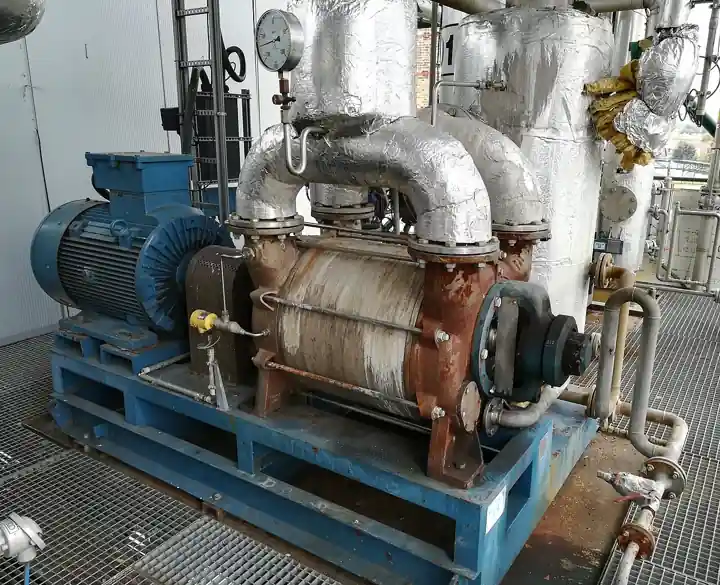
A vacuum distillation unit (VDU) uses low absolute pressure to recover gas oil and other heavy distillates from atmospheric residue. It combines a feed heater, a low-pressure fractionating tower, wash and draw circuits, and equipment that removes overhead gases and condensable vapor. Vacuum residue remains as a separate product for the receiving process.
For a buyer, the difficult part is increasing useful recovery while preserving gas oil quality and an acceptable run length. The relevant constraints span heater duty, vapor distribution, wash-section fouling, column pressure drop, condenser conditions and the vacuum train's utility requirements.
Evaluate a VDU by feed envelope, flash-zone pressure and gas oil quality together. The design that recovers the most usable gas oil has to sustain the necessary pressure, control droplet carryover and transfer every stream under the agreed conditions.
Chapter 1 / 06
What a Vacuum Distillation Unit Separates
A vacuum distillation unit (VDU) is a refinery plant for recovering useful fractions from atmospheric residue. The feed contains material that was too heavy to recover economically as atmospheric distillate. The unit adds heat and sends the mixed-phase feed through a transfer line into a column operating at low absolute pressure. That pressure lets a larger fraction vaporize at temperatures the hot oil can tolerate. The vapor is separated into useable cuts and the unvaporized portion leaves at the bottom as vacuum residue. Sulzer describes light ends, gas oils, lubricant fractions in applicable configurations, and residue as potential outputs [1].
Lowering pressure shifts the phase equilibrium. It does not turn heavy molecules into light molecules, and a VDU cannot promise the heavier gas oil that a particular feed does not contain. In a conversion refinery the usual product target is one or more vacuum gas oil cuts. Some refining schemes make vacuum distillates suitable for further work in a lubricants train. In a fuels scheme, products called light and heavy vacuum gas oil can be collected separately or combined according to refinery needs. The cut labels by themselves convey neither the boiling curve nor the allowable contaminants at the agreed downstream feed connection.
The feed to the vacuum unit is sometimes called reduced crude. Establish whether it comes directly from an upstream atmospheric tower, through storage, or from a combination of those paths. Direct transfer uses sensible heat already in the residue, but tightly couples the availability of the two units. Storage can decouple schedules while requiring a different heat, viscosity, and transfer basis. A tank-bottom excursion or a feed water event may fall outside the performance envelope rather than be covered by a normal run acceptance test. The bid should show whether alternate feed sources or upstream operating cases were used in hydraulic and thermal ratings.
The highest throughput is only one measure of capacity. If a requested deep cut increases asphaltene-rich entrainment or leaves more carbon-forming material in the wash zone, the apparent extra gas oil can be unsuitable for the next unit. A gas-oil hydrotreater buyer may ask for distillation endpoints, metals, and a stated carbon residue test along with rate. In parallel the bottoms receiver may care about viscosity, temperature, or remaining distillate. Every guaranteed yield should carry these quality and transfer conditions so that richer gas oil does not merely shift a problem from one facility to another.
Vacuum residue may go to a delayed coker, a visbreaker, a blending or asphalt route, or another specified destination. Listing these outlets is not a performance promise for every residue. For example, a change in vacuum cut depth can alter the residue characteristics seen by a unit whose economics or run length depend on them. Agree which party characterizes each crude case and which owns variation after the VDU. A measured product and a predicted product should be compared at the same sampling point, after any known dilution or conditioning specified in the receiver contract.
Stream
Information needed
Interface question
Atmospheric residue
Case by case flow, assay, hot tank or direct feed conditions
Who owns compression or pumping and heat at the feed point?
Light vacuum gas oil
Boiling-range method, discharge temperature and destination pressure
Is it tested separately or in a combined gas oil product?
Heavy vacuum gas oil
Heavy end recovery, metals basis and carbon residue method
Which contaminant or hydraulic limit constrains its yield?
Vacuum residue
Viscosity, temperature and expected outlet routing
Is transfer directly hot or through the storage system?
Overhead gas and condensate
Noncondensables, vapor load, oil and aqueous phases
Which collection systems accept each phase on each case?
Consider the feed variability that actually influences separation. Properties of the crude at its original receipt point do not always describe the vacuum feed, because upstream cut decisions change which fractions arrive. Residue characterization at the VDU boundary should therefore identify the upstream operating case and relevant treatment history. Where a new upstream desalter alters impurity removal, include its interface basis. Where the unit is supplied for multiple upstream towers, ask for credible combinations and avoid double counting the limits of a given crude and the limits of the upstream operation.
Chapter 2 / 06
The Heater, Flash Zone and Wash Section
The vacuum charge heater supplies heat after preheat recovery. The fluid experiences different conditions along the coil and across individual passes. A furnace that delivers enough total energy can still impose adverse local conditions through heat flux or uneven flow distribution. Give the bidder the expected range of feed viscosity, temperature, and rate along with the credible dirty preheat case. Ask for the predicted location of the governing tube and process constraints, along with the basis for restrictions on outlet temperature. This helps compare a furnace intended to make an average yield with one built to keep availability on difficult residue cases.
Low pressure increases the volume occupied by a given quantity of vapor. The transfer line therefore has to be treated as a two-phase system with velocity, elevation, pressure loss, expansion, and mechanical supports assessed together. Pressure at the heater outlet, pressure at the flash-zone measurement, and pressure at the top of the column answer different questions. Loss in the line takes away part of the pressure advantage supplied by the tower. The design team should compare two-phase feed velocity and flow distribution at representative loads rather than size the line based on the liquid feed pipe or on a single estimated vapor fraction.
At the feed inlet, vapor turns upward while heavy liquid and droplets must be directed away from sensitive internals. Inlet devices address the momentum and distribution of the incoming stream. Sulzer identifies feed distribution in the flash zone as important to yield and quality and lists inlet devices for duties including liquid pre-separation and momentum handling [1]. The designer needs the likely range of vapor loading and liquid entrainment before rating an inlet device. A correct drawing also leaves room for the vapor to develop before it reaches packing or other contacting hardware, since a reduced free area can create a new local restriction.
The wash section limits migration of heavy droplets into recovered gas oil and provides contact between the upward vapor and the descending liquid. This is a harsh duty because the circulating liquid is heavy and solids or coke can accumulate. Wetting and uniform distribution are part of the separation specification rather than purely mechanical details. Too little wash duty may permit heavier carryover or poor wetting, while sending more liquid down as wash costs recovery or affects circulation. The owner should request the governing conditions for low and high flow, the specified distributor performance, and an explanation of how the design accommodates fouling over a stated expected run.
Wash material and entrained droplets can collect as a heavier stream sometimes called slop wax. The flow and definition depend on the individual plant. A case can return it to another location or blend it into a lower-value destination, with different effects on the fresh feed calculation and internal hydraulic traffic. Represent it explicitly in the material balance. A large increase in reported circulation might be preserving wash wetting, increasing recycle through a furnace, or changing how material is accounted for. Engineers cannot compare cases unless the balance defines gross flow and fresh feed separately where those differences apply.
A pump-around takes heat from a section of the tower and returns cooler liquid, which changes vapor loading while providing a heat source for crude or residue preheat. A shell-and-tube exchanger in that service must be rated with the selected liquid, duty, fouling behavior, and pressure loss. An auxiliary air-cooled exchanger may be selected where an installation uses air cooling for an appropriate heat rejection duty. Specify seasonal extremes and the reliability assumptions for the alternative heat sinks. A heat recovery design that only works with a particular downstream exchanger in service may be a production constraint despite a favorable normal heat balance.
For a project that uses stripping steam in its lower section, articulate its purpose and boundary conditions. Steam can reduce the hydrocarbon partial pressure and help recover volatile fractions without requiring an equivalent increase in bulk oil temperature. It increases vapor load and contributes condensate to the overhead system. In a case with less stripping steam or a dry configuration, the heat balance and internals duty must be stated on that basis. A bidder should account for utility availability and the treatment burden of collected water in the same schedule that describes the desired distillate yield.
Chapter 3 / 06
Tower Internals and Vacuum-System Choices
Tower capacity is governed section by section. An upper packed section for gas oil recovery sees different liquid quality and hydraulic traffic from a wash bed or the lower stripping region. Structured packing provides a large surface area for contacting vapor with liquid and can offer a lower pressure drop than a tray arrangement in a suitable design. Sulzer presents Mellapak and MellapakPlus as examples and offers structured grids for severe services [1, 2]. These are relevant examples of product families, not generic pressure-drop guarantees. A catalog test curve must be rated with the intended phases, loads, contaminants, and geometry.
Pressure drop needs a section budget because the vapor must pass from the flash zone to the overhead pressure measurement. With the same overhead pressure, additional drop in the column means a higher flash-zone absolute pressure. That can reduce vaporization or require a change elsewhere to recover the same amount. Ask for allowances for each contacting section, inlet or outlet fittings where relevant, collectors, and distribution hardware, plus the pressure range used for design. This is more informative than a single number that does not show where the available pressure is consumed. Also identify which readings can be checked by installed field instruments.
Trays can still make sense where local liquid distribution, contact stages or access suit the job. A design using trays in an individual service should demonstrate rate margin and pressure drop at the actual vapor density rather than relying on a comparable atmospheric service. In a packed bed, supporting hardware and liquid distributors can govern performance. Poor distribution causes some parts of the cross section to carry more liquid than others. During a revamp obtain drawings showing tray rings, attachments, nozzles, removable sections and the complete assembly sequence, because a high-performance replacement is useful only if the installation preserves its liquid and vapor distribution.
Assembly
Important design question
What to request
Flash inlet
How do the two phases enter and separate across design cases?
Two-phase feed basis, predicted distribution and mechanical loads
Wash grid or packing
Can the section stay appropriately wetted under allowable loads?
Distributor rating, fouling assumptions and carryover basis
Fractionation packing
How much pressure loss is needed for the required separation?
Section curves with effective phase properties and liquid load
Trays where selected
Will low-density vapor support contacting without excessive pressure drop?
Efficiency and hydraulic rating over the operating envelope
Collectors and supports
Will open area, drainage and support rigidity be maintained?
Assembled geometry, access dimensions and installation inspection plan
A steam ejector generates suction using motive steam and has no driven rotor in the ejector itself. A vacuum train can pair stages with condensers so that much of the vapor is removed before a later stage handles the remaining gas. Availability of motive steam and the cooling media both influence the vacuum the train can maintain. Evaluate cooling availability on difficult days and ask how noncondensable gas changes the stage loads. Utility pressure or temperature at the site header has to be converted to the condition actually available at the package connection, after the applicable distribution loss.
A liquid-ring vacuum pump is an alternative or a component of a hybrid system in suitable services. It adds mechanical drive and a seal-liquid circuit, with performance tied to the properties and temperature of that liquid. Quoting a vacuum pump displacement without the suction pressure, gas composition, and seal conditions does not confirm what it can remove in refinery service. Other designs, including a dry screw pump, have a different tolerance for condensable or contaminating streams and require independent selection. Compare utility and waste burdens for the complete train, not for the motor or nozzle alone.
Refer to wet and dry as defined by the design, not as universal labels promising a particular overhead pressure. A flowsheet should state where steam enters the heater or column, whether it is used as motive steam, and where cooling water contacts or remains separate from process vapor. Where condensers are staged, identify the separation equipment that transfers condensate and noncondensables to their respective destinations. A knockout drum and three-phase separator serve different phase-removal duties even when both appear in one overhead arrangement. Ask for normal and limit cases for water, oil, and gas separately.
Chapter 4 / 06
Key Specifications and Guarantee Basis
Arrange the specifications around a common performance case and named design extremes. Use absolute pressure for vacuum where the engineering calculations depend on it and flag any gauge values. Place each pressure measurement on a drawing so the condenser inlet, top of tower, and flash zone cannot be interchanged. Give stream properties in the units and condition needed by the supplier calculations. If an agreed target is achievable only with one feed, one coolant temperature, and fresh heat-transfer surfaces, it belongs in that narrowly defined guarantee. Ask separately for the documented margins under agreed adverse but credible cases.
Vetted bid field
Reporting basis
What a guarantee must resolve
Fresh feed rate
Mass per time and any reference volume conversion
Separation performance at the agreed boundary and slate
Flash-zone pressure
Absolute value at an identified location
Admissible pressure with stated noncondensables and utility conditions
Heater duty and limits
Duty balance, inlet case, fluid and tube constraints
Feasible rate with credible heat exchanger fouling
Gas oil cut quality
Distillation test, metals and carbon residue method as required
Yield evaluated together with agreed usable product quality
Heavy residue quality
Viscosity and temperature basis plus delivery boundary
Compatibility with transport and downstream feed handling
Column pressure drop
Each section clean and specified expected operating case
Allocation consistent with the vacuum train and separation rating
Vacuum load
Composition, condensable and noncondensable flow and overhead conditions
Aspiration capacity and acceptable residual pressure over the design envelope
Utilities and discharge
Steam, water, power, vent load and wastewater by case
Comparison across design options with consistent site boundaries
Specify the laboratory method and sample custody for distillation, solids or metals and any measures of carbon-forming tendency. Results from different carbon residue methods or units should not be assumed interchangeable unless the contract states how they are interpreted. For a combined gas oil guarantee, decide who prepares and tests a representative result and how it is related to the flows of component draws. Make sure the field measurement set includes both fresh feed and streams that are recycled around an internal boundary. Otherwise an increase in measured throughput can just be a change in recirculation, which never left as useful product.
Distinguish a product property failure from a utility condition that was outside the contract. A poor vacuum reading in hot weather can reflect cooling performance rather than a shortcoming in the tower hardware. Conversely deeper vacuum does not guarantee lower gas oil metals if the inlet entrainment and wash duty are wrong. An acceptance schedule can record rate, product quality, absolute pressures, steam conditions, condensate flow, cooling conditions and duty stability together. Any allowed correction to a guaranteed test result should be agreed before the test and backed by a method whose validity is limited to the range actually measured.
Metallurgy should be selected by circuit exposure rather than by duty title. Hot, sulfur-bearing residue and acid species in certain boiling fractions can affect furnace outlet circuits and other hot sections. Overhead condensing regions have their own aqueous exposures, while erosion or impingement can change a local limit. Use assay information plus pressure, temperature, and expected phase conditions. The designer can then identify susceptible welds, nozzles, elbows or equipment areas and document material choice, allowances and inspection access. A material used successfully in a cooler circulation loop does not establish suitability on the transfer line or in the wet overhead.
A tower whose internal process pressure is well below atmospheric pressure must have a structural design basis for external pressure. The required checks include shell geometry, actual allowable differential pressure, credible simultaneous process temperature, and any other applicable pressure or load case. A higher pressure design case addresses a separate question and needs its own documented rationale. In a revamp request inspection and thickness data as well as drawings. The engineering and inspection authorities should review the condition of existing stiffening rings or supports before a new internal loading or pressure scenario is accepted.
Chapter 5 / 06
How to Select a VDU or Plan a Revamp
Compare options on the refinery economics imposed by the product destinations. A unit that recovers extra gas oil at the cost of shorter runs or poorer feed to downstream treating may lower overall value. Another option may prioritize narrow cuts for individual outlet trains while investing in more internal contacting and pressure-control capacity. The owner should supply the value of each acceptable stream and the practical penalty for off-grade material or a restricting test result. Include the utility use and annual maintenance requirements associated with each claim so comparable alternatives are priced against the same cases.
Classify existing problems before replacing tower internals. Collect a reconciled heat and material balance, pressure profile, vacuum-system utility readings, feed assay and representative product analyses. If top pressure is normal but flash-zone pressure has risen, examine where increased differential pressure appears before concluding that the vacuum train is inadequate. If both have deteriorated, confirm the condenser and suction conditions alongside possible gas ingress. These observations are screening questions for plant engineering rather than instructions to intervene. A sustained trend and credible measurements are more convincing than a snapshot during inventory movement or a downstream outage.
Decide how the preferred vacuum system draws steam, water and power from the refinery. Motive steam might come from a steam boiler or an existing heat recovery steam generator. Purified return through a condensate polisher requires a suitable condensate quality and remains a distinct utility interface from process-contaminated water. If the approved wastewater route uses a sour water stripper, agree what can be sent to it and who monitors any oil contamination. Connection capacity belongs on both sides of the battery limit. This is how a refrigeration or condensing choice can change cost beyond the vacuum system itself.
A utilities package can greatly change the closure of the project scope. A reboiler in an auxiliary distillation or treatment service has a different heat transfer path from a fired residue heater and belongs at the precise point shown on the process diagram. An amine treating unit may handle compatible sour gas under agreement and route recovered acid gas to a sulfur recovery unit. These units do not define a routine destination for every VDU vent. Make a source-and-destination table that names normal, startup, upset and emergency boundaries with the owner's approval.
Ask for a schedule showing equipment supply, internals installation and availability of supervision during a planned outage. Confirm that the vendor has survey information for access and for transporting bulky hardware through the actual refinery. A replacement wash bed needs correctly level supports and an inspected distributor that can be serviced through the site's access route. The downstream receiver has to be ready if a performance test requires continuous product transfer. Procurement milestones should put dimensional and fit-up evidence early enough to correct a mismatch before shared rigging and turnaround resources are mobilized.
Use an RFQ to request both option descriptions and performance guarantees for the same feed cases. Identify the target flash-zone pressure, gas oil recovery and quality, residue destination, preferred steam or mechanical vacuum supply, and requirements for emissions, wastewater and reliability. State whether offsites, insulation, instrument junction boxes, analyzers and controls integration belong to the quote. Ask which model inputs the owner must supply, where ratings remain provisional, and whether guarantees assume unquoted equipment. Compare offers by the physical work and the risk that actually transfers rather than the total number of pages submitted.
Chapter 6 / 06
Instrumentation, Protection and Acceptance
Readiness starts with sensible pressure and temperature measurement locations. Instrument tags should distinguish absolute pressure in the vessel from differential pressure over an internals section. Flow and inventory measurement help close the material balance, but they should be checked for changes in phase and density at the meter. A representative sample system protects analytical comparisons from contamination or fractionation in the sampling path. A laser gas analyzer should only be considered for a suitable species and matrix. An oil-in-water analyzer helps define an aqueous discharge duty without substituting for the gas oil quality samples.
Protection of the vacuum boundary requires review of both process and utility interfaces. Consider credible ingress, utility failure, overpressure sources, and the path for any pressure relief to an approved system. A safety relief valve is chosen for the equipment and scenario it protects. A flare system must accept only approved discharges, including the specified gas behavior and any liquid separation upstream. A flame arrester is a device for a defined service in an approved design and does not replace a compatible vacuum system or full hazardous release analysis. Use the site process safety review to allocate responsibility and test evidence.
At low suction pressure a hot liquid may have little available margin before it flashes into a pump inlet. A centrifugal pump for residue or circulating oil needs a rating with actual suction conditions, available head, minimum flow and likely changes in viscosity. Piping layout, vessel elevation and liquid level contribute to the usable suction pressure. Specify any control valve separately on maximum and minimum flow with the actual pressure and properties. In a revamp, a new internal collector or cut draw can create a pump load that the existing process sheet never covered. Check the stream and equipment ratings together.
Observation
Evidence that helps distinguish causes
Bid or handover document
Flash pressure rises at steady overhead pressure
Separate validated sectional drops at comparable traffic
Section-by-section pressure budget and clean baseline
Heavy gas oil contaminants increase
Samples, wash circulation and evidence of feed change
Product quality boundary and rated wash system
Vacuum weakens as weather changes
Coolant approach, condenser pressure and steam or seal-fluid readings
Seasonal vacuum train utility guarantee
Feed heater fuel rises at similar recovery
Pressure drops and duties across each preheat service
Clean and expected fouled heat balance
Bottoms transfer becomes limited
Viscosity, suction conditions and receiving pressure
Residue transport and pump duty data at all cases
Acceptance should include factory inspections appropriate to the hardware and a field test appropriate to the unit. A shop inspection can check packing geometry, support tolerances and materials. It cannot prove live gas oil yield. A field test runs the agreed safe operating envelopes and measures the relevant yields and quality together. For an owner revamp the test should preserve as-built dimensions, instrument calibration and initial vacuum readings. Document any constraints on the test in advance, including feed availability and downstream reception. A meaningful performance handover identifies which figures were measured, which were inferred, and which conditions remain to be shown.
Keep baseline measurements for future detection of fouling and mechanical problems. A useful record pairs measured section pressure drop and yield with residue characterization, utility conditions, wash circulation and sample test methods for each accepted case. The next time a preheat exchanger goes out of service or a new crude is introduced, equivalent measurements can help determine whether the change is environmental, hydraulic, or chemical. A new gauge by itself provides no history. Provide a stable data export and clear definitions for calculated tags so that a correct dashboard trend can still be traced to the physical measurement.
FAQ
Why run the heavy crude fraction under vacuum?
Lower absolute pressure lets a greater share of the heavy feed vaporize at a given temperature. That reduces the need to expose the residue to conditions that favor thermal cracking and coking. The recovery still depends on feed composition, the permissible furnace conditions, pressure losses, and the ability of the tower to separate entrained heavy material from useful vapor.
What is the difference between column-top and flash-zone pressure?
Column-top pressure is measured near the overhead vapor outlet. The flash zone is below the contacting sections through which vapor flows upward, so its pressure includes the intervening drop. Two designs with the same top pressure can have different flash-zone pressures. Bid and test documents should state the actual measurement location and absolute or gauge basis.
What do LVGO and HVGO mean?
They designate lighter and heavier vacuum gas oil streams, respectively. Their actual boiling ranges, metals content, carbon residue and intended receiving service are contract definitions rather than universal properties. An owner can request separate draws or a combined gas oil product, but needs to specify how each stream is measured and how the acceptance samples represent the flows.
What does the wash section protect?
It helps keep heavier liquid droplets and contaminants carried by the feed vapor out of gas oil drawn above the flash zone. Its own burden includes liquid distribution, fouling and coke tendency. The buyer should request a rated operating envelope and a documented connection between wash circulation, product contamination limits and recovery, since improving one measure can affect the others.
What vacuum equipment should be specified?
Steam ejector trains, mechanical equipment such as liquid-ring pumps, and combinations can all be suitable when rated for the service. Compare the actual suction load, absolute pressure, vapor composition, cooling availability, steam or electricity use, and disposal of condensate or seal liquid. The vacuum system is an integrated equipment train with operating constraints at each stage.
Is a vacuum residue stream the same as atmospheric residue?
Atmospheric residue is the feed to vacuum distillation in a typical integrated refinery. Vacuum residue is what remains after additional heavy distillates are recovered under vacuum. Its viscosity, handling temperature and quality depend on the feed and the selected cut depth. Agree on its properties at the transfer connection with the receiving conversion, blending or storage facility.
Can a packing revamp raise recovery without a new heater?
It can be worth testing if pressure drop, distribution or tower capacity is the limiting item and the existing heater can cover the proposed conditions. A rating of the internals needs support from a whole-unit model that includes the transfer line, vacuum system, wash duty and receiving conditions. The measured bottleneck and mechanical survey should drive the decision.